
On this page
Start here
Quick answer
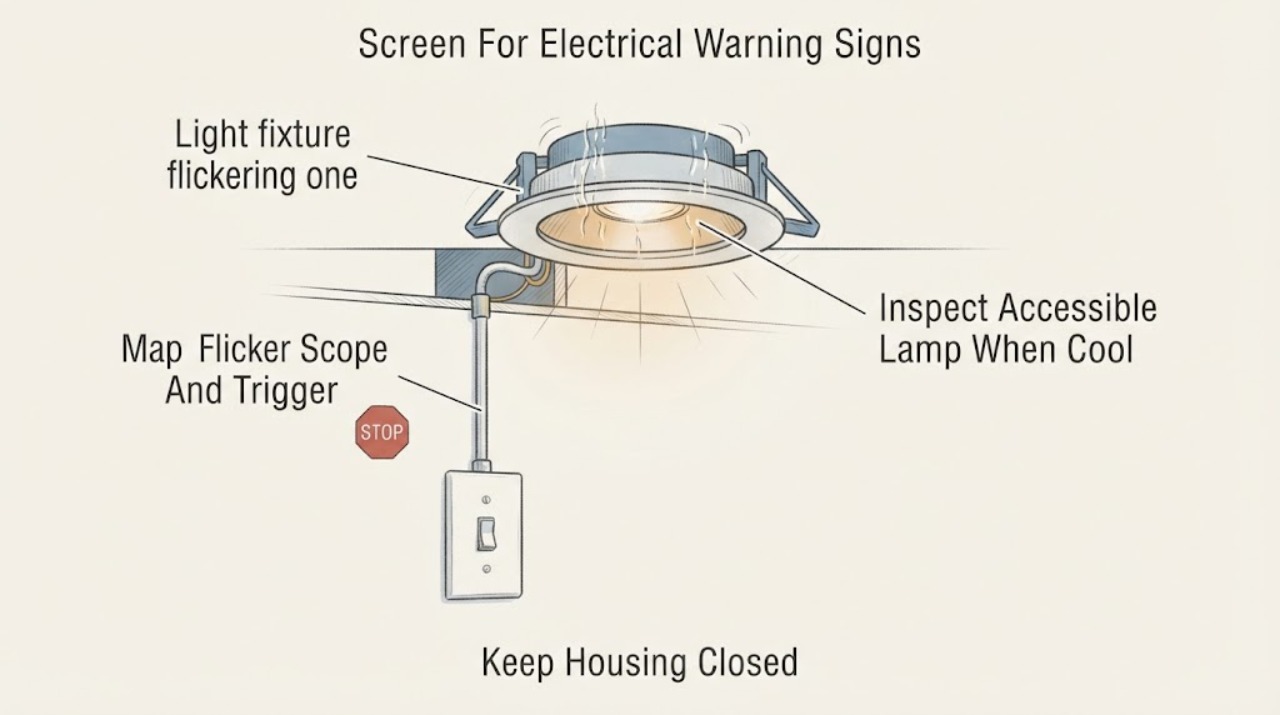
When flicker is limited to one light fixture or one room, start by separating a lamp, LED-driver, dimmer, switch, or fixture problem from a branch-circuit connection problem. Note whether the flicker follows one bulb, changes with a dimmer position, happens only when another load starts, or affects other lights and receptacles in the same room. With the light off and cool, check only the accessible bulb and visible exterior for a poor fit, damage, discoloration, heat, buzzing, or odor; do not open the fixture, remove a switch plate, or work inside a panel. A known-compatible replacement lamp may help identify a lamp or control mismatch, but persistent flicker, a warm or discolored switch, buzzing, burning smell, sparking, repeated breaker trips, or flicker spreading beyond the fixture needs a qualified electrician. If the whole home changes brightness or flicker follows wind or utility activity, stay away from service equipment and contact the electric utility.
Before you begin
Safety first
- This article supports observation and a cool, accessible lamp check only. A qualified electrician must handle fixture wiring, sockets, switches, dimmers, drivers, junctions, branch circuits, panels, energized testing, and service-entry equipment.
Work through in order
Diagnostic checks
Use only checks that match the exact appliance or system and its official guide.
-
Check 1
During one brief observation from a normal standing position, note whether the flicker affects one lamp, the whole fixture, other lights, receptacles, or the room; record whether it changes with the switch, dimmer position, a nearby appliance starting, or wind outside.
Expected result: Only one lamp flickers, every lamp in one fixture flickers, several lights in one room change together, or brightness varies across the home or with utility activity.
Next step: Use the pattern to select the checks below. Stop and arrange urgent electrical or utility help for heat, odor, buzzing, sparks, smoke, shock, or whole-home instability; do not open an electrical panel.
Stop if: Do not continue the observation if the fixture or switch is hot, discolored, smoking, sparking, buzzing loudly, or giving off a burning odor.
Why this matters
Why: One lamp or one fixture points more toward the lamp, driver, dimmer, switch, or local fixture connection. Several loads together make a shared branch-circuit connection or supply issue more important. Whole-home or wind-correlated changes can involve service equipment or the utility and are not a bulb diagnosis.
-
Check 2
With the switch off and without touching exposed parts, look and listen for a hot or discolored wall plate, buzzing or crackling, burning odor, smoke, scorch marks, sparks, a loose switch, repeated breaker trips, or a tingle when operating the control.
Expected result: There are no warning signs, or there is heat, discoloration, noise, odor, smoke, sparking, a shock or tingle, or repeated tripping.
Next step: Leave the affected light off and keep clear. Arrange a qualified electrician; for smoke, active arcing, or fire, leave the area and contact emergency services from a safe location. Do not reset a repeatedly tripping breaker or touch service equipment to investigate.
Stop if: Do not touch hot plates, exposed conductors, sparking fixtures, wet switches, or damaged cords, and do not use the fixture until it has been assessed.
Why this matters
Why: No warning sign permits only limited cool, external observations. Any warning sign is evidence of a possible wiring, connection, overload, or fixture hazard and cannot be safely cleared by changing a bulb.
-
Check 3
After the light has been switched off and is cool, inspect only the accessible lamp and fixture exterior for a loose fit, wrong lamp type, visible damage, darkening, or a lamp that was recently replaced; do not remove the fixture, socket, cover, or wiring.
Expected result: The lamp is loose or visibly damaged, the lamp was recently changed, the fixture label or manual specifies a different lamp requirement, or the lamp and exterior appear normal.
Next step: If safe and permitted by the fixture instructions, replace only the accessible lamp with a known-compatible type and rating, then observe once. If flicker remains or the fixture is damaged, leave it off and call an electrician; do not open the housing.
Stop if: Do not handle a hot, cracked, wet, or arcing lamp, exceed the fixture’s marked rating, or use a lamp with a damaged base or exposed conductors.
Why this matters
Why: A poor fit, damaged lamp, recent replacement, or incorrect lamp type can explain a local flicker, but a normal-looking lamp does not clear the socket, switch, driver, or wiring. Heat or discoloration can indicate a fixture problem rather than ordinary lamp wear.
-
Check 4
Without removing the control or changing wiring, note whether flicker occurs only at a low, middle, or high dimmer setting, only with a smart control, or with an ordinary on/off switch; record the lamp and control names if visible.
Expected result: Flicker occurs only while dimming, only at one control position, began after an LED or dimmer change, or occurs at every setting including full output.
Next step: Use the fixture and dimmer instructions to check compatibility and arrange a qualified electrician for a control or driver change. Do not remove the dimmer, jumper a control, or test the box while energized.
Stop if: Do not continue using a control that is hot, buzzing, discolored, loose, or producing a burning smell, and do not bypass any switch or dimmer safety function.
Why this matters
Why: A position-specific or post-change symptom makes lamp-driver-dimmer compatibility more likely. Flicker at every setting, especially with heat, noise, odor, or a loose control, keeps a socket, switch, wiring, or circuit fault in the diagnosis.
-
Check 5
From normal room use, note whether the flicker starts when a heater, motor, appliance, or other sizable load runs and whether nearby lights or receptacles change together; do not add loads, open the panel, or probe outlets.
Expected result: Only the fixture reacts, several lights change when a load starts, the breaker trips, receptacles are warm or discolored, or unrelated rooms flicker together.
Next step: Stop using the affected circuit and arrange an electrician for shared-load, breaker, receptacle, or wiring symptoms. If flicker spans the home or follows outdoor service conditions, contact the utility and do not touch service equipment.
Stop if: Do not keep starting appliances to reproduce flicker, install a higher-rated fuse or breaker, reset a tripping device repeatedly, or open the service panel.
Why this matters
Why: One fixture remains more consistent with a local lamp, control, socket, or fixture issue. Several loads responding together can indicate a branch-circuit connection, voltage disturbance, overload, or supply problem. Warm receptacles, repeated trips, or unrelated rooms affected are electrical warning signs.
-
Check 6
Record when the flicker began, whether a lamp or control was changed, how often it occurs, which fixtures and loads are affected, and any alerts or trips; do not repeatedly cycle the light or circuit to collect more data.
Expected result: Flicker stops with a compatible lamp, persists with the lamp and control unchanged, follows a load or weather event, or is accompanied by warning signs.
Next step: Give the timeline and observations to a qualified electrician; contact the utility for whole-home or service-entry symptoms. Leave the fixture off if flicker persists or any warning sign appears.
Stop if: Do not open the fixture, switch box, junction box, or panel; do not make an energized measurement or keep operating a suspect circuit to reproduce the symptom.
Why this matters
Why: Stopping after a compatible lamp change supports a lamp or control issue but does not prove the wiring is safe. Persistence, load or weather correlation, or warning signs shifts the decision toward electrician or utility diagnosis.
Use your observations
Decision map
Find the observation that best matches what you see, then follow the next safe action.
-
PATH 01Next step
What you see
Only one lamp flickers, the fixture and switch stay cool with no odor or noise, and the symptom follows a recent lamp change or one dimmer position.
Do this next
Use the fixture and control instructions to select a known-compatible replacement or have an electrician assess the control. Stop if flicker occurs at all settings or any warning sign appears.
Why this path and its safety boundary
Why it matters: A lamp, driver, or lamp-dimmer compatibility issue is more likely than a whole-home supply fault, but a local socket or fixture connection is not ruled out.
-
PATH 02Next step
What you see
The same fixture flickers with a compatible lamp, or the switch, socket, or fixture is hot, discolored, buzzing, loose, sparking, or smells burned.
Do this next
Leave the light off and arrange qualified electrical inspection. Do not remove the cover or attempt to tighten, bypass, or replace internal connections.
Why this path and its safety boundary
Why it matters: A local connection, switch, socket, driver, overload, or wiring fault becomes more likely and may present a fire or shock hazard.
-
PATH 03Next step
What you see
Several lights or receptacles in one room change together, especially when a nearby load starts, or the breaker trips or receptacles are warm or discolored.
Do this next
Stop using the affected loads and call a qualified electrician. Do not add loads, install a larger protective device, or keep resetting a tripping breaker.
Why this path and its safety boundary
Why it matters: A shared branch-circuit connection, overload, receptacle, breaker, or wiring issue is more likely than a single lamp fault.
-
PATH 04Next step
What you see
Lights in multiple rooms flicker together, brightness varies when wind or outdoor utility activity occurs, or the television image changes with the light fluctuation.
Do this next
Do not touch service equipment or try to correct it. Contact the electric utility and arrange an electrician as directed; leave sensitive loads off if safe to do so.
Why this path and its safety boundary
Why it matters: A service-entry, utility, or broader supply connection is more likely than a fixture-only problem and can be hazardous to touch.
-
PATH 05Next step
What you see
There is smoke, active arcing, a burning odor, painful heat, a shock or tingle, visible exposed wiring, water at the fixture, or a damaged cord or socket.
Do this next
Leave the area if smoke or fire is present, keep people away, and contact emergency services from a safe location. Otherwise leave the light off and obtain qualified electrical help without touching the hazard.
Why this path and its safety boundary
Why it matters: The symptom is an immediate electrical or fire-safety concern, not a lamp-selection problem.
Helpful context
Understand the symptom
Use the affected area to narrow the fault, not to dismiss it
A single flickering light can have a local cause such as a loose lamp, failing lamp electronics, an incompatible dimmer, a switch, or a fixture connection. If several lights or receptacles in one room change together, the branch circuit or a shared connection becomes more important. Flicker throughout the home, or brightness that changes when wind moves service wires, belongs with the utility or an electrician. Scope is a useful clue, not a safety verdict.
LED and dimmer combinations can flicker without proving a wiring fault
LEDs respond quickly to the current supplied by their driver, and the driver and dimmer must work together. Flicker that appears only at a certain dimmer position or only after an LED replacement can indicate compatibility or control behavior. That possibility does not excuse a hot switch, buzzing, discoloration, odor, or persistent flicker; those signs require electrical inspection rather than repeated lamp swaps.
Stay on the user side of the electrical boundary
A homeowner can observe patterns and inspect a cool, accessible lamp without exposing wiring. Permanently installed fixture connections, switch boxes, junctions, branch circuits, service equipment, and energized testing belong to a qualified electrician. Turn the light off and leave it unused when there is heat, smoke, smell, buzzing, sparking, shock, or a damaged cord or socket.
Safety boundary
Stop conditions
- Leave the fixture off for heat, discoloration, buzzing, crackling, burning odor, smoke, sparks, shock, water intrusion, exposed wiring, or repeated breaker trips.
- Do not remove a switch plate, fixture cover, junction-box cover, or electrical-panel cover; do not tighten, splice, probe, or test energized wiring.
- Do not reset a breaker repeatedly, install a larger fuse or breaker, bypass a switch or dimmer, or add loads to reproduce the flicker.
- Do not exceed the fixture’s marked lamp requirements or use a damaged, wet, loose, or visibly overheated lamp or socket.
- For whole-home flicker, wind-correlated service symptoms, smoke, or active arcing, stay away from service equipment and contact the utility or emergency services from a safe location.
Only after diagnosis
Potential parts
- known-compatible replacement lamp
Consider this category only when the accessible lamp is loose, failed, recently changed, or incompatible with the fixture or dimmer and there are no heat, damage, or wiring warning signs.
Match the fixture’s marked lamp type, base, rating, enclosure requirements, and dimmer compatibility; do not select a lamp by brightness alone or exceed the fixture requirement. - LED-rated dimmer or lighting control
Consider this category only if flicker follows dimmer position or began after an LED and control change and an electrician confirms a compatibility issue.
The lamp, driver, control, load, wiring, and local code must be evaluated together; do not replace or rewire a dimmer as a DIY energized task. - fixture socket, LED driver, or fixture assembly
Consider this category only after qualified inspection finds a failed socket, driver, or fixture connection rather than a lamp or dimmer mismatch.
Confirm the exact fixture, electrical characteristics, enclosure, mounting, and certification requirements with the manufacturer or electrician; never replace an internal part from flicker alone.
When checks do not resolve it
Need a professional?
Arrange a qualified electrician when flicker persists after a safe, compatible lamp check, affects several fixtures or receptacles, changes with another load, follows weather or utility activity, or is accompanied by a warm or loose switch, discoloration, buzzing, odor, shocks, damaged wiring, or breaker trips. Contact the electric utility for whole-home or service-entry flicker, especially when brightness changes with wind. Treat smoke, active arcing, fire, painful heat, or a burning smell as an urgent safety event.
Safety scope: This article supports observation and a cool, accessible lamp check only. A qualified electrician must handle fixture wiring, sockets, switches, dimmers, drivers, junctions, branch circuits, panels, energized testing, and service-entry equipment.
Common questions
FAQ
Why is only one light fixture flickering?
A local lamp, LED driver, dimmer, switch, socket, fixture connection, or branch-circuit issue can affect one fixture. Note whether the flicker follows one lamp or a dimmer position, but treat heat, buzzing, discoloration, odor, sparks, shocks, and persistent flicker as reasons to call an electrician.
Can changing the LED bulb fix a flickering light?
It may help when the accessible lamp is failing or incompatible with the fixture or dimmer, but it does not prove the wiring is safe. Change a lamp only when it is cool, intact, and within the fixture’s stated requirements; do not open the fixture if the flicker remains.
Why does an LED flicker only when dimmed?
LED flicker can depend on the interaction between the lamp’s driver and the dimmer, especially after either component was changed. Check the manufacturer compatibility information and have an electrician handle any control replacement; do not remove or bypass the dimmer.
What does it mean if lights in one room flicker together?
A shared branch-circuit connection, load change, breaker, receptacle, or wiring issue becomes more likely than one bad lamp. Stop adding loads or repeatedly resetting a breaker and arrange qualified electrical inspection, especially for heat, noise, odor, discoloration, or trips.
What if lights throughout the house flicker?
Whole-home or wind-correlated flicker can involve service equipment or the electric utility rather than one fixture. Do not touch service equipment; contact the utility and an electrician, and treat smoke, arcing, or fire as an emergency.
Is a flickering light dangerous?
Sometimes it is only a lamp or control compatibility problem, but flicker is also an electrical warning sign. A hot or discolored switch, buzzing, burning odor, sparks, smoke, shock, damaged wiring, water, or repeated breaker trips requires leaving the fixture off and obtaining qualified help.
Read the exact guide
Official sources
- Light SafetyU.S. Consumer Product Safety Commission · General consumer light-safety guidance; installed fixture repairs should follow the fixture instructions and qualified electrical practice.
- Electrical Safety DosElectrical Safety Foundation International · General residential electrical-safety guidance; local electrical code and a qualified electrician control diagnosis and repairs.
- CPSC Guide to Home Wiring HazardsU.S. Consumer Product Safety Commission · General U.S. home-wiring hazard guidance; a qualified electrician or electric utility must handle service equipment and repairs.
- Flicker BasicsU.S. Department of Energy · General lighting technology education; installed lamp, driver, dimmer, and electrical-system instructions control product decisions.
- Retail Lamps Study 3.1: Dimming, Flicker, and Power Quality Characteristics of LED A LampsU.S. Department of Energy · DOE research on tested LED and dimmer combinations; it does not establish compatibility for an untested fixture or lamp.
- Home Wiring Safety TipsElectrical Safety Foundation International · General residential wiring safety guidance; a licensed electrician must inspect and repair wiring.
- Home Electrical FiresElectrical Safety Foundation International · General residential electrical-fire safety guidance; the fixture label, local code, and electrician control repairs.
Community feedback
Share a repair observation
Share a plain-text repair observation. Accepted observations are published automatically; this page may take a moment to update.