
On this page
Start here
Quick answer
No burning smell does not make a flickering light fixture safe to ignore. First determine whether the flicker is limited to one lamp or affects other lights, and note whether it changes when a switch, dimmer, appliance, or breaker operates. From ordinary safe access, look for a darkened or cracked bulb, heat, discoloration, buzzing, sparking, a loose fixture, or a breaker that trips; do not remove the fixture, open a switch or panel, or probe live wiring. A bulb or control compatibility issue may be possible, but persistent flickering can also indicate a loose or overheating connection. Stop using the affected light and arrange qualified electrician service for any heat, discoloration, buzzing, shocks, sparks, repeated breaker trips, or flicker that affects more than one fixture.
Before you begin
Safety first
- The electrician should determine whether the cause is the bulb, control, fixture, switch, branch circuit, or upstream wiring and perform repairs under applicable local requirements.
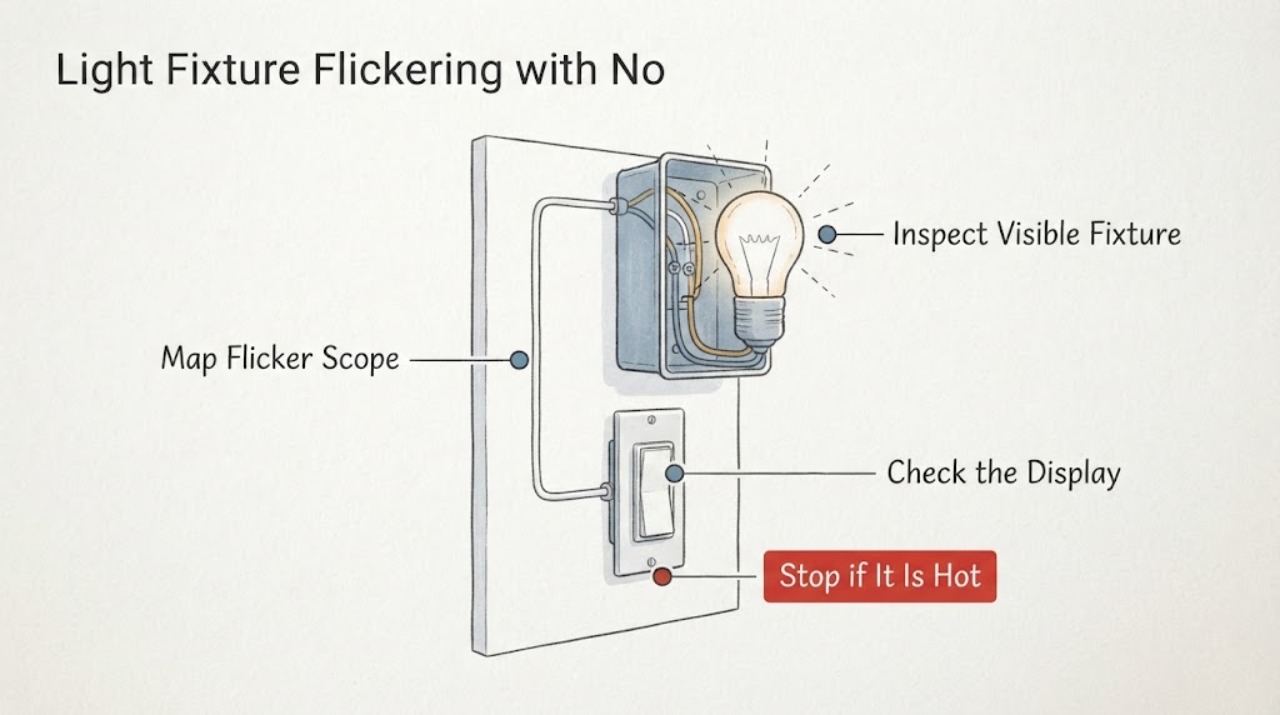
Work through in order
Diagnostic checks
Use only checks that match the exact appliance or system and its official guide.
-
Check 1
From a normal standing position, observe the affected light and nearby lights during ordinary use without removing a bulb or fixture cover; note the time and what else is running in the home.
Expected result: Only this fixture flickers, several lights on one area flicker, lights across the home flicker, or the flicker changes when an appliance, motor, switch, or dimmer is used.
Next step: Write down the affected rooms, timing, controls, and loads and give the pattern to a qualified electrician; stop using the affected light if any heat, noise, discoloration, or worsening appears.
Stop if: Do not reproduce the flicker repeatedly by switching loads on and off, and do not open a cover to trace the circuit.
Why this matters
Why: A single-fixture pattern makes the bulb, socket, control, fixture electronics, or local connection more plausible. A multi-light or load-related pattern points toward a shared circuit, supply, or connection and should not be treated as a bulb-only issue.
-
Check 2
With the light switched off and cool, inspect only visible surfaces of the bulb, socket face, fixture, switch plate, and nearby ceiling or wall from safe access; do not touch a suspect part.
Expected result: Look for a darkened bulb or socket, melted or cracked material, discoloration, a hot or painful-to-touch plate, buzzing or sizzling, visible sparking, a loose fixture, or no visible abnormality.
Next step: Leave the light off and request qualified electrician service for any abnormal sign; if nothing is visible, continue only with label and history checks rather than disassembly.
Stop if: Do not touch a hot, damaged, energized, or sparking part, and do not remove a globe, socket, switch plate, or recessed trim to look behind it.
Why this matters
Why: Heat, discoloration, damage, buzzing, sizzling, or sparks indicates a potential overheating or connection hazard even when no odor is present. A clean appearance does not rule out a concealed loose connection or an internal fixture fault.
-
Check 3
From safe access, read the bulb type and wattage marking, the fixture rating if visible, and whether the light is controlled by a dimmer, smart control, timer, or other special switch; do not change the wiring or install an unverified substitute.
Expected result: The bulb is new or recently changed, the marking is missing or does not clearly match the fixture, a dimmer or electronic control is present, or the bulb and control have been unchanged while the flicker persists.
Next step: Use only the fixture and control manufacturer's documentation to identify a compatible replacement; ask an electrician when ratings, compatibility, or wiring are uncertain or when the flicker remains.
Stop if: Do not exceed the fixture rating, bypass a dimmer or control, touch the socket, or make a wiring change as a compatibility experiment.
Why this matters
Why: A recent bulb or control change makes a manufacturer-specified bulb and control compatibility question plausible, but a marking mismatch or missing information cannot be resolved by guessing. Persistent flicker with unchanged equipment keeps a socket, fixture, switch, or circuit fault in consideration.
-
Check 4
Without removing the electrical-panel cover or repeatedly resetting anything, record whether the light's breaker has tripped, whether other devices on the same area lose power, and whether the flicker started after a renovation or added load.
Expected result: The breaker trips or will not remain on, other outlets or lights are affected, the problem follows a recent electrical change, or the flicker is isolated with no breaker history.
Next step: Do not install a higher-rated breaker or keep resetting a trip. Leave the affected circuit or light unused as appropriate and arrange qualified electrical inspection.
Stop if: Do not remove the panel cover, replace a fuse with a different rating, hold a breaker on, or work inside the panel.
Why this matters
Why: A trip, wider outage, or recent wiring/load change raises concern for a circuit or connection issue rather than a lamp-only fault. An isolated light with no breaker event may still have a local fixture or control problem; it does not prove the wiring is safe.
-
Check 5
Record whether anyone has felt a shock or tingle, heard crackling, seen a flash, noticed moisture or a recent leak near the fixture, or observed flicker during weather or utility disturbances; keep away from a wet or damaged area.
Expected result: There has been a shock, tingle, arc, flash, moisture, recent work, or a weather-related change, or none of these has been observed.
Next step: Stop using the light and keep people away for any shock, spark, moisture, or damaged wiring; request a qualified electrician and describe the event rather than attempting to locate it yourself.
Stop if: Do not touch wet fixtures, exposed conductors, metal parts that may be energized, or a damaged switch, and do not use a tester on live wiring.
Why this matters
Why: A shock, flash, moisture, or recent work makes the situation an immediate electrical safety concern regardless of odor. A lack of those signs lowers neither the need to investigate persistent flicker nor the possibility of a concealed connection problem.
-
Check 6
Prepare a service record with photos taken from safe access, the fixture and bulb markings, the control type, the flicker pattern, circuit or breaker history, and any recent work; leave the light unused when the cause is unresolved.
Expected result: The electrician can be given a localized pattern, a multi-light or load-related pattern, a control or bulb change, or an electrical hazard sign such as heat, buzzing, sparks, shocks, or trips.
Next step: Arrange qualified electrician service for persistent flicker or any warning sign and provide the record without opening the fixture, switch, or panel.
Stop if: Do not disassemble the light or switch, expose conductors, or perform a repair while the circuit's condition is uncertain.
Why this matters
Why: A concise record helps the professional choose between a fixture, control, branch-circuit, or broader wiring inspection. It cannot establish that a bulb is the cause or make concealed wiring safe to access.
Use your observations
Decision map
Find the observation that best matches what you see, then follow the next safe action.
-
PATH 01Next step
What you see
Only one light flickers, no heat, buzzing, discoloration, sparks, shock, or breaker issue is observed, and the bulb or control was recently changed.
Do this next
Use the exact fixture and control documentation to identify a compatible bulb or control, without altering wiring; obtain electrician service if the flicker persists or any warning sign appears.
Why this path and its safety boundary
Why it matters: A bulb type, rating, or control-compatibility issue is more plausible than a whole-home supply problem, but the absence of odor does not prove the socket or fixture is safe.
-
PATH 02Next step
What you see
Only one fixture flickers, the bulb and control are unchanged, and the flicker continues without an obvious external load change.
Do this next
Leave the light off when practical and arrange qualified electrician inspection rather than repeatedly replacing bulbs or opening the fixture.
Why this path and its safety boundary
Why it matters: A local socket, switch, fixture electronics, or connection fault remains possible even if the light looks normal and has no burning smell.
-
PATH 03Next step
What you see
Several lights flicker together, the flicker changes when an appliance or motor operates, or other outlets and devices are affected.
Do this next
Avoid using the affected lighting circuit or load pattern and request qualified electrical inspection; do not try to balance the load or alter a breaker.
Why this path and its safety boundary
Why it matters: A shared circuit, supply, or connection problem is more likely than one defective bulb. Flickering is a wiring warning even when the room has no odor.
-
PATH 04Next step
What you see
The fixture, bulb, switch plate, or nearby surface is hot, discolored, cracked, melted, buzzing, sizzling, sparking, or visibly damaged.
Do this next
Stop using the light, keep people away, and request prompt qualified electrician service; use a safe alternate light only if it does not require interacting with the suspect fixture.
Why this path and its safety boundary
Why it matters: This is a potential overheating, arcing, or shock hazard. No burning smell is not a safe exception because heat and electrical damage can precede an odor.
-
PATH 05Next step
What you see
Someone felt a shock or tingle, moisture is present, a flash occurred, the breaker trips, or a fuse or breaker issue accompanies the flicker.
Do this next
Keep clear and leave the affected light or circuit unused; arrange urgent qualified electrical service and report the shock, moisture, flash, or trip exactly.
Why this path and its safety boundary
Why it matters: The situation is an electrical safety concern independent of the bulb and requires professional assessment. Resetting or touching the fixture can increase exposure.
-
PATH 06Next step
What you see
The light flickers persistently but no odor, heat, visible damage, noise, shock, spark, or breaker event has been observed and the cause cannot be localized safely.
Do this next
Avoid repeated operation and schedule a qualified electrician to diagnose the fixture and circuit. Do not treat the absence of a burning smell as permission to disassemble it.
Why this path and its safety boundary
Why it matters: A persistent flicker remains unresolved; a concealed connection, fixture, control, or circuit fault cannot be ruled out by a clean appearance.
Helpful context
Understand the symptom
The missing odor is useful context, not a clearance
A flicker with no burning smell may come from the bulb, socket, dimmer, fixture electronics, a switch, or an upstream connection. Flickering can appear before heat or odor becomes noticeable, so use the absence of smell only as one observation to report. CPSC and ESFI treat flickering or dimming lights as an electrical warning sign, especially when it occurs with buzzing, heat, discoloration, sparks, shocks, or breaker trouble.
Compare scope before touching anything
If one fixture flickers while nearby lights remain steady, the fault may be local to that lamp, its control, or its connection. If several fixtures flicker together, or lights change when a motor or large appliance starts, an upstream circuit or supply issue becomes more plausible. This comparison helps an electrician without requiring a homeowner to remove a cover or make a live electrical measurement.
Keep inspection at the ordinary-user boundary
Read visible labels and observe the fixture, bulb, switch, and breaker from safe access only. Do not open the fixture, socket, switch box, junction box, or electrical panel to tighten a connection. CPSC's wiring guidance is a hazard-identification guide, not a repair manual; a persistent flicker or any sign of heating belongs with a qualified electrician.
Safety boundary
Stop conditions
- Stop using the affected light for heat, discoloration, melting, buzzing, sizzling, sparks, a shock or tingle, moisture, a damaged fixture, or a breaker that trips.
- Do not remove a fixture, socket, switch plate, junction-box cover, recessed trim, or electrical-panel cover to investigate a flicker.
- Do not probe live wiring, make a live-voltage measurement, bypass a dimmer or safety device, hold a breaker on, or install a higher-rated fuse or breaker.
- Keep people away and request qualified electrician service for persistent flickering, multi-light flickering, load-related changes, or any unresolved concern even when no burning smell is present.
Only after diagnosis
Potential parts
- replacement lamp or LED bulb
Consider this only if the fixture and control documentation confirms the correct bulb type, base, rating, and compatibility and no electrical warning sign is present; a new bulb is not a remedy for a loose connection or persistent circuit flicker.
Confirm the fixture marking and control manufacturer's requirements before ordering. Do not exceed the fixture rating or use a replacement bulb to avoid electrician inspection.
When checks do not resolve it
Need a professional?
Use prompt service for a persistent single-fixture flicker and urgent service for heat, visible damage, buzzing or sparking, shocks, moisture, repeated breaker trips, or flicker across multiple lights or loads.
Safety scope: The electrician should determine whether the cause is the bulb, control, fixture, switch, branch circuit, or upstream wiring and perform repairs under applicable local requirements.
Have this ready
- Photos from safe access of the fixture, bulb markings, switch or dimmer, and surrounding discoloration if present
- Whether one fixture, one room, several rooms, or the whole home is affected
- The flicker pattern, timing, sound, and whether it changes with a dimmer, appliance, motor, or weather event
- Breaker or fuse history and any recent fixture, switch, renovation, or load changes
- Any heat, shock, tingle, spark, moisture, damaged material, or burning smell, including that no odor was observed
Common questions
FAQ
Is a flickering light safe if there is no burning smell?
No. Flickering is an electrical warning sign even without an odor. Observe whether it affects one light or several and look only from safe access for heat, discoloration, buzzing, sparks, shocks, or breaker trouble; arrange qualified electrician service for persistent flickering.
What should I check first when one light fixture flickers?
Record whether nearby lights are steady, whether the bulb or control was recently changed, and whether the fixture or switch shows heat, discoloration, buzzing, or visible damage. Do not open the fixture or switch to inspect a connection.
What does it mean if several lights flicker together?
Several lights flickering together, or changing when an appliance or motor operates, points toward a shared circuit, supply, or connection issue rather than one bulb. Avoid repeated operation and request qualified electrical inspection.
Can I replace the bulb to fix a flickering fixture?
Only consider a bulb replacement when the exact fixture and control documentation confirms the bulb type, base, rating, and compatibility and no warning sign is present. A replacement bulb cannot make a hot, buzzing, sparking, damaged, or persistently flickering circuit safe.
When should I turn off a flickering light and call an electrician?
Stop using it for heat, discoloration, melting, buzzing, sizzling, sparks, a shock or tingle, moisture, a damaged fixture, a tripping breaker, or flicker affecting multiple lights. Persistent unexplained flickering also warrants qualified inspection even when no burning smell is present.
Read the exact guide
Official sources
- Home Wiring Safety TipsElectrical Safety Foundation International · Supports escalating dim or flickering lights, unusual sounds, heat, discoloration, arcs, sparks, shocks, and damaged insulation to a licensed electrician.
- Repairing Aluminum WiringU.S. Consumer Product Safety Commission · Supports treating flickering lights as a possible electrical connection warning even without a burning odor and not attempting to diagnose or repair wiring personally.
- Switch to SafetyElectrical Safety Foundation International · Supports treating flickering or dimming lights and loose, hot, discolored, buzzing, or sparking switches as reasons for qualified electrical inspection.
- CPSC Guide to Home Wiring HazardsU.S. Consumer Product Safety Commission · Supports treating dimming or flickering lights, sizzling or buzzing, overheating, odors, shocks, and breaker problems as warning signs; it also sets a professional boundary for identifying and repairing electrical defects.
Community feedback
Share a repair observation
Share a plain-text repair observation. Accepted observations are published automatically; this page may take a moment to update.