
On this page
Start here
Quick answer
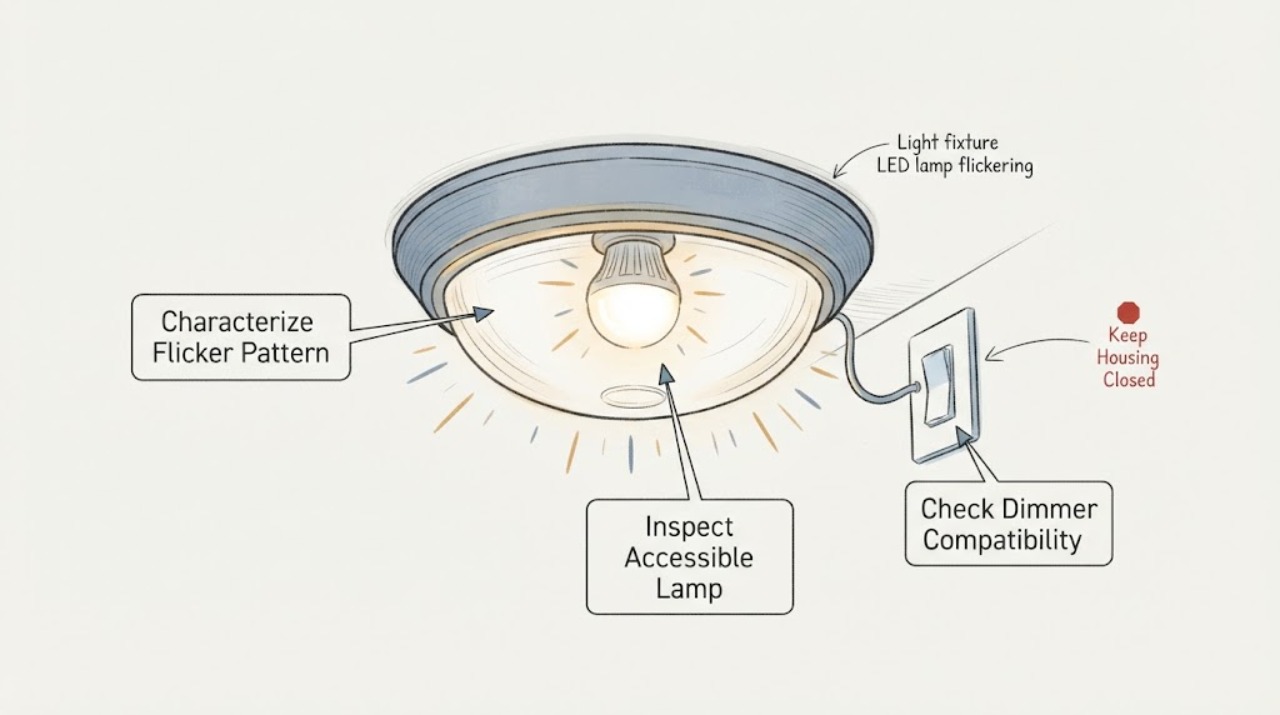
An LED lamp that flickers may have a dimmer-compatibility problem, a failing lamp or driver, a poor connection, or a wider circuit issue. First note whether the flicker occurs only while dimming, follows one lamp, or affects several lights. With the switch off and the lamp cool, check only an accessible, user-replaceable lamp and its label; use a dimmable lamp only with a compatible control. If flicker occurs at full brightness, affects multiple lights, or comes with buzzing, heat, discoloration, a burning smell, or sparking, stop using the fixture and have a qualified electrician inspect it.
Work through in order
Diagnostic checks
Use only checks that match the exact appliance or system and its official guide.
-
Check 1
From a safe position, observe the light at steady full output and, if a dimmer is present, at several normal settings. Note whether one lamp, one fixture, several fixtures, or the whole room flickers and whether the effect is visible, a brief flash, or a faint glow while off.
Expected result: Flicker appears only at low or high dimming levels, continues at full output, occurs while the switch is off, follows one lamp, or affects multiple lights together.
Next step: Record the setting, affected fixtures, and timing before changing anything. Continue to the safe lamp and fixture check, and stop for any heat, odor, buzzing, discoloration, or sparking.
Stop if: Do not climb, open the fixture, or touch a switch or outlet that feels warm or gives a shock or tingle.
Why this matters
Why: A dimming-range or off-state pattern makes control compatibility more likely; a single-lamp pattern makes the lamp or driver more likely; simultaneous changes across fixtures keep a shared circuit or supply issue in consideration.
-
Check 2
If the lamp is user-replaceable and reachable without a ladder or fixture disassembly, turn the wall switch off, allow the lamp to cool, and inspect the visible lamp, base, socket area, and fixture shade for looseness, dark marks, damage, or heat discoloration.
Expected result: The lamp is loose, visibly damaged, discolored, unusually hot, or the socket area looks normal.
Next step: Do not use a damaged or heat-affected lamp. If the lamp is intact and the fixture instructions allow it, continue with a compatible-lamp comparison; otherwise leave the light off and arrange service.
Stop if: Do not remove a fixture cover, bend contacts, tighten wiring, or handle a lamp or socket that is hot, cracked, wet, or arcing.
Why this matters
Why: A damaged or heat-affected lamp or socket can create unstable operation, but a normal appearance does not rule out an internal LED driver or connection fault.
-
Check 3
Read the lamp packaging or visible label and the dimmer instructions without opening the wall box. Confirm that the LED is marked dimmable and that the dimmer or control is intended for that LED load; note whether the flicker begins at a particular end of the dimming range.
Expected result: The lamp is non-dimmable, the dimmer model or compatibility is unknown, the lamp is not on the control manufacturer's compatibility information, or flicker occurs only near the minimum or maximum setting.
Next step: Return the control to a stable setting and follow only the dimmer manufacturer's user instructions for an available range adjustment. If compatibility is unknown or the flicker continues, use a documented compatible lamp or have an electrician assess the control; do not rewire it.
Stop if: Do not remove the wallplate, change wiring, install a bypass component, or work inside the box while energized.
Why this matters
Why: An LED that is not designed for dimming, or a lamp and dimmer combination that is not compatible, can flicker or drop out even when both devices appear to work separately. A narrow unstable range can reflect the control's minimum or maximum setting.
-
Check 4
When the fixture accepts a user-replaceable lamp and the control is known to be compatible, switch the light off, let it cool, and install one manufacturer-approved or documented compatible LED lamp of the same required type. Do not alter the fixture or control.
Expected result: The replacement lamp is stable, the replacement flickers in the same fixture, or the original lamp flickers in another compatible fixture.
Next step: Keep the stable compatible lamp only if it meets the fixture and control instructions. If the symptom stays with the fixture or returns, stop swapping lamps and arrange qualified diagnosis.
Stop if: Do not use a lamp with a different required type, exceed the fixture's marking, or continue testing when there is heat, odor, buzzing, or visible damage.
Why this matters
Why: A symptom that follows the original lamp makes its electronics or driver the leading suspect. Flicker that stays with the fixture points toward the dimmer, socket, integrated driver, or wiring; a lamp that flickers elsewhere may be defective or incompatible with that other control.
-
Check 5
Without operating the fixture beyond a normal brief observation, note whether nearby lights flicker at the same time or whether the event coincides with another appliance starting, a switch or outlet warming, a buzzing sound, a burning smell, or a breaker or protective device operating.
Expected result: Only this fixture flickers with no hazard signs, several lights change together, the event tracks another load, or any heat, odor, discoloration, buzzing, arcing, or protective-device operation is present.
Next step: Leave the affected light off and contact a qualified electrician for a shared-circuit or hazard pattern. For an isolated, hazard-free symptom, provide the lamp, fixture, and control details for a targeted inspection.
Stop if: Stop immediately for smoke, burning odor, visible arcing, a hot switch or outlet, shock or tingling, or repeated protective-device operation; keep people clear and seek urgent qualified help.
Why this matters
Why: A shared timing pattern can indicate a circuit or supply disturbance rather than a single LED lamp. Heat, odor, discoloration, buzzing, or arcing can indicate an electrical fault and is not a safe user-level diagnosis.
Use your observations
Decision map
Find the observation that best matches what you see, then follow the next safe action.
-
PATH 01Safety boundary
What you see
The LED flickers or drops out only while dimming, especially near one end of the range, and the lamp and dimmer have not been confirmed as compatible.
Do this next
Confirm the lamp is dimmable and use the control manufacturer's compatibility information. Apply only a user-accessible range adjustment described in the exact control instructions; replace the lamp or control through a qualified installer if compatibility remains uncertain.
Why this path and its safety boundary
Why it matters: Lamp-control compatibility or the control's configured range is more likely than a loose building connection.
Safety stop: Do not open or rewire the dimmer.
-
PATH 02Safety boundary
What you see
One accessible LED lamp flickers at full output, and the symptom follows that lamp when it is placed in another documented-compatible fixture.
Do this next
Stop using the affected lamp and replace it only with a correctly specified, compatible lamp. If the replacement also flickers in the original fixture, arrange service for the fixture or control.
Why this path and its safety boundary
Why it matters: The lamp's internal driver or electronics are more likely than the original fixture wiring.
Safety stop: Do not use a visibly damaged, overheated, or discolored lamp.
-
PATH 03Safety boundary
What you see
A known-compatible lamp flickers at full output in the same fixture, the armature or socket is damaged, or the symptom does not follow the original lamp.
Do this next
Leave the light off as appropriate and have a qualified electrician inspect the fixture, control, and circuit with power isolated according to the applicable procedure.
Why this path and its safety boundary
Why it matters: An integrated driver, socket, dimmer, connection, or concealed wiring fault remains possible; changing lamps will not establish which one.
Safety stop: Do not remove the fixture, open a junction box, or test wiring as a homeowner troubleshooting step.
-
PATH 04Safety boundary
What you see
Several lights flicker together, the timing follows another load, or the flicker appears with a warm or discolored switch, buzzing, burning odor, arcing, shock, or repeated protective-device operation.
Do this next
Stop using the affected circuit when safe, keep people clear of any damaged equipment, and contact a qualified electrician. Escalate immediately for smoke, flames, active arcing, or a rapidly worsening condition.
Why this path and its safety boundary
Why it matters: A circuit, supply, overload, or connection problem is more concerning than an isolated LED lamp mismatch and may present a fire or shock hazard.
Safety stop: Do not continue cycling the light or reset a protective device repeatedly to see whether the flicker stops.
-
PATH 05Safety boundary
What you see
The lamp and fixture look normal and the flicker is isolated, but it returns at full brightness or after one compatible-lamp check.
Do this next
Record when it occurs, the lamp and control models, and the comparison result, then arrange a qualified inspection rather than repeated replacements.
Why this path and its safety boundary
Why it matters: A hidden driver, socket, control, or connection issue remains possible even without visible damage.
Safety stop: Do not treat a temporary improvement as proof that the circuit is safe.
Helpful context
Understand the symptom
What LED flicker can indicate
LEDs respond quickly to changes in the current supplied by their electronic driver. Flicker can therefore come from the LED lamp or integrated driver, an incompatible dimmer or control setting, a loose or failing connection, or a supply disturbance. The timing is more useful than the word “flicker”: a problem only at the bottom of a dimming range is different from a light that pulses at full output or several lights that change together.
Keep the checks de-energized and accessible
Do not remove a fixture cover, open a junction box, or touch wiring to investigate a flicker. If an accessible lamp is explicitly designed to be user-replaced, switch it off, let it cool, and work from the floor or another stable position; circuit power must be isolated before any fixture or wiring access. A warm switch, discoloration, buzzing, burning odor, shock or tingle, or visible arcing is an electrician call, not a bulb experiment.
Use the pattern to choose the next step
If changing an accessible lamp moves the symptom with the lamp, the lamp or its driver is the leading suspect. If a known-compatible lamp still flickers in the same fixture, the control, fixture driver, socket, or wiring needs diagnosis. If multiple lights flicker together or the timing tracks another high-load device, stop local troubleshooting and have the circuit and supply assessed.
Safety boundary
Stop conditions
- Stop immediately for smoke, burning odor, visible arcing, a hot or discolored switch or outlet, shock or tingling, water exposure, or repeated protective-device operation.
- Do not work on energized wiring, open a fixture or wall box, bypass a safety device, or install an unverified bypass component.
- Do not use a damaged, overheated, wet, or discolored LED lamp or fixture.
- If flicker persists at full output, affects multiple fixtures, or stays with the fixture after one compatible-lamp check, leave it off and call a qualified electrician.
Only after diagnosis
Potential parts
- dimmable LED lamp
Consider only when the original lamp is non-dimmable, defective, or incompatible and the fixture marking and control documentation specify an acceptable replacement.
Confirm the required lamp type, base, enclosure rating, load limits, and documented dimmer compatibility before selection. - LED-compatible dimmer
Consider only when a compatible lamp still flickers in a dimming installation and a qualified electrician confirms the control is the mismatch or failed component.
Confirm the wiring arrangement, control type, lamp or fixture load, and manufacturer compatibility information before selection. - LED fixture driver
Consider only for an integrated LED fixture when the lamp is not user-replaceable and qualified diagnosis identifies the driver as the cause.
Confirm the exact fixture model, driver output requirements, enclosure and thermal requirements, and manufacturer service procedure before selection.
When checks do not resolve it
Need a professional?
Call a qualified electrician when flicker persists at full brightness, stays with the fixture after a compatible-lamp check, affects several lights, follows another load, involves an integrated fixture driver, or requires opening the fixture, wall box, or wiring.
Have this ready
- Fixture and LED lamp model information from labels or packaging
- Whether the lamp is replaceable and whether a dimmer or smart control is present
- The dimming setting and whether the flicker occurs at full output or while off
- Whether the symptom follows the lamp or stays with the fixture
- Any heat, odor, buzzing, discoloration, arcing, shock, or simultaneous circuit symptoms
Common questions
FAQ
Why does my LED lamp flicker only when dimmed?
A non-dimmable lamp, an incompatible lamp and dimmer combination, or an unstable end of the dimming range can cause this pattern. Confirm the lamp's dimming label and the control manufacturer's compatibility information before changing any setting or part.
Does a flickering LED always need to be replaced?
No. First determine whether the symptom follows the lamp, stays with the fixture, occurs only with a dimmer, or affects several lights. A lamp replacement is reasonable only when the fixture and control documentation support that lamp; persistent fixture or circuit flicker needs professional diagnosis.
What does flicker at full brightness suggest?
It can come from a failing LED driver or lamp, a socket or fixture connection, a control problem, or a wider circuit disturbance. If it remains after one compatible-lamp check or occurs in multiple fixtures, leave the light off and call a qualified electrician.
Is it safe to keep using a flickering light?
Do not keep using it when flicker is accompanied by heat, discoloration, buzzing, burning odor, smoke, arcing, shock or tingling, water exposure, or repeated breaker or protective-device operation. Stop and obtain qualified electrical help.
What information should I give the electrician?
Provide the fixture and lamp labels, dimmer or control model, when the flicker occurs, whether it follows the lamp, whether other lights change together, and any heat, odor, sound, discoloration, or circuit symptoms.
Read the exact guide
Official sources
- Why Does My LED Bulb Flicker or Turn Off When Dimming?Leviton · Leviton dimmer support; compatibility and adjustment behavior vary by control and lamp.
- My bulb does not dim all of the way or flickers when I dim too lowLeviton · Leviton Decora Smart dimmer guidance; exact control and lamp instructions govern.
- Flicker BasicsU.S. Department of Energy · General solid-state lighting context; the installed lamp, driver, control, and circuit determine the household fault.
- Home SafetyElectrical Safety Foundation International · General residential electrical safety guidance.
- Downlights Key Product CriteriaENERGY STAR · ENERGY STAR downlight criteria; an individual fixture's certification and instructions govern.
Community feedback
Share a repair observation
Share a plain-text repair observation. Accepted observations are published automatically; this page may take a moment to update.