
On this page
Start here
Quick answer
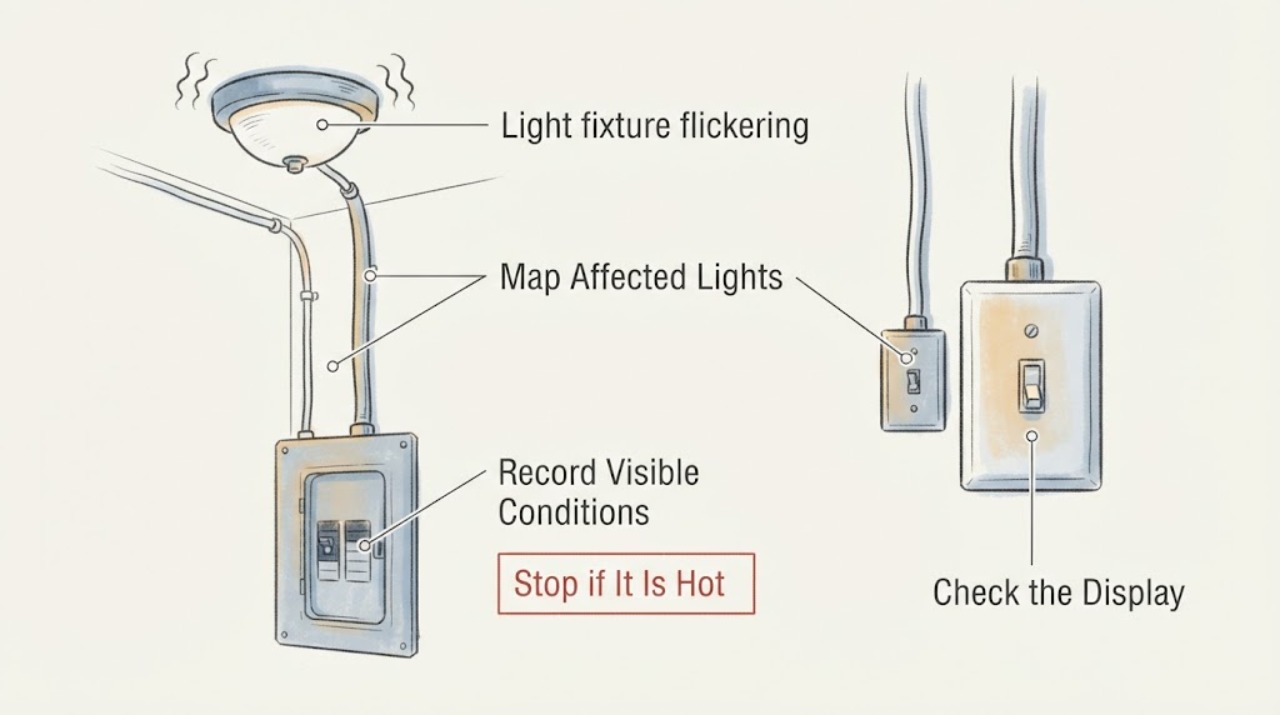
A flickering light fixture can be a local lamp or LED-driver issue, but it can also signal a switch, dimmer, loose connection, branch-circuit, breaker, or service-supply problem. From a safe distance, first determine whether one fixture or several are affected and whether flicker follows a dimmer, switch, appliance load, weather, or recent electrical work. Look only for external warning signs such as heat, buzzing, odor, discoloration, smoke, sparks, or a shock. Turn the light off and get qualified electrical help for any warning sign, recurring flicker, repeated breaker operation, or whole-home dimming. Do not remove a fixture, switch, outlet, or panel cover or perform live testing.
Work through in order
Diagnostic checks
Use only checks that match the exact appliance or system and its official guide.
-
Check 1
From a safe standing position, observe the suspect light and compare it with other lights in the same room, on the same floor, and in another room. Do not repeatedly cycle the suspect switch just to reproduce the flicker.
Expected result: Record whether only one fixture flickers, several fixtures on one branch flicker, or lights throughout the home dim or pulse together; note whether brightness changes are mild or abrupt.
Next step: Keep the affected light or circuit off when practical and give the electrician the exact locations and timing. Do not open a fixture or panel to compare wiring.
Stop if: Stop for widespread dimming, a bright flash, smoke, sparks, heat, burning odor, buzzing, or a shock or tingling sensation.
Why this matters
Why: One fixture keeps the lamp, LED driver, local switch, dimmer, socket, or local connection in focus. Several lights point more toward a shared branch or connection, while whole-home behavior raises a service-supply concern.
-
Check 2
Write down when the flicker begins and ends relative to turning the light on, changing a dimmer, activating a motion sensor or smart control, starting an appliance, a power outage, wind, rain, or recent electrical work. Do not add a high-load appliance to test the circuit.
Expected result: Separate flicker that follows a control setting, flicker that begins when a motor or heater starts, flicker that occurs randomly, and flicker that tracks weather or an entire-home event.
Next step: Stop using the light if the pattern repeats, and provide the trigger sequence to an electrician. Contact the utility for a suspected service event, especially when multiple rooms are affected.
Stop if: Do not deliberately overload the circuit, touch service equipment, or keep testing after a breaker trips or a visible electrical warning appears.
Why this matters
Why: A control-linked pattern keeps a lamp/driver/control interaction in focus; a load-linked pattern makes branch capacity or a connection more plausible; weather- or service-linked whole-home flicker can involve the utility side. None of these patterns identifies a component by itself.
-
Check 3
Without removing anything, identify whether the fixture uses an incandescent, fluorescent, replaceable LED, or integrated LED source and whether the control is a plain switch, dimmer, motion sensor, or smart control. Note a recent lamp, dimmer, control, or fixture change and read only the visible lamp and fixture markings.
Expected result: Record whether the flicker began after a replacement, appears only at a low dimmer setting, occurs with an integrated fixture, or remains at every setting; also note whether the lamp rating or control model is unknown.
Next step: If a clearly accessible lamp is cool, intact, and explicitly user-replaceable, follow the exact fixture instructions for an approved replacement; otherwise leave the fixture off and arrange electrical service rather than guessing at a dimmer or driver.
Stop if: Stop for a hot housing, buzzing control, discolored socket, cracked fixture, visible arc, or any need to open the fixture or handle conductors.
Why this matters
Why: A recent change or low-setting-only flicker makes source and control compatibility worth checking against the manufacturer instructions. Flicker at all settings or an integrated fixture with no user-replaceable source makes a driver, connection, or branch fault more likely and needs professional diagnosis.
-
Check 4
From outside the equipment, look and listen without touching for a warm or discolored switch plate, outlet cover, cord, lamp base, or fixture; a loose-looking fixture; buzzing, sizzling, or crackling; a hot-insulation smell; smoke; or a visible spark. Do not remove a plate, tighten a screw, or open a canopy.
Expected result: Classify the exterior as cool and intact, or as warm/hot, discolored, loose, buzzing, smoking, sparking, or odorous; note any shock or tingling when using the device without touching exposed parts.
Next step: Turn the light or affected device off and call a qualified electrician urgently for any warning sign. If there is smoke, flame, active arcing, or immediate danger, leave the area and contact emergency help.
Stop if: Stop immediately for smoke, flame, sparks, a bright flash, a hot or painful-to-touch part, exposed insulation, a burning smell, or a shock.
Why this matters
Why: Heat, discoloration, odor, unusual sound, arcing, or shock can accompany a deteriorating connection or overloaded/defective equipment and outweighs any lamp-level explanation. A cool exterior only means no warning was visible; it does not clear the wiring.
-
Check 5
From outside the panel and without opening it, note whether a visible breaker has tripped, a fuse has opened, or the flicker coincides with a particular appliance or group of outlets losing power. Record the appliance or light that starts the event; do not change a fuse rating or repeatedly reset a breaker.
Expected result: Look for repeated operation of one protective device, a light-linked trip, a load-linked flicker, or a pattern that affects one branch versus the whole home.
Next step: Leave the suspect light, appliance, or circuit unused and provide the sequence to qualified service. Never install a higher-rated fuse or breaker to stop the symptom.
Stop if: Stop for repeated trips, panel heat, smoke, arcing, an unknown panel condition, or any need to touch the panel interior or service equipment.
Why this matters
Why: A device that trips when a particular light or switch is used can indicate a fault requiring an electrician. A load-linked branch problem may be overload or an equipment defect; a service-wide event needs utility or electrician assessment rather than a fixture replacement.
-
Check 6
Prepare a service handoff with the fixture location, light-source and control type, number of affected fixtures, flicker timing, recent changes, load or weather trigger, visible warning signs, and the state of any visible breaker. Take photographs only from a safe distance and do not restore use to make a video.
Expected result: The record either shows a repeatable local/control pattern, a shared branch pattern, a whole-home/service pattern, or an unresolved symptom with no safe external explanation.
Next step: Request qualified electrical diagnosis and provide the record. Ask the professional to assess the fixture, switch/dimmer, wiring, branch protection, and service supply as the pattern warrants.
Stop if: Do not reopen the fixture, switch, outlet, breaker panel, or service equipment after documenting the symptom.
Why this matters
Why: A precise sequence helps the electrician choose between source/control checks, branch and connection diagnosis, or service-supply coordination without unsafe homeowner testing. No visible cause does not make recurring flicker safe.
Use your observations
Decision map
Find the observation that best matches what you see, then follow the next safe action.
-
PATH 01Safety boundary
What you see
Only one cool, intact fixture flickers and the symptom follows a lamp replacement, dimmer setting, switch, motion sensor, or smart-control event.
Do this next
Use only the manufacturer’s instructions for a clearly accessible lamp check; leave the fixture off and call an electrician if flicker persists, the fixture is integrated, or compatibility is uncertain.
Why this path and its safety boundary
Why it matters: A local source, driver, or control interaction is more likely than a whole-home service fault, but compatibility or a concealed connection still needs confirmation.
Safety stop: Do not open the fixture or control, and stop for heat, buzzing, odor, discoloration, sparks, or shock.
-
PATH 02Safety boundary
What you see
Several lights or outlets on one branch flicker, or the flicker starts when a particular motor, heater, or other load operates.
Do this next
Leave the affected load or circuit unused and arrange qualified electrical diagnosis; provide the exact trigger and affected locations.
Why this path and its safety boundary
Why it matters: A branch-circuit load, breaker, connection, or appliance fault is more plausible than a single lamp problem.
Safety stop: Do not add load, reset repeatedly, change protection ratings, or open the panel.
-
PATH 03Safety boundary
What you see
Lights in multiple rooms or throughout the home dim or flicker together, especially with wind, rain, or a utility/service event.
Do this next
Keep clear of service equipment and contact the utility or a qualified electrician from a safe location, reporting weather and timing.
Why this path and its safety boundary
Why it matters: The pattern can involve service equipment or the incoming supply rather than the fixture or branch wiring.
Safety stop: Do not touch the meter, service drop, panel interior, or any visibly damaged exterior equipment.
-
PATH 04Safety boundary
What you see
A switch, outlet, cord, socket, fixture, or panel area is hot, discolored, buzzing, smoking, sparking, or smells burnt, or anyone feels a shock.
Do this next
Stop using the equipment, keep people clear, and obtain urgent qualified electrical help. Leave the area and contact emergency services for smoke, flame, or active arcing.
Why this path and its safety boundary
Why it matters: These are electrical warning signs with fire or shock implications; continued observation or a lamp replacement is unsafe.
Safety stop: Stop all troubleshooting and do not touch the device or reset its protection.
-
PATH 05Safety boundary
What you see
The flicker returns at every setting or no safe external pattern explains it, even though no warning sign is visible.
Do this next
Leave the fixture or circuit off when practical and arrange qualified electrical assessment before normal use.
Why this path and its safety boundary
Why it matters: A failing source/driver, local connection, branch fault, or control problem remains possible; absence of heat or odor is not a repair diagnosis.
Safety stop: Do not repeatedly operate the light to capture the symptom or replace components by guesswork.
Helpful context
Understand the symptom
Flicker is a symptom, not a bulb diagnosis
A single fixture that changes when its lamp, dimmer, or switch is used is a different lead from several fixtures that pulse together. LED sources and their drivers can reveal changes in delivered power that another lamp might mask, but a compatible-looking lamp does not prove that the control or wiring is sound. Note the scope and timing before buying a replacement.
What makes flicker urgent
The Consumer Product Safety Commission lists dim or flickering lights alongside arcs or sparks, unusual electrical sounds, overheating, hot odors, loose plugs, damaged insulation, and shocks as potential warning signs. A switch plate, outlet, cord, or fixture that is hot, discolored, buzzing, or smells burnt should not be used while waiting for an electrician.
Why a breaker or service issue can look like a bad fixture
Branch circuits feed groups of lights and receptacles, so a load-linked flicker can involve the circuit, a connection, or protection rather than the lamp. Flicker throughout a home, or flicker that changes with wind or other service events, can involve the service entrance. Those areas are not homeowner repair points; preserve the observation and contact the utility or a qualified electrician.
Safe boundary
The checks below stay outside the fixture, switch, outlet, breaker panel, and service equipment. Do not remove covers, tighten terminals, change a breaker or fuse rating, probe voltage, bypass protection, or repeatedly reset a tripped device. OSHA’s qualification guidance and the CPSC guide reserve exposed electrical work and testing for people with the required training and skills.
Safety boundary
Stop conditions
- Stop using the light or circuit for heat, discoloration, buzzing, sizzling, burning odor, smoke, sparks, arcing, a bright flash, damaged insulation, a shock, or a hot or painful-to-touch part.
- Do not remove fixture, switch, outlet, or panel covers; touch wiring; perform live electrical testing; bypass protection; or install a higher-rated fuse or breaker.
- If flicker affects multiple rooms, follows weather or service events, recurs with a load, or requires concealed electrical access, leave it to a qualified electrician or utility service.
Only after diagnosis
Potential parts
- lamp or LED driver
Consider only when the fixture maker identifies an accessible source or driver and a qualified check confirms the flicker is local to that part.
Confirm the exact fixture, source type, electrical ratings, connectors, dimming requirements, and manufacturer fit information before selection. - light switch or dimmer
Consider only after an electrician identifies the control as the cause and confirms the correct device for the fixture, load, and circuit.
Do not assume a dimmer or switch is compatible with every lamp or driver; installation and wiring should be performed by a qualified person. - circuit breaker or fuse
Consider only if a qualified electrician diagnoses a defective protective device and verifies the panel, branch wiring, and load requirements.
Never increase the rating or substitute a device from appearance alone; confirm exact panel compatibility, rating, and applicable electrical requirements.
When checks do not resolve it
Need a professional?
Arrange service before normal use when flicker recurs or affects more than one fixture; call urgently for heat, odor, buzzing, discoloration, smoke, sparks, arcing, or shock.
Have this ready
- Fixture location, source type, control type, and visible model markings
- Whether one fixture, one branch, several rooms, or the whole home is affected
- Flicker timing and any dimmer, appliance-load, weather, outage, or recent-work trigger
- Safe photographs and observations of heat, odor, buzzing, discoloration, smoke, sparks, or damage
- Any visible breaker or fuse event and what covers or wiring were not touched
Common questions
FAQ
Is a flickering light fixture always caused by a bad bulb?
No. A lamp or LED driver may be involved, but the switch, dimmer, local connection, branch circuit, breaker, wiring, or service supply can produce the same symptom. Compare how many fixtures are affected and what event triggers the flicker before considering an approved lamp replacement.
What does it mean if several lights flicker together?
Several lights on one branch can indicate a shared load, connection, or protection problem. Flicker throughout the home, especially during weather or a service event, can involve the incoming supply. Leave the affected circuit unused and ask a qualified electrician or utility to assess it.
Can I tighten the switch or fixture connection?
Do not remove covers or touch wiring as a troubleshooting step. A warm, discolored, loose-looking, buzzing, or odorous switch or fixture should remain unused until a qualified electrician inspects it in a de-energized safe condition.
When is a flickering light an electrical emergency?
Treat smoke, sparks, arcing, a bright flash, burning odor, hot or discolored parts, a shock, or repeated protective-device operation as a stop condition. Leave the area when there is immediate danger and obtain qualified electrical or emergency help from a safe location.
Should I replace the breaker when the light flickers?
Not from flicker alone. A breaker or fuse may be involved, but the underlying issue could be an overloaded branch, defective appliance, loose connection, or service condition. Never install a higher-rated protective device; have an electrician diagnose the circuit and panel.
Read the exact guide
Official sources
- CPSC Guide to Home Wiring HazardsU.S. Consumer Product Safety Commission · CPSC consumer safety guide for home wiring; the installed system, current local requirements, and qualified electrician assessment govern a particular property.
- Qualified employee requirements for the servicing and maintenance of electrical equipment.Occupational Safety and Health Administration · OSHA interpretation used for safety-boundary context; local licensing and electrical-code requirements also apply to a residential repair.
- Flicker BasicsU.S. Department of Energy · DOE lighting guidance provides mechanism context; fixture, lamp, driver, dimmer, and manufacturer compatibility requirements control a particular installation.
Community feedback
Share a repair observation
Share a plain-text repair observation. Accepted observations are published automatically; this page may take a moment to update.