
On this page
Start here
Quick answer
When a light fixture will not turn on and the circuit breaker is involved, first look for a tripped or intermediate breaker position and note whether other lights or outlets are also out. Do not keep resetting the breaker, open the panel, remove the light fixture, touch wiring, or make a live electrical measurement. From a dry position, operate the ordinary wall switch once only if there is no heat, smoke, odor, buzzing, water, or visible damage. A single dead fixture can involve the switch, lamp, fixture, or local connection; several dead fixtures or a breaker that opens again points to a branch-circuit or wiring problem. Stop for arcing, burning odor, a hot or discolored switch, shock, or water, and arrange licensed electrician service.
Before you begin
Safety first
- Keep the light and affected circuit out of use for smoke, odor, heat, buzzing, arcing, water, shock, damaged insulation, or repeat trips. Panel, switch-box, fixture, wiring, and protective-device work belongs to a qualified electrician.
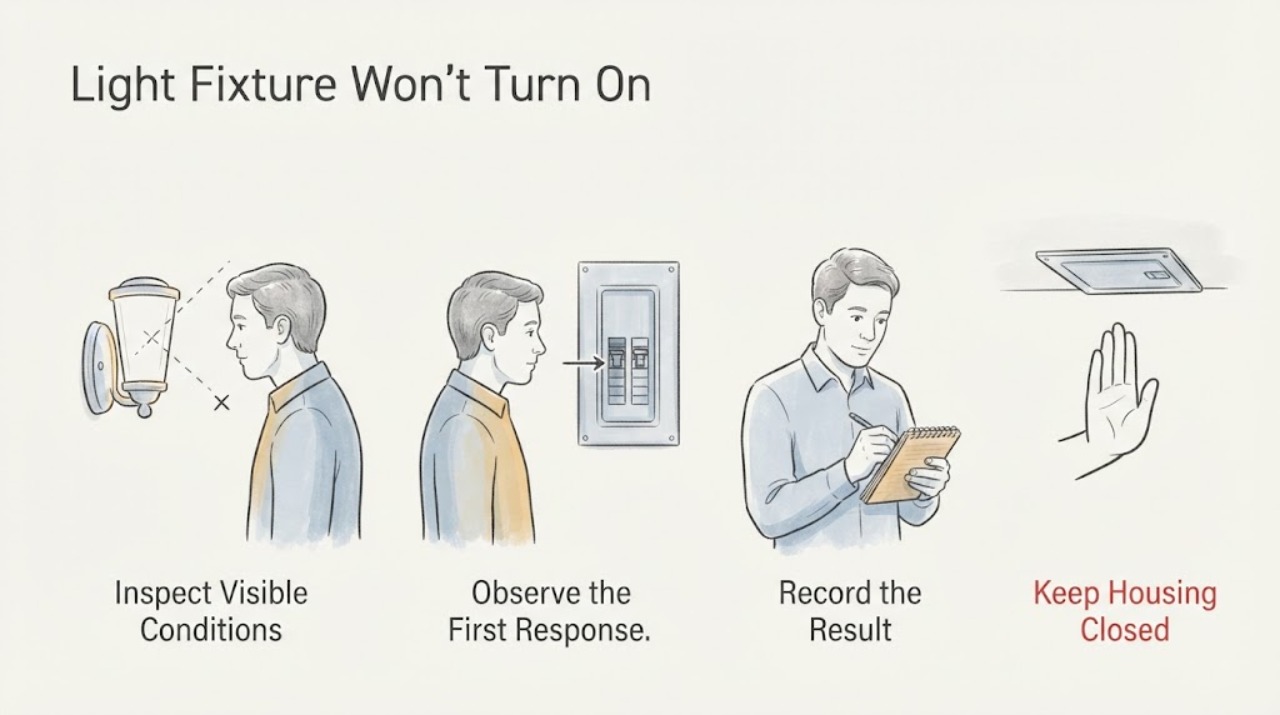
Work through in order
Diagnostic checks
Use only checks that match the exact appliance or system and its official guide.
-
Check 1
From the floor and a dry, safe position, look at the light fixture, switch plate, nearby receptacle, and visible cord for smoke, burning odor, heat, buzzing or sizzling, visible spark or arc, discoloration, cracked insulation, water, or a shock or tingling symptom; do not touch the fixture or switch plate to check temperature.
Expected result: A hazard sign is present, or the area is wet, hot, smoky, visibly damaged, or associated with a shock.
Next step: Stop using the light and keep clear. Leave the breaker and fixture alone, arrange licensed electrician service, and use the local emergency route from a safe location for smoke or fire.
Stop if: Stop immediately for smoke, fire, arcing, burning odor, heat, buzzing, shock, water near electrical equipment, or damaged insulation.
Why this matters
Why: The dark light may be the result of overheating, arcing, damaged wiring, moisture, or another electrical hazard rather than a routine lamp failure.
-
Check 2
Without removing the panel cover or touching any wiring, observe from outside whether the labeled lighting breaker appears fully on, visibly tripped, or between positions; note the label and position as found instead of repeatedly operating it.
Expected result: The breaker appears open or intermediate, looks fully on while the fixture is dark, or its label is unclear.
Next step: If the breaker is open or intermediate, keep it as found and have an electrician assess why it opened. If it looks on but the light is still dark, continue only with external scope and switch observations.
Stop if: Stop for a hot, buzzing, smoking, or damaged panel, an exposed conductor, or any need to remove the cover or operate the breaker repeatedly.
Why this matters
Why: An open position can explain a dark fixture, while a breaker that looks on does not rule out a switch, fixture, connection, or hidden circuit issue. An unclear label prevents a safe circuit conclusion.
-
Check 3
From normal room controls, observe whether other lights, receptacles, or rooms are also without power; record which devices remain normal and which failed at the same time, without plugging in a tester or moving wiring.
Expected result: Only one fixture is dark, several fixtures on one branch are dark, or unrelated rooms and outlets are also affected.
Next step: Leave the affected light off and give the outage map to an electrician. Do not use a different breaker, extension, or improvised connection to restore the fixture.
Stop if: Stop for repeated breaker operation, smoke, heat, odor, buzzing, arcing, shock, or water at any affected point.
Why this matters
Why: A single dark fixture shifts attention toward its switch, lamp, fixture, or local connection. Several affected points suggest a branch-circuit, breaker, or wiring issue; a wider outage may involve the home supply.
-
Check 4
If the switch and surrounding area are dry, cool, intact, and free of odor, operate the ordinary wall switch once from a standing position and observe whether the fixture remains dark, flickers, buzzes, flashes, or causes the breaker to open; do not remove the switch plate or touch its terminals.
Expected result: The fixture stays dark with a normal-feeling switch, flickers or buzzes, or the breaker opens when the switch is used.
Next step: For a persistent dark light, arrange an electrician to inspect the switch and fixture. For flicker, buzzing, a flash, heat, or a new trip, stop using the switch and leave the circuit for urgent electrical assessment.
Stop if: Stop for any abnormal sound, flash, heat, odor, smoke, shock, or breaker opening.
Why this matters
Why: A single dark response can involve the lamp, switch, fixture, or local connection. Flicker, buzzing, or a new trip is a warning of a possible connection or overload fault and is not a cue to keep trying.
-
Check 5
From a safe position, record whether the dark light is a ceiling or wall fixture, a plug-in lamp, or a recessed fitting; note any accessible label, recent installation or renovation, moisture event, and whether the light uses a dimmer or smart control, without moving, opening, climbing to, or touching the fixture.
Expected result: The fixture is hard-wired, plug-in, recessed, recently installed, exposed to moisture, or connected to a dimmer or smart control; the type remains unknown.
Next step: Give the fixture type, control type, label, installation history, and moisture history to the electrician. Keep a recessed, hot, discolored, or wet fixture out of use until inspected.
Stop if: Stop if the fixture is above a ladder-height location, hard-wired, wet, hot, cracked, discolored, or would need a cover removed.
Why this matters
Why: The power path and hazard boundary differ by installation. Recessed lights can overheat when the lamp rating or surrounding insulation is unsuitable, while a plug-in lamp has a cord and receptacle path; the observation does not identify a failed part.
-
Check 6
Record what else was operating when the breaker opened or the light went dark, including heaters, kitchen equipment, portable loads, or recent work on the same room or circuit; use appliance labels and prior observations only, without changing the circuit or repeating the load.
Expected result: Several loads were active, the light failed after recent electrical work, the breaker opened during a high-load event, or no shared load or recent change is known.
Next step: Keep the affected circuit and light out of service as needed and ask an electrician to assess load, connections, breaker, and fixture. Do not add a larger protective device or relocate loads as a substitute for inspection.
Stop if: Stop for a second trip, hot or discolored equipment, smoke, odor, buzzing, arcing, shock, or water.
Why this matters
Why: Too much demand on a branch circuit or a disturbed connection can contribute to a trip, but a repeated trip can also indicate a fault in the fixture, switch, wiring, or protective device.
-
Check 7
Prepare a service note with the fixture location and type, breaker label and position as found, outage scope, switch response, visible hazard signs, fixture and control labels, recent work or moisture, and loads operating at the time; keep covers, panels, and wiring untouched.
Expected result: The fixture remains dark, the breaker trips again, the cause is uncertain, or diagnosis would require access to the panel, switch box, fixture, cord termination, or wiring.
Next step: Arrange a licensed electrician to inspect and restore the circuit safely. Keep the light out of use until the professional confirms the circuit and fixture are safe.
Stop if: Stop all user diagnosis when any panel, switch box, fixture cover, wiring, or hard-wired connection would need to be accessed.
Why this matters
Why: The unresolved possibilities include a branch overload, breaker or wiring fault, switch or connection fault, lamp or fixture fault, or an installation-specific thermal issue.
Use your observations
Decision map
Find the observation that best matches what you see, then follow the next safe action.
-
PATH 01Next step
What you see
Smoke, burning odor, heat, buzzing, arcing, shock, water, or damaged insulation is present.
Do this next
Stop using it, keep clear, and arrange urgent licensed electrician service; leave and use the local emergency route for smoke or fire.
Why this path and its safety boundary
Why it matters: The dark fixture is part of an electrical or fire hazard, not a routine lamp check.
-
PATH 02Next step
What you see
The lighting breaker appears tripped or intermediate, or it opens again after the light is used.
Do this next
Do not keep resetting it or substitute a larger protective device; leave the circuit for a licensed electrician.
Why this path and its safety boundary
Why it matters: The breaker is responding to an overload, short, leakage, or another circuit condition that needs diagnosis.
-
PATH 03Next step
What you see
Several lights or outlets are out at once, or unrelated rooms lose power.
Do this next
Keep affected equipment off and arrange electrician or building service with the outage map; do not open the panel.
Why this path and its safety boundary
Why it matters: A branch-circuit, panel, building wiring, or wider supply problem is more likely than one lamp alone.
-
PATH 04Next step
What you see
Only one fixture is dark, the breaker remains stable, and the switch is normal with no hazard sign.
Do this next
Arrange electrician service for the switch and fixture; do not remove the fixture or touch its wiring.
Why this path and its safety boundary
Why it matters: A lamp, switch, local connection, fixture control, or fixture fault is possible, but the circuit is not proven safe for internal handling.
-
PATH 05Next step
What you see
The light is recessed, hot, discolored, exposed to water, or has a history of insulation or renovation around it.
Do this next
Leave the light off and arrange qualified electrical inspection before any replacement or cover removal.
Why this path and its safety boundary
Why it matters: An installation or thermal condition may be involved, and lamp or fixture handling could expose the user to shock or heat risk.
Helpful context
Understand the symptom
A dark fixture does not prove the bulb is the problem
A light can go dark because the branch circuit has opened, the switch or control is not supplying power, the lamp has failed, or the fixture has a wiring or thermal fault. The assigned circuit-breaker clue changes the first decision: establish whether the circuit is affected before touching the fixture. If the breaker opens again, it is protecting the wiring from a condition that needs qualified diagnosis.
Use the pattern, not a risky test
Record whether one fixture, one room, or several rooms are dark; whether the switch feels normal; and whether the breaker opened before the light failed. A wall or ceiling fixture may be hard-wired, while a plug-in lamp has a different power path. Do not move a heavy fixture, remove a cover, climb to reach it, or substitute a different breaker rating to make the symptom disappear.
When to stop
Smoke, a hot or discolored switch plate, burning odor, buzzing, visible sparks, a shock, water, or damaged insulation changes this from a no-light problem to an electrical hazard. Leave the fixture and panel alone, keep people away, and contact a licensed electrician. If there is smoke or fire, leave and use the local emergency route from a safe location.
Safety boundary
Stop conditions
- Stop immediately for smoke, fire, visible sparks or arcing, burning odor, buzzing or sizzling, heat, shock or tingling, water near electrical equipment, or damaged insulation.
- Do not repeatedly reset the breaker, install a larger fuse or breaker, bypass protection, or use an improvised cord or adapter to restore the light.
- Do not remove the service-panel cover, switch plate, fixture cover, or recessed trim; do not touch wiring or make a live electrical measurement.
- Stop if the breaker opens again, will not remain closed, or several lights and outlets lose power; arrange licensed electrician service.
- If smoke or fire is present, leave the area and use the local emergency route from a safe location; do not return to investigate.
Only after diagnosis
Potential parts
- circuit breaker or branch-circuit protective device
Consider this only if a licensed electrician finds that the protective device or branch circuit is defective or incorrectly applied; a dark fixture alone does not identify it.
The electrician must verify the wiring, circuit design, and exact protective-device requirements before any replacement. - wall switch or fixture control
Consider this only if the circuit is safe and professional inspection finds that the switch or control is not passing power.
Match the control to the fixture, load, dimming or smart-control setup, and wiring configuration after professional identification. - lamp or light fixture assembly
Consider this only after inspection rules out a circuit or wiring hazard and confirms that the lamp or fixture itself has failed.
Confirm the fixture label, lamp type, rating, mounting, and installation conditions; do not choose a replacement from the symptom alone.
When checks do not resolve it
Need a professional?
The breaker is tripped, intermediate, will not remain closed, or opens again when the light is used., Several lights or outlets are dark, or the outage affects more than one room., The fixture or switch is hot, discolored, buzzing, smoky, wet, damaged, or associated with a shock., The light is recessed or was affected by renovation, added insulation, moisture, or recent electrical work., Diagnosis would require removing a cover, accessing a switch box or panel, touching wiring, climbing to the fixture, or changing a protective device.
Safety scope: Keep the light and affected circuit out of use for smoke, odor, heat, buzzing, arcing, water, shock, damaged insulation, or repeat trips. Panel, switch-box, fixture, wiring, and protective-device work belongs to a qualified electrician.
Common questions
FAQ
Should I keep resetting the breaker when the light stays off?
No. A repeated trip is a protective warning. Record the breaker position and outage pattern once, leave the light off, and arrange licensed electrical service.
Does one dark light mean the bulb is bad?
Not necessarily. A switch, local connection, branch circuit, breaker, fixture, lamp, or thermal condition can be involved. The circuit-breaker position and whether other lights are affected should be established before any fixture handling.
Can I replace the breaker with a larger one so the light works?
No. A protective device with an unsuitable rating can leave the branch wiring exposed to overheating and fire. Have a licensed electrician verify the circuit and the fixture installation.
Read the exact guide
Official sources
- Home Wiring Safety TipsElectrical Safety Foundation International · Residential electrical hazard recognition and licensed-electrician referral.
- Understanding Your Home Electrical SystemElectrical Safety Foundation International · Residential service panels, branch circuits, breakers, grounding, and overload protection.
- CPSC Guide to Home Wiring HazardsU.S. Consumer Product Safety Commission · Home wiring, branch-circuit, light-fixture, switch, breaker, and electrical hazard safety guidance.
Community feedback
Share a repair observation
Share a plain-text repair observation. Accepted observations are published automatically; this page may take a moment to update.