
On this page
Start here
Quick answer
A flickering light fixture can be caused by the bulb or lamp holder, a switch, a loose connection, a circuit overload, a breaker problem, or a supply issue. Do only non-contact observations: note whether one fixture or several lights flicker, whether a large load triggers it, and whether the plate or fixture shows heat, discoloration, noise, odor, moisture, or sparks. Keep the affected light off and arrange qualified electrical service when the cause is not an obvious bulb issue. Smoke, burning odor, hot surfaces, crackling, arcing, shock, or repeated breaker operation requires immediate stop and urgent help.
Before you begin
Safety first
- Keep the affected light and circuit unused. Do not touch or open the fixture, switch, receptacle, breaker panel, meter, service equipment, or wiring; do not reset repeatedly, bypass protection, or perform energized electrical testing.
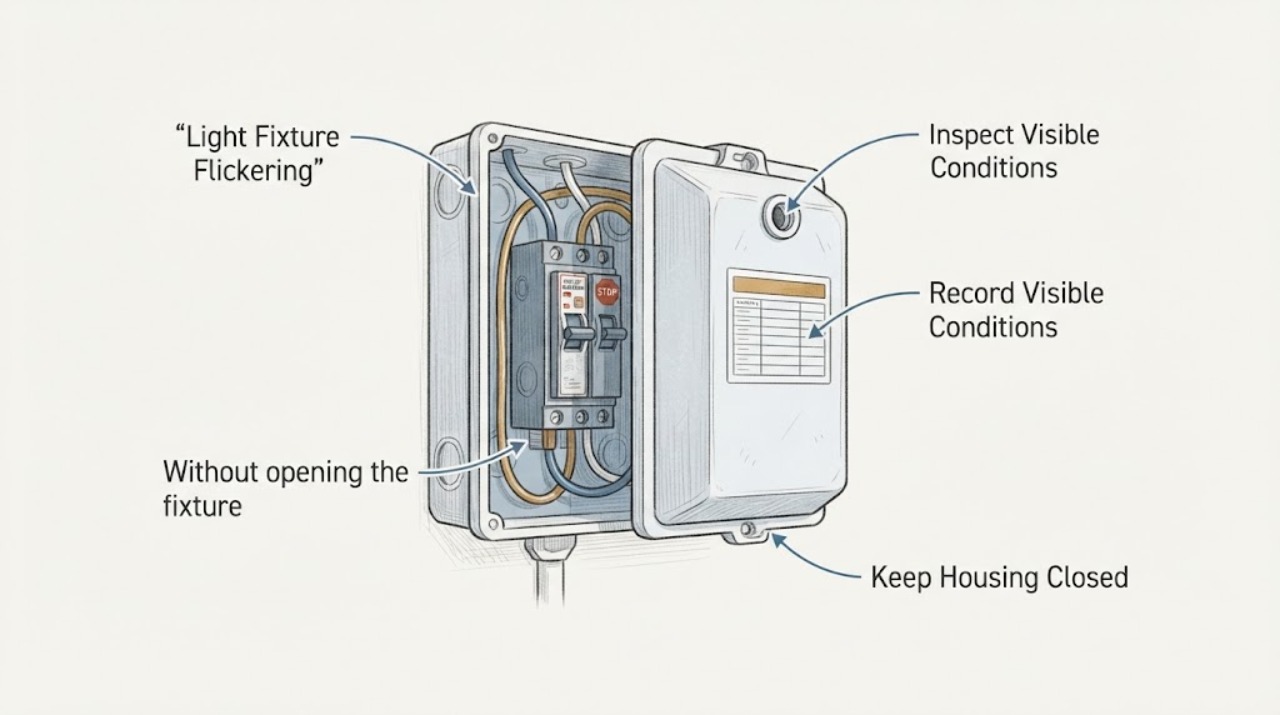
Work through in order
Diagnostic checks
Use only checks that match the exact appliance or system and its official guide.
-
Check 1
From a clear, dry position, observe whether the flicker is limited to one light fixture, every light in the room, or lights in more than one room. Do not touch the fixture, bulb, switch, breaker, or wiring while observing.
Expected result: Record the exact locations, whether all lamps in the fixture change together, and whether any other loads lose power or dim.
Next step: Keep the affected circuit or fixture out of use and give the location pattern to an electrician. If the whole property changes or outside lines visibly spark, move away and contact the utility or emergency service from safety.
Why this matters
Why: One fixture points toward a local bulb, socket, switch, or connection; several rooms point toward a branch, panel, service, or utility-side issue. Location alone cannot identify a failed part.
-
Check 2
Note the trigger and timing without deliberately recreating a severe symptom: record whether flicker begins when a heater, motor, charger, or other sizeable load starts, and whether it stops when that load is no longer operating.
Expected result: Write down the load, room, approximate sequence, and whether one or many lights respond. Do not move plugs, operate a suspect switch repeatedly, or cycle a breaker to test the theory.
Next step: Stop using the affected light and any nonessential load on the same circuit until an electrician assesses the circuit capacity, connections, protective device, and supply pattern.
Why this matters
Why: A load-related pattern can indicate an overloaded branch, a supply disturbance, or a poor connection; it does not prove that the named load or the breaker is defective.
-
Check 3
Without opening the fixture or touching its parts, check the visible identity and condition of the bulb and fixture: note bulb type, whether the bulb is visibly loose or damaged, and whether the fixture has a cracked lens, water entry, scorch mark, or heat damage.
Expected result: A correct bulb that is visibly damaged, a loose-looking lamp, or any mark, moisture, or heat is a stop signal. A normal-looking bulb does not clear the holder, switch, circuit, or wiring.
Next step: Do not remove a bulb from a suspect fixture or reach into it while it is connected. Leave it off and provide the fixture type and visible condition to qualified service.
Why this matters
Why: A bulb or lamp problem may be local, but signs of heat, moisture, arcing, or damage can expose energized parts and require professional isolation.
-
Check 4
From outside the electrical enclosure, look at the nearby switch plate, receptacle, and accessible cord path for discoloration, deformation, moisture, or a loose-looking plate. Listen for buzzing or crackling only from a safe distance.
Expected result: A warm or discolored surface, arcing sound, smoke, odor, or visible spark means stop immediately. A quiet, normal-looking plate is not evidence that hidden wiring is sound.
Next step: Keep the fixture and switch unused. Do not remove a cover, tighten a terminal, touch a conductor, spray cleaner, or perform an energized meter check; arrange an electrician, or emergency help for smoke or fire.
Why this matters
Why: These signs can be consistent with overheating, arcing, damaged equipment, or a loose connection in the wiring or switching path.
-
Check 5
Observe the breaker status only from a safe, dry position and record whether it is visibly tripped, whether another protective device has operated, and whether the flicker began before or after that event. Do not reset it repeatedly or open the panel.
Expected result: A trip, repeated trip, missing power, or a breaker that will not stay engaged changes the issue from a lamp symptom to a protective-device or circuit investigation.
Next step: Leave the affected circuit out of use and call an electrician. If there is smoke, heat, arcing, or a burning smell, move away and obtain urgent emergency help rather than trying another reset.
Why this matters
Why: A breaker can respond to overload or fault conditions, but its position does not identify whether the fault is in the fixture, wiring, connected load, or supply.
-
Check 6
Record recent changes that preceded the flicker, such as a new fixture, bulb type, switch, wiring work, water intrusion, storm, or a new high-demand appliance. Include whether the symptom is constant, intermittent, or tied to weather.
Expected result: A symptom after installation or moisture narrows the history but cannot confirm a connection; flicker that changes with wind or affects the property broadly may involve service equipment or the utility side.
Next step: Give the timeline and photos taken from a safe distance to an electrician; contact the utility for a broad supply pattern. Do not touch overhead equipment, the meter, panel internals, or any exposed conductor.
Why this matters
Why: Recent work and weather can change the urgency and the responsible professional, while concealed service equipment is not a safe user repair area.
-
Check 7
Prepare a service note with the fixture location, flicker pattern, trigger, breaker label if safely visible, recent work, bulb and fixture type, and all heat, sound, odor, moisture, or smoke observations.
Expected result: A complete pattern helps the electrician choose a safe isolation and inspection plan without asking the occupant to open energized equipment.
Next step: Keep the affected light off until the electrician confirms the fixture, switch, circuit, breaker, wiring, and supply are safe to return to service.
Why this matters
Why: The assigned circuit-breaker and wiring components require qualified diagnosis; visual observations cannot establish conductor integrity, breaker condition, or a safe repair.
Use your observations
Decision map
Find the observation that best matches what you see, then follow the next safe action.
-
PATH 01Next step
What you see
Only one light fixture flickers and there is no heat, smell, sound, moisture, or visible damage.
Do this next
Keep it off and report the bulb, socket, switch, and fixture pattern to an electrician. A local symptom may still be a loose connection or damaged fitting; do not open it to prove which one.
-
PATH 02Next step
What you see
Several lights or rooms flicker together, or the symptom tracks a large load.
Do this next
Stop nonessential use on the affected circuit and request electrical inspection of branch loading, connections, breaker, and supply. If the pattern is property-wide or weather-related, contact the utility from a safe position as well.
-
PATH 03Next step
What you see
The breaker is tripped, will not remain engaged, or trips again.
Do this next
Do not keep resetting it. Leave the circuit unused and arrange an electrician to identify the overload or fault before restoring power.
-
PATH 04Next step
What you see
A switch plate, fixture, plug, or socket is hot, discolored, damaged, wet, buzzing, or crackling.
Do this next
Stop using the light and keep people away. Do not touch, remove, dry, tighten, or replace the fitting; obtain urgent qualified help.
-
PATH 05Next step
What you see
The flicker began after a fixture, bulb, switch, or wiring change, or after water or storm exposure.
Do this next
Preserve the history and keep the affected circuit unused. Have an electrician inspect the work and concealed connections; do not reopen or retest the installation.
-
PATH 06Next step
What you see
There is smoke, a visible arc or spark, a burning odor, shock, rapid heating, fire, or exposed service equipment.
Do this next
Stop immediately, move away, keep others away, and obtain emergency help. Do not touch the equipment, operate switches or breakers near the hazard, or investigate the source.
Helpful context
Understand the symptom
First identify what is actually flickering
Watch from a safe position and identify the exact light: one bulb, every lamp on the fixture, the whole room, or multiple rooms. Also note whether the change is a brief blink, a repeating pulse, dimming, or a full interruption. A single fixture can point toward a bulb, lamp holder, switch, or local connection, while several lights or a whole home pattern can involve a branch circuit, service connection, or utility supply. This distinction changes who must inspect it; it does not justify opening a cover or testing live conductors.
Treat heat, sound, and smell as safety information
Do not touch a suspect fixture, switch plate, breaker, plug, or socket to test its temperature. From a safe distance, look for a brown mark, melting, smoke, visible flash, water entry, or damaged cord and listen only if doing so does not put you near the hazard. Electrical Safety First and government fire guidance treat flicker, overheating, arcing sounds, and discoloration as reasons to stop using the item and obtain competent help.
Why a breaker or wiring fault stays on the list
A circuit breaker is protective equipment, not a diagnosis. Flicker that starts when a heater, motor, charger, or other high-demand load operates may reflect a shared circuit or supply disturbance. A loose connection in the fixture, switch, branch wiring, panel, or service equipment can also create unstable light and heat. Because the assigned circuit-breaker and wiring components are inside energized electrical systems, a qualified electrician must isolate the circuit and inspect it before any connection or component is repaired.
Safety boundary
Stop conditions
- Stop immediately for smoke, fire, a burning or electrical odor, visible arcing or sparks, crackling, rapid heating, melting, a shock, or an exposed conductor. Leave the area and obtain emergency help when appropriate.
- Stop using the light, switch, breaker, and nearby connected equipment for moisture, water entry, scorch marks, discoloration, damaged insulation, a hot surface, or a repeated protective-device trip.
- Do not remove the fixture, bulb, switch plate, receptacle cover, breaker-panel cover, or service equipment; do not touch wiring, tighten connections, bypass protection, use a meter, or perform an energized test.
- Do not keep cycling the switch or breaker to reproduce flicker. A normal-looking light or breaker does not prove hidden wiring or service connections are safe.
Only after diagnosis
Potential parts
- light bulb or lamp holder
Consider only if a qualified diagnosis isolates the fault to the bulb or holder and confirms the correct type for the exact fixture.
Confirm the fixture model, socket type, lamp rating, and installation instructions before ordering or fitting any part. - light switch
Consider only if inspection identifies the switch as the source rather than a branch, breaker, or supply fault.
A qualified electrician must confirm circuit type, rating, wiring method, and local requirements. - circuit breaker
Consider only after an electrician confirms the breaker is faulty and that the underlying circuit fault or overload has been addressed.
Breaker type, rating, panel family, and installation method must be verified by a qualified electrician; never substitute a higher rating. - branch wiring connection
Consider only when inspection finds a damaged conductor, connection, or concealed wiring fault causing the flicker.
Wiring repair is site-specific electrical work and must be designed and completed by a qualified electrician.
When checks do not resolve it
Need a professional?
Call after recording fixture locations, timing, load relationship, breaker status, recent work, and visible safety signs without touching electrical parts. Escalate urgently for heat, discoloration, moisture, buzzing, crackling, odor, smoke, sparks, shock, exposed conductors, or repeated trips.
Safety scope: Keep the affected light and circuit unused. Do not touch or open the fixture, switch, receptacle, breaker panel, meter, service equipment, or wiring; do not reset repeatedly, bypass protection, or perform energized electrical testing.
Common questions
FAQ
Is one flickering light always a bad circuit breaker?
No. One fixture can have a bulb, lamp holder, switch, local connection, branch, or breaker issue. Several rooms, a load-related pattern, or a repeated trip raises the need for circuit and supply inspection. Do not open the fixture or panel to decide which part failed.
Can I keep using the light if it still works?
It is safer to leave a flickering fixture unused until its cause is clear. Heat, discoloration, buzzing, crackling, odor, moisture, smoke, sparks, shock, or a breaker trip means stop immediately and obtain urgent help.
Should I reset the breaker to stop flickering?
Do not repeatedly reset it. Record its visible status from a safe position and leave the affected circuit unused; an electrician must determine whether the issue is an overload, fault, breaker, wiring, fixture, or connected load.
What does flickering in several rooms mean?
It can involve a branch circuit, a shared load, a service connection, or a utility-side disturbance rather than one fixture. Record the locations and triggers, avoid touching service equipment, and contact an electrician or the utility from a safe position.
What should I tell the electrician?
Provide the fixture and room, blink or dim pattern, timing, load or weather trigger, breaker status if safely visible, bulb and fixture type, recent work or water exposure, and any heat, mark, noise, odor, smoke, spark, shock, or trip.
Read the exact guide
Official sources
- CPSC Guide to Home Wiring HazardsU.S. Consumer Product Safety Commission · General residential wiring hazard education; it is not a substitute for site-specific diagnosis.
- Fire safety in the home (accessible version)Home Office, GOV.UK · Fire-safety guidance for England; the emergency principle is broadly useful but local emergency arrangements vary.
- LEDVANCE Recalls Recessed Canister Light Kits Due to Shock and Electrocution HazardsU.S. Consumer Product Safety Commission · Applies only to the listed recalled Sylvania recessed kits; used here only to support the warning not to troubleshoot an electrically hazardous light by touch.
- Electrical Safety Advice for LampsElectrical Safety First · Lamp and portable-light guidance; fixed-fixture wiring requires separate electrical assessment.
- Electrical Safety Advice for Living RoomsElectrical Safety First · General household electrical safety guidance; it does not identify a fault in a particular fixture.
Community feedback
Share a repair observation
Share a plain-text repair observation. Accepted observations are published automatically; this page may take a moment to update.