
On this page
Start here
Quick answer
First verify that the fan's existing wall switch supplies power, then replace the Minka Aire remote battery with the exact type and polarity shown in the model manual. Test the light and any accessible pull-chain or wall control without opening the fan. If the fan works locally but ignores the remote, the transmitter may be unpaired, on a different frequency, incompatible with the receiver, or failed; Minka Aire control procedures and batteries vary by model, so do not use a generic reset sequence. If the fan and light are both dead from local controls, suspect the wall switch, breaker, receiver power, or fan wiring instead of only the remote. Stop for smoke, burning smell, heat, buzzing, sparking, visible damage, or a recurring breaker trip, and arrange qualified electrical service for receiver, canopy, or wiring work.
Before you begin
Safety first
- This article covers safe observation from the floor, handheld battery replacement, accessible control comparison, and model identification. It does not authorize wall-plate or canopy removal, receiver access, electrical measurement, exposed-wire handling, frequency or DIP changes by guesswork, receiver bypass, or energized work.
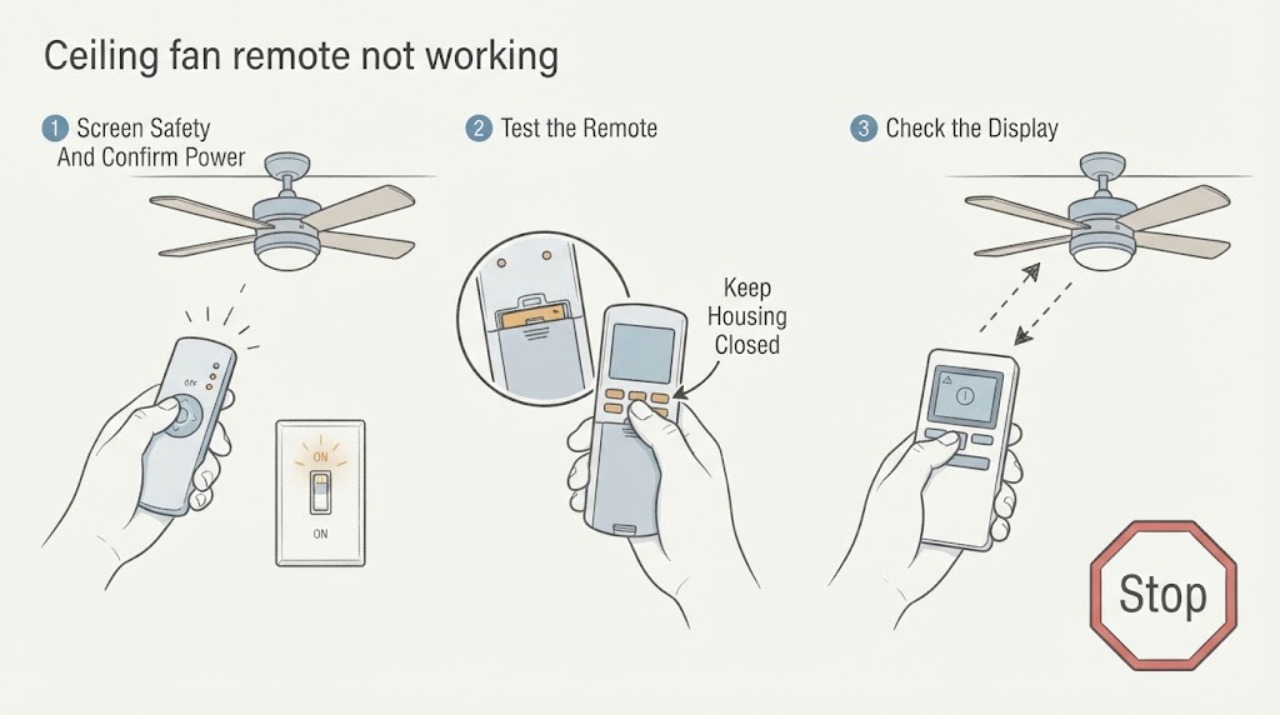
Work through in order
Diagnostic checks
Use only checks that match the exact appliance or system and its official guide.
-
Check 1
From the floor, look for smoke, burning smell, abnormal heat, buzzing, sparking, visible damage, water, or a breaker that trips again. If none is present, put the existing fan wall switch in its normal on position and press one ordinary fan or light command on the remote once.
Expected result: Record whether the remote has an indicator (if its model provides one), whether the fan or light responds, whether the wall switch feels normal, and whether the breaker remains stable.
Next step: For any warning, leave the fan off and arrange qualified electrical service. Without a warning, continue with the battery and local-control checks without opening covers or repeatedly cycling power.
Stop if: Do not keep resetting a tripping breaker, operate a hot or damaged control, remove a wall plate, climb to the fan, or touch a wire.
Why this matters
Why: A warning sign or recurring breaker trip is an electrical safety issue, not a pairing problem. A stable switch with no fan response makes supplied power or the fan control path more likely; any fan response provides a baseline for investigating the handheld control.
-
Check 2
Open only the handheld remote's battery compartment. Read the battery marking and the exact Minka Aire manual, install the specified fresh battery or batteries with the shown polarity, and inspect for corrosion, moisture, a stuck button, or a damaged compartment.
Expected result: Record the battery type, orientation, old and new battery condition, any corrosion or moisture, whether a button is stuck, and whether the remote indicator or fan responds after the change.
Next step: Test one command at a time from the normal distance. If there is no response, identify the exact fan and remote models before attempting a frequency or pairing procedure; do not choose a generic replacement based only on appearance.
Stop if: Do not pry open the remote electronics, bridge battery contacts, use a leaking cell, or spray cleaner into the remote.
Why this matters
Why: A depleted cell, wrong polarity, corrosion, or damaged button can make the transmitter appear dead. If a fresh correctly installed battery changes nothing while the fan works locally, the remaining possibilities are transmitter failure, lost frequency/pairing, compatibility, or receiver response.
-
Check 3
If the fan has an accessible pull chain or wall control, use it to test the motor and light separately, then return the control to its normal position and try one remote command. Do not remove a shade, reach into the housing, or use a ladder for this comparison.
Expected result: Classify the result as motor and light both work locally, only the light works, only the motor works, neither works, or the fan has no local control. Note whether the remote changes any function.
Next step: Use the matching symptom branch below. If the fan uses a wall control or accessory remote, follow that model's operating instructions rather than assuming the handheld remote is the only power control.
Stop if: Do not force a pull chain, bypass the receiver, remove a light kit, or perform a wiring test as part of this comparison.
Why this matters
Why: Local operation with remote failure points toward the transmitter, learned frequency, compatibility, or receiver command path. Local failure of both motor and light points toward the wall switch, breaker, receiver power, or fan wiring rather than only the handheld transmitter. One-function failure can indicate a function-specific load or control path.
-
Check 4
Read the fan model label or documentation from a safe, already accessible location and note the remote model. In the exact Minka Aire manual, find the frequency-learning or pairing section and follow only its stated external button sequence; if power must be cycled, use the stated control and keep other nearby fans off as directed.
Expected result: Record the fan model, remote model, battery type, whether the manual uses frequency learning, DIP switches, or another pairing method, the required power state, and the manual's success indication.
Next step: If the model-specific procedure succeeds, retest the intended fan and light functions. If it fails, the model is unknown, or the instructions require receiver, canopy, or wiring access, stop and provide the model and observations to a qualified technician.
Stop if: Do not guess frequency settings, change hidden switches by copying another fan, remove the canopy, or handle receiver wiring. Any electrical access requires power isolation and qualified work.
Why this matters
Why: Minka Aire control families differ. The RC1000 manual describes a learned-frequency system, a limited window after receiver power is restored, and a test of fan speed; another Minka Aire manual can specify a different battery or control sequence. A procedure for one model cannot prove a receiver fault in another.
-
Check 5
After the battery, local-control comparison, and model-specific procedure, stop testing and summarize the results rather than repeatedly cycling power or disassembling the fan.
Expected result: Record whether the remote is dead or merely ignored, whether motor and light work locally, whether the wall switch and breaker remain stable, the fan and remote models, and any pairing success indication.
Next step: Arrange qualified electrical service when the remote remains unusable after the exact battery and manual checks, when local controls also fail, or when receiver or wiring access would be needed. Give the technician the recorded sequence.
Stop if: Stop immediately for smoke, burning smell, heat, buzzing, sparking, visible damage, water near the control, a recurring breaker trip, or exposed wiring.
Why this matters
Why: These observations separate a transmitter or frequency issue from a receiver, wall-control, supply, or fan-wiring issue, but they do not identify a safe component replacement without model-specific testing.
Use your observations
Decision map
Find the observation that best matches what you see, then follow the next safe action.
-
PATH 01Safety boundary
What you see
The fan or light responds to a local wall control or pull chain, but the handheld remote has no indicator or command response after the exact fresh battery check.
Do this next
Confirm the fan and remote model numbers, then use the exact manual's frequency or pairing procedure. If it fails, have transmitter/receiver compatibility and operation checked before replacing either component.
Why this path and its safety boundary
Why it matters: Fan power and at least part of the fan control path are present. A failed transmitter, damaged battery compartment, incorrect remote, or lost learned frequency is more likely than a dead fan motor.
Safety stop: Do not open the remote electronics, substitute a visually similar control, or access the receiver without qualified electrical work and the correct manual.
-
PATH 02Safety boundary
What you see
The remote has a fresh battery or indicator and the fan has power, but every command is ignored; local operation works or the fan stopped responding after a control change.
Do this next
Use the model manual to confirm the expected pairing sequence and success response. If that fails, arrange professional receiver and control diagnosis using the exact fan and remote information.
Why this path and its safety boundary
Why it matters: A learned-frequency mismatch, wrong control family, receiver fault, or receiver power/control issue is more likely than a simple battery fault. One function working does not clear the receiver or its output path.
Safety stop: Do not change frequency or DIP settings by guesswork, bypass the receiver, or replace a receiver based only on connector appearance.
-
PATH 03Safety boundary
What you see
Neither the remote nor the accessible wall control or pull chain operates the motor or light, or both functions stopped together.
Do this next
Check only the existing wall-switch position and visually note whether the breaker is tripped; do not keep resetting it. Arrange qualified electrical diagnosis if the fan remains dead or the breaker trips again.
Why this path and its safety boundary
Why it matters: The fault is not isolated to the handheld transmitter. The wall switch, breaker, receiver supply, fan wiring, or internal control may be interrupting power.
Safety stop: Do not remove the wall plate or canopy, measure terminals, or reset a breaker repeatedly, especially with heat, smell, buzzing, or visible damage.
-
PATH 04Safety boundary
What you see
The remote or local control operates the motor but not the light, or operates the light but not the motor.
Do this next
Confirm the exact manual's button and light-control behavior, then test the correct command once. If the function remains absent, arrange service for the receiver, load, and wiring path.
Why this path and its safety boundary
Why it matters: Power reaches at least one fixture function, so a completely dead handheld battery is less likely. The failed function may have its own load, receiver output, control setting, or wiring issue.
Safety stop: Do not access lamp sockets, receiver wires, or internal controls while energized; stop for burning odor, heat, buzzing, or visible damage.
-
PATH 05Safety boundary
What you see
The problem began after installation, a remote replacement, a nearby fan installation, or an unknown control change, or the fan and remote models cannot be identified.
Do this next
Use Minka's manual search to identify the exact fan and remote documentation. Follow that documentation or have a qualified technician verify compatibility and receiver configuration; keep nearby controlled fans off during learning when the manual directs it.
Why this path and its safety boundary
Why it matters: A control-system mismatch, lost frequency, changed address, or installation issue becomes more likely. Minka Aire manuals describe different remote families, batteries, and frequency methods.
Safety stop: Do not order a generic transmitter, copy settings from another fan, or change receiver switches without model-specific documentation and safe power isolation.
-
PATH 06Safety boundary
What you see
There is smoke, a burning smell, abnormal heat, buzzing or sparking, visible damage, water near the control, or a breaker that trips again.
Do this next
Leave the fan off and arrange urgent electrical service; for active smoke or fire, leave the area and contact emergency help from a safe location. Provide the model and warning without opening the fixture.
Why this path and its safety boundary
Why it matters: The priority is an electrical or equipment safety fault. Remote pairing and repeated testing could increase the hazard or obscure the cause.
Safety stop: Do not touch hot controls, reset the breaker, operate the fan, spray liquid, open the canopy, or handle exposed wiring.
Helpful context
Understand the symptom
A Minka Aire remote problem is not always a remote problem
A handheld transmitter can lose its battery power or learned frequency while the fan still has power. The opposite pattern is also possible: the remote is transmitting, but the fan's wall switch, receiver supply, or wiring is not. Compare the remote with the light and any accessible local control before assuming that a replacement transmitter will solve the fault.
Use the exact Minka Aire manual
Minka Aire documentation covers several control families. One remote manual specifies two AAA cells and a learned-frequency sequence, while other fan manuals specify an A23 12-volt cell or a different control layout. The Minka literature page provides the model-manual search. Identify the fan and remote model first; do not transfer button timing, frequency settings, or battery information from another model.
Receiver and wiring checks are electrical work
Minka Aire installation manuals show a receiver in the fan's electrical path and warn that power must be off at the electrical panel before repairs. A battery replacement and observation from the floor are reasonable homeowner checks. Receiver access, frequency-switch changes inside the fan, electrical measurements, and wiring repairs require safe isolation and a qualified professional.
Safety boundary
Stop conditions
- Stop and arrange qualified electrical service for smoke, burning smell, abnormal heat, buzzing, sparking, visible damage, water near the control, or a breaker that trips again.
- Do not remove the canopy, wall plate, receiver, or switch housing, measure terminals, handle exposed wiring, bypass the receiver, or change wiring as a remote reset.
- Do not guess a Minka Aire frequency or pairing sequence; use the exact fan and remote manual because battery and control procedures vary by model.
- Do not repeatedly cycle a tripping breaker or keep operating a fan with an electrical warning just to see whether the remote recovers.
- Stop after safe battery, local-control, and model-identification checks if the remote remains unusable or the fan has no local response; provide the recorded observations to a qualified technician.
Only after diagnosis
Potential parts
- remote-control battery
Consider this only when the remote battery is depleted, installed incorrectly, corroded, or damaged and the exact Minka Aire manual confirms the required type.
Match the battery chemistry, size, polarity, and remote model; Minka Aire manuals vary between battery formats. - Minka Aire-compatible remote transmitter
Consider this only after a fresh specified battery and the model-specific frequency or pairing procedure fail, and diagnosis confirms the handheld transmitter is defective or unavailable.
Confirm the exact fan series, remote model, receiver system, functions, and learning method before replacement. - ceiling fan remote receiver or control module
Consider this only when the fan has stable power, the transmitter is confirmed compatible and functional, and qualified testing shows the receiver does not accept commands.
Match the exact fan model, receiver/control version, wiring configuration, load ratings, and manufacturer service information; receiver access is electrical work. - ceiling fan wall control
Consider this only when qualified diagnosis identifies the wall control or its compatibility as the cause of missing fan power or failed control commands.
Confirm the fan control system, electrical ratings, wiring requirements, and exact model compatibility before installation.
When checks do not resolve it
Need a professional?
Arrange qualified electrical service when a fresh correctly oriented battery and the exact model-specific frequency or pairing procedure do not restore the remote, when the fan or light also fails from local controls, when the model or receiver compatibility is unknown, or when receiver, canopy, or wiring access would be required. Treat smoke, burning smell, sparking, abnormal heat, water near controls, visible damage, or a recurring breaker trip as an urgent electrical safety issue.
Safety scope: This article covers safe observation from the floor, handheld battery replacement, accessible control comparison, and model identification. It does not authorize wall-plate or canopy removal, receiver access, electrical measurement, exposed-wire handling, frequency or DIP changes by guesswork, receiver bypass, or energized work.
Common questions
FAQ
Why is my Minka Aire remote not working after a battery change?
A fresh correctly oriented battery rules out only the simplest transmitter-power problem. If the fan works locally, the remote may need model-specific frequency learning, may be incompatible, or may have a failed transmitter. Identify the fan and remote models and follow the exact manual before considering a replacement.
How do I pair a Minka Aire ceiling fan remote?
The procedure depends on the Minka Aire control family. Use the exact fan manual: the RC1000 manual describes a learned-frequency process, while other Minka Aire manuals can use a different battery or control layout. Do not copy a timing or button sequence from another model.
What if both the Minka Aire remote and fan are not working?
Check the existing wall-switch position and visually note the breaker, then compare whether the light or any accessible local control responds. If both motor and light remain dead, the issue may be supplied power, wall control, receiver power, or fan wiring rather than the handheld remote. Do not repeatedly reset a tripping breaker or open the fan; arrange qualified electrical service.
Can I inspect or replace the Minka Aire receiver myself?
The receiver can be inside the canopy and in the electrical path between the house supply and fan. Minka Aire manuals warn that power must be off at the electrical panel before repairs. If receiver access, electrical testing, or replacement is needed, use a qualified professional with the exact model and control information.
When is a nonworking fan remote an electrical emergency?
Stop using the fan and arrange urgent electrical help for smoke, burning smell, sparking, abnormal heat, buzzing, visible damage, water near the control, or a breaker that trips again. Do not keep testing the remote or open the fixture to investigate.
Read the exact guide
Official sources
- Minka-Aire Calais F544 Installation InstructionsMinka Lighting LLC / Minka-Aire · F544 fan manual; battery and control details apply only to that model family and illustrate why the exact manual is necessary.
- AireControl Universal Hand Held Remote System, Model RC1000Minka Lighting LLC / Minka-Aire · Only the RC1000 control family; battery and frequency details must not be generalized to another Minka-Aire model.
- Minka-Aire F831L Installation InstructionsMinka Lighting LLC / Minka-Aire · F831L installation manual; wiring details are model-specific and are not homeowner troubleshooting instructions.
- LiteratureMinka Lighting LLC · Official Minka literature page for locating the manual for a particular Minka-Aire fan or control.
- Minka-Aire F802 Installation InstructionsMinka Lighting LLC / Minka-Aire · F802 fan manual; it establishes model-specific receiver and frequency concepts, not a universal repair procedure.
Community feedback
Share a repair observation
Share a plain-text repair observation. Accepted observations are published automatically; this page may take a moment to update.