
On this page
Start here
Quick answer
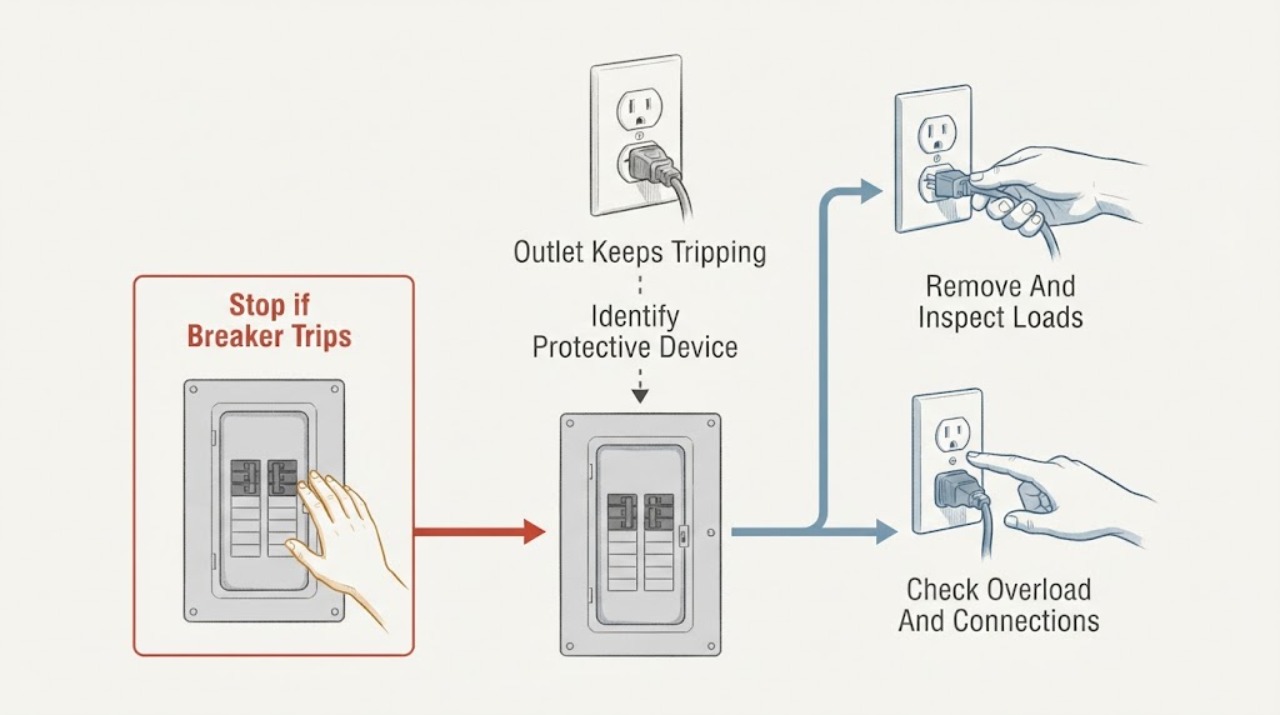
If an outlet keeps tripping, first determine whether its reset button is a GFCI device or whether a circuit breaker trips at the panel. Unplug every device from the affected outlet and any outlets that lost power, then check cords, plugs, moisture and obvious overloads without removing the outlet cover. Do not keep resetting a device that trips with no load, or one that is warm, discolored, buzzing, sparking, damaged or associated with a shock. A trip caused by one appliance points to that appliance; a trip with an empty outlet or across several outlets needs a qualified electrician to inspect the receptacle, protection device and wiring.
Work through in order
Diagnostic checks
Use only checks that match the exact appliance or system and its official guide.
-
Check 1
Observe whether the outlet’s TEST and RESET buttons change state or whether a breaker at the electrical panel moves to its trip position, without removing any cover.
Expected result: A popped RESET button identifies a GFCI-type receptacle; a tripped panel handle identifies a branch-circuit protection event. Note whether the trip happens as soon as a plug is inserted, when a device starts, or with no load connected.
Next step: Record the affected outlet, nearby outlets that lost power and the timing, then unplug every load before making one external reset attempt as directed by the device instructions.
Stop if: Stop without resetting if the device or outlet is warm, discolored, cracked, wet, buzzing, sparking or emitting an odor.
Why this matters
Why: The protective device and timing narrow the path: a load-start trip suggests an appliance or overload, while a no-load trip points toward wiring, the receptacle or the protective device.
-
Check 2
Unplug every appliance, power strip, charger and extension lead from the affected outlet and any outlets that went dead; inspect each accessible plug and cord for cuts, looseness, crushed insulation, moisture or scorching.
Expected result: If one device or cord is visibly damaged, or the trip returns when that one device is connected, the appliance or cord is a likely contributor. If the outlet trips while empty, the load has not explained the event.
Next step: Keep a suspect appliance unplugged and send it to an authorised repair route or replace it as appropriate. If the empty outlet still trips, leave it unused and arrange an electrician inspection.
Stop if: Do not plug in a device with damaged insulation, a loose plug, evidence of water or a burning smell, and do not repair a cord yourself.
Why this matters
Why: Removing loads separates a faulty appliance from a receptacle or branch-circuit problem without opening the electrical system.
-
Check 3
With the circuit left de-energized by its protection, review whether several heat-producing or high-demand appliances share the outlet or circuit, and remove extension leads, multi-outlet converters and daisy-chained adaptors from the setup.
Expected result: The trip appears only when several loads run together, while a single correctly connected device does not cause it, when the combined demand is too much for that branch. A trip with a single small load or no load is not explained by simple overload.
Next step: Use only the arrangement allowed by the appliance and electrical instructions; once the circuit is stable and no hazard is present, reconnect at most one known-good load for observation. Escalate if the protection trips again.
Stop if: Do not substitute a larger fuse or breaker, use an extension cord for a major appliance, or keep adding outlets or adaptors to avoid the trip.
Why this matters
Why: An overloaded branch can make the protection operate as designed, but repeatedly resetting or moving the problem to another outlet can conceal an appliance or wiring fault.
-
Check 4
If the affected device is a GFCI receptacle, look for moisture or a connected downstream outlet in a kitchen, bathroom, laundry, basement, garage or outdoor area; use only the TEST and RESET controls as the manufacturer instructs.
Expected result: A GFCI that resets after the load and moisture issue are removed but trips again when a particular device is connected suggests leakage from that device. A GFCI that will not reset, trips with no load or has a failed self-test remains unsafe to use.
Next step: Keep the receptacle and connected area out of use and call a qualified electrician if it will not reset, trips empty, is wet or the source of the fault is not clear.
Stop if: Do not handle the receptacle or plugs with wet hands, use it while wet, defeat the protection or remove its cover.
Why this matters
Why: Ground-fault protection is intended to interrupt a shock hazard; a reset failure is not permission to bypass or replace the device without proper identification and electrical competence.
-
Check 5
With power left off after a trip, visually inspect only the outlet faceplate, plug fit and surrounding wall for warmth, discoloration, cracks, scorch marks, movement, buzzing or flickering nearby lights.
Expected result: A loose-fitting plug, hot or discolored plate, crackling sound, spark, burning odor, shock or flickering is a warning sign beyond a routine overload check. A cool, intact outlet does not prove the wiring is safe.
Next step: Leave the outlet unused, keep the breaker or GFCI off if it can be done safely, and contact a licensed electrician. Report whether the symptom appeared with a specific appliance or with no load.
Stop if: Stop immediately for smoke, fire, active sparking, a shock or a hot outlet; move people away and contact emergency services when there is an immediate fire or life-safety danger.
Why this matters
Why: These symptoms can indicate a loose connection, arcing, damaged wiring or a failing protective device and require inspection rather than a new receptacle installed by trial and error.
Use your observations
Decision map
Find the observation that best matches what you see, then follow the next safe action.
-
PATH 01Next step
What you see
The protection trips only when one appliance or cord is connected.
Do this next
Keep the suspect item unplugged and have it repaired or replaced through a qualified route; do not repeatedly try it on other outlets.
Why this path and its safety boundary
Why it matters: That appliance, cord or its leakage may be the trigger rather than the empty outlet.
-
PATH 02Next step
What you see
Several loads trip the same circuit, especially heat-producing appliances or loads on a power strip.
Do this next
Remove the extension or adaptor arrangement, reduce simultaneous demand according to the appliance instructions and arrange an electrician if normal use still trips the circuit.
Why this path and its safety boundary
Why it matters: An overloaded branch or unsuitable connection is possible.
-
PATH 03Next step
What you see
The GFCI trips with no load, will not reset, or is associated with moisture.
Do this next
Keep the area out of use and have a qualified electrician locate the fault; do not bypass the GFCI.
Why this path and its safety boundary
Why it matters: A ground fault, downstream fault or failed protective device remains possible.
-
PATH 04Next step
What you see
The outlet is warm or discolored, smells burned, buzzes, sparks, shocks, or has a loose plug or cracked faceplate.
Do this next
Stop using the outlet and call a licensed electrician; use emergency services for an active fire or immediate life-safety danger.
Why this path and its safety boundary
Why it matters: This is an electrical safety warning, not a reset nuisance.
-
PATH 05Next step
What you see
The trip persists with all accessible loads unplugged or affects multiple outlets and lights.
Do this next
Leave the affected circuit unused and provide the electrician with the outlet map, trip timing and any recent appliance or renovation changes.
Why this path and its safety boundary
Why it matters: The issue may be in fixed wiring, the receptacle, branch protection or a hidden downstream load.
Helpful context
Understand the symptom
Identify what is actually tripping
An outlet may have a GFCI reset button, while the device that opens the circuit may be a breaker elsewhere in the home. Either protective device is responding to a condition such as overload, a faulty appliance, a ground fault, arcing or a wiring problem. The pattern of the trip matters more than the outlet’s appearance alone.
Reset once only after removing the cause
Unplug loads before any external reset and keep hands and the floor dry. Do not remove the faceplate, pull the outlet from the box, change breaker or fuse size, bypass a GFCI or AFCI, or continue using an outlet that is hot, discolored, cracked, buzzing, sparking or smells burned.
A trip with no load is a different branch
If one appliance causes the trip, the appliance or its cord is suspect. If the protective device trips with everything unplugged, or multiple outlets are affected, the fault may be in the receptacle, downstream wiring or protection device. That second pattern is not a user-repair diagnosis.
Only after diagnosis
Potential parts
- GFCI receptacle or circuit protection device
A failed or incorrectly identified protection device can resemble a downstream fault, but replacement depends on the circuit, location, wiring and local requirements.
Do not order or install based only on appearance; a qualified electrician should identify and replace the device. - receptacle outlet and cover plate
A loose, cracked, scorched or worn receptacle may need replacement, but the underlying connection or wiring must be inspected first.
No fit or rating is asserted. Do not remove the cover or use a replacement to mask repeated trips.
When checks do not resolve it
Need a professional?
Call a licensed electrician if the outlet or GFCI trips with no load, will not reset, affects several outlets, or trips again with a normal single load. Call promptly for warmth, discoloration, buzzing, sparking, burning odor, shock, flickering lights, damaged cords or a cracked receptacle; use emergency services for an active electrical fire or immediate danger.
Common questions
FAQ
Why does an outlet keep tripping with nothing plugged in?
The fault may be in the GFCI or breaker, the receptacle, fixed wiring, a downstream load or moisture. Leave it unused and have a qualified electrician inspect it rather than repeatedly resetting it.
Is it safe to keep resetting a tripping outlet?
No. Remove the connected loads first and make only the external reset permitted by the device instructions. Recurring trips mean the cause needs correction; repeated resetting can leave an electrical hazard in service.
How can I tell whether the appliance or outlet is at fault?
Unplug all devices and inspect cords and plugs. If one device reliably triggers the trip, keep it unplugged and have it repaired or replaced. If the empty outlet trips, the outlet, protection device or wiring needs professional inspection.
What outlet warning signs mean I should stop immediately?
Stop for warmth, discoloration, crackling or buzzing, sparks, a burning smell, a shock, flickering lights, a loose plug or a cracked faceplate. Leave the outlet out of use and call a licensed electrician.
Read the exact guide
Official sources
- CPSC, National Electrical Safety Foundation Urge Consumers to Plug Into Electrical SafetyU.S. Consumer Product Safety Commission · CPSC advice to unplug repeatedly tripping appliances, inspect cords, avoid overloaded extension cords and stop using warm outlets.
- Electrical Safety: ChecklistNational Fire Protection Association · NFPA warning signs for frequent trips, warm or discolored outlets, burning odors, sparks and damaged cords.
- CPSC Guide to Home Wiring HazardsU.S. Consumer Product Safety Commission · CPSC guidance on overloads, repeated trips, appliance versus receptacle faults, GFCI protection and qualified electrician boundaries.
Community feedback
Share a repair observation
Share a plain-text repair observation. Accepted observations are published automatically; this page may take a moment to update.