
On this page
Start here
Quick answer
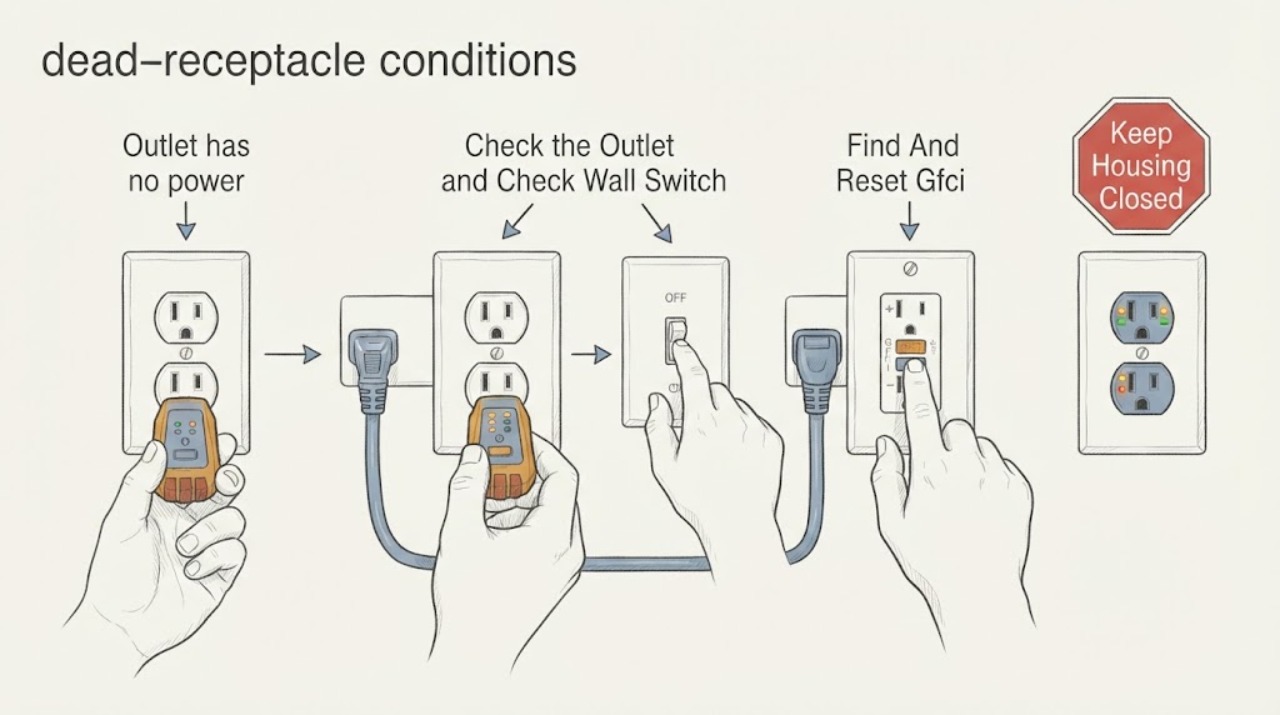
An outlet with no power may be a tripped GFCI, a tripped breaker, a switched or controlled receptacle, a failed upstream outlet, a loose connection, or a damaged branch circuit. First compare the dead outlet with a known-working device and nearby outlets, and note whether the room is wet or whether other outlets lost power. Look for a GFCI receptacle with TEST and RESET buttons in the room and nearby areas, then press RESET once only if the area is dry and the device is intact. Check the circuit breaker visually and reset it once if it is clearly tripped; if it trips again, do not keep resetting it. Stop immediately for a hot, scorched, cracked, loose, sparking, smoking, wet, or shock-producing outlet, and do not remove the cover, probe the slots, test live voltage, or replace wiring yourself. If the GFCI will not reset, the outlet remains dead, or the cause is not an obvious switch, GFCI, or single breaker state, leave it unused and arrange qualified electrical service.
Before you begin
Safety first
- This article covers ordinary-access comparison, documented GFCI reset, visible breaker observation, and exterior condition checks only. Receptacle, panel, wiring, grounding, breaker, GFCI replacement, and live-circuit testing require a qualified electrician.
Work through in order
Diagnostic checks
Use only checks that match the exact appliance or system and its official guide.
-
Check 1
With dry hands and no damaged cords, plug a known-working low-risk device into the dead outlet and then compare nearby outlets and the same outlet's other receptacle opening without inserting anything into the slots.
Expected result: Record whether the known-working device works elsewhere but not here, both openings are dead, only one opening is dead, nearby outlets are also dead, or the device or outlet shows heat, looseness, sparking, or odor.
Next step: Use the local-outlet or circuit branch below, and leave the outlet unused for any damage or electrical symptom.
Stop if: Stop immediately for shock, heat, scorch marks, smoke, sparks, water, a loose receptacle, or a plug that falls out easily.
Why this matters
Why: A failed device is not an outlet fault. One dead opening supports a receptacle-specific problem; several dead outlets support an upstream GFCI or branch-circuit issue. Heat, odor, looseness, or sparking overrides all reset checks and requires service.
-
Check 2
Check whether the receptacle is controlled by a nearby wall switch, timer, or occupancy control, and observe whether the outlet responds when that control is operated normally.
Expected result: Record a switch-controlled outlet that returns power, no change, a switch that feels hot or sparks, or uncertainty about which control operates the receptacle.
Next step: Leave a normal switched outlet in its documented operating state. If it remains dead or the switch is damaged, stop and arrange electrical service.
Stop if: Do not open the switch box, bypass the switch, use a jumper, or continue with heat, sparks, smoke, water, or a shock.
Why this matters
Why: Some outlets are intentionally switched, so a normal switch state can explain no power without a failed receptacle. No response or a hot, sparking, or loose switch points toward a circuit or wiring fault and not a reason to remove the switch plate.
-
Check 3
Look for an accessible GFCI with TEST and RESET buttons in the room and nearby wet or utility areas; if the device and area are dry and intact, press RESET once as the device instructions direct.
Expected result: Record a GFCI whose RESET returns power, a RESET that will not latch, an indicator that stays off or shows a fault, a GFCI that trips again, or no GFCI found.
Next step: If power returns, test the outlet once with the known-working device and stop. If the GFCI does not reset or trips again, leave the circuit unused and call a qualified electrician.
Stop if: Do not press RESET in a wet or damaged area, hold it down, remove the GFCI, change LINE or LOAD wiring, or bypass the protection.
Why this matters
Why: A tripped GFCI can remove power from downstream receptacles, so a successful reset supports a ground-fault interruption. A device that will not reset or trips again can indicate no upstream power, a fault, damaged or miswired protection, or a downstream problem and requires diagnosis.
-
Check 4
From outside the electrical panel, observe the breaker or fuse serving the affected area and identify whether it is visibly tripped or blown; if the panel and surroundings are dry and safe, reset a clearly tripped breaker once according to its labeling.
Expected result: Record a normal breaker, one clearly tripped breaker that restores power, a breaker that trips again, two linked breakers with one displaced, or a panel that is wet, hot, damaged, or inaccessible.
Next step: If one reset restores power and there are no hazard signs, test once without reconnecting a suspect appliance. If it trips again or the panel is abnormal, leave it off and arrange qualified electrical service.
Stop if: Do not repeatedly reset, install a larger fuse or breaker, open the panel cover, touch conductors, or reset a wet or hot panel.
Why this matters
Why: A single tripped breaker can explain a dead branch, but a repeat trip or an abnormal panel condition suggests overload, short, ground fault, damaged equipment, or wiring trouble. The breaker position does not prove the receptacle is safe to use.
-
Check 5
With power left off if a breaker or GFCI has tripped, inspect only the outside of the receptacle and wallplate for cracks, gaps, scorching, discoloration, moisture, a loose face, or a plug that does not fit firmly.
Expected result: Record an intact, dry, firm outlet; a cracked or missing plate; a hot or discolored face; moisture; a loose receptacle; visible arcing; or a loose plug fit.
Next step: Leave any damaged or loose outlet unused and request a qualified electrician. Do not remove the plate or attempt to tighten or rewire it.
Stop if: Stop immediately for smoke, sparks, heat, shock, water, a burning odor, exposed parts, or a plug that slips out of the receptacle.
Why this matters
Why: Heat, arcing, moisture, looseness, and damaged insulation can indicate a shock or fire hazard and cannot be cleared by a reset. A firm, intact outlet with no power after GFCI and breaker checks may have a hidden upstream connection or failed device.
-
Check 6
After one permitted GFCI or breaker reset and only when the outlet is dry and visibly intact, make one controlled test with the known-working device, then disconnect it if the outlet behaves abnormally.
Expected result: Record restored power, no power, intermittent power, immediate GFCI or breaker operation, warmth, noise, odor, or any spark.
Next step: Use the outlet only when the test is stable and no hazard sign is present; otherwise leave it unused and provide the electrician the reset behavior, affected outlets, device, and visible condition.
Stop if: Do not keep cycling protection, test with a high-load appliance, use an extension cord as a repair, or continue after any abnormal symptom.
Why this matters
Why: Stable restored power supports a protective interruption or switch state, but intermittent power, repeat tripping, warmth, noise, odor, or sparks indicates an unresolved receptacle or circuit fault.
Use your observations
Decision map
Find the observation that best matches what you see, then follow the next safe action.
-
PATH 01Safety boundary
What you see
The test device also fails at a known-working outlet.
Do this next
Unplug and stop using the suspect device; have its cord or plug assessed before using it again.
Why this path and its safety boundary
Why it matters: The device, cord, or plug is the immediate fault rather than the receptacle.
Safety stop: Do not use a damaged, hot, sparking, smoking, or wet device or cord in another outlet.
-
PATH 02Safety boundary
What you see
One opening of the receptacle is dead while the other works normally and the face is intact.
Do this next
Check the nearby wall switch once if applicable, then arrange electrician service if the opening remains dead.
Why this path and its safety boundary
Why it matters: A receptacle-specific failure, switched half, or internal connection issue is possible; the outlet should not be opened by an ordinary user.
Safety stop: Stop for looseness, heat, discoloration, sparks, shock, or a plug that fits loosely.
-
PATH 03Safety boundary
What you see
A nearby GFCI RESET returns power to the outlet and the outlet remains cool, dry, and stable on one retest.
Do this next
Use the outlet normally only with intact equipment and stop if the GFCI trips again; recurring trips need an electrician to identify the fault.
Why this path and its safety boundary
Why it matters: A ground-fault interruption or downstream protective trip likely caused the temporary loss, but the protected circuit should still be monitored for recurrence.
Safety stop: Do not bypass, replace, rewire, or hold the GFCI reset when it will not latch.
-
PATH 04Safety boundary
What you see
The GFCI will not reset, its indicator shows a fault or no power, or it trips again immediately.
Do this next
Leave the protected circuit unused and arrange qualified electrical diagnosis; do not remove the GFCI or change its wiring.
Why this path and its safety boundary
Why it matters: The circuit may have no upstream power, a continuing ground fault, a damaged or miswired device, or a downstream fault.
Safety stop: Stop for water, heat, smoke, sparks, a shock, or any need to open the box or panel.
-
PATH 05Safety boundary
What you see
One clearly tripped breaker resets once and the outlet works steadily with no hazard signs.
Do this next
Reconnect only known-safe equipment one at a time and stop if the breaker trips again; arrange service for recurrence.
Why this path and its safety boundary
Why it matters: A temporary overload or interruption may have opened the branch, but the cause is not proven if a particular appliance caused it.
Safety stop: Do not reset repeatedly, use a larger protective device, or continue with heat, odor, sparks, or a damaged appliance.
-
PATH 06Safety boundary
What you see
The breaker trips again, a fuse blows again, or power disappears as soon as a load is connected.
Do this next
Leave the breaker off, unplug suspect equipment if safe, and arrange qualified electrician service.
Why this path and its safety boundary
Why it matters: An overload, short, ground fault, defective appliance, or wiring fault remains and the protection is warning against continued operation.
Safety stop: Do not install a higher-rated breaker or fuse, open the panel, or keep cycling the protection.
-
PATH 07Safety boundary
What you see
The receptacle or switch is hot, scorched, cracked, wet, loose, sparking, smoking, or gives a shock.
Do this next
Stop using the outlet and arrange prompt qualified electrical service; if smoke or active arcing is present, follow local emergency safety guidance.
Why this path and its safety boundary
Why it matters: This is a potential shock or fire hazard, not a normal no-power reset branch.
Safety stop: Do not touch the faceplate, unplug by pulling a sparking plug, remove the cover, or re-energize the circuit to test it.
-
PATH 08Safety boundary
What you see
The device is known good, no switch or accessible GFCI explains the loss, the breaker appears normal, and the outlet remains dead.
Do this next
Leave the outlet unused and arrange qualified electrical diagnosis; provide the electrician the affected outlet map and reset results.
Why this path and its safety boundary
Why it matters: A hidden upstream connection, failed receptacle, branch conductor, panel connection, or protective device remains possible.
Safety stop: Do not remove the wallplate, probe the slots, test live voltage, or use improvised wiring.
Helpful context
Understand the symptom
First determine whether the outlet or the circuit is dead
A single dead receptacle with working outlets nearby suggests a local receptacle, upstream GFCI, wall switch, or connection problem. Several dead outlets in a line suggest a GFCI or branch breaker. If the breaker trips when a particular appliance is connected, the appliance or circuit may have a fault. Test only with an ordinary known-working device and never use a damaged cord or a metal object to investigate an outlet.
Reset only the accessible protective controls
GFCI receptacles are designed to interrupt power when they detect a ground fault and can protect downstream outlets. A GFCI may be in a bathroom, kitchen, garage, basement, exterior area, or another location upstream of the dead receptacle. If the face and surrounding area are dry and undamaged, press the intended RESET control once. A device that will not reset, shows a fault indication, or immediately trips again needs electrical diagnosis rather than a cover removal or wiring experiment.
Treat heat, sparks, shocks, and loose receptacles as stop conditions
CPSC warns that a hot receptacle or switch, visible arcing or sparking, a shock, a loose plug fit, damaged insulation, or a nonworking receptacle can signal a wiring or fire hazard. Do not use the outlet, tape over damage, bend plug blades, install a higher-rated breaker, or remove the wallplate to look for a loose wire. A qualified electrician can isolate the circuit and verify the receptacle, GFCI, breaker, connections, grounding, and load safely.
Safety boundary
Stop conditions
- Stop immediately for a shock, hot or scorched faceplate, visible arcing or sparks, smoke, burning odor, cracked or loose receptacle, damaged cord, water, or exposed electrical parts; leave the outlet unused and arrange qualified electrical service.
- Do not remove a wallplate or receptacle, open the panel, probe outlet slots, test live voltage, tighten wiring, bypass a GFCI or breaker, or install a higher-rated fuse or breaker.
- Do not repeatedly reset a GFCI or breaker, hold a reset button, use an extension cord as a repair, or reconnect a suspect appliance to see whether protection trips again.
- Do not touch an outlet or switch that is hot, wet, loose, sparking, smoking, or shocking; if active arcing or smoke is present, follow local emergency safety guidance.
- If one safe reset does not restore stable power, or the cause requires upstream, concealed, panel, or wiring access, stop troubleshooting and call a qualified electrician.
Only after diagnosis
Potential parts
- GFCI receptacle
Consider this only when qualified diagnosis confirms a failed or damaged GFCI after upstream power and downstream conditions are checked.
Confirm the exact device rating, location, protection arrangement, wiring configuration, and applicable electrical requirements; do not replace or rewire it from a reset symptom alone. - standard receptacle
Consider this only when a qualified electrician confirms the receptacle itself is worn, damaged, or failed and the circuit and protective arrangement are suitable.
Confirm device rating, grounding, box, conductor, location, and code requirements; do not infer compatibility from appearance or plug fit. - circuit breaker or fuse
Consider this only after professional testing confirms a failed protective device rather than an overload, short, ground fault, or wiring problem.
Match the panel, circuit, interrupt rating, and local requirements; never substitute a higher-rated device to stop trips. - receptacle wallplate
Consider this only when the wallplate is cracked, missing, or damaged and the receptacle and box are otherwise safe and correctly installed.
Confirm the exact opening, mounting, material, and electrical safety requirements; a plate does not repair a loose, hot, or damaged receptacle.
When checks do not resolve it
Need a professional?
Arrange qualified electrical service when the outlet remains dead after one permitted GFCI or breaker check, the GFCI will not reset or trips again, a breaker or fuse operates repeatedly, only one receptacle opening works, the outlet is loose, hot, cracked, wet, discolored, sparking, smoking, or shocking, a plug fits loosely, or diagnosis requires removing a cover, opening the panel, tracing a hidden upstream connection, testing wiring, or replacing a receptacle or protective device. Smoke, active arcing, shock, and water near energized parts require immediate attention.
Safety scope: This article covers ordinary-access comparison, documented GFCI reset, visible breaker observation, and exterior condition checks only. Receptacle, panel, wiring, grounding, breaker, GFCI replacement, and live-circuit testing require a qualified electrician.
Common questions
FAQ
What should I check first when an outlet has no power?
Test with a known-working device, compare nearby outlets, check whether a wall switch controls the receptacle, look for an accessible GFCI, and observe the branch breaker. Reset a GFCI or clearly tripped breaker only once and only when the area is dry and intact.
Can a GFCI elsewhere cause one outlet to lose power?
Yes. A GFCI can interrupt power to downstream outlets, so check accessible GFCIs in nearby wet or utility areas and press RESET once if dry and undamaged. If it will not reset or trips again, call an electrician.
Should I keep resetting a breaker when the outlet stays dead?
No. One documented reset may restore a temporary interruption, but a repeat trip indicates an unresolved overload, short, ground fault, appliance, or wiring issue. Leave the breaker off and arrange qualified electrical service.
Is a warm or loose outlet safe to use?
No. Heat, scorching, a loose receptacle or plug fit, sparks, smoke, or a shock can indicate a wiring or fire hazard. Stop using the outlet and call a qualified electrician; do not remove the cover or try to tighten wires.
What if the outlet still has no power after the GFCI and breaker checks?
Leave it unused. A hidden upstream connection, failed receptacle, branch conductor, panel connection, or protective device may remain. Diagnosing that requires electrical isolation and testing by a qualified electrician, not probing the outlet or opening the panel.
Read the exact guide
Official sources
- CPSC Guide to Home Wiring HazardsU.S. Consumer Product Safety Commission · CPSC consumer electrical-safety guidance; it does not replace local electrical code or an electrician's assessment of a particular circuit.
- Resetting GFI OutletsFlorida Power & Light Company · FPL customer guidance for GFI outlets; installed device layout and local electrical requirements control a particular home.
- GFCI Outlets & ReceptaclesLeviton · Leviton GFCI product and support guidance; exact indicator behavior and reset instructions vary by installed device.
Community feedback
Share a repair observation
Share a plain-text repair observation. Accepted observations are published automatically; this page may take a moment to update.