
On this page
Start here
Quick answer
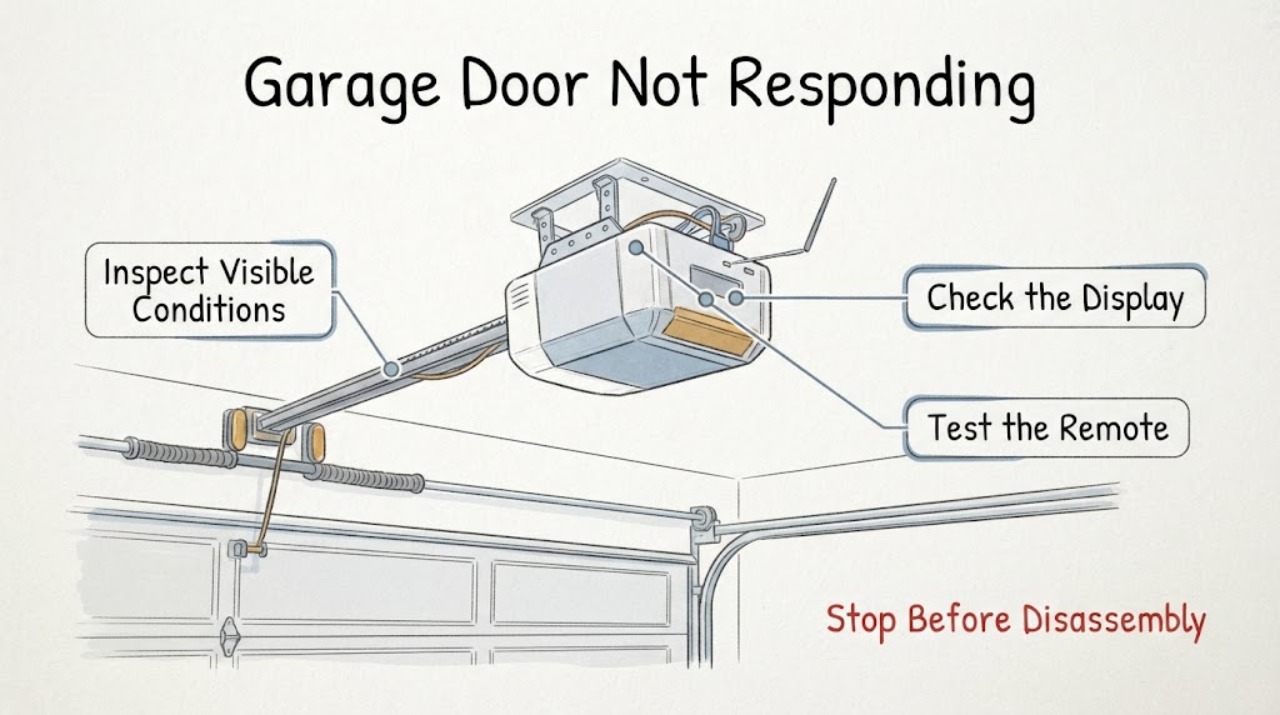
When a garage door is not responding, first keep everyone clear of the door and separate a control problem from a door or track problem. Check whether the opener has power, whether the wall control responds, whether the remote battery is usable, and whether the door path and photo-eye area are visibly blocked. Do not force a stuck door, adjust springs or cables, pull an emergency release while the door is open, or open the opener housing. A door that is crooked, heavy, binding, off its track, or falling, or an opener that hums without safe movement, needs qualified garage-door service.
Work through in order
Diagnostic checks
Use only checks that match the exact appliance or system and its official guide.
-
Check 1
From a safe position beside the door, press the wall control once and observe the opener light, diagnostic indicator, sound, and any door movement. Then, if the area remains clear, try the remote once without standing under the door. Do not repeatedly cycle the door or place hands in the path.
Expected result: A wall control response with no remote response points toward the remote or its battery. No response from either control suggests power, lockout, wiring, or opener control. A hum, click, or light with no movement shifts attention toward the door, track, carriage, or another mechanical branch.
Next step: Record which control was tried and every visible response. If the door moves unevenly, drops, binds, or starts without safe travel, stop immediately and arrange garage-door service.
Why this matters
Why: Separating the two controls prevents a dead remote from being mistaken for a failed opener and prevents a loaded door from being treated as an electronics problem.
-
Check 2
If the opener and wall control show no response, inspect the opener's plug, visible power cord, and the household breaker or fuse from a dry, safe position. Check that any wall-control lock or vacation setting is not active using the exact opener manual. Do not open the powerhead or touch exposed wiring.
Expected result: A disconnected plug, tripped breaker, or active lockout can prevent every control from starting the opener. If power is restored but the opener remains silent, or a breaker trips again, the electrical or control fault needs qualified diagnosis.
Next step: Reset a household breaker only once if the circuit is dry and safe. If it trips again, the outlet is damaged, or no opener response returns, leave the door out of service and arrange qualified electrical or garage-door service.
Why this matters
Why: A shared power or lockout problem affects both the wall control and remote, while a repeated protective-device trip is a stop condition rather than a reset challenge.
-
Check 3
Inspect the remote's battery compartment and visible buttons without opening the opener. Confirm the battery is seated, the buttons are not stuck, and the remote is the one paired with this opener. Compare with the wall control result; do not erase programming or perform a factory reset unless the exact manual calls for it.
Expected result: A wall control that works while the remote does not points toward battery, pairing, or remote hardware. If every control fails, changing a remote battery will not resolve the shared fault. A remote that works intermittently needs service or model-specific reprogramming if a fresh approved battery does not help.
Next step: Replace the remote battery only with the type specified by the manual and test once from a clear position. If remote and wall control remain unresponsive, continue to the path and track inspection rather than repeatedly pressing.
Why this matters
Why: Chamberlain asks for remote button and battery history because remote behavior is a separate diagnostic branch from opener power and door mechanics.
-
Check 4
With the opener idle, inspect the door opening, floor, photo-eye area, and both visible tracks for an object, ice, a shifted roller, a bent rail, or a track that no longer appears parallel. Do not reach into the track, force a roller back, remove a bracket, or move a heavy obstruction while the door is loaded.
Expected result: A blocked path or visibly misaligned track can stop safe movement. A crooked door, roller outside the track, binding, or a damaged rail indicates a mechanical hazard rather than a simple control fault.
Next step: Clear only a loose object that is safely outside the door and track. For a bent, displaced, binding, or damaged track, keep people clear and arrange qualified garage-door service.
Why this matters
Why: LiftMaster identifies path blockage and track misalignment as common causes, but track and door hardware can carry load and should not be straightened by an untrained user.
-
Check 5
From outside the door's travel path, look for a broken or separated spring, hanging cable, gap in the counterbalance assembly, visibly off-track panel, or door that is sitting crooked. Do not pull the emergency release if the door is open, do not manually lift a heavy or unbalanced door, and do not adjust springs, cables, brackets, or track hardware.
Expected result: A broken spring or cable, severe imbalance, binding, sticking, or a door that cannot remain safely supported can allow the door to fall. An intact-looking assembly does not prove that it is safe to disconnect or force by hand.
Next step: Leave the door in its current safe position, keep the opening clear, and arrange a qualified garage-door technician. Provide photographs from a safe distance and the opener model; do not continue control tests if hardware damage is visible.
Why this matters
Why: CPSC says an unbalanced, binding, or sticking door should be serviced professionally because it can crash unexpectedly; visual evidence is enough to stop, not a reason to test the hardware.
Use your observations
Decision map
Find the observation that best matches what you see, then follow the next safe action.
-
PATH 01Next step
What you see
The wall control works but the remote does not.
Do this next
Check the remote battery and pairing information in the exact opener manual. If the remote remains unresponsive while the wall control works, arrange model-specific support.
-
PATH 02Next step
What you see
Neither wall control nor remote produces light, sound, or movement.
Do this next
Check the visible plug and household breaker or fuse once, then stop if the breaker trips again or the opener remains silent. Arrange qualified electrical or garage-door service.
-
PATH 03Next step
What you see
The opener reacts or runs, but the door does not move or the track appears bent, shifted, blocked, or binding.
Do this next
Keep people clear and do not force the carriage, rollers, or track. Arrange qualified garage-door service for the loaded mechanical system.
-
PATH 04Next step
What you see
The door is crooked, heavy, off its track, visibly damaged, or a spring or cable is broken or separated.
Do this next
Do not pull the release while the door is open, lift the door, or adjust springs, cables, brackets, or track hardware. Leave the door clear and call a qualified technician.
-
PATH 05Next step
What you see
The door moves but will not close, reverses unexpectedly, or the safety sensors appear blocked or misaligned.
Do this next
Keep the path clear and use the exact opener manual for external sensor guidance. Do not defeat or bypass the reversing or entrapment protection; arrange service if the safety behavior is not restored.
Helpful context
Understand the symptom
Treat movement and balance as safety evidence
A silent remote is not the same problem as an opener that has power but cannot move a crooked door. Stand to the side, keep children and vehicles out of the door's path, and observe without placing hands near hinges, rollers, springs, cables, or the track. If the door is open and unsupported, do not pull a release cord or work beneath it.
Use controls and indicators to narrow the fault
Check the wall control and remote separately, then note whether the opener light or diagnostic indicator reacts. A remote-only failure points toward the remote or its battery; no response from any control points toward power, wiring, lockout, or the opener. A motor sound with no door movement points toward engagement or door hardware, not necessarily a dead remote.
Do not repair springs, cables, or a loaded track
Garage-door counterbalance springs, cables, brackets, and track hardware can store dangerous force. Do not loosen, wind, unwind, replace, or adjust them as an ordinary-user check. Stop for a broken spring or cable, a door that binds or sticks, a visibly off-track door, sudden dropping, or severe imbalance, and arrange qualified service.
Only after diagnosis
Potential parts
- remote control or wall control
Consider this class only if the wall control and opener power work but the remote or wall control alone remains unresponsive after the model-specific battery and pairing checks.
Confirm the complete opener model and manual before selecting a control component. - photo-eye safety sensor or sensor wiring
Consider this class only when qualified diagnosis links a close or reverse fault to the sensor path after the visible path and alignment checks.
Do not bypass or defeat entrapment protection; confirm model-specific compatibility and installation. - track, roller, or carriage component
Consider this class only after a qualified technician confirms a damaged or misaligned track, roller, or opener carriage rather than a blocked path or loaded spring system.
Track and counterbalance work can be hazardous; verify the door and opener model and use qualified installation.
When checks do not resolve it
Need a professional?
Provide the opener and door model if visible, installation or purchase timing, which controls were tested, remote battery history, opener light or diagnostic response, whether the motor sounds, door position, track and path observations, any broken spring or cable seen from a safe distance, and whether the issue followed weather, impact, or recent service. Keep people and vehicles clear until the technician arrives.
Common questions
FAQ
Why is my garage door not responding to the remote?
If the wall control works, check the remote battery and model-specific pairing information. If neither control works, check visible opener power and any lockout setting. Keep the door out of service if it is crooked, binding, or unsafe.
What if the garage door opener runs but the door does not move?
A blocked path, misaligned track, disengaged carriage, or damaged door hardware may be involved. Do not force the door or adjust loaded hardware; a track or door that binds needs qualified service.
Can I adjust a garage-door spring or cable myself?
No. Springs and cables can store dangerous force. Do not adjust, wind, unwind, replace, or disconnect them as a troubleshooting step. Arrange qualified garage-door service.
Should I pull the emergency release if the door is not responding?
Do not pull it while the door is open or unsupported. A weak or broken spring can let the door fall. If the door is binding, crooked, heavy, or off its track, keep clear and call a qualified technician.
Read the exact guide
Official sources
- Garage Door Opener Repair & Maintenance | LiftMasterLiftMaster · Generic garage door opener not responding or not moving safely
- Non-Reversing Automatic Garage Door Openers Are a HazardU.S. Consumer Product Safety Commission · Garage door that is not responding, binding, off balance, or unsafe to move
- Get Support | ChamberlainChamberlain · Generic opener-not-responding control and support triage
Community feedback
Share a repair observation
Share a plain-text repair observation. Accepted observations are published automatically; this page may take a moment to update.