
On this page
Start here
Quick answer
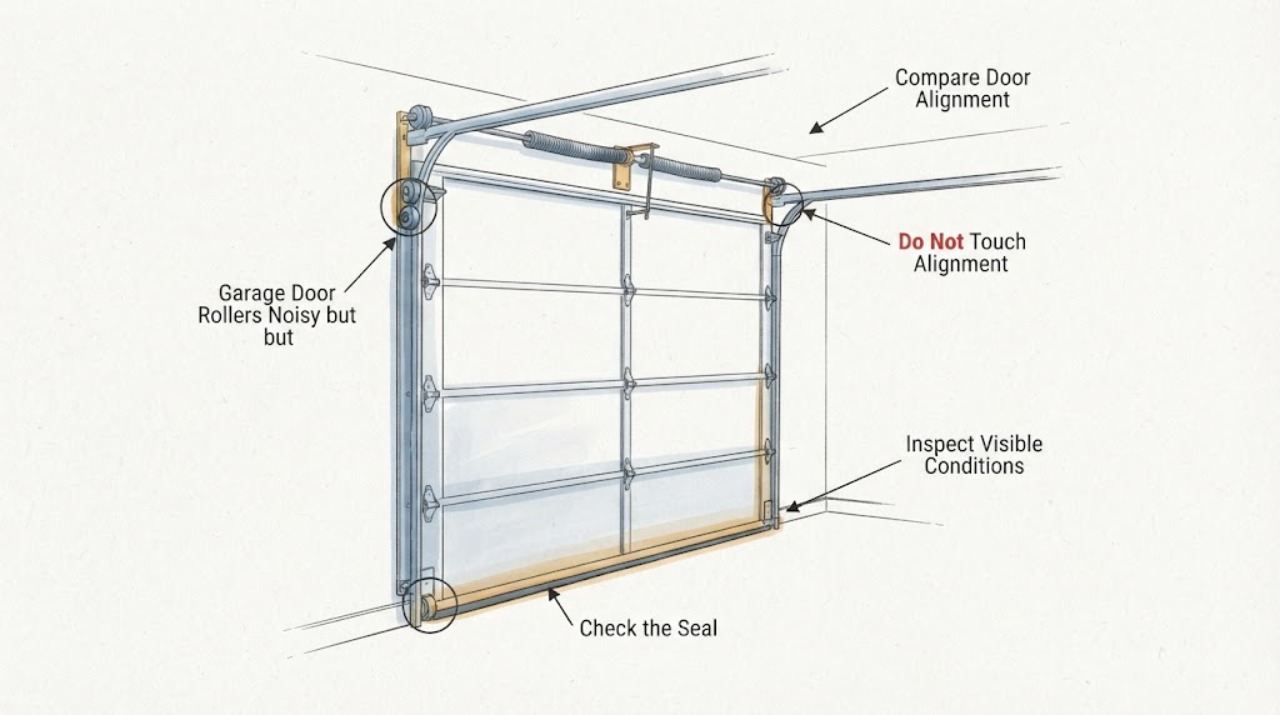
A balanced garage door with noisy rollers usually calls for a component-by-component check, not a spring adjustment. With the door closed, first identify whether the sound follows one roller, a hinge, or one point on the track. From a safe position, look for a cracked or seized roller, a bent or dirty track, loose hinge or track hardware, and a roller rubbing instead of turning. If the roller material and the owner's manual allow lubrication, apply only the specified lubricant to the roller or shaft, never as a substitute for a damaged or misaligned part. Keep clear of springs, lift cables, bottom brackets, and any door that binds, drops, comes off its track, or becomes unbalanced; those conditions need qualified garage-door service.
Work through in order
Diagnostic checks
Use only checks that match the exact appliance or system and its official guide.
-
Check 1
With the garage door closed, stand to the side of the opening and make one normal opener cycle only if the door is moving smoothly and you can see the full path. Note whether the noise is a squeak, rattle, scrape, grinding sound, or bang, and whether it occurs at one roller height, one panel joint, or one point along the track.
Expected result: The sound repeats at one roller or panel, appears at one fixed track location, or is broad and present throughout travel.
Next step: Record the location and sound with a short video from outside the travel path. Do not run more cycles if the door jerks, binds, drops, leaves the track, or shows cable or spring damage.
Stop if: Stop immediately for unstable movement, a door off its track, frayed or displaced cables, a broken spring, exposed electrical damage, or any need to stand under or reach into the moving door.
Why this matters
Why: A localized repeatable sound makes a particular roller, hinge, fastener, or track section more likely; a broad noise can involve several dry moving parts or the opener and needs separation before parts are ordered.
-
Check 2
With the door fully closed and the opener off, inspect each visible roller, hinge, and fastener from the floor or another normal standing position. Look for a cracked wheel, a wheel that appears seized or heavily worn, a roller stem rubbing the track, a loose hinge screw, or a loose track-support fastener; do not loosen brackets or remove any hardware.
Expected result: One wheel is cracked, flat-spotted, seized, visibly worn, or rubbing, or one hinge or accessible fastener is visibly loose; alternatively, all visible parts look intact and secure.
Next step: Photograph the affected part and arrange a qualified roller, hinge, or hardware assessment. Do not tighten anything attached to a spring, cable, bottom bracket, or high-tension assembly.
Stop if: Stop for a broken wheel, a roller out of the track, a displaced cable, a spring gap or break, bent structural support, or any fastener that would require moving the door or disturbing a bracket.
Why this matters
Why: A damaged or seized roller can create a localized grinding or scraping noise; a loose hinge or support can create a rattle and may let the door load the track unevenly. A clean visual result does not rule out a worn bearing inside a sealed roller.
-
Check 3
From inside the garage with the door closed, look along the vertical and curved track surfaces without touching or bending them. Use a dry cloth only on an accessible surface to remove loose dust or cobwebs; look for a dent, sharp edge, rust buildup, a displaced support, or a gap where the roller does not sit normally.
Expected result: The noise coincides with one dirty or visibly damaged section, the roller appears to rub that section, or the track looks straight and clear.
Next step: If the track is visibly bent, loose, separated from its support, or causing the roller to climb or rub, stop operating the door and call a qualified technician. If it is only dusty and the door remains smooth, clean the accessible surface and reassess once without applying lubricant to the track.
Stop if: Stop for a bent or loose track, a roller climbing out, a door that binds, or any need to hammer, pry, realign, remove a bracket, or climb for access.
Why this matters
Why: Debris can add friction, while a bent, displaced, or sharp track can repeatedly contact a roller and worsen wear. Cleaning a surface may remove a minor obstruction but cannot correct alignment or a bent rail.
-
Check 4
Only when the door is closed, the path is clear, the door has no visible damage, and the owner's manual permits manual operation, use the opener's normal release mechanism and lift the door by its handle a small amount from the side. Observe whether movement is smooth and whether the door remains supported at a partially open position; do not force it or test the springs.
Expected result: The disconnected door moves smoothly and remains supported, or it feels heavy, sticks at one point, drops, rises, or becomes uneven.
Next step: Reconnect the opener only according to the owner's instructions if the manual test was normal. If movement is heavy, uneven, or unsafe, leave the door closed, keep people clear, and arrange professional service; do not adjust spring tension or cables.
Stop if: Stop before manual movement if the door is damaged, off track, wet or unstable, or if the release mechanism, handle, springs, cables, or bottom brackets cannot be accessed and used exactly as the manual permits.
Why this matters
Why: Smooth supported movement is consistent with a localized roller, hinge, or track noise. Binding, sudden weight, sticking, or loss of position changes the problem to a door-system or spring/balance issue even if it previously appeared balanced.
-
Check 5
If the roller and track inspection finds no damage, check the owner's manual or the roller manufacturer's guidance for the installed roller material. Where lubrication is explicitly allowed, apply a small controlled amount only at the roller shaft-and-collar or shaft-and-wheel interface with the door closed, then wipe off excess; do not spray the track or opener belt or chain unless its manual specifically says to.
Expected result: The noise decreases after one permitted application, stays the same, or the installed roller is nylon/plastic and the instructions say not to lubricate it.
Next step: If the noise persists or returns, stop applying lubricant and ask a qualified technician to identify the failed component. If it quiets, monitor the same location and follow the manufacturer's maintenance interval rather than improvising a product or frequency.
Stop if: Stop for a cracked wheel, grinding that continues, lubricant on the track, contamination near the opener, or any need to remove a roller, hinge, spring, cable, or bracket.
Why this matters
Why: A temporary reduction supports friction at an allowed lubrication point but does not prove the roller is sound. No change, rapid return, or a plastic roller that should remain dry points toward wear, a sealed bearing, hinge, track, or alignment issue instead of more lubricant.
Use your observations
Decision map
Find the observation that best matches what you see, then follow the next safe action.
-
PATH 01Safety boundary
What you see
The door remains supported and smooth by hand, the sound repeats at one roller, and that wheel is visibly worn, cracked, seized, or noisy after permitted lubrication.
Do this next
Arrange a qualified roller assessment and provide the wheel location, material if known, and the recording; select a replacement only after the installer confirms the correct roller and stem fit.
Why this path and its safety boundary
Why it matters: The roller or its stem/bearing is more likely than a spring-balance problem.
Safety stop: Do not remove the roller or disturb a bottom bracket or cable yourself.
-
PATH 02Safety boundary
What you see
The sound occurs at one fixed height or track section, the roller rubs that area, or the track is dented, displaced, rusty, or visibly misaligned.
Do this next
Stop repeated operation and have the track and supports inspected; surface cleaning is reasonable only for loose debris and must not become bending, prying, or realignment.
Why this path and its safety boundary
Why it matters: Track debris, alignment, support, or damage is more likely than a simple dry roller.
Safety stop: Do not hammer, bend, loosen track supports, or force a roller back into position.
-
PATH 03Safety boundary
What you see
The noise follows a panel joint, several hinges, or loose visible hardware while the rollers look intact and the track is clear.
Do this next
Document the panel and hinge location. Follow the owner's maintenance instructions for any low-risk lubrication point, and have a technician tighten or replace hardware that is inaccessible, damaged, or part of a loaded assembly.
Why this path and its safety boundary
Why it matters: Hinge friction or loose door hardware can be transmitting the noise even though the user noticed the rollers first.
Safety stop: Do not remove hinge screws or adjust hardware that changes panel support or spring/cable loading.
-
PATH 04Safety boundary
What you see
The door becomes heavy, sticks, drops, leaves its track, loses its balanced position, or shows a broken spring, frayed cable, or damaged bottom bracket.
Do this next
Keep people and vehicles clear, leave the door in the safest stable position without forcing it, and call a qualified garage-door professional for spring, cable, track, and balance service.
Why this path and its safety boundary
Why it matters: This is no longer a limited roller-noise check; the door system may be unsafe and the opener should not be used to mask the condition.
Safety stop: Do not operate the opener, pull on cables, adjust springs, remove brackets, or attempt to lift a heavy or unstable door.
Helpful context
Understand the symptom
Why balance does not rule out roller noise
Balance describes how the door is supported through its travel; it does not prove that every roller bearing, roller stem, hinge, or track is healthy. A door can hold a halfway position and still make a squeak, rattle, scrape, or grinding sound at one section of travel. The useful clue is whether the sound follows a particular wheel or appears at one fixed point in the track.
Use sound location to separate rollers from tracks and hinges
A repeating squeak at one roller often points to friction at the wheel or shaft. A scrape or rub at one height is more consistent with debris, a track edge, a bend, or alignment trouble. A rattle that comes from a panel joint can be a hinge or loose fastener rather than a roller. Listen only during a normal, visible cycle and do not stand under the open door or place hands near moving joints.
Lubrication is limited and material-dependent
Manufacturer guidance is not identical for every roller. Clopay's roller bulletin describes applying lubricant at the shaft-and-collar or shaft-and-wheel interface, while its broader lubrication guidance says plastic or nylon rollers may not need lubricant; Amarr likewise says not to lubricate plastic rollers. Follow the door and roller manufacturer's instructions, wipe away excess, and never coat the track itself when the instructions say to keep it dry. If noise continues after a permitted application, treat that as evidence for inspection rather than repeatedly adding spray.
Only after diagnosis
Potential parts
- garage door roller
Consider only after the noisy wheel, stem, or bearing is confirmed as the cause; a roller replacement will not correct a bent track, loose support, or hinge problem.
Match the door model, track configuration, wheel material, stem length, bearing design, and manufacturer's fit instructions; do not infer fit from wheel diameter alone. - garage door hinge
Consider only when the noise follows a damaged or worn hinge or the technician identifies the hinge as the failed component.
Confirm the door section position, hinge pattern, gauge, model, and fastener requirements before ordering; hinge placement affects panel movement. - garage door lubricant
Consider only when the installed roller and door manual permit lubrication and inspection finds friction without a cracked, seized, or misaligned part.
Follow the specific door and roller instructions about silicone, lithium, oil, nylon or plastic rollers, application points, and excess; never assume a general-purpose spray is suitable.
When checks do not resolve it
Need a professional?
Call promptly for binding, an off-track roller, visible spring or cable damage, an unbalanced door, a bent or displaced track, or repeated grinding; plan service for a localized noise that remains after the manual-approved check.
Have this ready
- Provide the door brand and model if known, the roller material if visible, a short recording from a safe position, the exact panel or track location, whether the noise changes with manual movement, and any visible wear or damage.
Common questions
FAQ
Can garage door rollers be noisy if the door is still balanced?
Yes. Balance only tells you how the door is supported when stopped; a roller, hinge, fastener, or track can still squeak, rattle, scrape, or grind. Locate the noise and inspect only from a safe position before deciding whether a roller or another part is involved.
Should I lubricate noisy garage door rollers?
Only when the installed roller and door instructions allow it. Apply lubricant at the specified roller or shaft interface with the door closed, keep it off the track, wipe away excess, and do not lubricate plastic or nylon rollers when the manufacturer's guidance says not to.
What does a scraping noise at one spot on the track suggest?
A fixed-point scrape makes debris, a bent or displaced track, a sharp edge, or a roller rubbing that section more likely than a general balance issue. Clean only loose accessible debris; do not bend, pry, loosen supports, or force the door, and call a qualified technician for alignment or damage.
When is a noisy garage door unsafe to keep operating?
Stop using it when the door binds, sticks, drops, becomes heavy or uneven, leaves its track, or shows a broken spring, frayed cable, damaged bracket, bent track, or unstable hardware. Keep people clear and arrange qualified garage-door service rather than using the opener to force movement.
Read the exact guide
Official sources
- How to Properly Lubricate Your Garage Door ComponentsClopay · Clopay residential garage door maintenance guidance.
- Care & MaintenanceAmarr · Amarr residential garage door and opener maintenance guidance.
- Garage Door Replacement Parts GuideClopay · Clopay residential replacement-parts guidance.
- LUBRICATING NOISY WHEEL ROLLERSClopay · Clopay care and maintenance bulletin for noisy wheel rollers; use the installed door and roller manual when instructions differ.
- What’s That Sound? Troubleshooting Common Garage Door NoisesWayne Dalton Sales & Service · Wayne Dalton Sales & Service troubleshooting overview for common garage door noises.
- Publication - 523 Non-Reversing Automatic Garage Door Openers Are a HazardU.S. Consumer Product Safety Commission · CPSC consumer safety publication for automatic garage door systems.
Community feedback
Share a repair observation
Share a plain-text repair observation. Accepted observations are published automatically; this page may take a moment to update.