
On this page
Start here
Quick answer
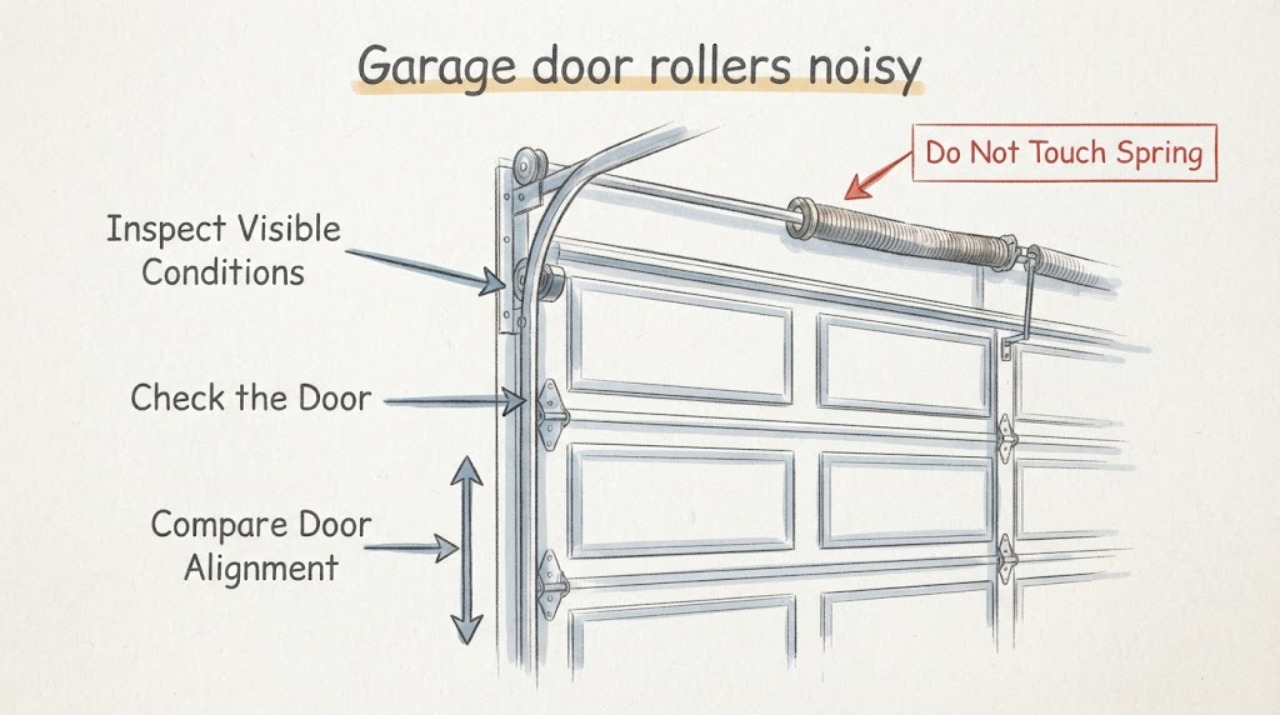
Noisy garage-door rollers are not always a roller failure: the sound may come from a worn or cracked roller, a hinge, track alignment, loose hardware, or the opener. From a safe distance, identify where the sound occurs and whether the door moves smoothly during one normal cycle. Do not touch the rollers, track, springs, cables, brackets, or hinges, and do not adjust travel or apply lubricant during this inspection. Stop using the door and call a qualified garage-door technician for grinding, scraping, jerky or crooked movement, a door off its track, a broken spring or frayed cable, or any noise that is getting worse.
Work through in order
Diagnostic checks
Use only checks that match the exact appliance or system and its official guide.
-
Check 1
With the doorway clear of people, pets, and objects, observe one normal opener cycle from a position outside the door's travel path. If the door is not already operating normally, do not activate it just to test the noise.
Expected result: Note whether the door moves smoothly or becomes jerky, slow, crooked, hesitant, or visibly off track, and whether the sound occurs while opening, closing, or both.
Next step: If movement is smooth, continue with stationary visual checks and record the part of the cycle where the noise occurs. If movement is uneven or unsafe-looking, stop using the door and arrange professional service.
Stop if: Stop the cycle immediately if the door reverses unexpectedly, shifts sideways, leaves the tracks, stalls, drops, or makes a sudden bang. Keep clear and call a technician.
Why this matters
Why: A consistent noise with smooth travel may be a localized roller, hinge, track, or opener issue. Noise paired with binding, uneven movement, or a door that does not stay aligned is a safety and mechanical problem, not a simple sound complaint.
-
Check 2
From a safe distance during that single observation, listen for the sound's location and character: near one side roller, along the track, between door sections, at the opener, or across the entire door. Do not put hands, tools, or a camera near moving parts.
Expected result: A repeating squeak or click at one door section can follow one roller or hinge as it passes. Grinding or scraping along a track can indicate a roller, track, or alignment problem. A hum, chain or belt noise, or sound from the ceiling points more toward the opener.
Next step: Write down the side, section, and part of travel where the sound is loudest, and whether the sound repeats at the same point. Give that observation to the technician rather than trying to reach the suspected part.
Stop if: Stop using the door if the noise is grinding, scraping, suddenly louder, or accompanied by visible contact between parts, a loose component, or debris that could enter the track.
Why this matters
Why: The location narrows the service diagnosis but cannot prove which component has failed. Similar sounds can be produced by worn rollers, hinges, tracks, hardware, or the opener.
-
Check 3
With the door fully stationary and the opener control unused, look from the room side at the visible rollers, hinges, and tracks without touching them or removing guards, covers, or hardware.
Expected result: Look only for a cracked or missing roller, a visibly bent shaft, a roller sitting outside the track, a hinge that appears broken, loose or missing fasteners, a bent or rusty track, or debris obstructing the visible path.
Next step: Take a normal-distance photo if it can be done without reaching into the mechanism. Keep the door stationary and send the photo and the observed noise pattern to a garage-door technician.
Stop if: Do not touch or reposition a roller, hinge, track, spring, cable, bracket, or loose hardware. Stop the inspection if any component looks displaced, broken, under tension, or likely to fall.
Why this matters
Why: A visible damaged roller or hinge may explain the noise, but replacing it can require moving or supporting the door. A roller outside the track, damaged track, or loose structural hardware requires professional assessment.
-
Check 4
Compare the symptom with the door's recent history without performing another test: note whether the noise began suddenly, follows weather or heavy use, appeared after an impact, or is getting progressively louder.
Expected result: A sudden bang, new crooked travel, rapid worsening, or noise after impact raises concern for damage. A gradual squeak with otherwise smooth travel may be maintenance-related, but it still does not identify a safe DIY repair.
Next step: Record when it started, the noise type, the direction of travel, and any visible change. Schedule a technician before normal use if the pattern is new or worsening.
Stop if: Treat a broken spring, frayed cable, door off track, fallen hardware, or a door that is heavy, crooked, or unable to move normally as a stop-use condition. Do not attempt to reset or repair it.
Why this matters
Why: Change over time helps set urgency. Sudden or worsening symptoms can precede a failure of a roller, hinge, track, spring, cable, or opener component.
Use your observations
Decision map
Find the observation that best matches what you see, then follow the next safe action.
-
PATH 01Next step
What you see
The door completes one normal cycle smoothly, and the sound is a repeatable squeak or click near one roller or hinge with no visible damage.
Do this next
Keep the door out of unnecessary use, document the location and timing, and schedule routine garage-door service. Do not lubricate, tighten, or replace the suspected part during this inspection.
-
PATH 02Next step
What you see
The sound is grinding or scraping, the door binds or moves unevenly, or the noise is rapidly worsening.
Do this next
Stop using the door and call a qualified technician. Ask for the rollers, hinges, tracks, hardware, and opener to be checked as a system.
-
PATH 03Next step
What you see
A roller is outside the track, a track is visibly bent, a hinge or fastener is damaged, or the door is crooked or sagging.
Do this next
Do not touch or realign the door. Keep the opening clear, stop operation, and arrange professional repair.
-
PATH 04Next step
What you see
A spring is broken, a cable is frayed or slack, the door drops or stalls, or there was a sudden bang.
Do this next
Treat it as urgent stop-use information. Stay clear of the door and hardware and contact a trained garage-door technician; do not attempt spring, cable, bracket, or roller work.
-
PATH 05Next step
What you see
The sound is clearly from the opener or ceiling while the door itself moves normally.
Do this next
Stop changing opener settings and ask a technician to inspect the opener and door interface. A quiet door does not rule out an opener fault.
Helpful context
Understand the symptom
Why the sound matters
A squeak, rattle, grind, or scrape can come from different parts of an overhead door system. Rollers ride in the tracks, while hinges connect the door sections; a bent or misaligned track, worn roller, loose hardware, or an opener can create similar noises. The safest first step is to map the sound and movement without reaching into the mechanism.
The boundary for a homeowner check
Keep this page to distance observation and visible inspection while the door is stationary. Do not lift the door by hand, disconnect the opener, remove a roller or hinge, loosen track hardware, touch a spring or cable, change travel or force settings, or run repeated cycles. A bottom roller bracket and other door hardware can be under hazardous tension; a technician should handle repair or part replacement.
Only after diagnosis
Potential parts
- garage door rollers
Consider this only after a technician confirms a worn, cracked, noisy, or damaged roller and identifies the correct door system and installation method.
Confirm roller material, stem, bearing arrangement, door weight, and manufacturer fitment; do not choose a roller from appearance alone. - garage door hinge
Consider this only if the noise and visible inspection lead a technician to a bent, cracked, or worn hinge connecting a specific door section.
Hinge location and numbering can vary by door; verify the section, hinge position, and manufacturer specification before ordering. - garage door track lubricant
Consider this only if the door manufacturer or technician specifically identifies lubrication as appropriate for the exact system; this article does not direct the homeowner to apply it during diagnosis.
Use only the product and application method approved for the door and opener system; never use lubrication to mask grinding, misalignment, damaged hardware, or a tension-related fault.
When checks do not resolve it
Need a professional?
Call a qualified garage-door technician for persistent or worsening noise, grinding or scraping, uneven travel, a roller outside the track, visible track or hinge damage, an opener-related sound, a broken spring, a frayed cable, or any door that is heavy, crooked, stalled, or unsafe to operate.
Have this ready
- Provide the door type if known, the sound (squeak, click, rattle, grind, scrape, or bang), the side and section where it is loudest, whether it occurs opening or closing, one-cycle movement observations, photos taken from a safe distance, and when the symptom began.
Common questions
FAQ
Can noisy garage-door rollers be diagnosed without touching the door?
Often the first diagnosis can be narrowed by listening from a safe distance during one normal cycle and looking at stationary, visible parts. Noise location does not prove the failed component, so keep repair and part removal for a qualified technician.
Is a squeak always caused by the rollers?
No. Hinges, tracks, loose hardware, or the opener can create similar sounds. Note where and when the sound occurs instead of assuming the roller is the cause.
Should I keep operating a garage door that is grinding or scraping?
No. Stop using it if the noise is grinding or scraping, the movement is jerky or crooked, a roller is outside the track, or the sound is suddenly worse. Keep clear and call a trained technician.
Can I replace a noisy garage-door roller myself?
Do not remove a roller or bottom roller bracket as a routine homeowner check. Some brackets and related hardware can be under hazardous tension; have a technician identify the part and perform the repair.
Read the exact guide
Official sources
- Garage Door Components - A Complete GuideClopay · Supports the roles of rollers, hinges, and tracks, and the need for professional help with tensioned springs, cables, and damaged or excessively worn components.
- How to Fix Your Noisy Garage Door - Do's & Dont'sClopay · Supports distinguishing squeaks, grinding, rattles, and bangs by likely system area and recognizing conditions that require professional help; this article keeps the public checks observational.
- Maintaining Your Garage DoorThe Genie Company · Supports visual roller inspection, observing whether rollers remain in the track, and the warning to use a professional for bottom roller bracket work under extreme tension.
Community feedback
Share a repair observation
Share a plain-text repair observation. Accepted observations are published automatically; this page may take a moment to update.