
On this page
Start here
Quick answer
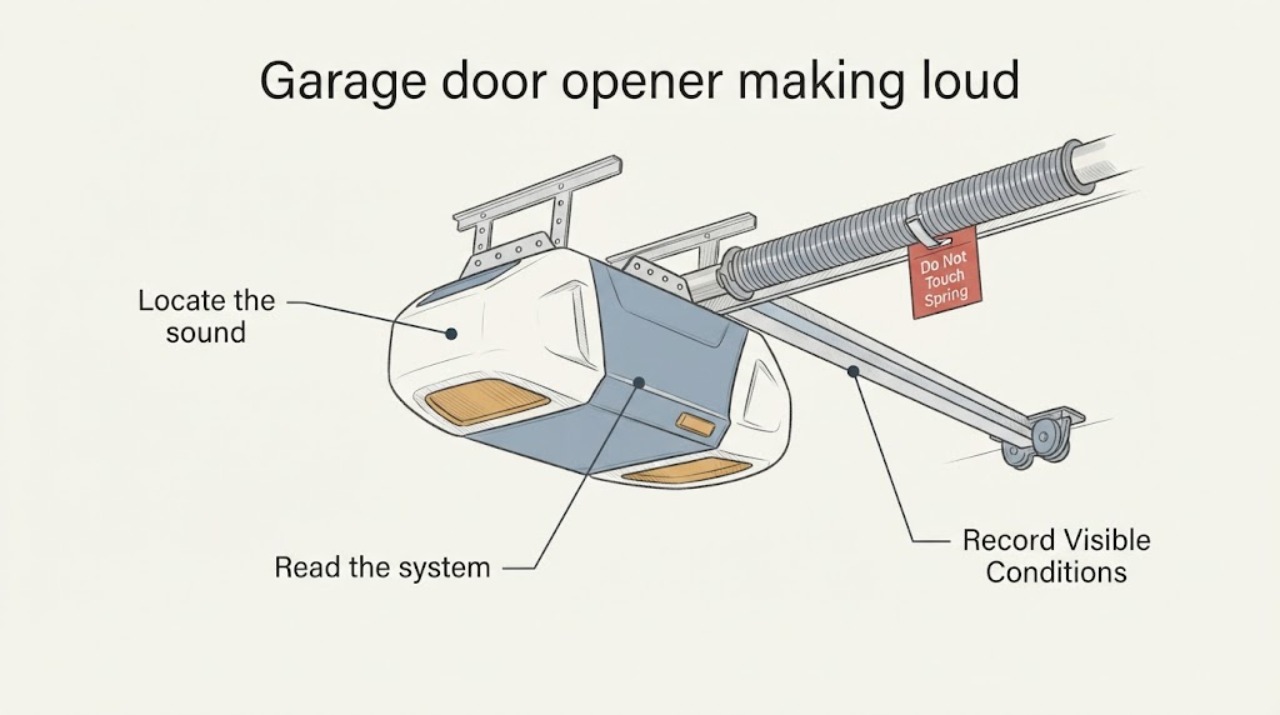
For a Wayne Dalton garage door opener making loud noise, first identify whether the sound comes from the opener, the door's visible track and rollers, or the Wayne Dalton counterbalance area, using only a safe ground-level view. Check the nameplate or manual for an iDrive, TorqueMaster, or TorqueMaster Plus configuration and record whether the door jerks, rubs, reverses, or appears unbalanced. Wayne Dalton's own guidance treats TorqueMaster springs, cables, brackets, and related hardware as trained-technician work and warns against adjusting them. Stop use for grinding, popping, an unbalanced or rapidly moving door, a hanging cable, or unexpected operation; do not open the motor housing, touch springs or cables, climb, or work on energized equipment.
Before you begin
Safety first
- This page is limited to ground-level observation and documentation. A trained door-systems technician should handle springs, cables, counterbalance brackets, balance, track or roller disassembly, opener housing, force settings, wiring, elevated access, and permanent repair.
Work through in order
Diagnostic checks
Use only checks that match the exact appliance or system and its official guide.
-
Locate the sound from the garage floor
With the door area, people, and vehicles clear, observe from the garage floor or outside the closed door. If the door is stable and normally controlled, record one ordinary cycle from a safe distance; otherwise, do not operate it again. Note whether the sound appears to follow the opener housing, visible rail or rollers, door sections, or the Wayne Dalton counterbalance tube and end-bracket area.
Expected result: The sound is localized at the operator, along the visible track or rollers, at the door sections, near the counterbalance area, or cannot be localized safely.
Next step: Record the location, cycle stage, and whether the door moved smoothly, then stop repeated testing and send the notes to garage-door service.
Stop if: Stop immediately for grinding, popping, jerking, rapid movement, a hanging cable, a door that will not remain controlled, or any view requiring a ladder or contact with the mechanism.
Why this matters
Why: A localized sound gives the technician a starting point but does not identify a failed gear, roller, spring, or cable. A counterbalance-area sound or an unlocalizable noise should be treated as a door-system assessment rather than generic opener-part replacement.
-
Read the Wayne Dalton system identity without opening it
From standing level, photograph the visible Wayne Dalton door or operator label and read the model or family name from the exterior, manual, or owner paperwork. Record any reference to iDrive, TorqueMaster, or TorqueMaster Plus, and whether the operator is a drawbar or another visible arrangement; do not remove covers, batteries, brackets, or wiring.
Expected result: The label identifies an iDrive or TorqueMaster-related system, a Wayne Dalton door series with a drawbar operator, a different operator, or no model information is available.
Next step: Send the label photos and the visible operator arrangement to a qualified garage-door technician and ask them to confirm compatibility before quoting a part.
Stop if: Stop if identifying the label requires elevated access, opening the operator, touching springs or cables, or exposing energized wiring.
Why this matters
Why: An iDrive/TorqueMaster combination changes the counterbalance and compatibility questions. Wayne Dalton's official guidance also calls out supplied drawbar brackets and possible top-section reinforcement for its 8000, 8100, 8200, and 9100 door series. Missing identity means no model-specific gear, rail, bracket, or lubricant should be ordered.
-
Record door motion and balance clues visually
From the floor and without disconnecting the opener or handling the door, note whether the door travels smoothly, rubs a jamb, shudders, stalls, reverses, drifts, or appears to rise or fall unevenly. Look only for visible cable slack, a displaced section, a track obstruction, or a door that is not seated; do not perform a manual balance test.
Expected result: The door moves smoothly, the sound occurs while the door is under load, the door jerks or reverses, the door looks uneven or unbalanced, or a cable or section appears displaced.
Next step: Keep the door closed and the area clear when movement is abnormal, and provide the exact motion pattern to a trained technician.
Stop if: Stop and do not operate the door if it is unbalanced, rapidly moving, off its track, supported by a damaged cable, or behaving unexpectedly.
Why this matters
Why: Smooth motion with a localized operator sound may support opener-focused diagnosis. Jerking, reversal, visible cable or section displacement, or apparent imbalance makes the door and counterbalance system part of the service scope; the noise should not be treated as a simple gear or lubricant issue.
-
Compare sound timing without repeated stress
Record whether the noise occurs at start-up, during lifting, at a particular section of travel, at reversal, while closing, or after the door stops. Note recent installation, weather, impact, or service history; do not change force settings, lubricate parts, or repeat cycles to make the noise louder.
Expected result: The sound is present only at start-up, under lifting load, at one travel point, during closing or reversal, after stopping, or on every cycle.
Next step: Keep a short log with model identity and a safe recording if available, then request garage-door service when the sound persists or affects operation.
Stop if: Stop if the noise changes to grinding, cracking, popping, burning, or metal-on-metal impact, or if the door movement becomes abnormal.
Why this matters
Why: Timing helps the technician compare the drive, track, door, and counterbalance paths. A noise tied to a travel point may implicate door or track interaction; a noise under lifting load or with abnormal motion warrants a wider door-system inspection.
-
Choose opener service or full door-system assessment
Combine the sound location, motion clues, Wayne Dalton model or family, operator arrangement, and recent history. Tell the provider whether the noise is isolated to the drive, follows a track or door position, or occurs with counterbalance or balance symptoms.
Expected result: The operator is the only apparent source and the door moves normally, the visible track or rollers are implicated, or the door and counterbalance show abnormal movement or identity-specific compatibility concerns.
Next step: Request a written diagnosis and scope, including whether service, a Wayne Dalton-compatible component, or operator replacement is appropriate.
Stop if: Do not remove the housing, adjust springs or cables, change force settings, or install a generic replacement as a test.
Why this matters
Why: A normal-moving door with an operator-localized noise may support opener diagnosis. Track or door-linked sound needs door hardware inspection. Counterbalance symptoms, abnormal motion, or an iDrive/TorqueMaster or Wayne Dalton drawbar compatibility question require a trained door-systems assessment before any part is selected.
Use your observations
Decision map
Find the observation that best matches what you see, then follow the next safe action.
-
PATH 01Safety boundary
What you see
The sound appears localized at the opener, the door travels smoothly, and no spring, cable, or balance warning is visible.
Do this next
Request opener-focused service with the Wayne Dalton model, drive arrangement, sound timing, and a safe recording if available.
Why this path and its safety boundary
Safety stop: Do not open the motor housing, change force settings, or order a gear from the symptom alone.
-
PATH 02Safety boundary
What you see
The noise follows one section of travel or appears along the visible rail, rollers, hinges, or door sections.
Do this next
Request garage-door hardware inspection and provide the exact travel position and visible rubbing or obstruction.
Why this path and its safety boundary
Safety stop: Do not climb, reach into the track, lubricate inaccessible hardware, or remove rollers or brackets.
-
PATH 03Safety boundary
What you see
The door shudders, reverses, drifts, appears unbalanced, has cable or counterbalance clues, or the Wayne Dalton TorqueMaster system is implicated.
Do this next
Keep the door closed and request a trained door-systems technician for the door and counterbalance assessment.
Why this path and its safety boundary
Safety stop: Do not release, wind, adjust, loosen, or otherwise handle Wayne Dalton springs, cables, end brackets, or related hardware.
-
PATH 04Safety boundary
What you see
The operator or door label is missing, the system may be iDrive or a Wayne Dalton drawbar configuration, or a replacement would need a supplied bracket or reinforcement.
Do this next
Provide the visible identity and door series to a qualified provider and require compatibility confirmation before parts or operator replacement.
Why this path and its safety boundary
Safety stop: Do not use a generic opener, gear, rail, bracket, or lubricant as a trial.
Helpful context
Understand the symptom
Locate the noise before naming a failed part
With people and vehicles clear, observe from the garage floor or outside the closed door. If the door is already jerking, rubbing, hanging, or moving unexpectedly, do not run another cycle. Otherwise, one normal cycle from a safe distance can help record whether the sound follows the opener housing, the visible track and rollers, the door sections, or the Wayne Dalton counterbalance tube and end-bracket area. Location narrows the service request; it does not prove which part has failed.
Wayne Dalton system identity changes the compatibility question
Record the visible brand and model label, operator name, and any reference to iDrive, TorqueMaster, or TorqueMaster Plus from the nameplate, manual, or exterior view. Wayne Dalton's official guide describes TorqueMaster counterbalance hardware and separately discusses iDrive installation with the door system. A drawbar operator on some Wayne Dalton door series may also require the supplied bracket or reinforcement; a generic opener or gear should not be selected from the noise alone.
Use the motion pattern as a safety branch
A smooth door with a sound localized near the drive or visible track is a different service request from a door that shudders, stalls, reverses, drifts, or appears to carry its weight unevenly. The manufacturer states that spring, cable, bracket, and balance work belongs to a trained door-systems technician. Keep the observation at floor level and hand over the pattern, location, and model information rather than trying to release, balance, or adjust the door.
Keep replacement and lubrication model-specific
The correct scope may be opener service, track or roller service, Wayne Dalton counterbalance service, or a compatible operator replacement. The official guide calls for the supplied drawbar bracket and appropriate reinforcement on specified Wayne Dalton door series when that operator type is used, and it distinguishes materials that should and should not be lubricated. Let the provider confirm the exact model, drive arrangement, door series, bracket, and material before a part or lubricant is chosen.
Safety boundary
Stop conditions
- Do not touch, adjust, wind, release, loosen, or replace springs, counterbalance cables, end brackets, or other spring-connected hardware.
- Do not climb, use a ladder, open the operator housing, remove covers or brackets, change force settings, or work on energized wiring.
- Stop use for grinding, popping, burning odor, metal impact, jerking, reversal, a rapidly moving or unbalanced door, a hanging cable, or unexpected operation.
- Do not select a generic gear, rail, bracket, vibration isolator, or lubricant before the Wayne Dalton model, door series, drive arrangement, and cause are confirmed.
Only after diagnosis
Potential parts
- garage door opener gear
Consider only after a qualified technician confirms a gear failure and the exact Wayne Dalton operator model and drive arrangement.
Match the operator model, drive assembly, mounting, and manufacturer guidance; loud noise can originate in the door or counterbalance system instead. - garage door rail lubricant
Consider only after the provider identifies an accessible, compatible surface and confirms that lubrication is appropriate for that Wayne Dalton system.
Do not assume the same product belongs on every rail, roller, bearing, or plastic component; follow the applicable Wayne Dalton guidance. - garage door vibration isolator
Consider only after a technician confirms that vibration transfer at a compatible mounting point, rather than a door or counterbalance fault, is the diagnosed cause.
Confirm operator model, mounting arrangement, door series, bracket, and load requirements before considering this class.
When checks do not resolve it
Need a professional?
Request garage-door service when the loud noise persists, the door is not moving smoothly, a Wayne Dalton iDrive or TorqueMaster configuration is involved, the model or compatibility is unclear, or any spring, cable, bracket, balance, elevated, or electrical work would be required.
Safety scope: This page is limited to ground-level observation and documentation. A trained door-systems technician should handle springs, cables, counterbalance brackets, balance, track or roller disassembly, opener housing, force settings, wiring, elevated access, and permanent repair.
Common questions
FAQ
What is distinctive about a noisy Wayne Dalton opener?
The operator may be paired with a Wayne Dalton iDrive and TorqueMaster or TorqueMaster Plus door system, so noise and abnormal motion can involve the counterbalance and compatibility of the door system, not just a generic opener gear. Identify the visible model and system family before parts are considered.
Can I adjust the Wayne Dalton springs or cables to stop the noise?
No. Wayne Dalton's official guidance warns that springs, counterbalance cables, brackets, and related hardware are under extreme tension and should be handled by a trained door-systems technician. Keep the observation at floor level and request service.
How can I tell whether the opener or the door is making the sound?
From a safe distance, record where the sound appears and whether it follows a particular travel position, lifting load, or door motion. A smooth door with an operator-localized sound differs from noise accompanied by rubbing, jerking, reversal, cable clues, or apparent imbalance; neither pattern proves a part without inspection.
Can I install a generic opener or replacement gear?
Do not use a generic part as a test. Wayne Dalton guidance calls out iDrive and drawbar arrangements, supplied brackets, and possible reinforcement for some door series. A qualified provider should confirm the model, drive arrangement, bracket, and compatibility first.
Read the exact guide
Official sources
- TorqueMaster One Quick Start Guide To TorqueMaster PlusWayne Dalton, a division of Overhead Door Corporation · Supports the brand-specific distinction between TorqueMaster counterbalance hardware and operator arrangements, supplied drawbar brackets and reinforcement considerations, professional spring and cable work, and model-specific maintenance.
- Automatic Residential Garage Door OperatorsUnited States Consumer Product Safety Commission · Provides official safety context for treating an automatic garage-door operator as a regulated safety device and escalating unsafe operation rather than experimenting with controls or repairs.
Community feedback
Share a repair observation
Share a plain-text repair observation. Accepted observations are published automatically; this page may take a moment to update.