
On this page
Start here
Quick answer
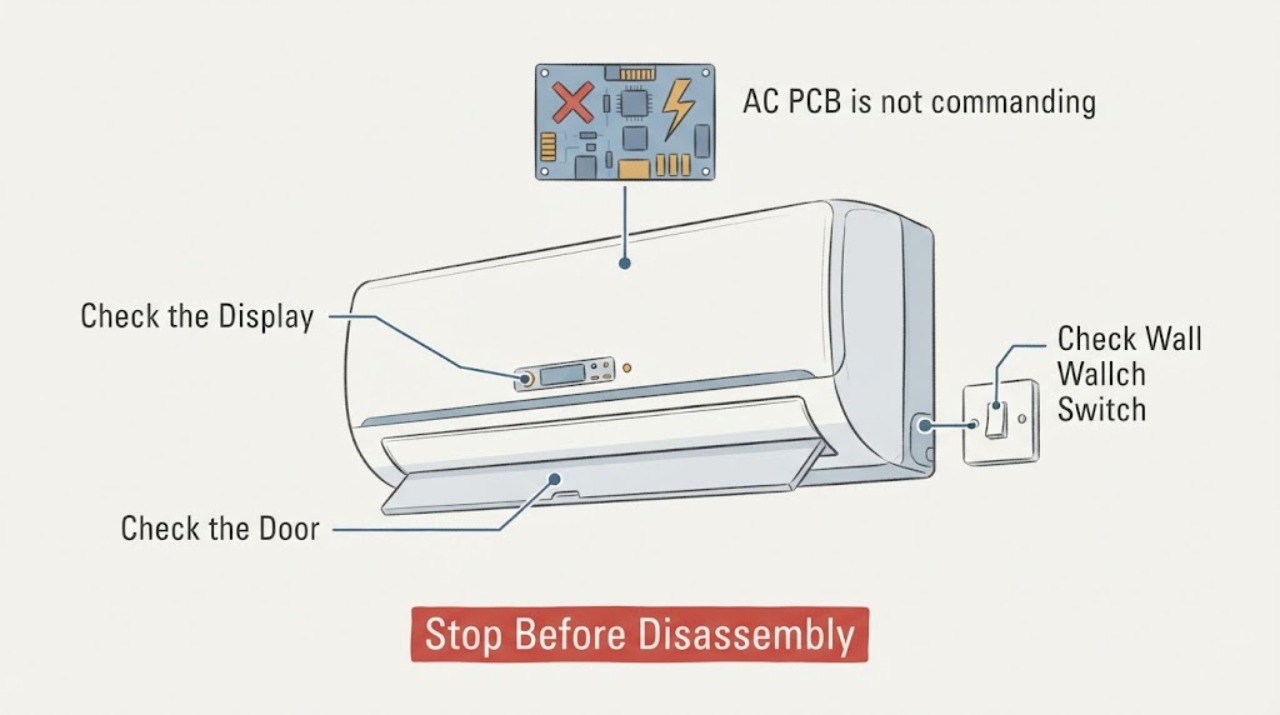
An outdoor compressor that does not start does not prove the PCB is the cause. Before calling it a control-board failure, confirm the thermostat is actually calling for cooling, allow any model-specific anti-short-cycle delay, check for a tripped indoor or outdoor power source without repeatedly resetting it, inspect the filter and visible ice or water, and note whether the indoor fan and outdoor condenser respond. If the outdoor unit is silent or a breaker trips, leave the system off and use a qualified HVAC technician; PCB, contactor, capacitor, refrigerant, safety-switch, and compressor tests are model-specific professional diagnostics.
Work through in order
Diagnostic checks
Use only checks that match the exact appliance or system and its official guide.
-
Check 1
Check the thermostat display and settings without opening the equipment: select COOL, set the target below the room temperature, set the fan to AUTO, and confirm that any battery-powered thermostat has working batteries.
Expected result: The display is blank, the mode is not COOL, the fan is set to ON, or the set point is not below room temperature; alternatively, the thermostat is calling for cooling correctly.
Next step: Correct only the visible settings and allow the equipment's normal delay to pass. If the call is correct but the outdoor unit still does not respond, continue with external checks and do not jumper thermostat wiring.
Why this matters
Why: Trane and Lennox identify thermostat mode, fan setting, battery, and set point as first-line causes of an apparent no-start. A correct call does not by itself prove that the PCB or compressor is bad.
-
Check 2
Note whether the indoor air handler runs and whether the outdoor condenser makes any sound or turns its fan. Look only at accessible equipment status; do not remove covers or touch wiring.
Expected result: The indoor fan runs while the outdoor unit is silent, the outdoor fan runs without normal cooling, or neither section operates.
Next step: Record the two-unit behavior and model number for service. Do not label the PCB as failed from this observation or keep running the indoor fan alone as a workaround.
Why this matters
Why: Lennox says indoor airflow with a silent outdoor unit can indicate an outdoor-unit problem, while the same symptom can arise from power, safety, capacitor, contactor, refrigerant, motor, or compressor conditions.
-
Check 3
Inspect the electrical panel, accessible indoor service switch, and outdoor disconnect only for an obvious OFF or tripped state. Do not repeatedly reset a breaker, and do not remove a disconnect cover.
Expected result: A breaker or service switch is off/tripped, the breaker trips again, or all accessible power controls appear on.
Next step: Leave a repeatedly tripping or uncertain circuit off and call a qualified HVAC professional. If the accessible controls are on, continue with the non-electrical checks; do not open the PCB compartment.
Why this matters
Why: A tripped power device can prevent the compressor from receiving a start command, but repeated tripping indicates an electrical fault rather than a normal reset condition. Trane specifically advises contacting an HVAC professional for a tripped breaker.
-
Check 4
Inspect the return-air filter and the visible indoor coil area for severe blockage or ice, and look for water around the condensate pan or drain area without opening sealed panels.
Expected result: The filter is clogged, ice is visible, or water is present around the drain pan; alternatively, these external conditions look normal.
Next step: Turn the system off if ice or water is present and arrange service; replace only an accessible filter with the model-specified type. Do not scrape ice, add refrigerant, or bypass a float switch.
Why this matters
Why: Carrier and Trane explain that restricted airflow, a frozen coil, or a clogged condensate drain/safety switch can stop or protect the system. These conditions can mimic a missing compressor command and do not identify a PCB fault.
-
Check 5
Find the equipment rating label and exact model, then retrieve its owner and service documentation. Record any display code, thermostat message, compressor hum/click, burning odor, or previous board replacement for the technician.
Expected result: The model-specific manual gives a user-accessible status check, or it provides no safe homeowner test for the compressor command.
Next step: Follow only the exact model's user instructions; otherwise leave the system off and give the recorded observations to a qualified HVAC technician. Do not supply a guessed PCB or compressor part number.
Why this matters
Why: Control-board logic, safety switches, delay timers, and compressor-start circuits differ by model. Carrier says dealers use advanced diagnostics to identify control-board and safety-switch issues.
Use your observations
Decision map
Find the observation that best matches what you see, then follow the next safe action.
-
PATH 01Next step
What you see
The thermostat is not in COOL, the set point is not below room temperature, or the thermostat display is blank.
Do this next
Correct the visible setting or replace thermostat batteries if the model calls for them, then allow the normal delay; if the display remains blank, call service.
Why this path and its safety boundary
Why it matters: There may be no valid cooling call or thermostat power, so the compressor command cannot be evaluated yet.
-
PATH 02Next step
What you see
The thermostat calls for cooling, the indoor fan runs, and the outdoor condenser is silent.
Do this next
Check only accessible power-control positions, then leave the system off and arrange qualified service if the condenser remains silent.
Why this path and its safety boundary
Why it matters: The outdoor section may lack power or may be in a safety lockout or component fault; this observation cannot isolate the PCB.
-
PATH 03Next step
What you see
A breaker is tripped or trips again after an authorized single reset, or a burning smell, exposed wiring, or unusual electrical noise is present.
Do this next
Do not reset again or open the unit; leave power off and contact a qualified HVAC professional.
Why this path and its safety boundary
Why it matters: The symptom points to an electrical or equipment safety concern, not a homeowner PCB adjustment.
-
PATH 04Next step
What you see
Ice, severe filter blockage, or condensate water is visible near the indoor unit.
Do this next
Turn cooling off, replace only the accessible filter if needed, and call service for ice, water, drain, or refrigerant diagnosis.
Why this path and its safety boundary
Why it matters: Airflow, freezing, or a drain safety condition may be stopping the system to protect it; the PCB is not established as the cause.
-
PATH 05Next step
What you see
Thermostat, accessible power, filter, and visible ice/water checks are normal but the compressor still does not start.
Do this next
Stop homeowner diagnosis at this point and have a qualified HVAC technician perform model-specific electrical and refrigeration tests.
Why this path and its safety boundary
Why it matters: A control-board, contactor, capacitor, motor, compressor, wiring, or safety-control fault remains possible, and the evidence is insufficient to choose among them.
Helpful context
Understand the symptom
A missing compressor start is a symptom, not a PCB verdict
The indoor and outdoor sections of a split air conditioner work together. Lennox notes that the indoor fan can run while the outdoor condenser is not operating, and Carrier lists thermostat, power, filter, capacitor, contactor, refrigerant, wiring, motor, and control-board issues among different possibilities. Without the model, wiring diagram, fault history, and instrument readings, a homeowner cannot safely identify the PCB as the failed part.
Stay on the homeowner side of the boundary
The safe checks are thermostat settings, visible system status, filter condition, ice or water, and the position of accessible power controls. Do not remove the electrical panel, probe control-board terminals, jumper thermostat wires, discharge a capacitor, handle refrigerant, or substitute a board. Carrier says its dealers use advanced diagnostics for control-board and safety-switch issues, and Lennox directs homeowners to professional service for significant electrical, compressor, or refrigerant concerns.
When checks do not resolve it
Need a professional?
Stop and call a qualified HVAC professional for a tripped or repeatedly tripping breaker, burning smell, exposed or damaged wiring, visible ice or water, refrigerant concerns, a silent outdoor unit after the external checks, or any need to test the PCB, capacitor, contactor, compressor, safety circuit, or refrigerant circuit.
Common questions
FAQ
Does a silent compressor prove the AC PCB is bad?
No. Official manufacturer guidance lists several possible causes, including power, thermostat, safety, capacitor, contactor, refrigerant, wiring, motor, compressor, and control-board issues. Only model-specific service testing can separate them.
Should I keep resetting the AC breaker to make the compressor start?
No. If the breaker trips again or its state is uncertain, leave the system off and call a qualified professional. Trane warns that a tripped breaker may indicate a serious HVAC issue.
Can I jumper the thermostat wires to test the PCB command?
Do not jumper wires or probe the control board as a homeowner test. Carrier places control-board and safety-switch diagnostics in the dealer's advanced troubleshooting path, and HVAC equipment can contain hazardous voltage.
Read the exact guide
Official sources
- AC Not Turning On? Try ThisTrane · General residential thermostat, power, filter, drain, and freeze checks; exact equipment and safety behavior remain model-specific.
- Outdoor AC unit not turning onLennox · General residential outdoor condenser symptoms, thermostat/power observations, ice/refrigerant/electrical service boundaries; not a model-specific PCB diagnosis.
- AC Unit Not Turning On? Troubleshooting Steps & SolutionsCarrier · General residential AC external troubleshooting and service boundary; model-specific controls and electrical tests remain professional work.
- Common Thermostat Issues and How to TroubleshootCarrier · Thermostat response, delay, filter and service safety guidance; not proof of a particular thermostat or control-board fault.
Community feedback
Share a repair observation
Share a plain-text repair observation. Accepted observations are published automatically; this page may take a moment to update.