
On this page
Start here
Quick answer
Turn the air conditioner off when water appears, using only a dry normal control that you can reach safely. From a dry position, note whether the water is at an indoor air handler, wall-mounted unit, window unit, pan, drain outlet, ceiling, or floor, and whether it appeared during cooling, after shutdown, or after rain. Check only a user-accessible filter and visible airflow or ice clues; do not open panels, disconnect a drain, handle refrigerant, or perform electrical tests. A blocked or overflowing condensate path, damaged pan or pump, filter-related icing, or a level or installation problem can look similar. If water is active or spreading, reaches electrical equipment, damages a ceiling or wall, or the leak returns, keep the unit off and arrange qualified HVAC service. [src-carrier-ac-leak, src-energy-star-room-ac, src-epa-hvac-moisture, src-osha-wet-electrical]
Before you begin
Safety first
- The homeowner portion is limited to normal controls and safe visual observations. A qualified HVAC professional determines the drain, pan, pump, airflow, coil, control, installation, refrigerant, and repair scope; electrical or water-damage professionals handle hazards outside that scope.
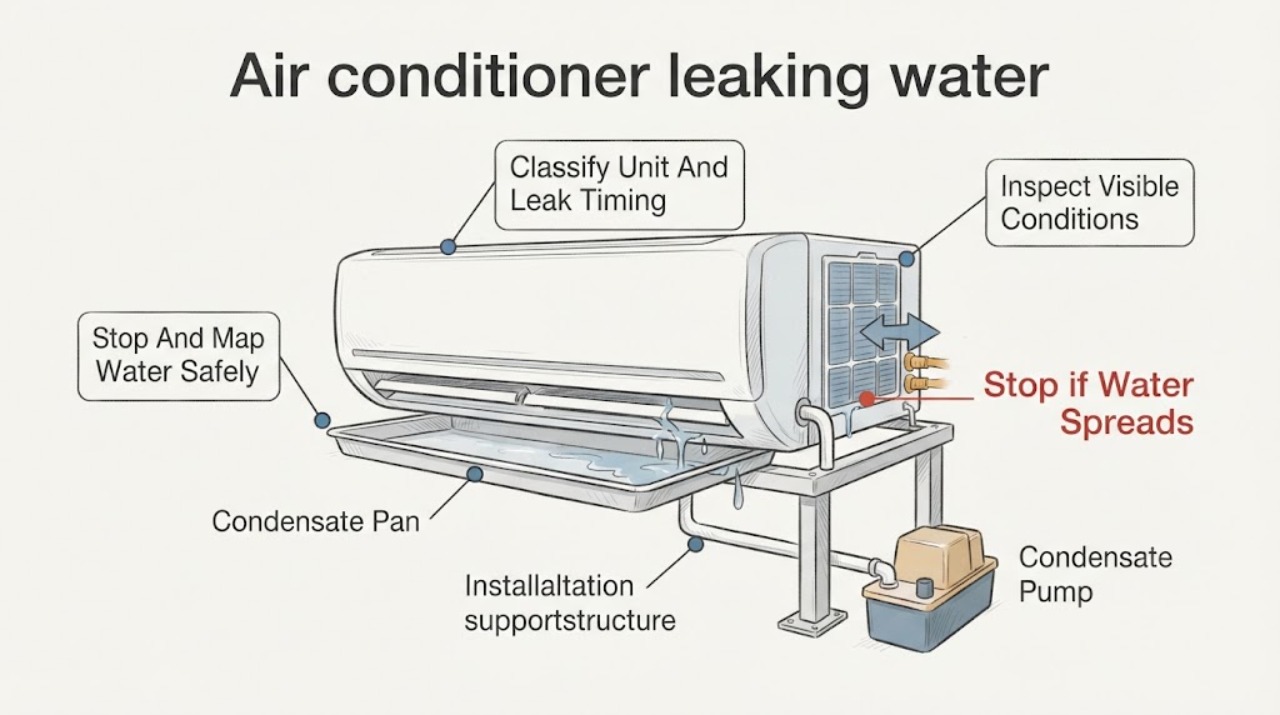
Work through in order
Diagnostic checks
Use only checks that match the exact appliance or system and its official guide.
-
Check 1
From a dry, stable position, turn cooling off through a normal thermostat or unit control if it is dry and reachable, then observe the first visible water location without opening the equipment.
Expected result: Record whether water is a drip, stream, or spreading pool; whether it is below an indoor unit, at a wall or ceiling, around a window unit, or near an outlet, cord, disconnect, furnace, air handler, or other electrical equipment; and whether the ceiling or wall is stained, soft, or bulging.
Next step: Keep cooling off, photograph the location and spread from a safe position, and arrange HVAC service. Add water-mitigation help when drywall, insulation, flooring, or furnishings are becoming wet.
Stop if: Stop immediately for water touching electrical parts, smoke, sparks, a burning odor, an energized wet cord or receptacle, a bulging ceiling, active structural spreading, or any need to stand in water or climb to a wet area.
Why this matters
Why: An indoor puddle can fit a condensate pan or drain problem, while a wall or ceiling mark can represent concealed travel or building damage. Water at electrical equipment is a shock and equipment hazard. Location alone does not identify the failed part.
-
Check 2
Without restarting a leaking system, identify the accessible form factor—central indoor air handler, wall-mounted ductless unit, window or through-wall room unit, or another design—and record when water appears relative to cooling, shutdown, high humidity, or rain.
Expected result: Water may appear during cooling, shortly after shutdown, only on humid days, after rain, or when the unit has been off; the drain route may be visible, hidden, or absent from the safe viewing position.
Next step: Keep a short timeline and photos for the technician. If rain is the trigger, have the exterior installation and water-entry path assessed; if shutdown is the trigger, have the coil, pan, drain, and airflow evaluated without reopening the system yourself.
Stop if: Do not remove a room unit from a window or wall, loosen brackets, reach behind the case, or restart the system solely to reproduce a leak.
Why this matters
Why: Timing helps separate condensate collection or drainage from meltwater, rain entry, or an installation issue, but it is not a diagnosis. A room unit has a different case and drainage arrangement from a central system, so its manual and support design matter.
-
Check 3
From outside the equipment and without disconnecting anything, look for a visible condensate pan edge, drain-pipe joint, secondary pan, pump reservoir, overflow indicator, or drain outlet; do not probe, flush, suction, cut, or pour treatment into the drain.
Expected result: The pan or reservoir may be dry, visibly full, overflowing, cracked-looking, displaced, or inaccessible; the outlet may drip, be dry, be intermittent, or be hidden while indoor water accumulates.
Next step: Photograph only the visible condition and ask an HVAC technician to inspect the complete pan, drain path, pump, overflow protection, and fittings. Keep cooling off while the leak is active or unexplained.
Stop if: Stop for a wet control, a hot or humming pump, a loose or cracked fitting, water inside a cabinet, an outlet requiring a ladder or crawlspace, sewage-like contamination, or any proposed chemical, pressurized-air, or pipe-disconnection test.
Why this matters
Why: A full pan or reservoir with abnormal outlet flow is consistent with a restricted drain, pump problem, or condensate-management fault. A flowing outlet does not rule out a cracked pan or leaking joint, and a dry outlet can also reflect system design or timing.
-
Check 4
With cooling off, inspect only the existing user-accessible filter and visible return or supply openings, and observe exterior frost or ice without touching the coil, tubing, or cabinet interior.
Expected result: The filter may be clean, visibly loaded, wet, damaged, missing, or the wrong size; airflow may be weak at several openings; ice or frost may be visible, melting, or absent.
Next step: Record the filter condition and airflow pattern. Replace a filter only according to the equipment instructions and only with the specified size and type; leave cooling off and request HVAC diagnosis if the filter is wet, airflow is weak, ice is present, or water continues.
Stop if: Do not scrape or chip ice, use a hair dryer, heater, flame, or hot water, open an air-handler panel, touch refrigerant tubing, or keep running the unit to see whether the leak stops.
Why this matters
Why: A restricted filter or airflow path can contribute to an evaporator coil freezing, after which meltwater may overwhelm a pan. A clean filter or absent visible ice does not clear a drain, pan, pump, installation, or concealed coil problem.
-
Check 5
If this is a window or through-wall room air conditioner, inspect from inside and outside only as far as the floor or ground permits whether the unit remains supported and level as required by its own installation instructions, and whether side curtains, seals, or the exterior drainage area show an obvious gap or water path.
Expected result: The case may look level and supported, sag toward the room, have a shifted bracket or seal, show rain entry, or have an exterior drainage path that is blocked or inaccessible; do not infer the correct tilt from appearance alone.
Next step: Keep the unit off and have a qualified installer or HVAC professional verify the model-specific support, level, seals, case drainage, and pan. Do not wedge, tilt, remove, or rehang a heavy room unit as a homeowner test.
Stop if: Stop for a loose bracket, unstable unit, damaged window or wall, falling-object risk, water near the cord or receptacle, or any need to lean out of a window or work from a ladder.
Why this matters
Why: ENERGY STAR says a room air conditioner should be level so its drainage system works effectively. A shifted or poorly supported installation can send water indoors, but a level-looking case does not rule out an internal pan or drain fault.
-
Check 6
Use the location, timing, form factor, pan or outlet observations, filter and airflow clues, and photographs to decide whether the leak is resolved or needs professional diagnosis; do not use repeated restarts as the test.
Expected result: The leak returns, water remains unexplained, ice reappears, the pan or pump overflows, cooling is weak, the unit is unstable, or any safe observation requires opening or disassembling equipment.
Next step: Leave the air conditioner off and schedule qualified HVAC service. Give the provider the unit type and model visible without opening it, water location and timing, photos, filter condition, ice or airflow clues, pan or pump observations, and any ceiling, wall, rain, odor, or electrical concern.
Stop if: Do not add or recover refrigerant, test live voltage, bypass an overflow switch, alter wiring, open a sealed circuit, remove a room unit, or keep operating a leaking system.
Why this matters
Why: Recurrence or an unresolved source points to a drain, pan, pump, airflow, coil, installation, control, or sealed-system condition that cannot be distinguished safely from exterior observations. A part should not be ordered from the symptom alone.
Use your observations
Decision map
Find the observation that best matches what you see, then follow the next safe action.
-
PATH 01Safety boundary
What you see
Water is touching electrical equipment, active pooling is spreading, a ceiling or wall is bulging or wet, or smoke, sparks, heat, or a burning odor is present.
Do this next
Keep people and pets clear. Leave cooling off only through a dry control that can be reached without entering water or touching the hazard, then request urgent HVAC, electrical, and/or water-mitigation help as appropriate.
Why this path and its safety boundary
Safety stop: Do not touch wet equipment, cords, plugs, switches, or breakers; do not stand in water or use powered cleanup equipment in the wet area.
-
PATH 02Safety boundary
What you see
A visible condensate pan or pump reservoir is full or overflowing, the outlet is dry or abnormal while indoor water is present, or a drain joint appears damaged.
Do this next
Keep cooling off and call an HVAC professional to inspect the complete condensate path, pan, pump, overflow protection, and routing.
Why this path and its safety boundary
Safety stop: Do not disconnect, flush, snake, suction, cut, pressurize, or chemically treat the drain, and do not reset or defeat a safety switch.
-
PATH 03Safety boundary
What you see
Ice or frost is visible, water appears as cooling stops, airflow is weak, or the filter is wet or heavily loaded.
Do this next
Leave cooling off, check only the accessible filter as described above, and arrange HVAC diagnosis of airflow, coil, condensate, and any sealed-system cause.
Why this path and its safety boundary
Safety stop: Do not scrape ice, apply heat, open the cabinet, handle refrigerant, or restart the system while ice or active overflow remains.
-
PATH 04Safety boundary
What you see
A window or through-wall unit is sagging, its support or seal has shifted, rain enters around the case, or the unit's drainage arrangement does not match its instructions.
Do this next
Keep the unit off and have a qualified installer or HVAC professional verify level, support, seals, pan, and model-specific drainage before use.
Why this path and its safety boundary
Safety stop: Do not wedge, tilt, remove, rehang, or reach outside a window to adjust the unit.
-
PATH 05Safety boundary
What you see
The source is hidden, the leak returns after the area dries, cooling is abnormal, or safe observations do not explain the water.
Do this next
Keep the air conditioner off and arrange qualified HVAC service; include the timeline, photos, form factor, filter and airflow observations, and any water-damage details.
Why this path and its safety boundary
Safety stop: Do not keep restarting the unit, order a pan or pump without confirmation, or open panels to continue the diagnosis.
Helpful context
Understand the symptom
Water from an air conditioner is a routing problem until proven otherwise
Cooling removes moisture from indoor air. In a central or ductless system, that condensate should collect in a pan and leave through a designed drain; in a room unit, the case and drainage arrangement depend on the model and its installation. A blocked drain, full or damaged pan, pump problem, melting ice, or installation issue can all put water where it does not belong. The first useful distinction is the unit type, leak location, and timing—not a guess at a failed part. [src-carrier-ac-leak, src-epa-hvac-moisture]
Separate drainage clues from an icing clue
A clean-looking filter does not prove that a drain or pan is healthy, and water after shutdown can be retained condensate or meltwater from ice. A visibly dirty filter or weak airflow can contribute to icing on some systems, while a pan edge, drain outlet, pump reservoir, or window-unit installation can point to a different path. Keep the system off while an active leak, ice, or electrical exposure is present. [src-carrier-ac-leak, src-epa-hvac-moisture]
Protect the building and the person checking it
Move belongings only from a dry, stable area and dry accessible building surfaces promptly if doing so does not bring you near the equipment. Do not operate a powered vacuum, fan, or other electrical device in a wet electrical area. EPA identifies standing water and wet insulation near cooling components as conditions needing prompt attention; OSHA warns that water can create a shock path around energized equipment. [src-epa-hvac-moisture, src-osha-wet-electrical]
Only after diagnosis
Potential parts
- replacement air filter
Consider this only when the existing user-accessible filter is visibly dirty, damaged, wet, missing, or the wrong size and the equipment instructions call for replacement. A filter cannot repair a drain, pan, pump, installation, or sealed-system problem.
Match the exact dimensions, type, airflow direction, and manufacturer instructions; do not choose a more restrictive filter or use replacement as a reason to run a leaking or iced system. - HVAC condensate drain pan
Consider this category only after a qualified HVAC technician confirms that a cracked, corroded, displaced, or incorrectly fitted pan is the leak source.
Confirm the exact equipment model, pan orientation, dimensions, drain-port arrangement, and overflow provisions before ordering; do not open the cabinet to measure it. - condensate pump
Consider this category only when the system is designed to use a condensate pump and a qualified technician confirms pump failure or an incompatible installation after checking the pan and drain path.
Match the pump capacity, reservoir, safety-switch wiring, discharge routing, and manufacturer requirements; do not bypass a safety switch or replace a pump without isolating the electrical and water hazards.
When checks do not resolve it
Need a professional?
Safety scope: The homeowner portion is limited to normal controls and safe visual observations. A qualified HVAC professional determines the drain, pan, pump, airflow, coil, control, installation, refrigerant, and repair scope; electrical or water-damage professionals handle hazards outside that scope.
Common questions
FAQ
Should I keep running an air conditioner that is leaking water?
No. Turn cooling off through a dry, normal control if safe and keep it off while the source is assessed. Continued operation can add water or worsen a drain, pan, pump, airflow, installation, or frozen-coil problem. [src-carrier-ac-leak, src-epa-hvac-moisture]
Why does an air conditioner leak after it turns off?
Water after shutdown can be consistent with ice melting or condensate retained by a restricted drain or pan, but timing alone cannot identify the cause. Record the timing, leave cooling off, and arrange HVAC diagnosis if the water continues or returns. [src-carrier-ac-leak]
Can a dirty filter cause an air conditioner to leak?
A restricted filter can reduce airflow and contribute to coil icing on some systems; when ice melts, water can overwhelm the condensate path. Check only the accessible filter, follow the equipment instructions for replacement, and do not keep operating the unit while it is leaking or iced. [src-carrier-ac-leak]
Why is my window air conditioner leaking into the room?
A shifted or improperly supported installation, a drainage or pan problem, rain entry, or another internal fault can send water indoors. ENERGY STAR advises keeping a room unit level so its drainage system works effectively. Keep the unit off and have a qualified installer or HVAC professional check the support, seals, pan, and model-specific drainage. [src-energy-star-room-ac]
Can I pour vinegar or drain cleaner into the AC condensate line?
Do not pour chemicals into an unknown, blocked, hidden, or active-leak drain. A professional should confirm the system design and choose any clearing or treatment method; chemicals cannot repair a cracked pan, failed pump, frozen coil, installation problem, or concealed leak. [src-carrier-ac-leak, src-epa-hvac-moisture]
When is an AC water leak an emergency?
Treat it as urgent when water is active or spreading, damaging a ceiling, wall, floor, or insulation, reaching electrical equipment, or accompanied by smoke, sparks, heat, burning odor, or exposed wiring. Keep clear and request appropriate HVAC, electrical, and water-mitigation help. [src-epa-hvac-moisture, src-osha-wet-electrical]
Read the exact guide
Official sources
- Why Is My AC Leaking Water?Carrier · General residential air-conditioner guidance; exact drain access and component design vary by system and model.
- Should You Have the Air Ducts in Your Home Cleaned?U.S. Environmental Protection Agency · General indoor HVAC moisture guidance; it is not a model-specific repair procedure or a recommendation for duct cleaning.
- Room Air ConditionersENERGY STAR · Room and window air-conditioner installation context; it does not replace the exact model installation instructions or authorize unsafe lifting or electrical work.
- eTool: Construction - Electrical Incidents - Power ToolsOccupational Safety and Health Administration · General electrical safety around damp or wet areas; used only for the stop boundary, not for HVAC repair instructions.
Community feedback
Share a repair observation
Share a plain-text repair observation. Accepted observations are published automatically; this page may take a moment to update.