
On this page
Start here
Quick answer
A short drip after cooling can be meltwater from ice on the evaporator coil, but water that keeps appearing or returns while the air conditioner is off needs attention. A backed-up condensate drain or pan, a thawing coil, and an outside water source are different possibilities. Keep the system off, identify the first wet point from a dry position, and arrange HVAC service before running it again. Do not open the cabinet or perform a live electrical check.
Work through in order
Diagnostic checks
Use only checks that match the exact appliance or system and its official guide.
-
Check 1
Leave the air conditioner off and look from a dry, stable position for active flow, water near the indoor unit, an outlet, wiring, disconnect, or a ceiling surface.
Expected result: The water is spreading quickly, the ceiling is bulging, or water has reached electrical equipment; otherwise the area is contained and the equipment remains dry.
Next step: For active damage or electrical contact, stay clear and call emergency property help plus a qualified electrician or HVAC professional. If contained, continue without restoring power.
Why this matters
Why: Rapid spread or water near electrical equipment is an immediate property and shock risk. A contained, dry area allows only non-invasive observation.
-
Check 2
Without restarting the system, place an absorbent towel or container where it can be reached safely and note whether the drip stops or returns while the unit remains off.
Expected result: A small amount stops and does not return, or water continues or reappears after the system has been off.
Next step: If it stops, document the time and arrange service before the next cooling cycle if the event was unusual. If it returns, go to the first-wet-point check and keep the system off.
Why this matters
Why: A brief, one-time drip can be residual moisture. Continued or renewed water points toward a drain or pan problem, thawing ice, or an external source rather than normal operation alone.
-
Check 3
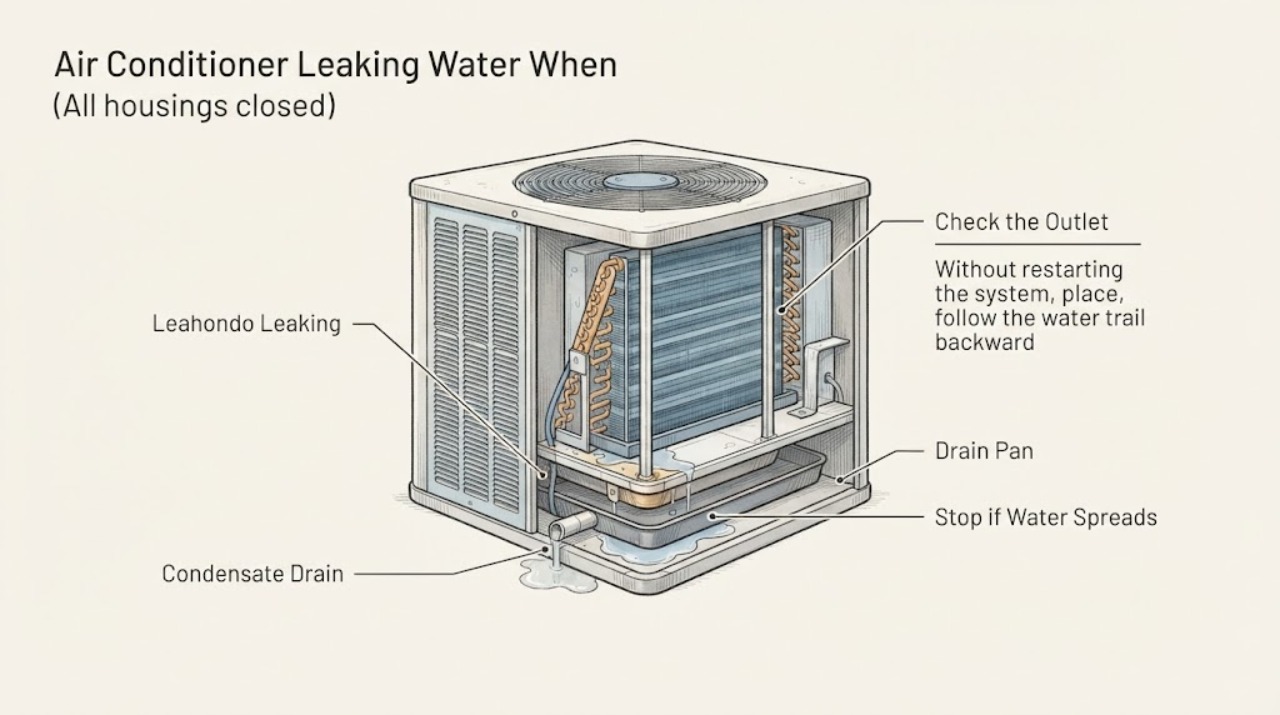
From outside the cabinet, follow the water trail backward with a dry tissue or visual inspection; check the floor, wall, ceiling, accessible drain-pan edge, and the visible condensate-line termination without removing panels.
Expected result: The first wet point is at the indoor unit or drain route, or the trail begins at a wall, ceiling, window, roof area, pipe, or another appliance.
Next step: Photograph the first wet point and keep the area protected. Have HVAC service inspect an indoor-unit route; have the appropriate building, plumbing, or roofing professional assess a separate source.
Why this matters
Why: A first wet point at the unit supports a condensate pan or drain investigation. A first wet point elsewhere makes an outside water source or building leak more likely.
-
Check 4
Review what happened before shutdown without operating the unit: recent cooling, reduced airflow, a dirty filter, frost or ice previously visible, unusual humidity, rain, or a recent drain problem.
Expected result: There was recent cooling with weak airflow or visible ice, or the water appears after rain or is unrelated to a cooling cycle.
Next step: Tell the technician the sequence and do not scrape ice, open the coil compartment, or make a refrigerant adjustment. If weather or another appliance matches the timing, route that inspection separately.
Why this matters
Why: Recent cooling plus ice makes thawing coil water plausible; restricted airflow can contribute to coil icing. A rain-linked or cycle-independent trail favors an external source. A drain history raises concern for blockage or backflow.
-
Check 5
Only if the condensate outlet and line termination are plainly accessible without a ladder or disassembly, look for a disconnected end, visible kinking, standing water, or water backing up at the termination.
Expected result: The line is visibly disconnected, kinked, blocked at the opening, or backing up; or no problem is visible from the safe external view.
Next step: Do not force the line, use compressed air or chemicals, or open the unit. Photograph the finding and ask HVAC service to clear, test, and inspect the complete drain and pan safely.
Why this matters
Why: A visible drain-path defect can explain water returning while off, but an unseen blockage, trap, pan crack, pump, or installation issue can look normal from outside.
-
Check 6
Prepare a service handoff with the equipment type (window, portable, ductless, split, or central), model if visible without disturbing anything, time since shutdown, amount and color of water, first wet point, ice history, weather, and any ceiling or wall damage.
Expected result: The record identifies a unit-side condensate pattern, a likely external source, or an urgent hidden-damage concern.
Next step: Request HVAC condensate-leak diagnosis and keep the air conditioner off until the leak source and any water-damaged electrical equipment have been evaluated.
Why this matters
Why: A clear sequence helps the professional distinguish residual condensate, drain backflow, thawing ice, pan or line damage, and unrelated building water without a risky test run.
Use your observations
Decision map
Find the observation that best matches what you see, then follow the next safe action.
-
PATH 01Next step
What you see
Water stops and does not return while the air conditioner remains off.
Do this next
Document it, keep the system off if there was pooling or damage, and arrange HVAC inspection before relying on cooling again.
Why this path and its safety boundary
Why it matters: Residual moisture is possible, but an unusual event can still indicate an earlier icing or drainage problem.
-
PATH 02Next step
What you see
Dripping continues or restarts without a new cooling cycle.
Do this next
Keep the system off, identify the first wet point without opening the unit, and schedule HVAC service; route a separate building source to the appropriate professional.
Why this path and its safety boundary
Why it matters: Backflow, a full or damaged pan, thawing coil ice, or an outside water source is more likely than ordinary active condensation.
-
PATH 03Next step
What you see
The first wet point is at the pan, drain route, or indoor air handler, or water visibly backs up at the line termination.
Do this next
Do not force-clean or disassemble the path; have an HVAC professional inspect and clear the drain, pan, coil, and any safety switch.
Why this path and its safety boundary
Why it matters: A condensate drainage or pan problem is supported, with ice melt and airflow history still relevant.
-
PATH 04Next step
What you see
The trail starts at a wall, ceiling, window, roof, pipe, or another appliance instead of the air conditioner.
Do this next
Keep water away from electrical equipment and arrange the relevant building, plumbing, or roofing assessment; tell HVAC service what was ruled out.
Why this path and its safety boundary
Why it matters: The air conditioner may be unaffected, and treating a building leak as a condensate clog could delay the right repair.
Helpful context
Understand the symptom
Why water can appear after shutdown
Cooling normally creates condensation at the indoor coil. That water should enter the drain pan and leave through the condensate line. A brief drip after a cooling cycle may be stored water finishing its path. Continued or renewed water while the system is off is more consistent with meltwater from an iced coil, a drain path that is backing up, a pan or line defect, or water that is not from the air conditioner at all. The timing alone cannot identify the cause.
What not to do
Do not restart the system just to see whether the leak returns. Do not remove access panels, reach into a wet air handler, pour chemicals into an unknown drain, force a blockage, or handle refrigerant. If the water has reached wiring, an outlet, a disconnect, or a ceiling with active damage, keep clear and use qualified help.
Use the result to choose the next step
The useful distinction is whether the water stops as residual moisture, comes back from the condensate path, follows visible ice melt, or tracks from the wall, ceiling, window, roof, or another appliance. Record the evidence without disturbing the equipment; an HVAC technician can then inspect the pan, drain, airflow, coil, and installation safely.
Safety boundary
Stop conditions
- Stop all inspection if water reaches wiring, an outlet, a disconnect, or other electrical equipment; do not touch wet equipment or restore power until qualified professionals evaluate it.
- Stop and seek urgent property help for fast-flowing water, a bulging ceiling, active drywall damage, sewage-like water, smoke, burning odor, arcing, or a tripped circuit.
- Do not restart the air conditioner to test it, open covers, enter a crawlspace or attic unsafely, scrape coil ice, handle refrigerant, force a drain blockage, or use chemicals or compressed air in an unknown line.
Only after diagnosis
Potential parts
- condensate drain line or drain pan
Consider a replacement only if an HVAC inspection confirms a cracked pan, failed line, or an installation-specific drainage defect.
Confirm the equipment model, configuration, dimensions, and manufacturer fit information before ordering any part.
When checks do not resolve it
Need a professional?
Call an HVAC professional before using the system again if water continues or returns while off, the first wet point is inside or near the air handler, there was ice or weak airflow, the pan or drain is damaged, or the source cannot be identified. Use a qualified electrician for water-damaged electrical equipment and the relevant building professional for a wall, ceiling, roof, window, or plumbing source.
Common questions
FAQ
Why does an air conditioner leak water after it is turned off?
Meltwater from an iced evaporator coil can appear after shutdown, and a blocked drain or damaged pan can let it overflow. Continued or returning water should be investigated before the system is used again.
Should I turn the air conditioner back on to test the leak?
No. Keep it off while you document the first wet point and arrange service. A test run can add condensate or worsen water damage, and water near electrical equipment is unsafe.
What if the water is coming from the ceiling or wall?
Treat it as a possible hidden building or HVAC leak, keep clear of wet electrical equipment, and arrange the appropriate HVAC and building professional. A bulging ceiling or fast-spreading water needs urgent property help.
Read the exact guide
Official sources
- Why Is My AC Leaking Water?Carrier · General residential AC condensate and water-leak mechanisms; exact equipment behavior depends on model and installation.
- Water-Damaged Electrical EquipmentElectrical Safety Foundation International · General household electrical safety when water contacts equipment; not an HVAC repair procedure.
- Is Your AC Unit Leaking Water?Lennox · General residential AC moisture and leak causes; do not infer model-specific parts or procedures.
- AC Condensate Drain Line Clogged? Learn What You Can DoTrane · General split-system and heat-pump condensate drainage explanation; visible layout varies by installation.
- Emergency HVAC Repair | 24/7 Emergency Heating & Cooling GuideCarrier · General residential HVAC emergency triage; local emergency procedures and equipment access vary.
Community feedback
Share a repair observation
Share a plain-text repair observation. Accepted observations are published automatically; this page may take a moment to update.