
On this page
Start here
Quick answer
Stop cooling first and keep water away from electrical equipment. Water around an evaporator coil is commonly condensation that is not draining, or ice on the coil that is melting after restricted airflow or another cooling fault. From outside the equipment, identify whether the water is at the indoor unit, drain outlet, ceiling, wall, or a separate source; look only for visible ice, a wet filter, a full or overflowing drain pan, or a blocked-looking external drain path. Do not open the air-handler cabinet, touch the coil or wiring, chip ice, use hot water or flame to thaw it, open a refrigerant circuit, or run the system to see if the leak worsens. Stop immediately for water near electrical parts, a bulging ceiling, mold or sewage, heavy continuous flow, smoke, burning odor, or a trip, and call an HVAC professional.
Before you begin
Safety first
- An HVAC professional should assess the evaporator coil, airflow, drain pan and line, pump or float protection, fan, and refrigerant circuit as appropriate; coil, refrigerant, electrical, and cabinet work are not user repairs.
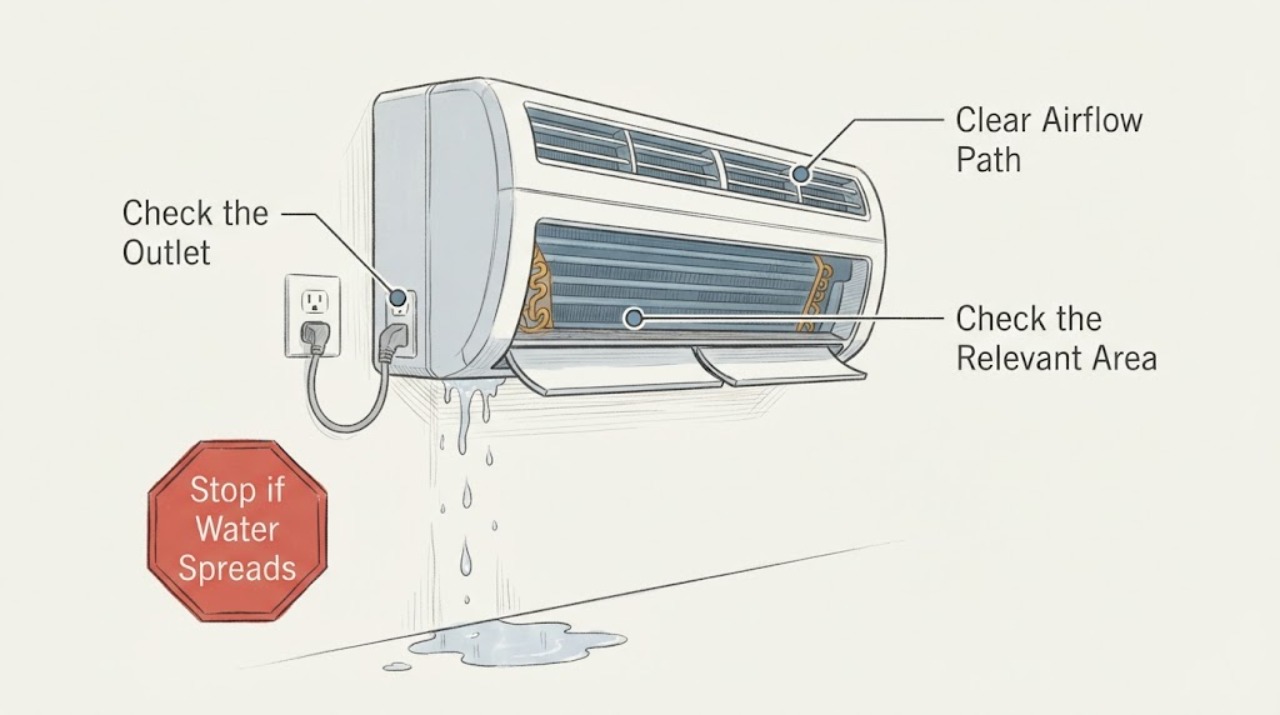
Work through in order
Diagnostic checks
Use only checks that match the exact appliance or system and its official guide.
-
Check 1
Turn the cooling function off at the thermostat and keep people away from the water. From a dry, safe position, note whether water is near an outlet, disconnect, air handler, furnace, ceiling fixture, or other electrical equipment; do not touch wet equipment or walk through standing water.
Expected result: Water near electrical equipment, a wet ceiling, an active large flow, or a leak that continues rapidly is an immediate stop condition; a small dry-area drip still requires prompt diagnosis.
Next step: If water contacts electrical equipment, the ceiling bulges, smoke or burning odor appears, or a breaker trips, leave the hazard area and use emergency or qualified help from a safe location. Do not restart cooling.
Why this matters
Why: Stopping cooling limits additional condensate and prevents a frozen coil from continuing to generate meltwater, while electrical and structural hazards determine whether anyone can safely approach.
-
Check 2
Trace the first visible wet point without opening the cabinet: below the indoor air handler, at a visible condensate drain outlet, around a drain pan edge, on a refrigerant line, at a duct or vent, near the outdoor unit, or away from the air conditioner entirely.
Expected result: Water below the indoor unit or at a drain outlet supports a condensate path issue; water on a line or after a cooling shutdown can follow a frozen-coil thaw; water from a ceiling, wall, roof, plumbing line, or outdoor weather source may not be AC condensate.
Next step: Photograph the first wet point from a safe position and stop if tracing requires a ladder, wet-area access, cabinet removal, or contact with the coil or wiring. Arrange HVAC or building-water service according to the observed source.
Why this matters
Why: Location separates coil and drain hypotheses from building, plumbing, rain, or unrelated equipment sources; a visible drip location may be downstream from the actual source.
-
Check 3
Look through normal user-access openings only for frost or ice, unusually weak airflow, a damp filter, or water appearing after the system has been off. Do not remove an access cover, touch the coil, chip ice, pour hot water, use a flame, or run the compressor to accelerate thawing.
Expected result: Ice or frost followed by water after shutdown supports a frozen-coil branch; weak airflow and a dirty filter can contribute, but low refrigerant and internal coil conditions cannot be confirmed visually.
Next step: Keep cooling off and arrange HVAC service for visible ice, repeated freezing, warm supply air, or water that returns after thawing. Only change a filter if it is a normal, dry, user-accessible filter and the equipment manual permits it.
Why this matters
Why: A frozen evaporator coil can release water as it thaws and can be damaged by continued operation; coil and refrigerant diagnosis belongs to HVAC service.
-
Check 4
Inspect only the visible external filter and return-air area when everything is dry and safe. Note whether the filter is heavily loaded, missing, wet, or the wrong type, and record the model instructions before handling it; do not reach into the air handler or remove coil panels.
Expected result: A dirty or blocked filter can restrict airflow and is associated with coil icing; a clean filter does not rule out a drain, pan, airflow, fan, or refrigerant fault.
Next step: Replace only with the model-approved filter if it is a routine user step and the area is dry. Keep cooling off and call HVAC service if the filter is wet, icing returns, airflow remains weak, or water persists.
Why this matters
Why: Filter condition is a limited maintenance clue, not proof that the evaporator coil or refrigerant circuit is the cause of the leak.
-
Check 5
From outside the equipment, check whether a visible condensate drain outlet is producing water, blocked by debris, disconnected, or overflowing, without inserting tools or flushing the line. Do not open the drain pan, use chemicals, blow into tubing, or dismantle a pump or trap.
Expected result: No flow at a visible drain outlet with water at the indoor unit can indicate a blocked or misrouted condensate path; water at the outlet with a separate indoor leak can indicate a pan, slope, overflow, or downstream issue.
Next step: Stop for active overflow, sewage or mold, a ceiling leak, or water near electrical parts. Arrange HVAC service for a concealed drain, pan, pump, or float issue rather than forcing a blockage clear.
Why this matters
Why: Condensate must be carried away from the cooling coil and air handler; an external observation cannot establish the condition of hidden tubing, pan, pump, or float protection.
-
Check 6
Compare the water timing with operation: only during cooling, for a while after shutdown, after a long run, after a filter change, or during rain or unrelated plumbing use. Note whether the system was cooling normally, had weak airflow, or was blowing warm air.
Expected result: Water after shutdown with prior ice supports thawing; water during normal cooling supports condensate drainage or pan investigation; water during rain or plumbing use points away from the evaporator coil.
Next step: Keep cooling off until the source is resolved. Give the timing and airflow or cooling changes to the HVAC professional or, for a non-AC source, the appropriate building-water professional.
Why this matters
Why: Timing connects the leak to condensation, icing, drainage, weather, or another building source without requiring a cabinet or refrigerant inspection.
-
Check 7
Record the equipment type, model if visible without moving it, thermostat setting, first wet point, water amount and color, ice or airflow clues, filter state, drain-outlet behavior, ceiling or wall condition, and any electrical or odor symptom. Do not restore cooling to collect more evidence.
Expected result: A complete record that distinguishes clean condensate from dirty or foul water, intermittent drips from active overflow, and ice from a non-AC leak gives service a usable starting point.
Next step: Arrange HVAC service for coil, freezing, condensate, or refrigerant clues and protect the building from water damage without entering unsafe areas. Keep the system off until cleared.
Why this matters
Why: Water alone cannot identify a failed evaporator coil, pan, drain, fan, filter, or refrigerant condition; professional diagnosis prevents unsafe component guesses.
Use your observations
Decision map
Find the observation that best matches what you see, then follow the next safe action.
-
PATH 01Next step
What you see
Water is near electrical equipment, a ceiling is bulging, the flow is heavy, or smoke, burning odor, or a trip is present.
Do this next
Leave the hazard area, keep others away, and use emergency or qualified help from a safe location. Do not restart cooling or touch wet equipment.
Why this path and its safety boundary
Why it matters: Treat the event as an immediate safety and property-protection stop condition.
-
PATH 02Next step
What you see
Visible ice or frost appears on the indoor coil or refrigerant tubing, or water arrives after cooling stops.
Do this next
Only perform a routine dry filter change if the manual permits it; do not chip ice, heat the coil, touch tubing, or investigate refrigerant.
Why this path and its safety boundary
Why it matters: Keep cooling off and treat a frozen evaporator coil as a professional HVAC branch.
-
PATH 03Next step
What you see
Water is below the indoor unit or at a visible condensate outlet, with no ice visible.
Do this next
Keep cooling off and arrange HVAC service; do not flush, probe, chemically treat, or dismantle the drain path.
Why this path and its safety boundary
Why it matters: Suspect the condensate drain, pan, pump, overflow, or installation path, while recognizing that hidden parts are not externally diagnosable.
-
PATH 04Next step
What you see
The first wet point is at a ceiling, wall, roof, plumbing line, outdoor weather path, or unrelated appliance.
Do this next
Keep cooling off until the water path is safe and contact the appropriate HVAC, plumbing, roofing, or building professional based on the observed source.
Why this path and its safety boundary
Why it matters: Do not assume the evaporator coil caused the water.
-
PATH 05Next step
What you see
The filter is heavily loaded or wet, airflow is weak, cooling is poor, or freezing returns after a routine filter change.
Do this next
Keep cooling off for visible icing or recurring water and arrange HVAC service for airflow, fan, coil, drain, or refrigerant assessment.
Why this path and its safety boundary
Why it matters: A restricted-airflow or deeper cooling fault remains possible; a filter observation does not prove the cause.
-
PATH 06Next step
What you see
There is no visible ice, the drain appears to flow, and water occurs only during rain or another household-water event.
Do this next
Keep the area dry and have the observed wall, ceiling, roof, plumbing, or weather path evaluated; do not reopen the AC cabinet to search for a cause.
Why this path and its safety boundary
Why it matters: The leak may be unrelated to the evaporator coil or condensate system.
Helpful context
Understand the symptom
Evaporator-coil water is usually a condensate-management problem, not a water supply leak. Humid air gives up moisture at the cold coil; that water should collect and drain away. A frozen coil creates a second pattern: ice melts after cooling stops and can release more water than the drain path handles. The first wet point and the timing after shutdown are more useful than the size of the puddle.
This guide stays at the thermostat and safe external observations. Central systems, heat pumps, ductless units, window units, and packaged equipment place the coil and drain components differently. The model instructions and a qualified HVAC professional decide what can be accessed; refrigerant, electrical, coil, and cabinet work are not ordinary-user checks.
Safety boundary
Stop conditions
- Stop cooling and keep clear for water near electrical equipment, standing water, a wet disconnect, a bulging ceiling, or a heavy continuous leak.
- Stop immediately for smoke, burning odor, arcing, a trip, or visible electrical damage; use emergency help from a safe location.
- Stop for visible ice or frost on the evaporator coil or refrigerant tubing; do not run the system, chip ice, use hot water or flame, or touch tubing.
- Do not open the air-handler cabinet, touch the coil or wiring, perform live testing, open a refrigerant circuit, or dismantle a pan, pump, drain, or float.
- Do not flush or probe a concealed drain, use chemicals, move wet equipment, climb to trace a leak, or enter a moldy or sewage-contaminated area.
- Keep the system out of use when water returns after a filter change, airflow is weak, cooling is poor, or the source cannot be identified safely.
Only after diagnosis
Potential parts
- condensate drain pan or drain-line component
Consider only after HVAC service confirms an overflow, crack, blockage, pump, float, or drain-routing fault.
Pan and drain designs vary by equipment type and model; confirm the exact equipment before selecting a component. - air filter or airflow component
Consider a routine filter only when the model permits user replacement; other airflow components belong to professional diagnosis after repeated icing or weak airflow.
Filter size and equipment access are model-specific; do not use a filter change to mask a coil, fan, or refrigerant fault. - evaporator coil, temperature sensor, or refrigerant-system component
Consider only when an HVAC professional confirms a coil, sensor, or sealed-system fault after inspecting airflow and condensate behavior.
Do not open the refrigerant circuit or select a coil from the symptom alone; verify the complete equipment model and approved fit.
When checks do not resolve it
Need a professional?
Any persistent condensate leak, frozen evaporator coil, suspected drain-pan or drain-line issue, refrigerant clue, structural water damage, or electrical or fire warning.
Safety scope: An HVAC professional should assess the evaporator coil, airflow, drain pan and line, pump or float protection, fan, and refrigerant circuit as appropriate; coil, refrigerant, electrical, and cabinet work are not user repairs.
Have this ready
- Equipment type and model, thermostat setting, first wet point, timing relative to cooling and shutdown, water amount and appearance, visible ice, airflow, filter state, drain-outlet behavior, ceiling or wall condition, and any odor or electrical symptom.
Common questions
FAQ
Why is my air conditioner leaking water near the evaporator coil?
Common patterns are condensate that cannot drain, a damaged pan, or ice on the evaporator coil that melts. Stop cooling, trace the first wet point from outside the equipment, and arrange HVAC service rather than opening the cabinet or refrigerant circuit.
Can a frozen evaporator coil cause water after the AC is turned off?
Yes. Ice can melt after cooling stops and release water faster than the drain path handles it. Keep the system off, do not chip or heat the ice, and call an HVAC professional for airflow, coil, drain, and refrigerant assessment.
Can I keep running an AC that is leaking water?
Do not keep running it while the source is unknown. Continued cooling can worsen a frozen-coil or drainage problem and can cause building damage. Water near electrical equipment, a ceiling leak, smoke, or a trip requires immediate stopping and safe escalation.
Is a dirty filter enough to explain water from an AC?
A dirty filter can restrict airflow and contribute to coil icing, but it does not prove the cause. Replace only a routine user-accessible filter when the manual permits it; recurring ice, weak airflow, poor cooling, or continued water needs HVAC service.
What should I tell the HVAC technician about the leak?
Give the equipment type and model, first wet point, timing relative to cooling and shutdown, water amount and appearance, visible ice, airflow, filter state, drain-outlet behavior, wall or ceiling damage, and any electrical, odor, or mold concern.
Read the exact guide
Official sources
- Condensate Capture Potential MapU.S. Department of Energy · Air-conditioning cooling-coil condensation, collection, drainage, and building-damage context
- Troubleshooting an AC Not WorkingCarrier · Manufacturer guidance on frozen evaporator coils, airflow, filters, condensate drainage, and professional refrigerant or electrical boundaries
- Why Is My AC Leaking Water?Carrier · Manufacturer guidance on AC water leaks, condensate drains, drain pans, frozen evaporator coils, filters, and service escalation
Community feedback
Share a repair observation
Share a plain-text repair observation. Accepted observations are published automatically; this page may take a moment to update.