
On this page
Start here
Quick answer
A new or unusually loud hum, buzz, or repeated click from an air conditioner's outdoor unit can involve the contactor, capacitor, fan, compressor, loose hardware, or another electrical or mechanical fault. From a safe position, note whether the sound is indoors or outdoors, whether it occurs at startup, shutdown, or continuously, whether the outdoor fan runs, and whether cooling changes. Check only thermostat settings, the accessible air filter, and the clear space around the outdoor unit. Do not remove the electrical panel, touch the contactor or capacitor, reach through the grille, hand-start a fan, test voltage, or keep resetting a breaker. Shut the system off and arrange HVAC service for a sudden loud noise, persistent buzzing or clicking, a fan that does not run, burning odor, smoke, arcing, a hot electrical connection, refrigerant hissing, ice, or a breaker that trips again.
Before you begin
Safety first
- Keep the system off for smoke, arcing, burning or melting odor, hot electrical parts, water near electrics, ice with abnormal operation, refrigerant hissing, or repeated breaker trips. Do not open the outdoor electrical compartment or perform energized checks.
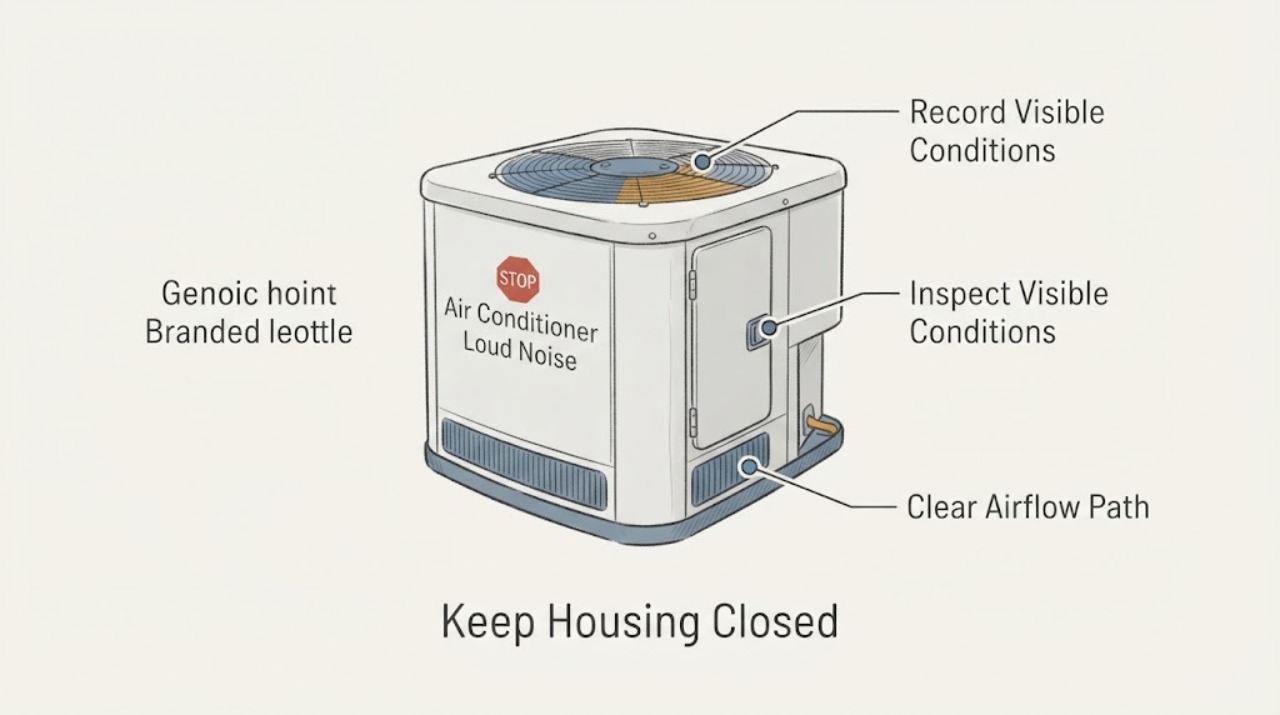
Work through in order
Diagnostic checks
Use only checks that match the exact appliance or system and its official guide.
-
Check 1
From a safe standing position, set the thermostat to the normal cooling mode and note whether the indoor blower, outdoor unit, or both make the loud sound. Record whether it is a single click, a hum, rapid repeated clicking, rattling, scraping, or a high-pitched tone, and whether it begins at startup, shutdown, or during steady operation.
Expected result: The sound is outdoors and coincides with a cooling call, repeats while the unit is running, or is suddenly louder than the system's established sound; alternatively, it is indoors or occurs only during a normal transition.
Next step: Stop the cooling call and arrange HVAC service for a new, persistent, or escalating outdoor sound. Keep the observation as a symptom record and do not open the outdoor electrical compartment.
Why this matters
Why: An outdoor startup or running hum or click can involve a contactor, capacitor, fan motor, compressor, or another fault, while indoor noise follows a different diagnostic path. A new change is more important than a sound that has always been normal for that model.
-
Check 2
Observe the outdoor unit only from outside the grille and without reaching through it. Note whether the fan is spinning normally, is stationary while a cooling call is active, turns slowly, or appears to strike something; also note severe vibration, a leaning cabinet, or a sound that changes with fan motion.
Expected result: The fan is not moving, is visibly damaged, turns slowly, strikes another part, or the cabinet vibrates strongly; the fan is normal but the hum or click continues.
Next step: Turn the system off from the thermostat and arrange HVAC service. Do not hand-start the blade, remove the grille, touch a contactor or capacitor, or use a tool near the fan.
Why this matters
Why: A fan or blade problem can create unusual noise and can leave the compressor or electrical controls operating under abnormal conditions. A normal fan does not rule out a contactor or another high-voltage fault.
-
Check 3
Check the thermostat display and settings without opening the equipment. Confirm that the mode and target temperature actually call for cooling, and note whether the indoor airflow is weak, warm, or normal. Inspect the user-accessible air filter and replace it only with the exact type and orientation specified for the system if it is visibly dirty or wet.
Expected result: There is no cooling call, the fan setting keeps the blower running, airflow is weak, the filter is dirty or wet, or settings and airflow are normal while the outdoor noise remains.
Next step: Correct only a clear thermostat or filter condition and make one supervised observation. If the unusual noise remains, cooling is poor, ice appears, or the filter becomes wet again, stop the system and arrange service.
Why this matters
Why: A control setting or restricted airflow can mimic a system fault, but it does not prove that the outdoor contactor is healthy. A wet filter or a frozen system needs more than a sound check.
-
Check 4
From a safe distance, inspect the area around the outdoor unit for leaves, a loose-looking external panel, an object touching the cabinet, standing water, ice, or an obstruction to airflow. Do not remove the electrical cover, move the cabinet, reach into the grille, or investigate a noise by touch.
Expected result: An external object or visible debris touches the cabinet, the unit is surrounded by water or ice, a panel is visibly loose, or the exterior is clear but the loud sound persists.
Next step: Keep clear of water, ice, and damaged parts. Remove only loose debris that is fully outside the unit and safe to reach; otherwise leave the system off and provide the observation to an HVAC technician.
Why this matters
Why: A simple external obstruction can add vibration, but water, ice, or a persistent sound can indicate an electrical, refrigerant, airflow, or mechanical condition that is not safe to isolate by opening the unit.
-
Check 5
Check the electrical panel only for a breaker that is already visibly in an off or tripped position, and record whether the air conditioner stopped at startup or after the noise began. Do not repeatedly reset it, open the disconnect, remove covers, or test an energized circuit.
Expected result: The breaker is tripped, trips again after a single permitted reset, there is a hot panel or connection, or no breaker change is visible but the noise and cooling fault continue.
Next step: Do not reset again. Keep the system off and arrange qualified HVAC or electrical service, especially for heat, arcing, smoke, burning odor, or a damaged connection.
Why this matters
Why: Carrier says an immediate repeat trip indicates a deeper electrical fault. A contactor, capacitor, compressor, wiring, or another high-voltage condition cannot be confirmed by a homeowner observation.
-
Check 6
Make one final safe symptom record: note the model, indoor and outdoor sound location, exact timing, fan movement, cooling result, thermostat state, filter condition, ice or water, vibration, odor, and breaker behavior. Do not run repeated cooling cycles or ask someone to listen beside an exposed unit.
Expected result: The loud noise is repeatable, cooling is reduced, the unit hums without starting, clicks continuously, hisses near refrigerant lines, or any burning, gas-like, or electrical warning is present.
Next step: Turn the system off and send the complete record to an HVAC professional. For smoke, arcing, a strong burning odor, a hot connection, or immediate danger, leave the area as needed and obtain emergency help; do not retest.
Why this matters
Why: A repeatable sound with a performance change needs professional diagnosis. Trane identifies electrical components, refrigerant, and mechanical parts as possible safety-sensitive causes, and Carrier directs high-voltage issues to a professional.
Use your observations
Decision map
Find the observation that best matches what you see, then follow the next safe action.
-
PATH 01Next step
What you see
The outdoor unit makes a new loud hum or repeated click when a cooling call begins or continues.
Do this next
Turn cooling off and arrange HVAC service. Keep the electrical compartment closed and do not attempt a component test.
Why this path and its safety boundary
Why it matters: Trane lists the contactor, capacitor, and fan motor among possible outdoor-unit causes, but sound alone cannot identify which part has failed.
-
PATH 02Next step
What you see
The outdoor fan is stopped, slow, damaged, or striking another part while the system is calling for cooling.
Do this next
Leave the system off and request HVAC service. Do not hand-start the fan or reach through the grille.
Why this path and its safety boundary
Why it matters: A fan blade or motor issue can create unusual noise and may expose the compressor or controls to abnormal operation.
-
PATH 03Next step
What you see
The sound is indoors, the filter is dirty or wet, or the thermostat does not actually call for cooling.
Do this next
Correct only a clear setting or accessible filter condition and observe once. Arrange service if the sound, weak airflow, wet filter, ice, or poor cooling returns.
Why this path and its safety boundary
Why it matters: The symptom may be airflow or control related rather than an outdoor contactor symptom, although a mixed fault remains possible.
-
PATH 04Next step
What you see
Ice, water, hissing near refrigerant lines, or an outdoor high-pitched noise accompanies the loud sound.
Do this next
Shut the system off and arrange HVAC service. Do not chip ice, open a refrigerant circuit, or investigate the line or electrical compartment.
Why this path and its safety boundary
Why it matters: Trane and Carrier associate these observations with refrigerant, airflow, compressor, or other system faults requiring professional handling.
-
PATH 05Next step
What you see
The breaker trips again, a connection or panel is hot, or there is smoke, arcing, or a burning electrical odor.
Do this next
Do not reset again or touch the equipment. Keep clear, obtain qualified HVAC or electrical help, and use emergency services for active smoke or fire.
Why this path and its safety boundary
Why it matters: This is a high-voltage or fire warning, not a contactor adjustment opportunity.
-
PATH 06Next step
What you see
The sound has always been the same brief startup or shutdown sound, cooling is normal, and no warning symptom is present.
Do this next
Record the normal baseline and mention it at routine maintenance. Arrange service if the sound changes, persists beyond the transition, or is joined by poor cooling or vibration.
Why this path and its safety boundary
Why it matters: Some systems have naturally noticeable transition sounds, but a change in loudness, duration, or cooling performance changes the decision.
Helpful context
Understand the symptom
Identify the sound before identifying a part
A loud air conditioner is not automatically a failed contactor. A normal startup or shutdown sound can differ from a new continuous buzz, a rapid click, a rattle, a scrape, or a high-pitched tone. Note the unit location, sound type, timing, cooling result, outdoor-fan behavior, thermostat display, and any odor or vibration. Trane specifically lists the outdoor contactor among possible causes of loud humming and clicking, while also listing other electrical and mechanical causes.
The contactor is not a homeowner test point
In a split system, the contactor is part of the outdoor electrical controls. Carrier warns that loud or unusual outdoor-unit noise can involve high-voltage components and should not be investigated with do-it-yourself electrical work. The Department of Energy likewise says air-conditioner repair involving high-voltage exposure belongs with trained service technicians. Keep the electrical compartment closed and limit your checks to controls and observations from a safe position.
Use the sound and cooling change to set urgency
A click only when the system starts or stops may be different from repeated clicking while a cooling call continues. A loud hum with no outdoor-fan movement can indicate an electrical or motor problem; a rattle can indicate vibration or a loose component; hissing near refrigerant lines or a burning electrical smell needs immediate shutdown. Do not keep running the system to make the sound easier to diagnose.
Safety boundary
Stop conditions
- Stop the air conditioner for smoke, arcing, burning or melting odor, a hot plug, panel, or connection, repeated breaker trips, or visible electrical damage. Keep clear and obtain qualified or emergency help.
- Stop for a loud sound with a stopped or damaged fan, strong vibration, ice, water near electrical equipment, hissing at refrigerant lines, or a compressor that repeatedly tries and fails to start.
- Do not remove electrical covers, touch a contactor or capacitor, hand-start a fan, test voltage, discharge a capacitor, open a refrigerant circuit, or bypass a safety control.
- Do not keep restarting the system to reproduce the noise. A single safe thermostat observation is enough; a returning or worsening symptom needs HVAC service.
Only after diagnosis
Potential parts
- contactor
Consider this only after an HVAC technician confirms that the contactor or its control circuit is responsible for the noise or failed start.
Contactors vary by equipment design and electrical rating. Confirm the exact model and professional diagnosis before selecting a component. - run capacitor
Consider this only when qualified diagnosis links startup hum, failed fan or compressor operation, or another symptom to the capacitor.
Capacitors retain electrical charge and must be selected and handled by a qualified technician for the specific equipment. - fan motor or fan blade
Consider this only when professional inspection confirms a damaged blade, motor, or fan assembly as the source of the noise.
Fan components are equipment-specific and should not be chosen from appearance or sound alone.
When checks do not resolve it
Need a professional?
Request an HVAC technician to diagnose a suspected contactor, capacitor, fan motor, compressor, wiring, or mechanical noise after the safe external observations are complete.
Safety scope: Keep the system off for smoke, arcing, burning or melting odor, hot electrical parts, water near electrics, ice with abnormal operation, refrigerant hissing, or repeated breaker trips. Do not open the outdoor electrical compartment or perform energized checks.
Common questions
FAQ
Can a contactor cause a loud air-conditioner hum or click?
It can be one possible outdoor-unit cause. Trane also lists the capacitor, fan motor, compressor, thermostat, and other controls, so sound alone cannot identify the failed part. Keep the electrical compartment closed and arrange HVAC service for a new or persistent sound.
What should I do if the outdoor AC unit hums but the fan does not spin?
Turn the cooling call off and observe only from a safe position. A capacitor, fan, motor, or another high-voltage fault is possible. Do not hand-start the blade or touch the electrical parts; arrange professional HVAC service.
Is a brief clicking sound at AC startup always a failed contactor?
No. Some systems have noticeable startup or shutdown sounds, but a sound that is new, louder, repeated, or joined by poor cooling or vibration needs attention. Record when it occurs and have an HVAC technician diagnose it.
Can I test an AC contactor or capacitor myself?
No. These components are inside the equipment's electrical system, and Carrier and DOE guidance place high-voltage diagnosis with trained professionals. Do not remove covers, test an energized circuit, discharge a capacitor, or bypass a control.
When should I shut the AC off immediately for noise?
Shut it off for a sudden loud or escalating sound, stopped or damaged fan, strong vibration, ice, hissing near refrigerant lines, smoke, burning or melting odor, arcing, a hot electrical connection, or a breaker that trips again. Arrange qualified service and do not restart to reproduce the sound.
Read the exact guide
Official sources
- Troubleshoot an Air Conditioner: 6 Steps to Fix an AC Not WorkingCarrier · Carrier residential central air guidance; controls and access vary by equipment.
- Is This Normal? HVAC Smells and Sounds, ExplainedTrane · Trane residential HVAC guidance; sound causes vary by equipment and model.
- AC Fan Not Working? Reasons Why It Stopped SpinningTrane · Trane residential air-conditioner troubleshooting; exact fan layout varies by system.
- Measure Guideline: Air Conditioner Diagnostics, Maintenance, and ReplacementU.S. Department of Energy · DOE technical guidance for air-conditioner diagnostics and maintenance; not a model-specific repair manual.
Community feedback
Share a repair observation
Share a plain-text repair observation. Accepted observations are published automatically; this page may take a moment to update.