
On this page
Start here
Quick answer
A loud air-conditioner noise near the evaporator coil can be caused by restricted airflow, a frozen or dirty coil, a blower or fan problem, vibration, or a refrigerant-side fault. First note whether the sound is indoors or outdoors and whether cooling, airflow, frost, or water changed at the same time. Turn cooling off if you see ice, frost, weak airflow, or water from thawing; do not chip ice, open the air-handler cabinet, touch a moving fan, or handle refrigerant. From a safe, dry position, check the filter, visible supply and return obstructions, thermostat mode, and accessible condensate signs. If the noise is sudden, grinding, rattling, hissing near the coil or refrigerant lines, paired with repeated icing, poor cooling, electrical symptoms, or a damaged fan, leave the system off and arrange qualified HVAC service.
Work through in order
Diagnostic checks
Use only checks that match the exact appliance or system and its official guide.
-
Check 1
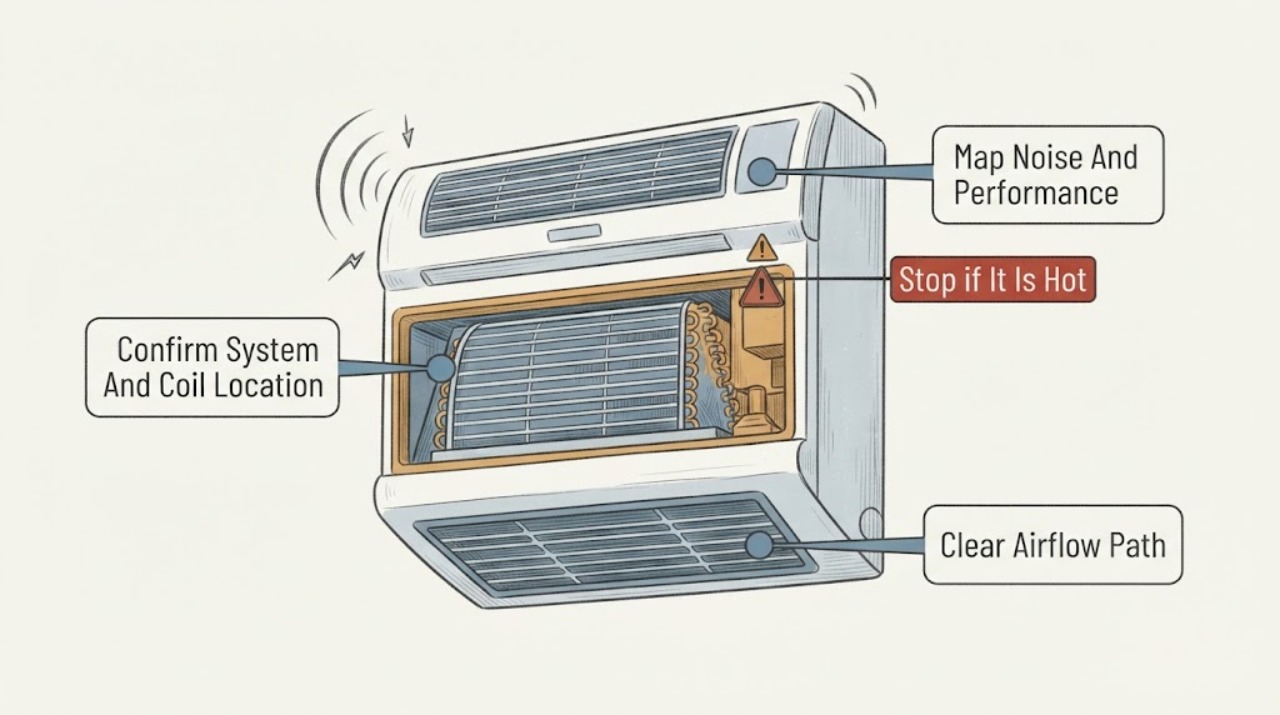
From a safe position, map the noise to the indoor air handler, supply or return grille, condensate area, outdoor unit, or refrigerant-line area and note whether it starts with the blower, cooling call, startup, shutdown, or continuously.
Expected result: Record the sound as a hum, whistle, hiss, rattle, scrape, bang, vibration, or intermittent click, along with airflow strength, cooling result, frost, water, and any electrical smell.
Next step: Keep the notes and use the matching branch below; stop rather than reproducing the noise if any hazard or rapid performance change is present.
Stop if: Stop the system for smoke, burning odor, arcing, exposed wiring, a rapidly worsening sound, severe vibration, or a suspected refrigerant release.
Why this matters
Why: A sound that tracks airflow suggests the blower, filter, duct, or coil path; a hiss near the evaporator or refrigerant lines, frost, or reduced cooling raises a refrigerant or coil concern; a sudden loud outdoor sound can be a fan or compressor issue.
-
Check 2
Identify the system type and find the evaporator-coil location from the owner materials or equipment label without removing an air-handler panel; note whether the indoor unit is a furnace, fan coil, packaged unit, heat pump, or another arrangement.
Expected result: Record the model, whether the coil is in a cabinet or ductwork, the current thermostat mode, and whether the system is cooling or in a heat-pump mode.
Next step: Use the exact owner manual for access limits and operating sounds; keep cabinet covers closed unless the manual explicitly identifies a safe user-accessible filter door.
Stop if: Stop if the identity is unclear, the coil is behind a service panel, or reaching the component would expose moving parts, wiring, refrigerant lines, or condensate.
Why this matters
Why: Coil access, fan behavior, defrost behavior, and safe checks depend on system type. A generic noise explanation cannot establish a coil fault when the component is hidden or the system is not in cooling mode.
-
Check 3
With the system off, inspect the user-accessible air filter, return grille, and supply registers; remove only an obstruction that is plainly loose and safe to move, and replace a dirty filter only with the exact size and type specified by the system instructions.
Expected result: Look for a clogged or wet filter, blocked return, closed register, furniture or drape over a vent, weak airflow at several outlets, or a clean and open airflow path.
Next step: Restore only the safe airflow conditions and keep cooling off if ice or water is present; arrange service for persistent weak airflow or a filter that becomes wet or dirty unusually fast.
Stop if: Do not run the system with a missing filter, reach into the blower, remove a coil cover, clean sealed components, or continue if smoke, water near electricity, or severe noise is present.
Why this matters
Why: Restricted airflow can make an evaporator coil freeze and can make airflow noise more prominent. If the path is clear but airflow remains weak, the blower, coil, duct, or control needs professional assessment.
-
Check 4
From outside the cabinet, look for frost or ice on visible coil surfaces or refrigerant lines and check for water below the indoor unit; if ice is present, switch the thermostat cooling function off and allow a natural thaw.
Expected result: Record where ice appears, whether airflow is weak, whether water increases during thaw, and whether the system has frozen before; do not scrape, chip, or heat the ice.
Next step: Keep cooling off until the ice has fully cleared and the area is dry; if the coil refreezes, airflow remains weak, or water cannot be controlled, arrange HVAC service.
Stop if: Stop for flooding, water near electrical equipment, a bulging ceiling or wall, a refrigerant-line hiss, or any need to chip ice, use a heat source, open the cabinet, or handle refrigerant.
Why this matters
Why: Ice indicates that the coil is too cold and can be associated with restricted airflow or a refrigerant-side issue. Continuing cooling with a frozen coil can stress the system and water from thawing can damage the surrounding area.
-
Check 5
After switching cooling off, inspect only the visible area beneath the indoor unit and the accessible condensate outlet or drain route for a pan full of water, a wet floor, or water staining; do not open the air handler.
Expected result: Note whether water is only appearing as ice melts, whether the pan or floor is already wet before thaw, whether the drain is overflowing, and whether the noise changes with water movement.
Next step: Keep cooling off, protect the area without touching electrical equipment, and request HVAC service for an overflowing pan, concealed drain, persistent water, or uncertain source.
Stop if: Stop for water near wiring or electrical equipment, ceiling or wall damage, sewage-like water, a large or fast leak, or any need to disassemble the drain or cabinet.
Why this matters
Why: A thawing frozen coil can create water, while water before thaw or an overflowing drain suggests a separate condensate or drainage problem. Either can damage the property and can become an electrical risk near equipment.
-
Check 6
With cooling off and no hazard present, compare the noise with the indoor blower and outdoor fan only from a safe distance; do not touch blades, grilles, capacitors, motors, or the coil.
Expected result: A sound that changes with blower speed, a visible loose or damaged outdoor fan blade, rattling vibration, or a low-airflow condition points to a fan, motor, mounting, or airflow investigation rather than a coil-only diagnosis.
Next step: Leave the system off and provide the noise pattern, airflow result, and safe visual findings to an HVAC professional; do not attempt to straighten, lubricate, or replace a fan component.
Stop if: Do not reach through a grille, remove a fan guard, handle a capacitor, or operate the unit if a blade is damaged, an electrical smell is present, or vibration is severe.
Why this matters
Why: Fan and motor faults can create loud or unusual noise and can also reduce air moving over the evaporator coil, which may lead to frost. A visible damaged blade or persistent rattling needs service.
-
Check 7
From a safe distance, note any hissing near the evaporator-coil cabinet or refrigerant lines, oil-like residue, repeated frost, poor cooling, or an unusual smell; do not loosen a fitting, open a line, or attempt a refrigerant check.
Expected result: Record whether the noise and cooling loss coincide, whether frost returns after thaw, and whether any visible line or coil damage exists without touching it.
Next step: Keep cooling off and arrange qualified HVAC service for leak testing, coil inspection, or charge diagnosis; tell the technician where and when the sound occurred.
Stop if: Stop for a suspected refrigerant release, dizziness or breathing irritation, a strong chemical odor, frost spreading rapidly, or any urge to manipulate a line or valve.
Why this matters
Why: A hiss near the coil or lines and repeated icing can indicate a refrigerant leak or pressure problem, but appearance alone cannot confirm charge or leak location. Refrigerant and sealed-system diagnosis is professional work.
-
Check 8
Only after all ice has cleared, water is controlled, the filter and registers are safe, and the exact equipment guidance permits it, make one brief normal cooling observation; otherwise keep the system off for service.
Expected result: Record whether airflow is restored, cooling is normal, the noise is absent, and no frost, water, electrical symptom, or new vibration returns; a returning symptom counts as unresolved.
Next step: Switch cooling off again and arrange HVAC service if any symptom returns; provide the complete timeline and safe observations rather than repeating the test.
Stop if: Do not restart with ice, active water, a suspected leak, damaged fan, exposed wiring, burning odor, or severe noise, and do not run an unattended test.
Why this matters
Why: A temporarily quiet system does not prove that a coil, blower, drain, or refrigerant fault is fixed. Recurring ice, loud noise, weak airflow, or water after a restart requires professional diagnosis.
Use your observations
Decision map
Find the observation that best matches what you see, then follow the next safe action.
-
PATH 01Next step
What you see
The filter is dirty, a return or supply path is blocked, or airflow is weak at several outlets without a confirmed refrigerant symptom.
Do this next
Correct only the visible filter or register issue allowed by the equipment instructions and keep cooling off if ice is present; use HVAC service if airflow stays weak or ice returns.
Why this path and its safety boundary
Why it matters: Restricted airflow can make the evaporator coil freeze and can change blower noise.
-
PATH 02Next step
What you see
Frost or ice is visible on the evaporator area or refrigerant line, with reduced cooling, weak airflow, or water during thaw.
Do this next
Turn cooling off, allow a natural thaw, and arrange service if water is uncontrolled, the coil cannot thaw, or ice returns. Do not chip or heat the ice.
Why this path and its safety boundary
Why it matters: A frozen coil can result from airflow restriction or a refrigerant-side problem and should not be operated through.
-
PATH 03Next step
What you see
There is a hiss near the evaporator coil or refrigerant lines, repeated icing after safe thaw, oil-like residue, or cooling loss not explained by airflow.
Do this next
Leave cooling off and call a qualified HVAC professional for sealed-system diagnosis and repair.
Why this path and its safety boundary
Why it matters: The pattern can indicate a refrigerant leak, pressure issue, or coil fault; it cannot be safely confirmed by a homeowner.
-
PATH 04Next step
What you see
Noise follows blower or fan speed, or there is rattling, scraping, vibration, a damaged blade, or persistently weak airflow without visible ice.
Do this next
Keep the system off and arrange HVAC service; do not reach into a grille or work on the motor or capacitor.
Why this path and its safety boundary
Why it matters: A fan, motor, mounting, or airflow component may be creating the noise and may be changing coil airflow.
-
PATH 05Next step
What you see
Water is near electrical equipment, a condensate pan is overflowing, a wall or ceiling is wet, or an electrical smell or repeated breaker trip accompanies the noise.
Do this next
Stop cooling, keep clear of the wet or energized area, and arrange HVAC or electrical service as appropriate; use local emergency procedures for smoke or fire.
Why this path and its safety boundary
Why it matters: The immediate risk is water or electrical damage, not just sound diagnosis.
-
PATH 06Next step
What you see
No safe visible cause is found, but the air conditioner is newly or unusually loud, the sound worsens, or cooling performance changes.
Do this next
Leave the system off and request qualified HVAC diagnosis rather than repeatedly cycling it or opening the air handler.
Why this path and its safety boundary
Why it matters: An internal fan, blower, motor, compressor, coil, control, or mounting issue remains possible even when the cabinet looks normal.
Helpful context
Understand the symptom
Start with the sound, not a guessed part
A blower-side rattle, an airflow whistle, and a hiss at the evaporator coil do not lead to the same next step. Record the location, when the sound begins, whether it follows the indoor blower or cooling call, and whether the vents feel weaker. If ice, frost, water, or a sudden loss of cooling appears with the noise, protect the system first and leave refrigerant and cabinet work to an HVAC professional.
An evaporator coil may be hidden inside the air handler
In a typical split system, the evaporator coil is indoors in or beside the air handler, furnace cabinet, or ductwork. It is not necessarily visible through a user access door. A filter and open registers are ordinary homeowner checks; deep coil cleaning, refrigerant testing, fan repair, and sealed-system work are not safe substitutes for a service call.
Ice changes the decision
Ice on the coil or the refrigerant line can reduce airflow and create water when it thaws. Restricted airflow and low refrigerant pressure are different causes that can produce similar frost. Shut off cooling and allow a natural thaw; do not chip ice or use a heat source. A recurrence after the filter and airflow path are corrected is evidence for professional diagnosis rather than repeated cycling.
Only after diagnosis
Potential parts
- evaporator coil
Consider only after qualified diagnosis confirms a leaking, damaged, or persistently malfunctioning evaporator coil rather than an airflow or drain issue.
Coil dimensions, refrigerant design, and system fit vary; confirm the complete equipment identity and professional fit information. - indoor blower motor or fan assembly
Consider only when the noise, low airflow, or fan behavior is traced to the indoor blower by a qualified diagnosis.
Motor and fan assemblies are equipment-specific; do not choose a part from sound alone. - air filter
Consider only for a visibly dirty or wet filter when the exact equipment instructions specify the required size and type.
Confirm the size, airflow rating, and installation direction from the equipment documentation; do not run without the required filter. - condensate drain or pump
Consider only after the visible water pattern and professional inspection identify a failed drain or pump as the source of overflow or leak.
Drain arrangements vary by installation; do not disassemble a drain or pump near electrical equipment.
When checks do not resolve it
Need a professional?
Stop the air conditioner and seek prompt qualified help for a suspected refrigerant release, hissing at the coil or lines, visible ice that returns, flooding or water near electrical equipment, smoke, burning odor, arcing, exposed wiring, a hot connection, severe vibration, a damaged fan blade, or a sudden loud noise with poor cooling. Leave the area and use local emergency procedures for fire or an immediate electrical hazard.
Have this ready
- Give the technician the equipment model, system type, noise location and description, operating stage, airflow result, frost or water timeline, filter condition, thermostat mode, and safe photos or recordings made without opening the cabinet.
Common questions
FAQ
Can a frozen evaporator coil make an air conditioner loud?
It can change airflow and make the system sound different, while also causing weak cooling and water as ice melts. Turn cooling off and allow a natural thaw. Do not chip the ice or keep running the system; recurring frost needs HVAC diagnosis for airflow, coil, or refrigerant causes.
What should I check first when the noise seems to come from the evaporator coil?
Record the noise and cooling pattern, then check only the filter, visible registers and returns, frost, and safe condensate signs. The coil may be inside the air handler, so do not open its cabinet. A hiss, repeated ice, or poor cooling needs professional service.
Should I keep running the AC to melt a frozen coil?
No. Shut off the cooling function and let the coil thaw naturally. Running a frozen system can strain the compressor, and chipping or heating the ice can damage the coil. Arrange service if the coil will not clear, water is uncontrolled, or the ice returns.
Does a hissing noise prove that the evaporator coil is leaking?
No. A hiss near the coil or refrigerant lines can be a warning sign of a refrigerant leak, but sound and appearance cannot confirm the charge or leak location. Keep the system off and have a qualified HVAC professional inspect it.
Can I clean the evaporator coil myself to stop the noise?
Only the safe, model-authorized maintenance described by the equipment instructions should be considered. The coil may be hidden, and deep cleaning, fan work, refrigerant work, and cabinet access can damage the system or create a safety risk. Use HVAC service when the coil is dirty, damaged, frozen, or tied to unusual noise.
Read the exact guide
Official sources
- Will Frozen AC Fix Itself? A Guide to Frozen AC CoilsCarrier · Air conditioner frozen evaporator coils, safe shutdown, natural thaw, airflow, and refrigerant causes
- AC Fan Not Working? Reasons Why It Stopped SpinningTrane · Air conditioner indoor and outdoor fan, airflow, unusual noise, electrical boundary, and professional service
- What Is an AC Evaporator Coil & What Does It Do?Carrier · Air conditioner evaporator coil location, airflow, maintenance, unusual noise, and professional repair guidance
- Coil Troubleshooting GuideTrane · Air conditioner and heat-pump coil troubleshooting, airflow restriction, frost, refrigerant, and professional service
- Is This Normal? HVAC Smells and Sounds, ExplainedTrane · HVAC loud, rattling, clicking, hissing, and electrical or refrigerant warning sounds
- Air Handler Freezing Up: Causes and SolutionsTrane · Air-handler evaporator-coil freezing, safe shutdown, airflow causes, refrigerant boundary, and no-ice-chipping warning
Community feedback
Share a repair observation
Share a plain-text repair observation. Accepted observations are published automatically; this page may take a moment to update.