
On this page
Start here
Quick answer
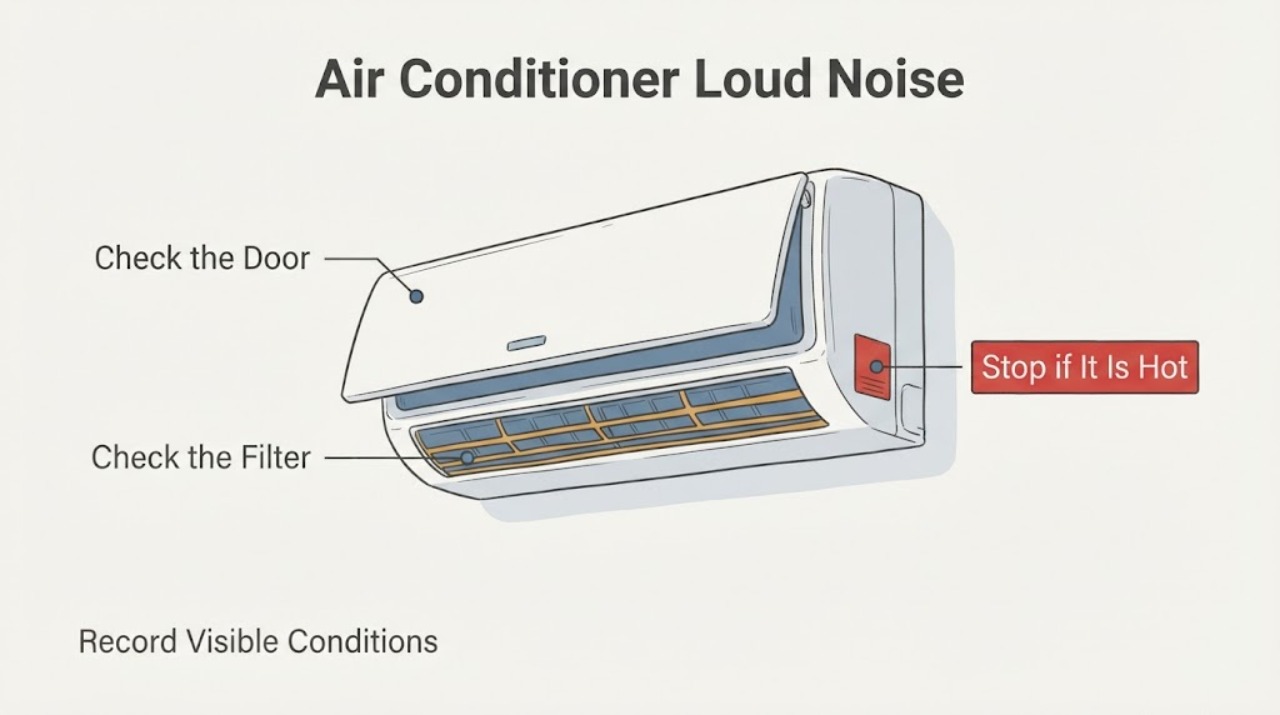
First determine whether the loud sound comes from the indoor air handler, a return or supply grille, a duct, or the condensate area, and whether it occurs at startup, while running, or during shutdown. A blocked filter, obstructed register, loose grille, duct vibration, or normal expansion can create indoor noise, but a new grinding, rattling, loud hum, hissing near the indoor coil, water, burning odor, or electrical sound means turn the system off and arrange HVAC service. Replace or reseat only an accessible filter when the system is off and use the exact equipment guide; do not open the cabinet, touch the blower or capacitor, handle refrigerant, or keep running a system with ice or abnormal noise.
Work through in order
Diagnostic checks
Use only checks that match the exact appliance or system and its official guide.
-
Check 1
From a safe position inside the house, identify the loudest point: the indoor air handler or furnace cabinet, return grille, supply register, exposed duct, condensate area, or a wall or ceiling that transmits vibration. Note whether the sound starts, runs, or stops with the cooling call.
Expected result: The sound is strongest at the indoor cabinet, at one grille, throughout the duct system, near a drain or pan, or only when the outdoor unit starts while the indoor sound is secondary.
Next step: Keep the system off if the noise is new, severe, or accompanied by heat, odor, water, ice, or electrical symptoms. Otherwise continue with the matching sound and airflow observation without deliberately reproducing an abnormal event.
Stop if: Stop immediately for smoke, burning odor, arcing, a hot cabinet, water near electrical equipment, visible ice, a damaged fan, or a strong refrigerant hiss.
Why this matters
Why: Location separates blower or cabinet noise from airflow turbulence, duct vibration, condensate movement, or sound transmitted from another part of the system. A house-wide sound or a sound with water or ice needs a broader HVAC assessment.
-
Check 2
Classify the sound from a safe distance as airflow roar or whistle, rattling or clanking, grinding, humming, clicking, hissing, dripping, or a brief expansion sound, and record whether it is new or has changed from the system's normal sound.
Expected result: The sound is a new loud rattle or grind, a loud indoor hum, a whistle with weak airflow, a hiss near the indoor coil, a drip or gurgle, or a brief repeatable click or duct ping.
Next step: Use the sound category to describe the issue to HVAC service. Do not put a tool into a grille, touch a rotating part, or remove a cabinet panel to confirm the source.
Stop if: Stop using the system for grinding, violent rattling, electrical buzzing, refrigerant-like hissing, smoke, burning odor, or a noise that is rapidly getting louder.
Why this matters
Why: Trane identifies indoor humming with possible blower or inducer concerns, rattling with vibration or moving-part possibilities, and hissing near an indoor coil or refrigerant line as a reason to shut down and call for service. A brief familiar click or duct ping can be normal, but a changed sound is more important than its label.
-
Check 3
Turn the thermostat and indoor system off, then inspect only the accessible filter and visible return and supply grilles; replace or reseat the filter only if the exact equipment instructions allow it and the filter is the correct type and orientation.
Expected result: The filter is visibly loaded, wet, collapsed, or installed incorrectly, or the filter and grilles are clean and unobstructed.
Next step: Correct only the accessible filter or grille issue, then make one cautious observation after the system has returned to a normal safe state. If the loud sound remains, stop and arrange HVAC service rather than increasing fan speed or removing panels.
Stop if: Stop for a wet filter, ice, water in or around the cabinet, a burning smell, a hot motor area, or any need to reach through the grille or cabinet.
Why this matters
Why: A restricted filter or blocked airflow path can strain the indoor blower and reduce airflow, but a clean filter does not clear the blower, duct, coil, or refrigerant system.
-
Check 4
With power and cooling off, inspect exposed duct sections, register covers, and the area around the indoor unit for a loose grille, crushed or disconnected visible duct, vibrating panel, blocked return, or furniture touching a grille; do not open walls or ceilings.
Expected result: The sound changes when a loose grille is held still from a safe cool position, is loudest at a restricted or damaged exposed duct, or does not change at the visible airflow path.
Next step: Remove only an obvious external obstruction without dismantling the system. Have an HVAC professional secure, seal, or inspect ductwork and the indoor assembly if the sound persists or the duct is damaged.
Stop if: Stop for a sagging or wet ceiling, exposed insulation or wiring, sharp metal, a moving cabinet, water, or any need to enter a crawlspace or attic to reach the duct.
Why this matters
Why: A grille or exposed duct can transmit or amplify airflow and vibration noise. A noise that does not respond to visible airflow conditions may originate at the blower, motor, coil, drain, controls, or concealed ductwork.
-
Check 5
Observe the indoor unit's airflow and visible condensate area without removing a cover: note weak or pulsing airflow, ice, water in a pan, a wet filter, drain gurgle, or cooling that has stopped while the fan noise continues.
Expected result: There is weak airflow with ice, water around the indoor unit, a wet filter, a drain or pan symptom, or normal airflow with only an abnormal mechanical sound.
Next step: Turn the system off for ice, water, or a wet filter and arrange HVAC service. Do not scrape ice, add refrigerant, clear a concealed drain with chemicals, or reach into the cabinet.
Stop if: Stop for ice, active water, a strong hiss, a chemical odor, electrical odor, smoke, or any need to remove the air-handler cover.
Why this matters
Why: Restricted airflow or low refrigerant can freeze an indoor evaporator coil, and condensate or drain problems can accompany indoor cooling faults. Mechanical noise with normal airflow can still involve the blower wheel, motor, or a loose internal component.
-
Check 6
If the noise is only a thermostat or relay click and the system otherwise operates normally, compare one normal start and stop without opening equipment; if the sound is loud, continuous, or accompanied by poor cooling, do not repeat the cycle.
Expected result: The click or brief ping is unchanged and the system cools normally, or the sound is new, loud, repeated, or followed by a failed start or stop.
Next step: Leave a normal brief sound under observation and mention it at routine maintenance. For a changed or persistent sound, shut the system off and schedule HVAC service with the timing and location recorded.
Stop if: Stop immediately for smoke, burning odor, arcing, an electrical buzz, a hot control, water, or a loud sound that continues after the cooling call ends.
Why this matters
Why: Some switching and duct expansion sounds are normal, but a changed indoor noise can signal a control, blower, airflow, or mechanical problem. Normal cooling does not make a burning or electrical sound acceptable.
-
Check 7
Prepare a service record with the indoor location, sound type, start or stop timing, thermostat mode and fan setting, filter condition, airflow strength, ice or water, visible duct condition, recent maintenance or installation work, and whether the outdoor unit was also running.
Expected result: The issue is repeatable at one stage, follows filter or duct changes, occurs only with cooling, or cannot be localized from safe indoor observations.
Next step: Keep the system off for any abnormal or hazardous symptom and request HVAC service. Provide a recording only if it can be made from a safe distance without entering a mechanical area.
Stop if: Stop user diagnosis when it requires removing covers, touching a fan or capacitor, handling refrigerant, entering a crawlspace or attic, or making electrical measurements.
Why this matters
Why: This history helps an HVAC technician distinguish airflow restriction and duct transmission from blower, motor, coil, drain, refrigerant, control, or electrical service paths without unsafe homeowner testing.
Use your observations
Decision map
Find the observation that best matches what you see, then follow the next safe action.
-
PATH 01Next step
What you see
The sound is a new loud hum, rattle, clank, or grind at the indoor unit.
Do this next
Turn the system off and arrange HVAC service; do not reach through the grille or run the unit to see whether a moving part fails.
Why this path and its safety boundary
Why it matters: The blower motor, blower wheel, fan, loose internal component, or vibration isolation may be involved.
-
PATH 02Next step
What you see
The sound is a whistle or roar at a return or supply grille and airflow is weak or uneven.
Do this next
Check only the accessible filter and grilles with the system off, then have HVAC service inspect airflow and ductwork if the noise remains.
Why this path and its safety boundary
Why it matters: A dirty filter, blocked register, restricted or damaged duct, or airflow imbalance may be amplifying the sound.
-
PATH 03Next step
What you see
There is ice, water, a wet filter, drain noise with leakage, or poor cooling near the indoor unit.
Do this next
Shut the system off and request HVAC service. Do not scrape ice, add refrigerant, or open the cabinet.
Why this path and its safety boundary
Why it matters: An airflow, coil, refrigerant, or condensate problem may be present and can damage the system if it continues running.
-
PATH 04Next step
What you see
A loud hiss is near the indoor coil or refrigerant lines, especially with reduced cooling.
Do this next
Turn the system off and arrange qualified HVAC repair. Do not search for the leak, loosen fittings, or add refrigerant.
Why this path and its safety boundary
Why it matters: A refrigerant leak or another sealed-system issue is possible; refrigerant diagnosis requires certified handling.
-
PATH 05Next step
What you see
The sound is a brief familiar click or duct ping, with normal airflow, no hazard, and no change from normal operation.
Do this next
Monitor without deliberately stressing the system and mention any change at routine HVAC maintenance.
Why this path and its safety boundary
Why it matters: Switching or duct expansion can be a normal operating sound on some systems.
-
PATH 06Next step
What you see
The indoor sound is accompanied by a burning odor, smoke, arcing, a hot cabinet, repeated electrical trip, or a noise that worsens quickly.
Do this next
Stop the system, leave it without power only from a safe location, keep clear, and contact emergency help for smoke or fire and qualified HVAC or electrical service for inspection.
Why this path and its safety boundary
Why it matters: This is an electrical, fire, or mechanical safety condition rather than ordinary HVAC noise.
Helpful context
Understand the symptom
Start by locating the indoor source
An indoor loud noise can be produced by the blower or its motor, the return grille, a supply register, duct panels that flex or vibrate, or water moving in a condensate drain or pan. The same room can also transmit sound from the outdoor unit through refrigerant lines or framing, so note the loudest location rather than assuming the cabinet is the source. Record whether the sound starts with the thermostat call, changes with fan speed, continues after cooling stops, or appears only at one register.
Sound type changes the next step
A brief click, relay sound, or mild duct ping can be normal on some systems. A sudden loud rattle or grinding points toward moving parts, a loose component, or vibration; a loud indoor hum can involve the blower motor; a high-pitched whistle can be related to airflow restriction; and hissing near the indoor coil or refrigerant lines can indicate a refrigerant problem. These are routing clues, not instructions to open the air handler.
Try only low-risk airflow checks
With the system turned off, inspect the accessible filter and make sure return and supply grilles are not blocked by furniture, drapes, dust, or a displaced grille. A dirty filter or restricted duct can reduce airflow and make the blower work harder. Do not remove an access panel, reach into a fan, straighten concealed ductwork, or use a stick to move a blade.
When to stop immediately
Shut the system off for smoke, a burning electrical or plastic odor, arcing, a hot cabinet, water near electrical equipment, visible ice, a damaged blower or blade, a strong refrigerant hiss, or a noise that rapidly worsens. A filter change cannot make an unsafe electrical or refrigerant condition safe; the HVAC technician needs the sound description, location, timing, airflow, and visible symptoms.
Only after diagnosis
Potential parts
- air filter
Consider only if the accessible filter is loaded, wet, collapsed, or the wrong orientation and the equipment guide identifies a matching replacement.
Filter dimensions, type, airflow direction, and installation location are equipment-specific; do not use a filter change to mask a blower, coil, or electrical fault. - blower motor or blower wheel
Consider only after an HVAC technician confirms that the indoor mechanical noise originates in the blower assembly and identifies the correct service part.
Motor and wheel fit, electrical characteristics, and air-handler configuration must be confirmed from the exact equipment model; do not open the cabinet. - condensate drain or pump component
Consider only when visible water, drain noise, or a pan symptom is confirmed and a technician identifies the condensate path as the cause.
Drain routing, pump capacity, safety switch, and installation requirements are system-specific; do not use chemicals or disassemble a concealed drain.
Common questions
FAQ
Why is my air conditioner suddenly loud inside the house?
Locate the sound first. A new indoor hum, rattle, grind, whistle, or hiss can involve the blower, airflow path, ductwork, coil, or a sealed or electrical system fault. Shut it off for a severe or changed sound and arrange HVAC service.
Can a dirty filter make an indoor AC loud?
A loaded filter can restrict airflow and strain operation. With the system off, inspect the accessible filter and replace it only according to the equipment guide. If noise or weak airflow remains, have the system inspected.
What does a loud humming sound from the indoor unit mean?
A loud indoor hum can involve the blower motor or another mechanical or electrical component. Do not open the cabinet or handle a capacitor; turn the system off and call HVAC service if the sound is new or persistent.
What if the AC is loud and there is ice or water inside?
Turn the system off and arrange HVAC service. Ice can accompany airflow or refrigerant problems, while water can indicate a condensate or coil issue. Do not scrape ice, add refrigerant, or reach into the indoor unit.
Is hissing from the indoor AC dangerous?
A hissing sound near the indoor coil or refrigerant lines can indicate a refrigerant problem. Shut the system off and obtain qualified HVAC repair; do not search for a leak or handle refrigerant connections.
Read the exact guide
Official sources
- Troubleshoot an AC Not WorkingCarrier · Residential air-conditioner filter, airflow, frozen-coil, electrical, and professional-service guidance
- Is This Normal? HVAC Smells and Sounds, ExplainedTrane · Indoor and outdoor HVAC sound categories, filter, refrigerant, and service boundaries
- Consumer Guide to Home Heating and CoolingU.S. Department of Energy · Home HVAC maintenance, filter, vent, and visible duct guidance
- AC Fan Not Spinning? Here’s Why and How to Fix ItCarrier · Indoor blower, filter restriction, fan damage, capacitor, and safe HVAC service boundary
Community feedback
Share a repair observation
Share a plain-text repair observation. Accepted observations are published automatically; this page may take a moment to update.