
On this page
Start here
Quick answer
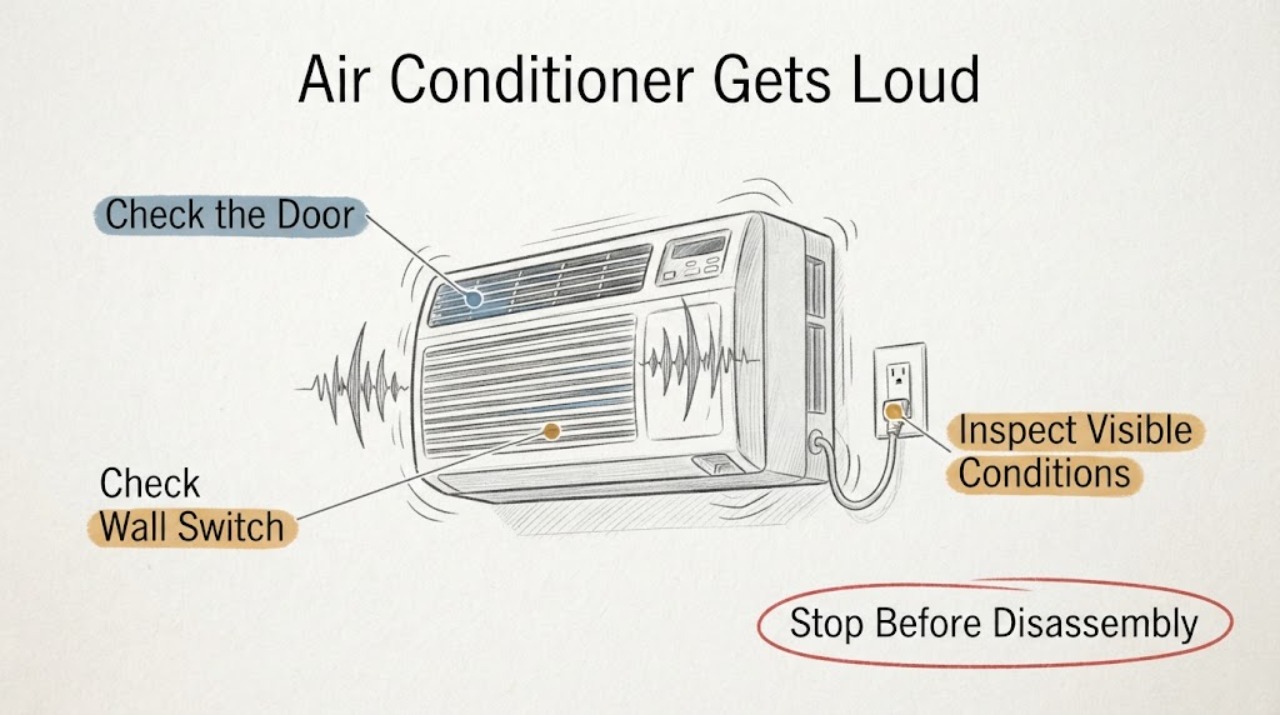
When an air conditioner becomes loud and then resonates as it starts, first identify whether the sound is coming from the indoor air handler, duct or grille, outdoor cabinet, or the building surface carrying vibration. A brief familiar startup sound may be normal for some systems, but a new or worsening resonance can involve an unstable mounting surface, loose external panel, duct transmission, fan or blower imbalance, motor trouble, capacitor or compressor trouble. Turn the cooling call off if the sound is harsh or new, and limit checks to settings, airflow, and visible external conditions. Do not open a cabinet, touch moving parts, handle a capacitor, or work on refrigerant or wiring.
Work through in order
Diagnostic checks
Use only checks that match the exact appliance or system and its official guide.
-
Check 1
From a safe distance, set the thermostat to stop the cooling call and map the loudest point: indoor air handler or grille, duct or wall, outdoor cabinet, or the mounting surface. Note whether the resonance starts exactly with the call, fades after a few seconds, continues during cooling, or appears at shutdown.
Expected result: The sound is a brief familiar startup hum, a new sustained resonance, an indoor grille or duct rattle, an outdoor cabinet vibration, or a harsh scrape, bang, or grind.
Next step: Follow the matching branch below. Keep cooling off for a new, harsh, or worsening sound, or for any sound paired with odor, smoke, sparks, severe heat, water, or a breaker event.
Why this matters
Why: Location and timing separate airflow or sound transmission from outdoor fan, motor, compressor, mounting, or control clues. A new loud sound is not made safe by the fact that the unit still cools.
-
Check 2
Read the thermostat without opening it. Confirm the normal cooling mode and fan setting, and note any delay, alert, rapid cycling, or mismatch between the cooling call and the sound. Avoid repeatedly switching the system on and off to reproduce the noise.
Expected result: The resonance occurs only when a cooling call begins, follows rapid starts and stops, continues with no cooling call, or is unrelated to thermostat activity.
Next step: Keep the settings at their normal values and record the timing. If the system repeatedly tries to start, short cycles, or makes the same loud sound, leave it off and request HVAC diagnosis rather than testing again.
Why this matters
Why: A call, delay, or short-cycle pattern can expose a control, airflow, or equipment problem, but it cannot prove that the thermostat is defective. Noise that continues without a call is less likely to be caused by the thermostat alone.
-
Check 3
With the system stopped, inspect only accessible airflow points: check whether the filter is visibly loaded, confirm supply and return grilles are not covered, and look for a loose external grille or an object at an opening. Replace a filter only with the exact type and direction specified for the equipment; do not reach inside.
Expected result: Airflow is weak at several grilles, the filter is loaded, one grille rattles, or airflow is normal while the resonance remains.
Next step: After a permitted filter change or moving an external obstruction, make only one normal observation. If the noise remains, ice or water is present, or the sound is scraping or grinding, keep the system off and arrange service.
Why this matters
Why: A restricted or uneven air path can raise blower noise, and a loose grille can act as a resonator. Normal airflow with persistent vibration makes a fan, blower, duct connection, mounting, or drive issue more relevant.
-
Check 4
From outside the equipment boundary, look for visible movement of the outdoor cabinet, a shifted pad or bracket, blocked clearance, a loose-looking external cover, or refrigerant tubing or ductwork visibly touching a surface. Do not remove panels, tighten internal hardware, bend tubing, or touch the fan grille.
Expected result: The unit rocks or transmits vibration into the wall or pad, a cover or duct rattles, tubing appears to rub, clearance is obstructed, or nothing visible explains the sound.
Next step: Do not improvise shims, insulation, fasteners, or tubing adjustments while the equipment is energized. Keep the system off and report the exact contact point or movement to an HVAC professional.
Why this matters
Why: A solid, level mounting surface and vibration isolation reduce transmitted noise; loose or unbalanced components, duct leakage, or lines touching sheet metal can amplify a startup vibration. A clear exterior does not rule out an internal motor, fan, capacitor, or compressor fault.
-
Check 5
If no hazard is present, make one final record without opening the unit: note whether the indoor airflow, outdoor fan start, cooling output, and noise change are normal or abnormal, then capture the model label and the sound timing for the service request.
Expected result: The fan fails to start, the unit hums and strains, cooling is poor, ice or water appears, the resonance persists, or the system returns to normal after a familiar brief startup sound.
Next step: For any unresolved or changed resonance, stop further testing and book HVAC service. Only resume normal operation if the sound was brief, familiar, and no stop condition is present.
Why this matters
Why: A non-starting fan, strained hum, poor cooling, ice, water, or persistent changed noise raises the likelihood of a service issue involving a motor, capacitor, compressor, airflow, mounting, or refrigerant system. A brief unchanged sound may be an operating characteristic, but the model manual remains the authority.
Use your observations
Decision map
Find the observation that best matches what you see, then follow the next safe action.
-
PATH 01Next step
What you see
The noise is loudest at an indoor grille or duct and airflow is weak or uneven.
Do this next
Check the accessible filter and confirm grilles are open and unobstructed. If the sound persists, request HVAC service for blower, duct sealing, airflow, and mounting checks.
-
PATH 02Next step
What you see
The noise is loudest at the outdoor cabinet and includes rattling, vibration, grinding, or banging.
Do this next
Turn the cooling call off and do not remove the cabinet cover or reach through the grille. Arrange HVAC service for fan, motor, compressor, mounting, and electrical diagnosis.
-
PATH 03Next step
What you see
A hum or click occurs at startup and the outdoor fan hesitates, fails to start, or the unit tries repeatedly.
Do this next
Leave the system off. This is a service clue for a motor, capacitor, control, or compressor problem; it is not a reason to handle a high-voltage part.
-
PATH 04Next step
What you see
The resonance is strongest at a wall, ceiling, pad, bracket, duct, or line contact point rather than at the equipment itself.
Do this next
Do not add improvised supports or alter refrigerant tubing. Photograph or describe the visible transmission point and request HVAC inspection of mounting, vibration isolation, duct connections, and line routing.
-
PATH 05Next step
What you see
The sound has always been a brief, unchanged startup characteristic and there is no poor cooling, vibration, odor, or unsafe symptom.
Do this next
Compare the behavior with the exact owner manual and monitor without repeated test starts. Schedule routine service if the sound changes, lasts longer, or becomes disruptive.
-
PATH 06Next step
What you see
Smoke, burning or electrical odor, sparks, severe heat, water near electrical equipment, ice with overflow, or a breaker event is present.
Do this next
Stop immediately and keep clear. From a dry, safe position, isolate power only if this can be done without contact with water or damaged equipment; do not reset a tripped breaker repeatedly. Use emergency help for fire or active arcing, and qualified HVAC or electrical service for the equipment.
Helpful context
Understand the symptom
Treat startup resonance as a symptom, not a diagnosis
The condition says the air conditioner becomes loud when it starts and then resonates. That pattern can be generated at the source or transmitted through a wall, floor, bracket, duct, grille, or cabinet. Note whether the sound is a hum, rattle, buzz, scrape, bang, or low-frequency vibration; whether it fades after startup; and whether cooling and airflow remain normal. A sound that recently changed is more important than a sound that has always been a brief, familiar startup characteristic.
Keep the boundary at external observation
Only use the thermostat, accessible filter, registers, and visible area around the equipment for homeowner checks. Capacitors, contactors, motors, compressors, refrigerant lines, and internal fan assemblies require trained service. Never remove a panel to chase a resonance, reach through a grille, measure live voltage, or attempt to discharge a capacitor.
What to give the HVAC technician
Record the equipment type, model from the exterior label, exact sound location, start and stop timing, whether the resonance changes with the indoor fan setting, whether the outdoor fan starts, and any loss of cooling. A short recording made from a safe distance can help compare the sound without repeatedly restarting the system.
Safety boundary
Stop conditions
- Stop immediately for smoke, a burning or electrical odor, visible sparks or arcing, severe heat, a damaged disconnect, or a breaker that trips again.
- Stop and keep clear if water or ice is near powered equipment, the floor is wet, or the indoor unit is leaking. Do not handle wet electrical equipment.
- Do not remove panels, touch a capacitor, contactor, motor, fan, or compressor, perform live electrical tests, alter refrigerant lines, or open the refrigerant circuit.
- Do not keep restarting a unit that hums without starting, grinds, bangs, vibrates violently, short cycles, or loses cooling.
Only after diagnosis
Potential parts
- vibration isolation mount or pad
Consider this category only if a qualified HVAC professional confirms that mounting or vibration transmission is the cause.
Mounting hardware, load rating, clearances, and local installation requirements vary. Do not select a pad or mount from the symptom alone. - fan motor or capacitor
Consider these categories only after professional diagnosis of a startup hum, failed fan start, or abnormal vibration.
Electrical ratings and physical fit must match the exact equipment. Capacitor handling and motor replacement are professional work.
When checks do not resolve it
Need a professional?
Request diagnosis for persistent or changed startup resonance, outdoor rattling, a non-starting fan, repeated attempts, poor cooling, ice, water, or any internal component suspicion.
Common questions
FAQ
Why does my air conditioner resonate when it starts?
The sound may be transmitted by a pad, bracket, wall, duct, grille, or loose external cover, or it may come from a fan, motor, capacitor, or compressor. Identify the loudest location and timing from a safe distance. A new or worsening resonance should be left off for HVAC diagnosis.
Is a brief startup hum always a fault?
Not always. Some systems have a brief, familiar startup sound, but a sound that is newly loud, lasts longer, or changes into rattling, grinding, or violent vibration is not something to repeatedly test. Compare it with the exact owner manual and arrange service if it has changed.
Can I tighten the air conditioner panel or test the capacitor?
Do not open the cabinet, touch moving parts, perform live electrical tests, or handle a capacitor. Describe the visible vibration or contact point and have an HVAC professional inspect mounting, fan, motor, electrical, and compressor conditions safely.
Read the exact guide
Official sources
- Quiet HVAC SystemsDaikin · HVAC noise transmission, outdoor placement, vibration isolation, unbalanced components, and duct noise
- Is This Normal? HVAC Smells and Sounds, ExplainedTrane · HVAC startup, humming, rattling, vibration, fan, capacitor, compressor, and stop-service guidance
- Troubleshoot an Air Conditioner: 6 Steps to Fix an AC Not WorkingCarrier · Air conditioner thermostat, filter, ice, outdoor unit, electrical, and professional escalation guidance
- Daikin Installation InstructionsDaikin · Commercial HVAC startup, unusual sound, vibration, duct connection, and power isolation warnings
- How to Install a Ductless Mini Split ACCarrier · HVAC mounting stability, airflow clearance, vibration reduction, electrical and refrigerant professional boundaries
Community feedback
Share a repair observation
Share a plain-text repair observation. Accepted observations are published automatically; this page may take a moment to update.