
On this page
Start here
Quick answer
A loud noise from a mini-split after you turn it off is worth classifying before you reset or open anything. A brief hiss immediately after stopping, a short creak as parts cool, a faint drain-pump sound, or limited outdoor run-on can be normal on some systems; a multi-zone system may also make a faint sound at a stopped indoor head while another head is operating. A new or loud noise that continues, gets worse, sounds like grinding, banging, metal scraping, or electrical buzzing, or occurs with water, ice, reduced airflow, burning odor, smoke, or a tripped breaker should be left off and sent to an HVAC professional. Record which unit made the sound, its location, type, duration, and whether another indoor head was running. Do not open panels, touch refrigerant fittings, hand-spin a fan, or repeatedly reset the power.
Before you begin
Safety first
- This article supports safe external observation, normal control-state checks, visible filter/debris checks, and recording sound timing. It does not authorize panel removal, fan-guard removal, sealed-system work, refrigerant measurement or charging, live electrical testing, repeated breaker resets, or hand-spinning a fan.
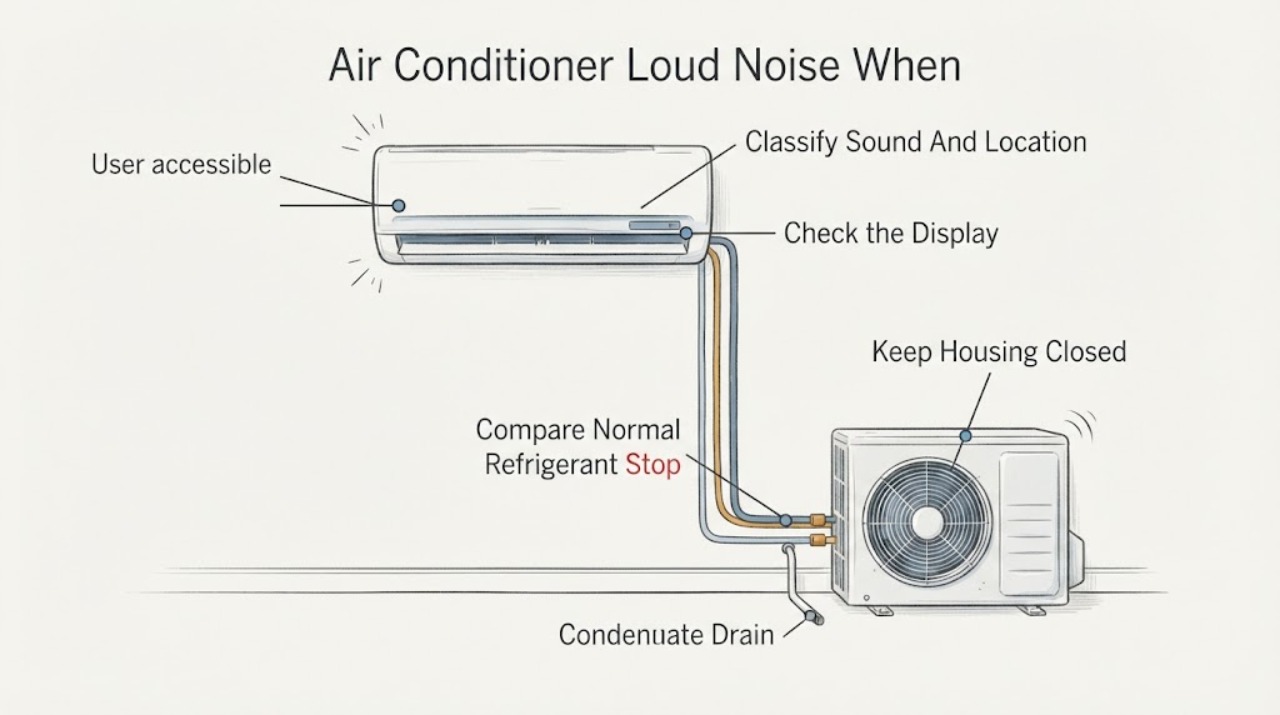
Work through in order
Diagnostic checks
Use only checks that match the exact appliance or system and its official guide.
-
Check 1
From a safe position, identify whether the loud noise is at the indoor head, outdoor unit, drain outlet, or a visible line or mounting surface, and describe it as a hiss, sigh, creak, trickle, click, hum, rattle, bang, scrape, or grind. Record when it starts after the stop command and whether it ends on its own.
Expected result: The sound is brief and directly tied to stopping, or it is loud, continuous, worsening, or mechanically harsh; its location is indoor, outdoor, or uncertain.
Next step: Continue only with the matching low-risk branch when there is no odor, smoke, water, ice, or electrical symptom; otherwise leave the system off and arrange HVAC service.
Stop if: Stop immediately for smoke, burning odor, sparking, electrical buzzing with heat, a falling or loose outdoor unit, active water near electrical equipment, or a carbon-monoxide or other building emergency.
Why this matters
Why: A brief post-stop hiss or creak can fit refrigerant flow change or thermal movement described in an official manual. A persistent bang, scrape, grind, or uncertain source is not identified safely by sound alone.
-
Check 2
Confirm that the affected mini-split actually received an off command and is not in fan-only, dry, timer, sleep, self-clean, or a model-specific post-run mode. In a multi-zone installation, check the normal user controls for other indoor heads and note whether any other zone is still operating; do not change wiring or enter service menus.
Expected result: Another zone is running, a timer or post-run state is displayed, or every zone is off while the noise remains.
Next step: Allow the documented post-run period to finish and record whether the noise fades; if it remains loud after all zones are off, use the service branch rather than repeatedly cycling power.
Stop if: Do not repeatedly command the system on and off, defeat a control lock, open a panel, or continue if the unit heats abnormally, smells burnt, sparks, or trips a breaker.
Why this matters
Why: A stopped head can still have a faint refrigerant or drainage sound when another head operates, while a noise that remains with all zones off is less consistent with that explanation.
-
Check 3
Without touching refrigerant lines or opening the unit, listen from a safe distance for a short hiss immediately after stopping and compare its duration and loudness with the same system's ordinary stop behavior. Do not use a gauge, loosen a fitting, or infer a charge from the noise.
Expected result: The hiss is brief and fades, or it is loud, prolonged, present when all zones are off, or accompanied by ice, poor cooling, or a visible oily/wet line condition.
Next step: For the brief isolated sound, document it and monitor without intrusive testing. For a prolonged sound or any performance/ice symptom, leave cooling off and arrange an HVAC leak and system diagnosis.
Stop if: Stop and keep clear for suspected refrigerant release, strong hissing with a visible leak, frost or ice, dizziness, breathing difficulty, smoke, or any need to access the sealed circuit.
Why this matters
Why: Daikin identifies a hiss at stopping as refrigerant flow stopping or changing, but Carrier lists hissing with ice or reduced performance as a possible low-refrigerant sign requiring professional attention. Sound alone cannot distinguish normal equalization from a leak or restriction.
-
Check 4
With operation stopped and only from ordinary safe access, look for water under the indoor head, a full drain pan, a drain hose that is visibly displaced, or a condensate pump that starts when water is present. Do not remove a drain hose, pour chemicals, climb unsafely, or reach into the cabinet.
Expected result: There is no water and the sound fades, a faint pump or trickle occurs briefly, or water remains, leaks indoors, or the pump makes a loud repeated hum.
Next step: Keep the system off if water is leaking or the pump noise persists, protect nearby contents without touching electrical equipment, and arrange HVAC service to inspect the drain path and pump.
Stop if: Do not approach wet electrical equipment, touch a wet controller, remove panels, or continue if water is spreading, the ceiling or wall is damaged, or the unit could fall.
Why this matters
Why: A short drain sound can be a normal pump cycle on some systems, but water leakage, a blocked drain, or a pump that runs loudly without clearing water can damage the room and needs diagnosis.
-
Check 5
After the system is off, inspect only visible and user-accessible areas: a dirty filter, leaves or debris around the outdoor cabinet, a loose-looking cover, or contact between the cabinet and a wall, bracket, pipe cover, or nearby object. Do not remove the outdoor fan guard or cabinet, and do not hand-spin any fan.
Expected result: The visible area is clear and secure, or debris, vibration contact, a shifted line cover, damaged mounting, or a loose part is apparent.
Next step: Only remove loose debris that is safely reachable without touching the equipment; leave the system off and request HVAC service for mounting, fan, guard, line, or cabinet damage.
Stop if: Stop for a loose or leaning unit, exposed wiring, sharp fins, a damaged guard, moving fan, smoke, burning odor, or any need to enter the cabinet.
Why this matters
Why: Restricted airflow, external contact, or mounting vibration can amplify noise, but a visible clue does not authorize tightening, bending, or internal repair. A damaged foundation or guard is a professional boundary.
-
Check 6
From a safe distance, note any electrical buzz or crackle, burning-plastic odor, smoke, visible arc, hot disconnect or panel, flickering display, or breaker trip that appeared with the noise. Do not open the disconnect or breaker panel, use test instruments, or keep resetting a trip.
Expected result: No electrical warning is present, or the noise is accompanied by heat, odor, smoke, arcing, flicker, or a trip.
Next step: For any electrical warning, keep people away, leave the system off, and contact an electrician or HVAC professional; use emergency services for active smoke or fire. Do not restore a breaker that trips.
Stop if: Do not touch hot equipment, wet switches, exposed conductors, or an arcing enclosure, and do not use water on an energized electrical fire.
Why this matters
Why: A quiet post-stop sound without hazard signs can be documented for normal comparison. Electrical warning signs can indicate a dangerous fault even when the equipment is nominally off because power may still be present.
-
Check 7
Prepare a service record with the equipment brand and model if visible, single-zone or multi-zone layout, indoor/outdoor sound location, sound description, start and stop timing, other zones' state, water or ice, airflow or cooling changes, visible damage, and any electrical warning. Do not perform another sound test once a service trigger is present.
Expected result: The record shows either a short repeatable post-stop sound with no other symptom or a persistent/new sound with a mechanical, drainage, refrigerant, performance, or electrical clue.
Next step: Keep the system off when the sound is persistent, loud, or associated with any hazard, and give the record to a qualified HVAC technician. Use emergency services for active fire, smoke, or immediate electrical danger.
Stop if: Do not open panels, remove guards, touch refrigerant connections, bypass controls, hand-spin fans, or repeatedly cycle a system that is noisy or unsafe.
Why this matters
Why: This separates a possible normal operating sound from a fault that requires sealed-system, fan, pump, mounting, drainage, or electrical diagnosis; it prevents a technician from guessing across mini-split designs.
Use your observations
Decision map
Find the observation that best matches what you see, then follow the next safe action.
-
PATH 01Safety boundary
What you see
The sound is a brief hiss immediately after stopping, fades without water or performance symptoms, and no other zone or hazard is involved.
Do this next
Record the timing and monitor ordinary operation. Arrange service if it becomes loud, lasts longer, changes character, or is joined by ice, reduced cooling, or a leak sign.
Why this path and its safety boundary
Why it matters: This pattern is consistent with the official description of refrigerant flow stopping or changing, but it is not proof that every system sound is normal.
Safety stop: Do not open the sealed circuit, loosen fittings, add refrigerant, or use a sound-only diagnosis to justify continued operation with unsafe signs.
-
PATH 02Safety boundary
What you see
The affected head is off but another indoor head is running, or the outdoor compressor/fan continues briefly after the stop command and then fades.
Do this next
Confirm the sound stops after the other zone and documented post-run period end. If it remains loud with every zone off, request HVAC diagnosis.
Why this path and its safety boundary
Why it matters: A shared multi-zone system can keep refrigerant moving through a stopped head, and some outdoor systems use a short post-run period.
Safety stop: Do not defeat zoning controls, remove guards, or continue if the run-on is accompanied by smoke, burning odor, ice, water, impact, or electrical symptoms.
-
PATH 03Safety boundary
What you see
The sound is a short low pump/trickle near the drain, or a loud repeated pump-like noise occurs with water under the indoor unit.
Do this next
Keep the system off if water is leaking or the pump repeats without clearing it; arrange HVAC service for the drain hose, pan, pump, or blockage.
Why this path and its safety boundary
Why it matters: Some systems use a drain pump, but water leakage or a pump that cannot clear condensate can cause property damage and is not a normal-noise conclusion.
Safety stop: Do not touch wet electrical equipment, remove the drain path, pour chemicals, or continue when water reaches wiring, ceilings, walls, or flooring.
-
PATH 04Safety boundary
What you see
The noise is banging, grinding, scraping, rattling, or a new vibration that remains after every zone is off.
Do this next
Leave the system off and arrange qualified HVAC service. Provide the location, timing, sound type, and visible mounting or debris observations.
Why this path and its safety boundary
Why it matters: External contact, mounting, fan, motor, bearing, or another mechanical condition is possible, but the internal cause cannot be selected from a homeowner listening test.
Safety stop: Do not remove a fan guard, hand-spin a fan, tighten internal parts, bend refrigerant lines, or operate a loose, leaning, or damaged outdoor unit.
-
PATH 05Safety boundary
What you see
The sound is electrical buzzing or crackling, or it occurs with burning odor, smoke, arcing, heat, a breaker trip, a suspected refrigerant release, ice, or breathing symptoms.
Do this next
Stay clear, keep the unit off, and contact emergency services for active smoke/fire or immediate danger, an electrician for electrical symptoms, and a qualified HVAC professional for equipment diagnosis from a safe location.
Why this path and its safety boundary
Why it matters: This is a safety boundary rather than a troubleshooting branch; the system may remain energized or present a fire, shock, refrigerant, or property hazard while nominally off.
Safety stop: Do not touch wet or hot equipment, reset a tripped breaker, operate switches near suspected gas/refrigerant or smoke hazards, open panels, or attempt leak or live-voltage testing.
Helpful context
Understand the symptom
First identify what is still making the noise
Turning one indoor head off does not always stop every sound immediately. In a multi-zone system, another indoor unit can keep refrigerant moving through a stopped head. Some outdoor equipment also runs briefly after a stop, and a condensate pump can run as it clears water. These explanations fit a short, repeatable sound with no other symptom; they do not explain a new loud mechanical or electrical noise. Note whether the sound comes from the wall-mounted indoor unit, the outdoor unit, a drain outlet, or a nearby line or mounting surface.
Separate normal stop noises from a developing fault
A brief hiss directly after stopping can be a refrigerant flow change, and a short creak after heating can be thermal movement of plastic parts. A low sigh or trickle can be associated with drainage or operation elsewhere in a shared system. The important change is the pattern: loudness, duration, repetition, grinding, impact, scraping, or a sound that remains while every zone is off moves the decision toward service. Do not diagnose refrigerant charge, a fan motor, a pump, or a compressor by sound alone.
Keep checks external and stop for safety signs
With the equipment off and a dry approach, it is reasonable to read the remote display, observe visible water or ice, check an accessible filter, and look for leaves or other debris around the outdoor cabinet without removing guards or panels. Carrier recommends professional inspection of refrigerant lines, mounting hardware, and electrical connections, and lists strange noises and indoor water leaks as reasons to call. Smoke, a burning smell, sparking, a hot disconnect, repeated breaker trips, or water reaching electrical equipment is not a listening exercise: stay clear and use the appropriate emergency or HVAC service path.
Safety boundary
Stop conditions
- Stop using the mini-split for smoke, fire, sparking, crackling, burning odor, a hot disconnect or panel, exposed wiring, shock, or a breaker that trips again; stay clear and use emergency or electrical service as appropriate.
- Stop for active water leakage, water near electrical equipment, a damaged wall or ceiling, a loose or leaning outdoor unit, or ice with reduced airflow; do not touch wet controls or open the cabinet.
- Do not open panels, remove fan guards, hand-spin fans, loosen refrigerant fittings, add refrigerant, use gauges, bypass controls, or repeatedly reset power.
- Stop for a new continuous hiss with suspected refrigerant release, dizziness, breathing difficulty, or any need to access the sealed circuit; leave diagnosis to a qualified HVAC professional.
- Keep the system off and arrange qualified HVAC service for loud persistent noise, grinding, banging, scraping, repeated pump noise, abnormal run-on, reduced cooling, ice, or a noise that remains with all zones off.
When checks do not resolve it
Need a professional?
Arrange qualified HVAC service when the noise is loud, new, persistent, worsening, mechanically harsh, repeatedly pump-like, associated with water, ice, reduced airflow or cooling, or present after every mini-split zone is off. Provide the sound location, exact timing, multi-zone status, visible observations, and model information if available. Use emergency services for active smoke, fire, immediate electrical danger, or a serious building hazard; do not perform internal, sealed-system, or live electrical tests.
Safety scope: This article supports safe external observation, normal control-state checks, visible filter/debris checks, and recording sound timing. It does not authorize panel removal, fan-guard removal, sealed-system work, refrigerant measurement or charging, live electrical testing, repeated breaker resets, or hand-spinning a fan.
Common questions
FAQ
Is a hiss after turning off a mini-split always a refrigerant leak?
No. A brief hiss immediately after stopping can be refrigerant flow stopping or changing on some systems. A prolonged or new hiss, especially with ice, reduced cooling, water, or a suspected release, needs the system left off and professional HVAC diagnosis; do not loosen fittings or use gauges.
Why can an indoor mini-split head make noise when it is off?
In a multi-zone system, another indoor unit may still be operating and a small amount of refrigerant can continue to flow through the stopped head. A drain pump or a short post-run sequence can also make a sound. If every zone is off and the noise is loud or persistent, arrange service.
Should the outdoor mini-split stop immediately when I press Off?
Not necessarily. An official Daikin manual describes outdoor compressor run-on that may stop after a short period, including five to ten minutes in that system, to manage oil and refrigerant. Do not apply that timing to every model; persistent, loud, or harsh noise is a service trigger.
What makes a mini-split noise an emergency?
Smoke, fire, sparking, crackling with heat, burning odor, exposed wiring, water reaching electrical equipment, a hot disconnect, or a repeated breaker trip requires staying clear and using emergency or electrical service as appropriate. Keep the HVAC system off and do not open panels or reset repeatedly.
Read the exact guide
Official sources
- Ductless Mini Split MaintenanceCarrier · Official Carrier ductless mini-split maintenance guidance; use the installed system's exact manual for model-specific procedures.
- Operation manualDaikin Comfort · Official Daikin operation manual; exact mini-split or multi-zone model manual controls when the installation differs.
Community feedback
Share a repair observation
Share a plain-text repair observation. Accepted observations are published automatically; this page may take a moment to update.