
On this page
Start here
Quick answer
A loud noise that seems to come from the blower wheel of an American Standard central air conditioner can be caused by a restricted filter or return, a loose or damaged blower-wheel or housing component, motor or bearing wear, belt or pulley trouble, vibration, or sound transmitted through the ductwork. From a safe position, note whether the sound is rattling, scraping, humming, squealing, or vibrating; check the external filter and return path; and compare the noise with airflow, cooling, and startup or shutdown. American Standard says homeowners can check or replace filters but should use a dealer for complicated motor and blower-bearing work, while manufacturer HVAC guidance treats a new loud indoor noise, vibration, burning smell, or weak airflow as a service issue. Do not remove the blower cover, reach into the wheel, lubricate internal parts, or keep running through smoke, burning odor, electrical symptoms, or severe vibration.
Before you begin
Safety first
- Do not remove the blower cover or wheel, lubricate bearings, adjust belts or pulleys, probe wiring, alter fan speed or electrical settings, bypass a safety control, or run the unit with smoke, burning odor, exposed wiring, severe vibration, or water near electrical parts.
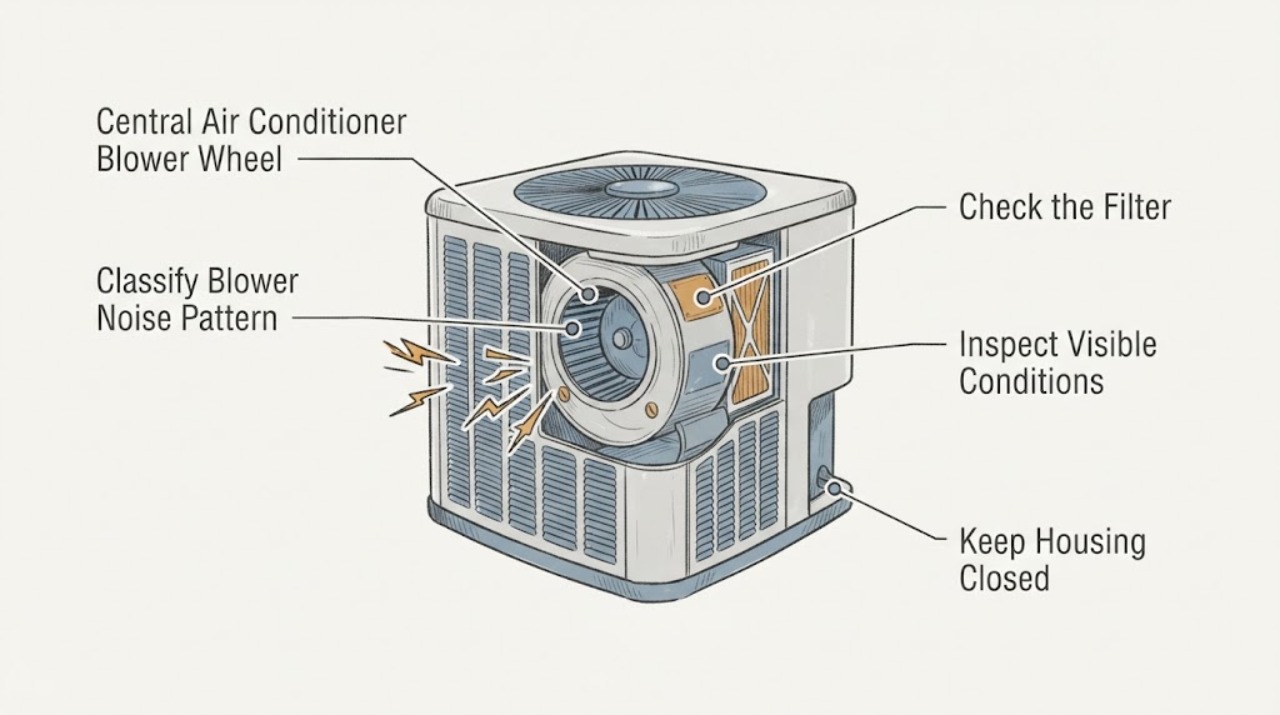
Work through in order
Diagnostic checks
Use only checks that match the exact appliance or system and its official guide.
-
Check 1
From a safe position, listen to the American Standard indoor unit and nearby registers without opening the cabinet or changing service settings. Record whether the sound is a rattle, scrape, thump, squeal, hum, whine, or strong vibration, and whether it begins at startup, continues while running, or occurs at shutdown.
Expected result: The noise is new and loud, rhythmic with blower speed, a single scrape or thump, continuous vibration, a high-pitched squeal, or accompanied by weak airflow, an odor, or a system shutdown.
Next step: Make a short recording from a safe location and note cooling performance and airflow. Arrange HVAC service for a new, loud, persistent, or worsening sound rather than repeatedly cycling the system to reproduce it.
Stop if: Turn the system off and leave the equipment area for smoke, burning electrical or plastic odor, sparking, exposed wiring, severe vibration, or an object striking the wheel.
Why this matters
Why: A rhythmic rattle or scrape makes a wheel, housing, fastener, or motor-related issue plausible; a hum can involve the blower motor; vibration can also come from duct or cabinet contact. The sound alone cannot identify a replacement part.
-
Check 2
With the system off, inspect the user-accessible air filter and return grille. Replace a dirty or damaged filter with the size and airflow direction specified by the equipment documentation, and remove only obvious room-side obstructions such as furniture or drapes from the return path.
Expected result: The filter is visibly loaded, collapsed, wet, or incorrectly installed; the return grille is blocked; airflow improves after a correct filter change; or the loud noise remains unchanged.
Next step: Run the system only with a correctly fitted filter and clear return path. If the noise persists, airflow is weak, or the filter repeatedly becomes wet or collapses, arrange qualified HVAC diagnosis.
Stop if: Do not operate without a filter, install a filter that does not fit, block a return, or reach through the grille toward the blower wheel.
Why this matters
Why: American Standard says a dirty filter can put the air handler into overdrive, and a starved return can reduce airflow. Improvement supports an airflow restriction; unchanged loud noise points toward the blower assembly, motor, duct, or another fault.
-
Check 3
From outside the cabinet, observe airflow at several supply registers and the return, and look for a loose accessible grille, duct panel, or cabinet vibration without removing covers or touching moving parts. Note whether rooms receive uneven airflow or whether the noise seems louder at a register than at the air handler.
Expected result: Airflow is weak or uneven, one register or duct vibrates, the cabinet contacts a nearby surface, the filter and return are clear, or airflow is normal while the blower noise remains loud.
Next step: Remove only an obvious room-side obstruction and report the apparent sound location to the HVAC technician. Do not seal, brace, or disassemble the air handler as a noise experiment.
Stop if: Do not enter the cabinet, touch the wheel, steady a vibrating panel by hand while running, or work near exposed electrical parts.
Why this matters
Why: American Standard links duct barriers and return-air limitations with airflow problems; a loose grille or duct can amplify a normal motor sound. Normal airflow with a loud indoor sound makes an internal blower-wheel, motor, bearing, or housing problem more likely.
-
Check 4
Compare the loud blower noise with cooling delivery, thermostat response, visible frost on accessible surfaces, water below the indoor unit, and any recent filter or duct change. Use existing observations only; do not force a defrost cycle or remove an access panel.
Expected result: Cooling is weak, airflow is reduced, frost or water appears, the system shuts down, or cooling and airflow remain normal despite the noise.
Next step: Turn the system off if it is icing, leaking, overheating, or repeatedly shutting down, and arrange HVAC service. Provide the timing of the noise and the cooling or airflow symptoms.
Stop if: Do not keep operating through ice, water near electrical parts, burning odor, smoke, or repeated protective shutdown.
Why this matters
Why: A restricted filter or airflow problem can affect coil operation, while water or frost can indicate a condition that needs service. Normal cooling does not make a loud new blower sound harmless; wheel, motor, bearing, or housing issues can still worsen.
-
Check 5
Record the American Standard model, indoor-unit location, sound type and recording, startup or running timing, filter age and condition, return and supply airflow, cooling response, vibration, frost or water, odors, and any recent installation or service. Keep the cabinet closed for the technician.
Expected result: The noise persists after the filter and return check, returns after service, increases with blower speed, or occurs with weak airflow, vibration, overheating, or a protective shutdown.
Next step: Arrange qualified American Standard HVAC service and request inspection of the blower assembly, wheel clearance, motor or bearing, belt or pulley where fitted, cabinet and duct vibration, filter, return, and electrical condition.
Stop if: Do not remove the blower assembly, lubricate bearings, adjust a belt, probe wiring, or bypass a safety control.
Why this matters
Why: Persistence or a combined noise and airflow or safety symptom favors a blower wheel, housing, motor, bearing, belt, pulley, duct, or control diagnosis. A wheel or motor part should not be selected from the sound description alone.
Use your observations
Decision map
Find the observation that best matches what you see, then follow the next safe action.
-
PATH 01Next step
What you see
The filter is dirty or incorrectly fitted, the return is blocked, and airflow or noise improves after the correct external filter or return correction.
Do this next
Keep the correct filter installed and the return unobstructed, then arrange service if the noise returns, airflow stays weak, or the filter rapidly loads or collapses.
Why this path and its safety boundary
Why it matters: An airflow restriction likely contributed to the blower strain or sound, although a damaged wheel or motor is not ruled out if noise continues.
-
PATH 02Next step
What you see
A new rattle, scrape, thump, or rhythmic vibration follows blower speed while the filter and return path are clear.
Do this next
Turn the system off if the noise is severe or worsening and arrange qualified HVAC inspection of the blower assembly. Do not reach into the cabinet or select a wheel from appearance alone.
Why this path and its safety boundary
Why it matters: A blower wheel, housing, fastener, motor, bearing, or cabinet or duct vibration is more likely than a routine airflow sound.
-
PATH 03Next step
What you see
Airflow and cooling are normal but the indoor unit develops a persistent squeal, whine, or loud hum.
Do this next
Arrange service and provide the noise timing and recording. Leave motor, bearing, belt, pulley, and wheel work to an American Standard dealer or qualified HVAC technician.
Why this path and its safety boundary
Why it matters: The motor, bearing, belt or pulley where fitted, or another rotating component may be involved; normal cooling does not clear an internal mechanical fault.
-
PATH 04Next step
What you see
The loud blower sound occurs with weak or uneven airflow, frost, water below the indoor unit, poor cooling, or repeated shutdown.
Do this next
Turn the system off when safe and request prompt HVAC service. Protect nearby property from water and report the filter, airflow, frost, and shutdown pattern.
Why this path and its safety boundary
Why it matters: An airflow, coil, drain, blower, or control condition may be interacting with the noise and can cause additional equipment damage if operation continues.
-
PATH 05Next step
What you see
There is a burning electrical or plastic odor, smoke, sparking, exposed wiring, severe vibration, an object striking the wheel, or water near electrical equipment.
Do this next
Leave the equipment area, keep people away, shut off the system at a safe control or disconnect only if it can be done without entering the hazard, and use local emergency guidance for immediate danger. Arrange qualified HVAC service after the area is safe.
Why this path and its safety boundary
Why it matters: This is an immediate fire, electrical, moving-part, or water hazard, not a filter or noise adjustment.
Helpful context
Understand the symptom
The blower wheel is inside the indoor air handler or furnace cabinet, so a sound that appears to come from it should be diagnosed by pattern rather than by reaching into the assembly. A dirty filter, restricted return, loose cabinet or duct panel, wheel imbalance, motor or bearing problem, and airflow-related coil condition can sound similar from a room register.
American Standard's maintenance guidance separates homeowner filter care from complicated motor and blower-bearing work. Keep the system off for an external inspection, and leave cabinet access, electrical diagnosis, wheel removal, bearing lubrication, and belt or pulley work to a qualified HVAC professional.
Only after diagnosis
Potential parts
- American Standard blower wheel or blower housing
Consider this category only if a qualified technician confirms wheel imbalance, damage, contact, or housing damage after checking airflow, filter, return, and cabinet or duct vibration.
Wheel dimensions, rotation, housing, shaft, and mounting vary by exact indoor-unit model; confirm professional fitment before ordering. - American Standard blower motor or bearing assembly
Consider this category only when service diagnosis confirms motor, bearing, or rotating-assembly wear as the source of the loud noise.
Motor type, speed control, shaft, mounting, and bearing arrangement are model-specific and require qualified confirmation. - American Standard blower belt or pulley hardware
Consider this category only if the specific air handler uses a belt drive and a qualified technician confirms belt or pulley wear, misalignment, or damage.
Not every model uses a belt drive; confirm the exact equipment configuration and professional fitment before selecting a component.
When checks do not resolve it
Need a professional?
Arrange qualified American Standard HVAC service for a new, loud, persistent, or worsening blower-wheel noise, especially with vibration, weak airflow, a squeal or scrape, frost, water, poor cooling, or repeated shutdown. Stop immediately for burning electrical or plastic odor, smoke, sparking, exposed wiring, severe vibration, water near electrical equipment, or an object striking the wheel.
Safety scope: Do not remove the blower cover or wheel, lubricate bearings, adjust belts or pulleys, probe wiring, alter fan speed or electrical settings, bypass a safety control, or run the unit with smoke, burning odor, exposed wiring, severe vibration, or water near electrical parts.
Have this ready
- Provide the American Standard model, indoor-unit location, sound description or recording, timing, filter and return condition, airflow and cooling response, frost or water, vibration, odors, shutdown behavior, and recent installation or service history.
Common questions
FAQ
Why is my American Standard central air conditioner blower wheel making a loud noise?
A loud blower-area sound can involve a dirty filter or restricted return, a loose or damaged wheel or housing, motor or bearing wear, belt or pulley trouble where fitted, or a vibrating cabinet or duct. Check only the external filter and return path; leave internal diagnosis to qualified HVAC service.
Can a dirty filter cause a loud blower sound?
Yes. American Standard says a dirty filter can make an air handler work harder and that return-air restrictions can affect blower airflow. Replace a dirty filter with the model-specified type and direction; if the noise remains, arrange service.
Should I remove the blower cover to inspect the wheel?
No. The wheel and motor are inside the air-handler cabinet, and American Standard assigns complicated blower-bearing and motor work to a dealer. Record the sound, check the external filter and return, and arrange qualified diagnosis instead of reaching inside.
What if the blower noise comes with weak airflow, frost, or water?
Turn the system off when safe and arrange prompt HVAC service. A filter, return, coil, drain, blower, or control problem may be involved, and continued operation can worsen equipment or water damage. Protect nearby property and report the full symptom pattern.
When is a loud American Standard blower noise urgent?
Stop immediately for burning electrical or plastic odor, smoke, sparking, exposed wiring, severe vibration, water near electrical equipment, or an object striking the wheel. For a persistent loud rattle, scrape, squeal, or hum without immediate danger, arrange qualified HVAC service and provide a recording.
Read the exact guide
Official sources
- Air Handler Troubleshooting - Contact a Local DealerTrane · Manufacturer air-handler airflow, filter, coil, water, blower-motor, and professional service guidance
- Is This Normal? HVAC Smells and Sounds, ExplainedTrane · Manufacturer HVAC noise patterns, blower-wheel or motor possibilities, vibration, hissing, odors, and service escalation
- Air Handler Maintenance TipsAmerican Standard · American Standard air-handler filter care, noise and vibration observation, blower-bearing work, and professional maintenance boundary
- Air Handler TroubleshootingAmerican Standard · American Standard air-handler return airflow, blower assembly, fan, duct, and filter troubleshooting
Community feedback
Share a repair observation
Share a plain-text repair observation. Accepted observations are published automatically; this page may take a moment to update.