
On this page
Start here
Quick answer
A new or unusually loud American Standard central-air-conditioner sound should be treated as a change in system behavior, not diagnosed by noise name alone. First note whether the sound comes from the indoor air handler, ductwork, or outdoor condenser and whether it happens at startup, during cooling, continuously, or at shutdown. From a safe position, check the thermostat setting, a visibly dirty filter, blocked return or supply registers, and leaves or debris around the outdoor unit without opening the cabinet or touching the fan. Rattling, grinding, scraping, high-pitched squealing, repeated hard starting, loud humming, hissing, burning odor, smoke, a frozen coil, or a damaged fan blade requires the system to be turned off and a qualified HVAC technician. A filter or airflow correction may help when the filter is visibly dirty, but it will not confirm a bad motor, capacitor, compressor, control, refrigerant circuit, or loose internal part. Do not remove panels, handle refrigerant, test a capacitor, oil a motor, or keep cycling the system to reproduce the noise.
Before you begin
Safety first
- Keep the system off for smoke, burning or electrical odor, arcing, a hot cabinet, hissing near refrigerant components, damaged fan blades, severe vibration, water near electrics, exposed wiring, or repeated breaker trips. Do not open the cabinet or handle refrigerant or capacitors.
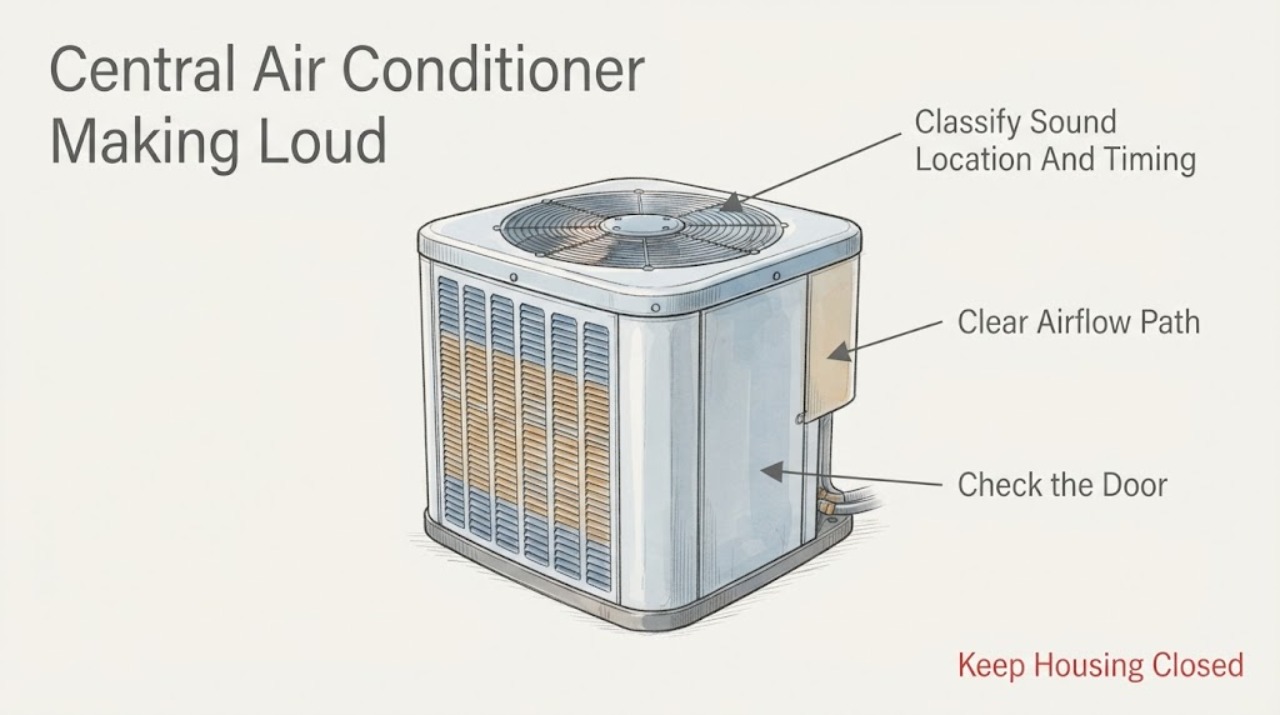
Work through in order
Diagnostic checks
Use only checks that match the exact appliance or system and its official guide.
-
Check 1
From outside the equipment's moving and electrical parts, note whether the loud noise is at the indoor air handler, outdoor condenser, duct or register, or thermostat, and whether it starts at startup, continues while cooling, or occurs at shutdown. Do not open either unit to listen closer.
Expected result: The noise is a new indoor hum or squeal, an outdoor rattle or high-pitched sound, a bang or hard start, a duct ping, or a hiss near the indoor coil or outdoor refrigerant lines.
Next step: Record a brief description and when it occurs, then use only the matching external checks below. Turn the system off for sudden loudness, grinding, scraping, hissing, burning odor, or hard starting and arrange service.
Stop if: Do not stand over an outdoor fan, remove a grille, or put hands or tools near moving parts.
Why this matters
Why: Location and timing narrow the diagnostic path: indoor sounds can involve the blower or airflow, outdoor sounds can involve the fan or compressor, and duct sounds can involve expansion or vibration. A new or intrusive change is more concerning than a known normal operating sound, but the sound does not identify a part by itself.
-
Check 2
Check the thermostat's mode and fan setting, then inspect the accessible air filter and return or supply registers. If the filter is visibly dirty, replace it only with the exact type and orientation specified by the manual; keep registers open and unobstructed.
Expected result: The thermostat is not calling for cooling, the filter is dirty or wet, a register is blocked, airflow is weak, or the external airflow checks are normal but the noise remains.
Next step: Correct only the thermostat, filter, or register condition documented for the system and observe one normal cycle. If noise or weak airflow remains, turn the system off and arrange HVAC diagnosis rather than trying to clean internal coils or motors.
Stop if: Stop for water at the filter or air handler, ice, burning smell, smoke, a hot electrical odor, or a filter that cannot be removed without opening a cabinet.
Why this matters
Why: A thermostat state, restricted filter, or blocked register can alter airflow and make the system work harder. A wet filter, weak airflow, or persistent noise after a correct filter change can indicate a frozen coil, blower problem, duct restriction, or another fault that an external check cannot confirm.
-
Check 3
With the thermostat off and without touching the outdoor unit, look around the cabinet for leaves, grass, a loose-looking exterior cover, a damaged fan blade visible through the top grille, or an unstable mounting surface. Clear only loose debris outside the cabinet while power remains isolated as the manual directs; never remove the grille or reach inside.
Expected result: The outdoor coil area is obstructed, a fan blade is broken or strikes something, the cabinet vibrates, the unit is visibly unlevel, or no external cause is visible.
Next step: Remove only loose exterior debris if safe and permitted, then make one supervised cooling attempt only when no safety symptom exists. If the noise returns, the fan blade is damaged, or the cabinet vibrates, keep the system off and call service.
Stop if: Do not touch the fan, straighten a blade, remove the grille, tighten internal hardware, or continue if the cabinet is sparking, smoking, hot, or leaking refrigerant.
Why this matters
Why: Obstructed airflow, a damaged or unbalanced fan blade, vibration against a surface, and an unlevel unit can produce noise or stress. A normal exterior does not rule out a fan motor, capacitor, compressor, contactor, or internal mounting problem.
-
Check 4
Record associated symptoms without opening the system: no or weak airflow, warm air, ice on accessible refrigerant lines or the indoor coil enclosure, water, short cycling, a breaker trip, an electrical or burning odor, or hissing. Do not touch refrigerant, ice, wiring, or a hot cabinet.
Expected result: The system is cooling normally with only a mild known sound, the noise accompanies weak or warm airflow, ice or water, repeated starts, hissing, or an electrical or burning odor.
Next step: For any associated fault, turn the system off and give the technician the sound timing, location, and symptoms. Do not add refrigerant, thaw ice with heat, reset a repeatedly tripping breaker, or restart to reproduce the condition.
Stop if: Stop immediately for smoke, electrical or burning odor, exposed wiring, refrigerant leakage, water near electrical components, or repeated breaker trips.
Why this matters
Why: A noise paired with airflow or ice can involve a filter, blower, frozen coil, or refrigerant issue. Repeated starts or hissing can indicate compressor, electrical, or refrigerant trouble. Burning odor, smoke, or a hot electrical condition is a safety event rather than a routine maintenance symptom.
-
Check 5
If the filter, registers, thermostat, and visible outdoor area are normal and no safety symptom exists, make at most one brief, supervised cooling call to confirm when the noise starts. Then turn the system off and save the sound description, model information, and any related symptom for service; do not run repeated tests.
Expected result: The noise is absent, returns at startup, continues while running, occurs only at shutdown, or becomes louder or is accompanied by vibration, odor, poor cooling, or a breaker trip.
Next step: Keep the system off for a returning or worsening noise and arrange qualified HVAC service. Provide the American Standard model, indoor or outdoor location, timing, filter and airflow observations, and any sound recording made from a safe distance.
Stop if: Do not repeat the call, open panels, test capacitors, lubricate motors, handle refrigerant, or operate through smoke, odor, arcing, or abnormal heat.
Why this matters
Why: A repeatable phase helps a technician separate startup electrical or compressor behavior, steady fan or blower operation, and shutdown vibration. A noise that changes or worsens remains a service concern even if cooling continues.
Use your observations
Decision map
Find the observation that best matches what you see, then follow the next safe action.
-
PATH 01Safety boundary
What you see
The noise began suddenly or is accompanied by smoke, burning or electrical odor, sparks, arcing, a hot cabinet, refrigerant hissing, water near electrical parts, or a breaker that trips.
Do this next
Turn the system off and isolate power only from a safe dry location if possible. Keep clear and obtain qualified HVAC service; use emergency help for fire, gas, or immediate danger.
Why this path and its safety boundary
Why it matters: Continued operation could worsen an electrical, refrigerant, motor, compressor, or water-related hazard.
Safety stop: Do not restart to identify the sound or touch the cabinet, wiring, refrigerant, or capacitor.
-
PATH 02Safety boundary
What you see
The loud noise is outdoors and includes rattling, scraping, vibration, or a visibly damaged or unbalanced fan blade.
Do this next
Keep the outdoor unit off and arrange HVAC inspection. Clear only loose debris outside the cabinet if safe; do not remove the grille or straighten or replace a blade.
Why this path and its safety boundary
Why it matters: A fan blade, motor, compressor, loose internal component, mounting surface, or unit level may be involved; the fan can cause additional damage if it continues.
Safety stop: Do not reach through the grille or stand over a running fan.
-
PATH 03Safety boundary
What you see
The sound is indoors and comes with weak airflow, a dirty or wet filter, warm air, or ice at the indoor coil area.
Do this next
Turn cooling off, inspect or replace the accessible filter as directed, and arrange service for ice, weak airflow, persistent noise, or warm air. Do not heat the coil or open the air handler.
Why this path and its safety boundary
Why it matters: Restricted airflow, a blower or motor problem, a frozen coil, or a refrigerant-related fault is possible; filter replacement alone cannot confirm the cause.
Safety stop: Stop for water near electrics, burning odor, exposed wiring, or a filter or panel that cannot be accessed safely.
-
PATH 04Safety boundary
What you see
The noise is a bang, clunk, or unusually loud start or stop, especially when the sound is new or the system struggles to start.
Do this next
Turn the system off after noting the phase and arrange HVAC service. Do not repeatedly cycle the thermostat or attempt capacitor or compressor work.
Why this path and its safety boundary
Why it matters: A startup or shutdown change can involve the compressor, capacitor, contactor, motor, duct movement, or mounting; a normal design sound cannot be assumed when the behavior changed.
Safety stop: Stop immediately for hard starting, repeated clicking, smoke, electrical odor, vibration, or a breaker trip.
-
PATH 05Safety boundary
What you see
The system makes a high-pitched outdoor sound or hisses near the indoor coil, refrigerant lines, or outdoor unit.
Do this next
Turn the system off and arrange qualified HVAC service. Keep people and pets away from any suspected refrigerant leak and do not handle refrigerant or open the circuit.
Why this path and its safety boundary
Why it matters: A fan motor, capacitor, compressor, loose part, refrigerant leak, or electrical issue may be involved. Hissing near refrigerant components is not a DIY recharge situation.
Safety stop: Do not continue operation, add refrigerant, or use an open flame near the system.
-
PATH 06Safety boundary
What you see
The sound is a known mild hum or normal duct expansion sound, has not changed, cooling and airflow are normal, and no odor, vibration, or safety symptom is present.
Do this next
Monitor without opening the equipment, keep the filter and outdoor area maintained, and schedule routine professional maintenance if the sound changes or other symptoms appear.
Why this path and its safety boundary
Why it matters: Some operating and duct sounds can be normal, but a change in type or volume is a more useful warning than a decibel guess.
Safety stop: Stop operation if the sound becomes loud, intrusive, metallic, repetitive, or is joined by poor cooling, vibration, odor, or electrical signs.
Helpful context
Understand the symptom
Locate and time the sound before guessing
A central system has an indoor air handler or furnace blower, an outdoor unit with a fan and compressor, and ductwork between them. Listen from a safe distance and record whether the sound is indoors, outdoors, in a register, or at a wall or cabinet. Note startup, steady cooling, cycling, and shutdown timing. A brief normal hum is different from a new rattle, scraping, squeal, bang, or repeated hard start.
Use only external maintenance checks
Set the thermostat to the intended cooling mode and inspect the accessible filter and registers. Replace a visibly dirty filter with the exact type and orientation specified by the system documentation, and clear leaves or grass around the outdoor cabinet without reaching through the grille. Do not remove panels or insert tools into either fan.
Noise patterns are clues, not part numbers
A rattle can come from vibration, a loose visible exterior panel, a blower wheel, fan, compressor, or an unlevel outdoor unit. A high-pitched outdoor noise can involve a fan motor, capacitor, compressor, or a loose part. A loud indoor hum can involve the blower motor. Hissing near an indoor coil or refrigerant line may indicate a refrigerant problem. These are diagnostic directions, not instructions to open the equipment.
When the system must remain off
Turn the system off and arrange HVAC service for a sudden loud noise, repeated hard start, grinding or scraping, a damaged fan blade, electrical or burning odor, smoke, hissing near refrigerant lines, a frozen coil, or a breaker that trips. Refrigerant, capacitors, compressors, motors, and energized wiring require trained handling.
Safety boundary
Stop conditions
- Turn the system off for sudden loudness, grinding, scraping, repeated hard starting, smoke, burning or electrical odor, sparks, arcing, a hot cabinet, refrigerant hissing, or a breaker that trips again. Isolate power only from a safe dry location.
- Stop for a broken or striking outdoor fan blade, severe vibration, a frozen coil, water near electrical components, exposed wiring, or a motor or compressor that will not start or stop normally.
- Do not remove HVAC panels, reach into a fan, test or discharge a capacitor, oil a motor, handle refrigerant, thaw ice with heat, adjust electrical controls, or bypass a safety switch.
- Do not keep cycling the thermostat or run repeated sound tests. A filter, thermostat, register, or visible debris check is the user boundary; persistent or changing noise requires qualified HVAC diagnosis.
Only after diagnosis
Potential parts
- outdoor fan blade or fan motor
Consider this only when qualified inspection confirms that the outdoor noise is caused by a damaged blade, motor, bearing, or related fan assembly.
Fan parts vary by exact American Standard model, rotation, motor specification, and assembly. Do not choose by sound or appearance. - compressor start or run component
Consider this only after a technician tests the compressor circuit and confirms a capacitor, contactor, or compressor-related fault; a hum or hard start alone is insufficient.
Capacitors and compressor components are energized and model-specific. They require qualified diagnosis and safe discharge and replacement procedures. - indoor blower motor or wheel
Consider this only if the indoor sound, airflow, and inspection identify a blower motor, wheel, bearing, or mounting fault.
Air-handler parts depend on the exact unit and control system. Do not open the cabinet or lubricate or adjust the blower based on noise alone. - filter, duct, mount, or vibration-isolation component
Consider this category only when a visibly restricted filter, duct restriction, loose accessible exterior mount, or vibration-isolation issue is confirmed and the exact system documentation supports the remedy.
Filter dimensions, duct components, and mounts must match the installed system; a filter correction does not substitute for diagnosis of an internal noise.
When checks do not resolve it
Need a professional?
Arrange qualified HVAC service for any new or persistent loud noise, rattling, scraping, grinding, squealing, hard starting, repeated clicking, hissing, weak airflow, ice, poor cooling, or vibration. Turn the system off first for an electrical or burning odor, smoke, arcing, damaged fan blade, refrigerant concern, water near electrics, or repeated breaker trips. Provide the American Standard model, noise location and timing, thermostat setting, filter and airflow observations, outdoor-unit condition, and any related symptoms.
Safety scope: Keep the system off for smoke, burning or electrical odor, arcing, a hot cabinet, hissing near refrigerant components, damaged fan blades, severe vibration, water near electrics, exposed wiring, or repeated breaker trips. Do not open the cabinet or handle refrigerant or capacitors.
Common questions
FAQ
Why is my American Standard air conditioner suddenly making a loud noise?
The location and timing matter. An indoor hum can involve the blower or airflow; outdoor rattling, squealing, or hard starting can involve the fan, motor, capacitor, compressor, or a loose component; a hiss near refrigerant components needs service. Turn the system off for a sudden loud change, vibration, odor, smoke, or poor cooling and have the complete system inspected.
Can a dirty filter cause a loud air-conditioner noise?
A dirty or wet filter can restrict airflow and contribute to a frozen coil or blower symptoms, but it does not prove the noise source. Check and replace an accessible filter only as the exact system instructions specify. If airflow is weak, ice is visible, or the noise persists, turn cooling off and arrange HVAC service.
Is outdoor air-conditioner rattling safe to ignore?
Do not ignore new or worsening rattling. It can involve a fan blade, motor, compressor, loose component, vibration, or an unlevel outdoor unit. From a safe distance, note whether the blade appears damaged and whether the cabinet vibrates, but do not remove the grille or reach inside. Keep the system off and arrange service if the noise returns.
Should I keep running the AC to identify the loud sound?
No. One brief supervised observation can document when the noise starts only when no safety symptom exists, but repeated cycling can worsen a fan, compressor, electrical, or refrigerant problem. Turn the system off for smoke, burning odor, hissing, scraping, damaged blades, abnormal heat, water near electrics, or a breaker trip, and call a qualified HVAC technician.
Read the exact guide
Official sources
- AC Fan Not Working? Reasons Why It Stopped SpinningTrane · Trane residential air-conditioner guidance used for general fan and safety clues; exact American Standard system and service manual control.
- Is This Normal? HVAC Smells and Sounds, ExplainedTrane · Trane residential HVAC guidance used for general split-system sound patterns; American Standard model documentation and a qualified technician control the actual diagnosis.
- Central Air ConditioningAmerican Standard · American Standard glossary description of common split central-air systems; packaged and other configurations can differ.
- Air Conditioner Troubleshooting Tips and TricksAmerican Standard · American Standard general central-air troubleshooting; exact system manual and qualified HVAC diagnosis control.
- Noises and Smells From Your HVAC SystemAmerican Standard · American Standard general HVAC guidance; exact equipment model and installation determine diagnosis.
Community feedback
Share a repair observation
Share a plain-text repair observation. Accepted observations are published automatically; this page may take a moment to update.