
On this page
Start here
Quick answer
A new loud noise from a central-air blower wheel is a stop-and-diagnose symptom, not a reason to reach into the air handler. Turn the system off at the thermostat, note whether the sound is scraping, rattling, humming, or accompanied by vibration or a burning smell, and check only the accessible filter and registers. Do not remove the blower panel, touch a wheel or capacitor, or keep running the unit if the sound is grinding, electrical, or burning. An HVAC professional should inspect the wheel, motor, bearings, housing, and airflow path.
Before you begin
Safety first
- Request diagnosis and repair by a qualified HVAC professional. This self-check does not include panel removal, electrical testing, blower-wheel access, capacitor discharge, or fan work.
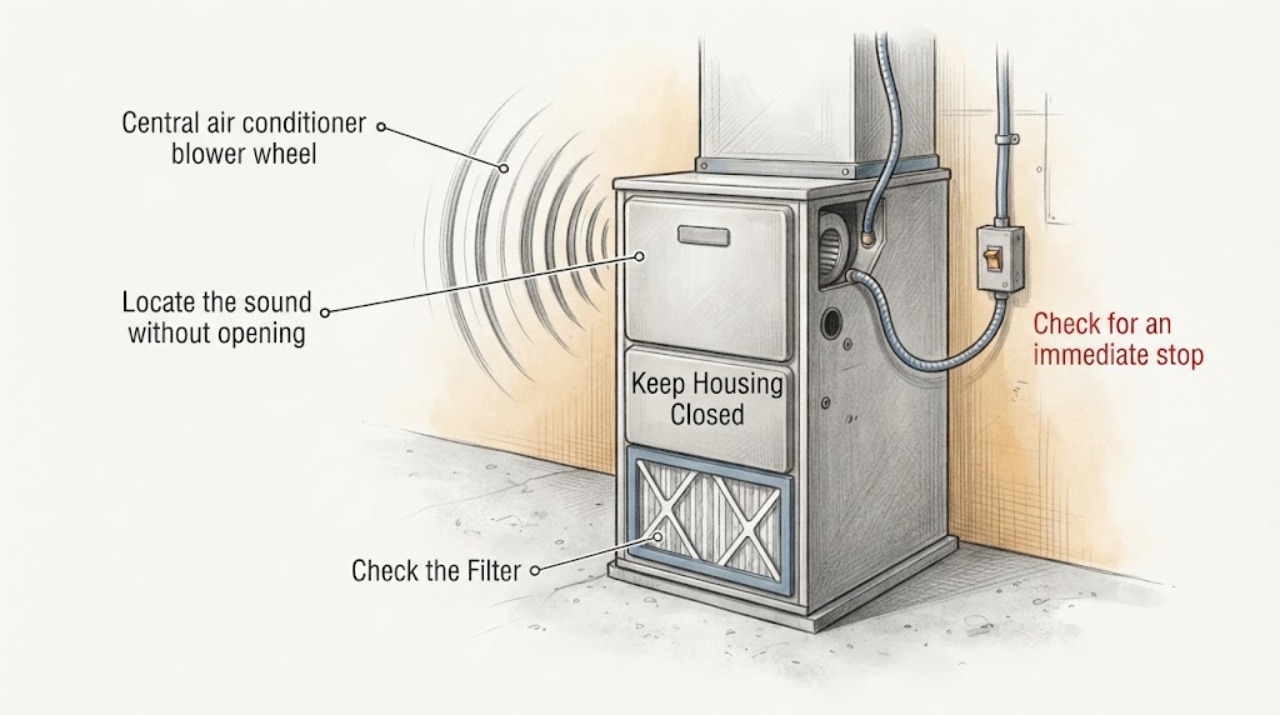
Work through in order
Diagnostic checks
Use only checks that match the exact appliance or system and its official guide.
-
Check for an immediate stop condition
Turn the system off at the thermostat and listen from outside the cabinet. Note whether the noise is grinding, scraping, banging, or accompanied by a burning/electrical smell, smoke, unusual heat, or a breaker trip.
Expected result: Yes: a stop condition is present. No: the sound is unusual but there is no smell, smoke, heat, or severe mechanical symptom.
Next step: For yes, leave the system off and request HVAC service promptly. For no, continue only with the external observations below and avoid opening the unit.
Stop if: Stop all troubleshooting if the system starts unexpectedly, smoke appears, a burning smell develops, or the cabinet becomes hot.
Why this matters
Why: A stop condition can represent moving-part damage or an electrical hazard; continued operation can worsen damage. The absence of an emergency sign does not make an internal inspection safe for a homeowner.
-
Locate the sound without opening the cabinet
From a safe distance, compare the sound at the indoor return/supply area with the outdoor condenser area during one brief normal call for cooling, only if there is no stop condition. Note whether it follows the indoor blower, the outdoor fan/compressor, or only startup/shutdown.
Expected result: The noise is strongest at the indoor air handler, at the outdoor unit, throughout the duct/registers, or cannot be localized.
Next step: Record the location, timing, and a safe-distance audio clip for the technician. Leave the system off if the noise is loud or worsening; do not put hands, tools, or a phone into an opening.
Stop if: Stop if locating the sound requires removing a grille or panel, approaching a moving fan, climbing, or placing anything inside the air path.
Why this matters
Why: An indoor sound can involve the blower wheel, motor, housing, filter, or duct connection; an outdoor sound points to a different fan or compressor path. An uncertain location is still useful and should not prompt panel removal.
-
Check only the accessible filter and registers
With the system off, look at the filter access that the owner’s instructions identify as user-accessible, without reaching toward the blower. Note whether the filter is visibly loaded, wet, collapsed, or the wrong size, and whether supply registers are blocked by furniture or drapes. Replace a filter only with the specified type and fit if the procedure is clearly accessible.
Expected result: The filter is clean and correctly seated, visibly restricted/damaged, or the filter location and specification are uncertain.
Next step: If the filter is clearly due for replacement, use the equipment-approved replacement and listen only after the system is reassembled and safe. If noise remains, or the filter is wet/damaged/uncertain, request service and report it.
Stop if: Stop if the filter is behind an electrical or blower panel, the access is stuck, moisture is present, or replacement would expose moving or energized components.
Why this matters
Why: A restricted filter or blocked register can alter airflow and noise, but it does not prove the wheel is healthy. A wet, collapsed, or uncertain filter arrangement can signal a wider HVAC issue.
-
Compare vibration and speed pattern
From the floor and without touching the unit, note whether the cabinet, nearby duct, grille, or floor vibrates in rhythm with the blower. Record whether the noise rises with airflow, occurs only at startup/shutdown, or persists after the blower stops.
Expected result: The sound follows blower speed with rhythmic vibration, is a short startup/shutdown event, is continuous, or seems to come from a loose external grille/duct.
Next step: Give the exact pattern to the HVAC technician and leave the system off if the sound is severe, new, or worsening. Only secure an obviously loose room grille when it can be done without removing equipment panels; otherwise report it.
Stop if: Stop if vibration is severe, the noise becomes scraping/grinding, any fastener is inside the cabinet, or a repair would require tools near the blower or capacitor.
Why this matters
Why: Speed-linked vibration can be consistent with an unbalanced wheel, contact, motor/bearing issue, or loose mounting; a short transition sound has a different diagnostic path. A duct or grille can transmit sound but should not be tightened inside an energized cabinet.
-
Prepare the repair handoff
Provide the technician with the unit location, indoor/outdoor sound location, sound type, start/stop timing, filter condition, airflow change, vibration, odors, recent maintenance, and the date the noise began. Include a safe-distance recording if available.
Expected result: The report separates what was heard and seen from internal parts that were not inspected.
Next step: Schedule HVAC inspection if the noise persists after an approved filter check, is newly loud, or is localized near the air handler. Keep the system off for any stop condition.
Stop if: Stop self-diagnosis when the suspected cause is inside the air handler or electrical compartment, or when operation makes the noise worse.
Why this matters
Why: This helps the professional test the blower wheel, shaft, housing, motor, bearings, capacitor, duct vibration, and outdoor components without relying on a guessed part.
Use your observations
Decision map
Find the observation that best matches what you see, then follow the next safe action.
-
PATH 01Safety boundary
What you see
Burning/electrical odor, smoke, hot cabinet, severe grinding, or a breaker trip is present.
Do this next
Leave the HVAC system off and request prompt HVAC service; if there is smoke or an immediate fire hazard, follow local emergency guidance.
Why this path and its safety boundary
Safety stop: Do not reset repeatedly, open the cabinet, or touch the motor, capacitor, wheel, or wiring.
-
PATH 02Safety boundary
What you see
The loud noise is strongest at the indoor air handler and follows blower speed.
Do this next
Keep the unit off if loud or worsening and request inspection of the blower wheel, housing, shaft, motor/bearings, filter, and duct connections.
Why this path and its safety boundary
Safety stop: Do not reach through a grille or remove an access panel.
-
PATH 03Safety boundary
What you see
The accessible filter is visibly restricted, wet, collapsed, or does not match the specified fit.
Do this next
Use only an equipment-approved replacement if it can be changed without exposing internal parts, then arrange service if noise persists or moisture/damage is present.
Why this path and its safety boundary
Safety stop: Do not run with a missing, loose, or improvised filter and do not force stuck access.
-
PATH 04Safety boundary
What you see
The sound is strongest outdoors or cannot be localized safely.
Do this next
Leave the unit off if it is unusually loud and give the timing and location to an HVAC professional; the outdoor fan/compressor path may not be the indoor blower wheel.
Why this path and its safety boundary
Safety stop: Do not remove the outdoor grille or approach a moving fan.
-
PATH 05Safety boundary
What you see
The sound stops after a clearly correct, accessible filter replacement and no stop condition exists.
Do this next
Monitor the next normal cycle and document the filter type and date; call if the noise returns, airflow changes, or the filter loads unusually quickly.
Why this path and its safety boundary
Safety stop: Do not assume a temporary improvement proves the blower wheel is sound.
Helpful context
Understand the symptom
Make the stop-use decision first
A sudden loud or unusual HVAC noise can indicate a moving, electrical, or airflow problem. Turn cooling or heating off at the thermostat and let the blower stop. If you smell burning plastic or an electrical odor, see smoke, hear severe grinding, or notice a hot cabinet, leave the system off and arrange HVAC service promptly. Do not remove an access panel: the blower can start unexpectedly and electrical components can remain hazardous.
The checks below are limited to listening, observing airflow, and checking an accessible filter. They cannot prove that the blower wheel itself is the cause. Loose hardware, a motor or bearing, a restricted filter, duct vibration, or an outdoor fan can sound similar.
Record what changed
Write down when the sound began, whether it occurs at startup, continuously, or at shutdown, and whether airflow or comfort changed. A short recording made from a safe distance can help a technician, but do not stand near an exposed fan or open cabinet to capture it.
What the pattern means
A scraping or rhythmic rattle that follows blower speed deserves prompt inspection because a wheel may be unbalanced, contacting its housing, or affected by a loose internal part. A steady hum may instead involve the motor or electrical controls. A noise that changes with a filter or register condition can be airflow-related, but continued loud noise still warrants service.
Safety boundary
Stop conditions
- Turn the system off and request service for grinding, scraping, severe vibration, burning/electrical odor, smoke, unusual heat, or a breaker trip.
- Do not open the air-handler or outdoor-unit cabinet, touch a blower wheel, motor, capacitor, fan, shaft, or wiring, or put tools into a grille.
- Stop if filter access is wet, stuck, damaged, or behind an equipment panel; do not run without a correctly fitted approved filter.
- Do not keep cycling a newly loud or worsening system to test it.
Only after diagnosis
Potential parts
- condenser fan motor
Only relevant if a professional confirms the noise is from the outdoor condenser fan and identifies the exact equipment requirements.
Match the unit documentation and motor specifications; do not use a generic motor based on appearance. - HVAC blower wheel
A blower wheel is conditional on a technician confirming damage, imbalance, shaft fit, rotation, and housing clearance.
Match the air-handler documentation and dimensions; do not order from a sound description alone. - fan capacitor
A capacitor may be involved in some motor symptoms but requires professional electrical diagnosis and exact ratings.
Do not handle or substitute a capacitor without qualified service and equipment-specific identification.
When checks do not resolve it
Need a professional?
Request HVAC service for a newly loud blower-wheel sound, persistent noise after an approved filter check, speed-linked vibration, uncertain source, or any stop condition. Burning/electrical odor, smoke, severe grinding, or hot equipment should remain off pending prompt service.
Safety scope: Request diagnosis and repair by a qualified HVAC professional. This self-check does not include panel removal, electrical testing, blower-wheel access, capacitor discharge, or fan work.
Common questions
FAQ
Can I keep running the AC if the blower wheel is loud?
If the noise is new, loud, worsening, grinding, or accompanied by vibration or burning/electrical odor, leave the system off and request HVAC service. Do not keep cycling it to test the sound.
Could a dirty filter sound like a blower-wheel problem?
A restricted filter can change airflow and noise, but it does not prove the blower wheel is at fault. Check only an accessible filter using the equipment instructions; if it is wet, damaged, uncertain, or the noise remains, call for service.
Should I remove the blower panel to look for a loose wheel?
No. The blower can start unexpectedly and internal electrical parts can remain hazardous. Describe the sound and vibration and have a qualified HVAC professional inspect the wheel and housing.
Why does the noise happen only at startup?
A brief transition sound can have a different cause from a continuous speed-linked rattle, but a new or unusually loud startup noise still deserves an HVAC assessment. Record when it occurs and whether it is worsening.
Read the exact guide
Official sources
- HVAC PartsCarrier · Supports treating blower motors, capacitors, and condenser fans as equipment-specific parts rather than generic user-selected fixes.
- Is This Normal? HVAC Smells and Sounds, ExplainedTrane · Supports treating newly loud or unusual HVAC noise as a service issue, distinguishing blower/motor and airflow possibilities, and leaving repair to an HVAC professional.
Community feedback
Share a repair observation
Share a plain-text repair observation. Accepted observations are published automatically; this page may take a moment to update.