
On this page
Start here
Quick answer
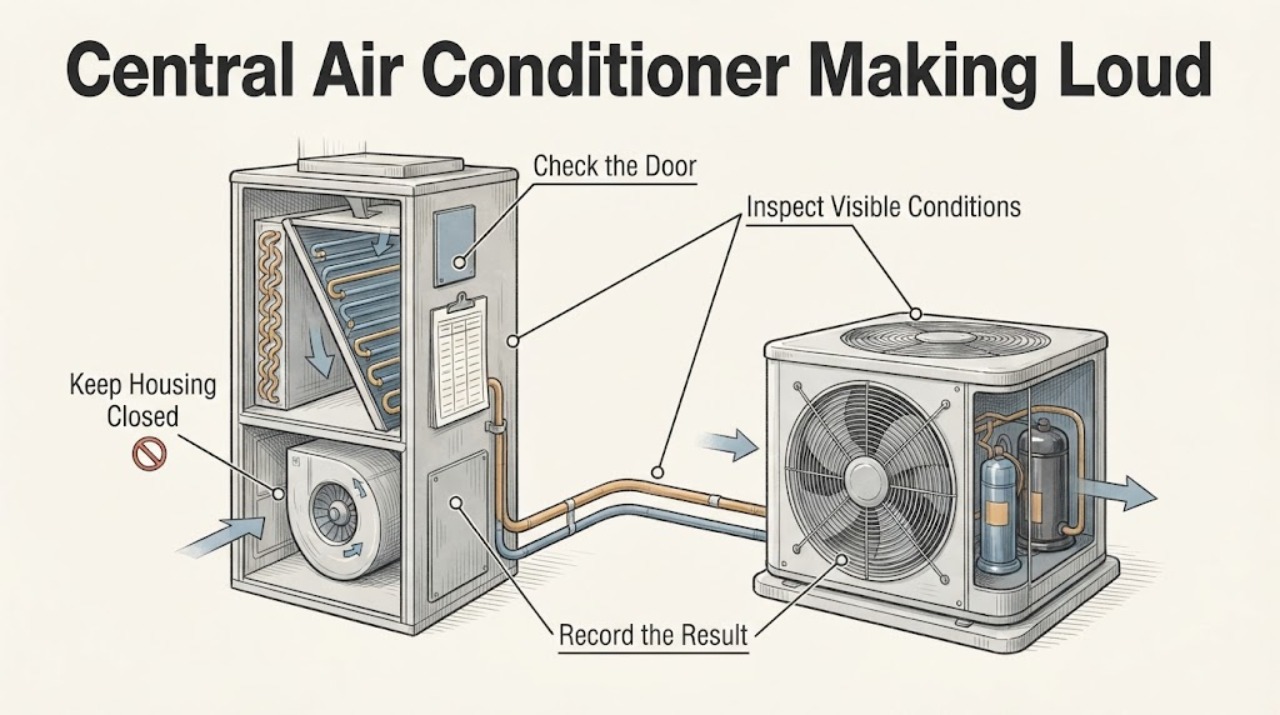
A new or unusually loud sound is more useful when you identify which unit makes it and when it happens. In a split central system, the indoor unit contains the evaporator and blower while the outdoor unit contains the condenser fan and compressor. A loud indoor hum, rattle, or vibration can involve the blower, wheel, airflow path, or a loose panel; an outdoor hum, buzz, rattle, or high-pitched sound can involve the fan, motor, capacitor, compressor, or cabinet. Hissing near the indoor coil or outdoor refrigerant lines can indicate a refrigerant leak. From a safe position, note the source, sound type, timing, airflow, and visible debris or damage. Do not remove panels, reach through a grille, touch wiring or capacitors, handle refrigerant, or try to quiet a moving fan. If the noise started suddenly, is worsening, comes with burning odor, smoke, exposed wiring, repeated electrical trips, poor cooling, ice, or hissing, turn the system off at the thermostat and arrange qualified HVAC service.
Before you begin
Safety first
- Do not remove indoor or outdoor access panels, reach through a grille, touch wiring or capacitors, straighten fan blades, connect gauges, add or release refrigerant, spray the unit, use heat or flame to investigate, or repeatedly reset a breaker. Turn the system off at the thermostat for smoke, burning odor, arcing, exposed conductors, hissing with cooling loss, visible frost, water near electrical equipment, severe vibration, or repeated trips.
Work through in order
Diagnostic checks
Use only checks that match the exact appliance or system and its official guide.
-
Check 1
From a safe standing position, identify whether the loudest sound is at the indoor air handler or furnace area, the outdoor condenser, the supply or return grilles, or the connecting line area. Note whether it occurs at startup, shutdown, continuously during cooling, or only when the blower speed changes. Do not stand under an unsecured cabinet, reach through a grille, or place hands near moving equipment.
Expected result: The sound is clearly indoor, clearly outdoor, transmitted through a grille or wall, present only at startup or shutdown, or present continuously while the system runs.
Next step: Record a short safe-distance audio clip and the exact timing, then use the matching indoor or outdoor check below. If the noise is sudden, rapidly worsening, or accompanied by odor, smoke, poor cooling, ice, or repeated trips, turn the system off at the thermostat and arrange HVAC service.
Why this matters
Why: The location and timing separate an indoor airflow or blower path from an outdoor fan, compressor, electrical, or cabinet path. A sound that is new and continuous is more concerning than a brief, unchanged operating sound, while a wall or grille transmission may make the source seem closer than it is.
-
Check 2
With the system off, inspect only the normal user-accessible indoor airflow points. Look at the filter through its ordinary access, and note whether it is visibly loaded, collapsed, wet, or seated incorrectly. With a normal cooling call, compare the airflow at several supply registers and listen for a noise that rises with blower speed. Do not open the air-handler cabinet or remove a blower cover.
Expected result: The filter is visibly restricted or damaged; airflow is weak at several registers; a whistle or hum follows the indoor blower; or airflow is normal but the indoor unit still rattles or hums loudly.
Next step: If the filter is clearly due for replacement, use only the exact size and type specified for the equipment and observe whether the sound changes; do not force an ill-fitting filter. If the filter is wet, airflow is weak across the home, the noise persists, or the cabinet itself vibrates, stop troubleshooting at the filter and arrange qualified service.
Stop if: Stop the cooling call for burning odor, smoke, arcing, water near the air handler, a loose cabinet panel, or any need to reach inside the unit.
Why this matters
Why: A restricted filter or broad airflow change can make the indoor blower work against higher resistance, while a noise that follows blower speed makes the blower wheel, motor, duct vibration, or an indoor panel more plausible. Normal airflow with a persistent loud mechanical sound makes a filter-only explanation less likely.
-
Check 3
Observe the outdoor unit from outside the grille and from a safe distance while a normal cooling call is active, if there is no abnormal odor or sound requiring immediate shutdown. Note whether the fan turns, whether air is discharged, whether the cabinet vibrates or rocks, and whether leaves or grass visibly obstruct the coil surface. Do not remove the grille or top, reach toward the fan, push the cabinet, spray it, or touch the refrigerant lines.
Expected result: The sound is an outdoor hum, buzz, rattle, or high-pitched tone; the fan is not turning; the cabinet visibly vibrates; the coil is heavily obstructed; or the unit has a burning smell, smoke, exposed wiring, or visible damage.
Next step: Photograph the exterior condition from a safe position and turn the system off at the thermostat for an abnormal noise, odor, smoke, exposed wiring, repeated trip, or significant vibration. Leave cabinet cleaning, electrical diagnosis, fan work, and any internal obstruction to a qualified HVAC professional.
Stop if: Stop immediately for smoke, burning odor, arcing, exposed conductors, a damaged or loose cabinet, a fan that contacts the grille, or any need to reach through the outdoor unit.
Why this matters
Why: Outdoor noise can involve the fan motor, capacitor, contactor, compressor, loose or vibrating components, or an unlevel cabinet. Visible debris can restrict condenser airflow, but a fan that appears to run does not clear the compressor or electrical circuit. Odor, smoke, exposed wiring, or visible damage makes continued operation unsafe.
-
Check 4
Classify the sound without trying to reproduce it: describe it as a hum, buzz, rattle, vibration, high-pitched whine, click, or hiss, and note whether cooling performance changed at the same time. For a hiss, look only at accessible areas near the indoor coil and outdoor refrigerant lines for frost, oil-like staining, or a strong change in cooling; do not touch the lines or remove insulation.
Expected result: There is a hiss near the coil or lines; a high-pitched outdoor sound; a rattle with visible vibration; repeated clicking at startup; or a sound without cooling loss or other change.
Next step: For hissing near refrigerant components, poor cooling, frost, burning odor, or a new high-pitched or vibrating sound, turn the system off at the thermostat and schedule qualified HVAC diagnosis. For a brief unchanged sound with normal cooling, document it and consult the exact model manual; do not assume it is normal if the pattern changes.
Stop if: Stop operating the equipment for hissing with cooling loss, smoke, burning odor, visible frost, or a sound that is rapidly worsening.
Why this matters
Why: Hissing near refrigerant components can indicate a leak or compressor/electrical issue. An outdoor high-pitched sound can involve a loose fastener, fan motor, capacitor, or compressor; rattling with vibration can involve a blower wheel, fan, compressor, loose component, or unlevel unit. Clicking may involve controls, a contactor, a safety switch, or the thermostat. A sound unchanged since installation and isolated to a brief mode transition may be model-specific, but it should still be compared with the owner's manual if it is uncertain.
-
Check 5
Check the ordinary user controls and the run pattern without changing wiring or opening any control box. Note the thermostat mode and fan setting, whether the noise begins when the indoor blower starts or when the outdoor unit starts, whether it ends at shutdown, and whether the system short-cycles or fails to cool. Do not repeatedly restart an abnormal unit just to compare sounds.
Expected result: The noise tracks the indoor blower; begins only when the outdoor unit starts; continues after the system should stop; appears with short cycling; or occurs while cooling remains normal.
Next step: Correct only an obvious normal thermostat setting mismatch and observe one normal call. If the setting is correct and the abnormal sound or poor cooling remains, preserve the timing and arrange HVAC service; do not test capacitors, controls, refrigerant, or motor bearings yourself.
Why this matters
Why: A blower-linked sound favors the indoor motor, wheel, airflow, duct, or panel path. An outdoor-start sound favors the condenser fan, compressor, controls, or startup components. A sound that continues after shutdown, occurs with short cycling, or accompanies poor cooling raises the priority for service rather than a normal-sound explanation.
-
Check 6
Prepare the service handoff from the observations already made: record which unit is noisy, the sound description, start date, operating mode, cooling change, filter condition, visible outdoor obstruction or vibration, and any odor, ice, water, or breaker event. Include the equipment model and a safe-distance photo if the label and condition are readable. Do not remove panels to find a model label or expose internal parts.
Expected result: The symptom can be tied to one unit and one operating event; the source remains uncertain; or safety symptoms prevent further observation.
Next step: Give the timeline, audio clip, photos, thermostat behavior, cooling result, and safety symptoms to the HVAC technician. Keep the system off when the stop conditions are present and do not attempt an internal repair based only on the sound label.
Why this matters
Why: A timed description distinguishes an indoor blower event, outdoor fan/compressor event, refrigerant-line hiss, and a building-transmitted vibration even when the failed component cannot be identified by sight. Uncertainty is useful information and is safer than guessing a replacement part.
Use your observations
Decision map
Find the observation that best matches what you see, then follow the next safe action.
-
PATH 01Next step
What you see
The system was normally quiet but the indoor or outdoor unit suddenly became much louder, or the noise is worsening or paired with poor cooling.
Do this next
Turn the system off at the thermostat and arrange qualified HVAC service. Give the technician the timing, sound recording, unit location, and any cooling or odor change; do not keep restarting it for comparison.
Why this path and its safety boundary
Why it matters: A new change is more consistent with a mechanical, electrical, airflow, or refrigerant fault than with the equipment's normal operating character. The source location helps the technician prioritize the blower/indoor section versus condenser/outdoor section.
-
PATH 02Next step
What you see
The noise follows the indoor blower, changes with airflow, or comes from the indoor cabinet or registers; the accessible filter is restricted or the indoor cabinet vibrates.
Do this next
Use only ordinary filter access and the exact replacement specified for the equipment if the filter is due. If the sound remains, airflow is weak, the filter is wet, or the cabinet vibrates, stop and have a qualified HVAC professional inspect the indoor section; do not open it.
Why this path and its safety boundary
Why it matters: An airflow restriction, blower wheel or motor, duct vibration, or loose indoor panel is more likely than an outdoor compressor fault. A wet filter or water around the indoor section adds a condensate or frozen-coil concern.
-
PATH 03Next step
What you see
The noise starts when the outdoor condenser starts and is a hum, buzz, rattle, vibration, or high-pitched tone, especially if the fan is intermittent, the cabinet vibrates, or cooling changes.
Do this next
Keep hands and tools outside the unit, turn it off for a new or abnormal sound, and schedule qualified diagnosis. Do not remove the grille, test a capacitor, straighten a blade, or replace an electrical part from a sound description alone.
Why this path and its safety boundary
Why it matters: The outdoor fan motor, capacitor, contactor, compressor, fan assembly, loose component, or cabinet support becomes more plausible. A visibly dirty coil may affect heat rejection but does not identify the noisy component.
-
PATH 04Next step
What you see
A hiss is heard near the indoor coil or outdoor refrigerant lines, particularly when cooling is weak, frost appears, or the sound continues beneath normal operation.
Do this next
Switch the system off at the thermostat and arrange qualified HVAC service. Do not connect gauges, add or release refrigerant, remove insulation, scrape frost, or use a flame or heat source to investigate.
Why this path and its safety boundary
Why it matters: A refrigerant leak or compressor/electrical issue is possible. This is not a user-level refrigerant diagnosis, and touching or opening the circuit can create a safety and equipment problem.
-
PATH 05Next step
What you see
The sound is brief, predictable at startup, shutdown, or a mode transition, has not changed from the equipment's usual pattern, and cooling remains normal with no odor, vibration, ice, or electrical symptom.
Do this next
Document the sound and compare it with the exact equipment owner's manual or a qualified technician's assessment. Arrange service if it becomes louder, lasts longer, changes character, or appears with poor cooling or another warning sign.
Why this path and its safety boundary
Why it matters: Some air conditioners and heat pumps have model-specific startup, shutdown, refrigerant-flow, or defrost sounds. That pattern is less urgent than a new persistent sound, but a homeowner cannot confirm normality from timing alone.
Helpful context
Understand the symptom
Location changes the likely fault path
A split central air conditioner has two sound-producing zones. The indoor air handler or furnace cabinet moves room air across the evaporator coil; the outdoor condenser rejects heat through its fan, coil, and compressor. A noise that follows the indoor blower points toward airflow, the blower wheel or motor, duct vibration, or an indoor panel. A noise that begins with the outdoor call points toward the condenser fan, compressor, electrical controls, cabinet, or the area around the unit. Packaged systems place more components outdoors, so describe the equipment layout when you call for service.
Sound timing is evidence, not a repair instruction
Write down whether the sound occurs at startup, shutdown, continuously while running, or only during a mode change. A brief predictable operating sound can be normal for some models, but a sudden change from the system's usual sound deserves attention. A new rattle, vibration, high-pitched tone, or hissing sound should not be tested by repeatedly restarting the equipment. A short recording made from a safe location, plus the unit location and cooling symptoms, is more useful to a technician than a guess at the failed part.
Keep the inspection outside the cabinets
The user-safe boundary is the thermostat, the ordinary filter access if provided, the supply and return grilles, and a visual view of the equipment from a safe standing position. Do not remove an access panel, reach through an outdoor grille, touch a capacitor or wiring, straighten a fan blade, lubricate an unknown motor, connect gauges, or open the refrigerant circuit. If there is smoke, a burning smell, arcing, exposed conductors, water near electrical equipment, or a repeated breaker trip, keep the system off and arrange prompt service.
Only after diagnosis
Potential parts
- replacement air filter
Consider this category only when the accessible filter is visibly loaded, wet, damaged, or due for replacement and the noise or airflow changes with the filter condition; a filter does not explain every indoor hum or rattle.
Confirm the exact dimensions, type, airflow direction, and equipment guidance before ordering. The filter must seat correctly without bypass gaps or excessive restriction. - indoor blower motor or blower wheel
Consider this category only after a qualified technician confirms that an indoor blower motor, wheel, bearing, or related assembly is the source of a blower-linked hum, rattle, or vibration.
Match the equipment model, motor characteristics, wheel dimensions, mounting, controls, and manufacturer service information. This is not an ordinary-user cabinet repair. - outdoor condenser fan motor or capacitor
Consider this category only when a qualified technician identifies a failed outdoor fan motor or capacitor from the outdoor startup, hum, buzz, or fan symptom; a noise alone does not identify either part.
Confirm the equipment model, electrical ratings, motor characteristics, mounting, and manufacturer service data with the servicing professional. Do not handle energized or charged components. - compressor or refrigerant-system component
Consider this category only after qualified testing links a persistent outdoor noise, hissing, or poor cooling to a compressor or sealed-system fault; high-pitched or humming sounds can have several other causes.
Confirm the complete system match, refrigerant design, electrical requirements, and manufacturer procedures with a qualified HVAC professional. Do not order or install a generic sealed-system component.
When checks do not resolve it
Need a professional?
Stop and arrange qualified HVAC service for a sudden or worsening loud noise, a persistent hum, buzz, rattle, vibration, high-pitched tone, or hiss; poor cooling; visible frost or water; burning odor, smoke, arcing, exposed wiring, severe cabinet movement, or repeated electrical trips. Turn the system off at the thermostat for those conditions. Do not open cabinets, reach through grilles, handle capacitors or wiring, connect gauges, add refrigerant, or keep restarting the equipment to reproduce the sound.
Safety scope: Do not remove indoor or outdoor access panels, reach through a grille, touch wiring or capacitors, straighten fan blades, connect gauges, add or release refrigerant, spray the unit, use heat or flame to investigate, or repeatedly reset a breaker. Turn the system off at the thermostat for smoke, burning odor, arcing, exposed conductors, hissing with cooling loss, visible frost, water near electrical equipment, severe vibration, or repeated trips.
Common questions
FAQ
How can I tell whether the loud noise is from the indoor or outdoor AC unit?
From a safe standing position, listen during one normal call and note whether the sound is strongest at the indoor air handler, outdoor condenser, supply or return grilles, or the line area. Also record whether it begins with the indoor blower or outdoor unit. Do not reach through a grille or open a cabinet. A short recording and timing are useful even when sound transmission makes the exact source uncertain.
Is a humming sound from a central air conditioner normal?
A steady operating hum can be part of normal equipment sound, but a new or noticeably louder hum is not something to dismiss. Trane associates indoor loud humming with a blower or inducer motor and outdoor loud humming with a capacitor, contactor, or fan motor. Turn the system off and arrange service when the hum is new, worsening, accompanied by poor cooling, vibration, odor, or an electrical symptom.
What does a rattling or vibrating outdoor AC unit mean?
A rattle with vibration can involve the outdoor fan, fan motor, compressor, a loose component, or an unlevel cabinet; visible debris can also obstruct the condenser coil. Observe from outside the grille, but do not push the cabinet, remove the top, reach toward the fan, or attempt to tighten internal hardware. A new or strong rattle should be serviced, particularly if cooling changes.
What should I do if my AC makes a hissing sound?
If the hiss is near the indoor coil or outdoor refrigerant lines, especially with weak cooling or frost, turn the system off at the thermostat and arrange qualified HVAC service. Do not touch or open the refrigerant circuit, connect gauges, add refrigerant, remove insulation, or use heat to investigate. Trane identifies this pattern as a possible refrigerant leak or compressor/electrical problem.
Can I fix a loud central AC by replacing the filter?
Only treat a filter as a possible airflow contributor when it is visibly loaded, wet, damaged, or incorrectly seated and the equipment provides ordinary filter access. Use the exact specified size and type, then note whether airflow or sound changes. A persistent mechanical sound, weak airflow across the home, wet filter, poor cooling, or cabinet vibration needs HVAC diagnosis; do not open the air handler to reach the blower.
Read the exact guide
Official sources
- What is Central Air Conditioning and How Does Central Air Work?Carrier · Manufacturer explanation used to locate the indoor evaporator and blower versus the outdoor fan, condenser coil, and compressor when tracing a noise
- Is This Normal? HVAC Smells and Sounds, ExplainedTrane · Manufacturer guidance for homeowners distinguishing normal operating sounds from new or abnormal indoor and outdoor air-conditioner noises
- Measure Guideline: Air Conditioner Diagnostics, Maintenance, and ReplacementU.S. Department of Energy, Building America · Government technical guidance supporting a visual outdoor obstruction check and the boundary against opening or internally cleaning a condenser without appropriate skill
Community feedback
Share a repair observation
Share a plain-text repair observation. Accepted observations are published automatically; this page may take a moment to update.