
On this page
Start here
Quick answer
When an American Standard central air conditioner is not cooling, first separate a control or airflow problem from a refrigeration or outdoor-unit fault. From a dry, safe position, confirm the thermostat is on COOL with the fan on AUTO, check the air filter and open registers, and inspect the outdoor unit for leaves or other blockage without touching the equipment. Check whether the indoor blower and outdoor fan run, whether the airflow is weak, whether ice is visible, and whether the condensate pan is rising. A dirty filter can reduce airflow and freeze the indoor coil; a blocked drain can shut the indoor unit down; a tripped breaker, failed capacitor, compressor issue, or refrigerant leak needs professional diagnosis. If you see ice, water near electrical parts, refrigerant staining, burning odor, repeated breaker trips, or no cooling after the safe checks, turn the system off and call a licensed HVAC professional. Do not open panels, handle refrigerant, test live voltage, or keep running a frozen or repeatedly tripping system.
Before you begin
Safety first
- Owner checks are limited to normal thermostat controls, a safe filter change, unobstructed registers, loose surface debris, and visual observations from a dry distance. A licensed professional must handle panels, live electrical tests, refrigerant, compressor, capacitor, contactor, coil, condensate-cabinet, and wiring work.
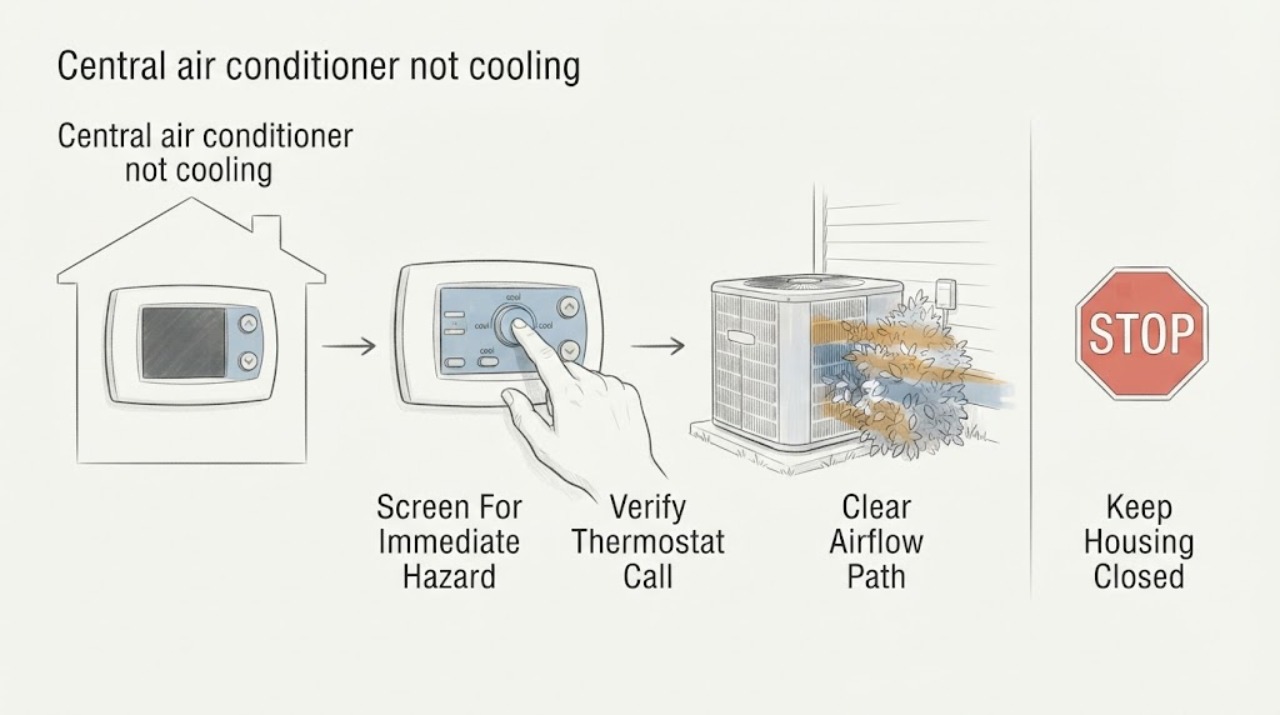
Work through in order
Diagnostic checks
Use only checks that match the exact appliance or system and its official guide.
-
Check 1
From a dry, stable position, check for smoke, burning odor, sparks, a repeated breaker trip, refrigerant hiss or staining, water touching electrical equipment, or active flooding. Do not touch the indoor cabinet, outdoor unit, refrigerant lines, or wiring.
Expected result: Record no immediate hazard, or record smoke, odor, sparks, repeated trips, suspected refrigerant release, water near electrical parts, or flooding.
Next step: Turn the system off using the normal control if that is safe, leave the area for smoke or suspected refrigerant release, and contact emergency services or a licensed HVAC professional from a safe location. Do not restart the system to test it.
Stop if: Stop immediately for smoke, burning odor, sparks, repeated breaker trips, suspected refrigerant release, flooding, or water reaching electrical equipment.
Why this matters
Why: These signs can indicate fire, shock, chemical, pressure, or property-damage risk and take priority over cooling checks.
-
Check 2
Check the thermostat display and settings without opening it: mode COOL, fan AUTO, set temperature below the current room temperature, schedule or hold state, and battery indication if applicable. Use the normal thermostat control once; do not remove wiring or open the HVAC cabinet.
Expected result: The thermostat is off, not in COOL, fan is ON, the setpoint is not calling for cooling, the display is blank, or a normal cooling call is present.
Next step: Correct only an obvious user setting or replace thermostat batteries when the model allows and the area is dry. If the display is blank or a valid call produces no cooling, continue with safe visual checks and arrange service if it persists.
Stop if: Stop for a wet or damaged thermostat, exposed wiring, a breaker that trips, or any need to open the thermostat or cabinet.
Why this matters
Why: A wrong mode, fan setting, setpoint, schedule, or dead battery can make warm air feel like an equipment fault. A valid cooling call with no response shifts attention to power, airflow, condensate, outdoor operation, or service-level faults.
-
Check 3
Turn cooling off at the thermostat, then check the filter and accessible return and supply registers. Replace a visibly dirty filter with the correct model-approved type and make sure furniture or drapes are not blocking airflow; do not remove the indoor coil or scrub it.
Expected result: The filter is clean, visibly loaded with dust, the return is blocked, airflow is weak at several registers, or airflow is normal but the air is warm.
Next step: After a filter change, run cooling only if there is no ice, leak, or electrical warning. If airflow stays weak, ice appears, or warm air continues, turn cooling off and request HVAC service.
Stop if: Stop for visible ice, water at the air handler, a damaged filter rack, exposed wiring, or any need to access the blower or coil.
Why this matters
Why: Restricted airflow can reduce cooling and freeze the evaporator coil or cause a shutdown. Normal airflow with warm air makes a thermostat, outdoor-unit, refrigerant, compressor, or control fault more likely.
-
Check 4
Without opening the air handler, look for frost or ice on visible refrigerant tubing, the cabinet exterior, or the accessible coil area, and look for water in or around the condensate pan or drain outlet. Do not chip ice, use heat, pour chemicals, or open the cabinet.
Expected result: No ice or water is visible, ice is present, the pan or drain area is wet or rising, or the area is inaccessible.
Next step: Turn cooling off and call a licensed HVAC professional for ice, standing water, a blocked drain indication, or an inaccessible source. Do not restart cooling until the cause is addressed; do not handle refrigerant.
Stop if: Stop for ice, standing water, a wet electrical area, hot or energized equipment, or any need to enter the air handler.
Why this matters
Why: Ice can follow restricted airflow or low refrigerant and continued cooling can damage the system. A rising condensate pan can trip a safety switch and stop the indoor unit; water near electrical components adds shock risk.
-
Check 5
With a cooling call present and only from a safe distance, note whether air comes from the registers and whether the outdoor fan runs. Keep hands, tools, and clothing away from the outdoor unit and do not remove its service panel.
Expected result: The indoor blower is silent, the outdoor unit is silent, only one unit runs, the outdoor fan runs but air is not cool, or both units run with weak cooling.
Next step: Record the pattern and request professional diagnosis when either unit fails to operate normally or cooling remains weak. Do not test a capacitor, contactor, compressor, refrigerant pressure, or wiring yourself.
Stop if: Stop for abnormal electrical noise, smoke, a repeatedly tripping breaker, a fan that is obstructed or damaged, or any need to remove a panel or reach moving parts.
Why this matters
Why: No indoor airflow can involve power, blower, controls, or a condensate safety; no outdoor operation can involve power, contactor, capacitor, controls, or compressor. An outdoor unit that runs without cooling keeps refrigerant, compressor, airflow, and coil faults in consideration.
-
Check 6
Visually inspect the area around the outdoor unit and accessible return or supply paths for leaves, grass, plants, stored items, or debris blocking airflow. Remove only loose debris that can be picked up without touching the unit, and keep clear of the fan and coil fins; do not wash or dismantle the condenser.
Expected result: The outdoor unit is clear, its intake or discharge is blocked by loose debris, plants are crowding it, or the obstruction is inside the cabinet or coil.
Next step: Clear only safe loose surface debris, then allow the system to operate if no ice, water, odor, or electrical warning exists. If cooling does not improve, the obstruction is internal, or the coil is damaged, call an HVAC professional.
Stop if: Stop for a running fan, sharp or damaged metal, chemical residue, electrical damage, or any need to spray, bend fins, remove panels, or clean an internal coil.
Why this matters
Why: Blocked outdoor airflow raises operating stress and reduces heat rejection, while indoor register or return blockage reduces delivered airflow. An internal coil obstruction or damaged fin needs professional cleaning or repair.
-
Check 7
Record the thermostat call, indoor and outdoor operation, filter state, airflow, ice or condensate evidence, outdoor obstruction, indoor temperature trend, system age and model, and whether the issue started after a storm, power event, maintenance, or refrigerant work. Do not keep running the system to force a diagnosis.
Expected result: Cooling returns after a safe filter or setting correction, the symptom is unchanged, the system cycles off on a safety, the breaker trips, or the home temperature continues rising.
Next step: Turn cooling off when ice, water, electrical symptoms, or persistent no-cooling is present and arrange licensed HVAC service. Provide the model, photos of safe visible conditions, and the observed sequence.
Stop if: Stop owner troubleshooting after the safe thermostat, filter, airflow, and visual outdoor checks, or sooner for ice, water, electrical symptoms, refrigerant concern, or repeated shutdown.
Why this matters
Why: A simple setting or airflow restriction may be corrected by the owner; persistent no-cooling, safety shutdown, breaker behavior, or rising indoor temperature indicates a control, electrical, condensate, refrigerant, compressor, or duct problem that requires testing.
Use your observations
Decision map
Find the observation that best matches what you see, then follow the next safe action.
-
PATH 01Next step
What you see
The thermostat is off, not in COOL, has fan ON, has a setpoint above room temperature, or has a blank battery-powered display, while the HVAC equipment shows no hazard.
Do this next
Correct only the obvious user setting or battery, then observe one normal cooling call. If the display stays blank or cooling does not start, request service.
-
PATH 02Next step
What you see
The filter or return is blocked, airflow is weak, or ice is visible on the indoor coil or refrigerant line.
Do this next
Turn cooling off, replace only a visibly dirty filter if safe, and call a licensed HVAC professional for ice, persistent weak airflow, or refrigerant diagnosis. Do not chip ice or add refrigerant.
-
PATH 03Next step
What you see
The indoor blower is off or intermittent and water is visible in the drain pan or near the air handler, or a condensate safety appears to have stopped operation.
Do this next
Turn the system off and arrange HVAC service. Do not open the cabinet, pour chemicals into the drain, or operate wet electrical equipment.
-
PATH 04Next step
What you see
The thermostat calls and the indoor blower runs, but the outdoor unit is silent, the breaker trips, or the outdoor fan or compressor behaves abnormally.
Do this next
Do not reset a repeatedly tripping breaker or remove the outdoor panel. Turn the system off and request licensed HVAC diagnosis.
-
PATH 05Next step
What you see
Both units run, airflow is reasonable, but air remains warm or the home does not cool; ice, oily staining, unusual compressor behavior, or a recent charge history may be present.
Do this next
Turn the system off if ice or damage is present and call a licensed HVAC professional. Refrigerant recovery, leak repair, charging, compressor, and electrical work are not owner procedures.
-
PATH 06Next step
What you see
The equipment operates and produces cooling, but some rooms remain warm, registers have uneven airflow, doors or windows leak conditioned air, or the system runs continuously without reaching setpoint.
Do this next
Check only accessible registers and windows or doors. If the equipment is running continuously or comfort remains uneven, have an HVAC professional evaluate airflow, ducts, load, and system performance.
Helpful context
Understand the symptom
Start with the whole central-air system
A split central system has an indoor air handler or furnace coil, an outdoor fan, compressor and condenser coil, and ductwork. A failure in one section can feel like the entire air conditioner is not cooling. American Standard's own troubleshooting distinguishes thermostat and filter checks from compressor, refrigerant, condensate and electrical faults. The first useful observation is therefore whether the system has a call for cooling, airflow, outdoor operation, and a safe drain path.
Weak airflow can freeze the coil
A clogged filter or blocked return can reduce air crossing the indoor evaporator coil. American Standard notes that restricted airflow can lead to a frozen coil or system shutdown. Ice on the indoor coil or refrigerant line is not a reason to add refrigerant; turn cooling off, leave the fan behavior to the model instructions, and arrange service so airflow and charge are checked after the ice clears.
Refrigerant and high-voltage work stay professional
A running outdoor unit that does not remove heat can have a refrigerant leak, compressor or capacitor issue, dirty condenser coil, or another electrical fault. American Standard states that refrigerant is hazardous and that these root causes should be handled by an HVAC professional. A cool-looking thermostat or audible fan does not establish that the refrigeration circuit is healthy.
Water can be a cooling-system shutdown clue
Cooling removes moisture and sends it to a condensate pan and drain. A blocked drain can raise the pan and trip a safety switch, stopping the indoor unit. Treat water around the air handler as a leak or condensate problem, not as permission to pour cleaner into a line or open the cabinet; the safe next step is model-specific professional inspection.
Safety boundary
Stop conditions
- Stop immediately for smoke, burning odor, sparks, repeated breaker trips, exposed wiring, water near electrical equipment, suspected refrigerant release, or active flooding; turn the system off if safe and obtain urgent qualified help.
- Do not open indoor or outdoor panels, test live voltage, handle refrigerant, recharge the system, replace a capacitor or contactor, repair a compressor, or alter gas or electrical wiring.
- Do not keep running a system with visible ice, rising condensate water, weak airflow, abnormal noise, or repeated safety shutdown; do not chip ice, use heat, or pour drain chemicals into the system.
- Do not infer a failed compressor or refrigerant leak from warm air alone. Stop part selection until the model, operating pattern, airflow, condensate state, and professional test results support a specific repair.
Only after diagnosis
Potential parts
- air filter
Relevant only when the installed filter is visibly dirty and the correct model-approved replacement is confirmed; a filter change does not address ice or an internal airflow fault.
Confirm the exact filter dimensions, type, airflow rating and installation direction from the model manual or existing frame; do not substitute a restrictive filter without system guidance. - thermostat
Relevant only when a professional confirms the thermostat or its wiring is not sending or interpreting a cooling call after settings and power are verified.
Confirm system type, staging, heat-pump or conventional configuration, wiring, controls, and manufacturer compatibility before replacement; do not move wires live. - condensate drain or safety switch
Relevant only when a qualified technician confirms a blocked drain, failed pump, rising pan, or condensate safety is stopping the indoor unit.
Match the exact air-handler model, drain arrangement, switch rating and installation requirements; do not bypass a condensate safety or pour chemicals into an unknown drain. - blower or outdoor fan motor component
Relevant only when professional testing confirms a motor, capacitor, or control-output fault after airflow, power, and safety conditions are evaluated.
Confirm exact model, motor type, electrical ratings, control scheme and capacitor requirements; live electrical and moving-part work requires licensed service. - refrigerant leak repair or compressor service
Relevant only when a licensed HVAC technician confirms a refrigerant leak, metering fault, compressor failure, or related refrigeration-circuit problem.
Confirm the refrigerant, system design, repair method and charge requirements from the nameplate and service data; refrigerant handling and compressor work are professional tasks.
When checks do not resolve it
Need a professional?
Call a licensed HVAC professional when the thermostat and filter checks do not restore cooling, the outdoor unit is silent or abnormal, the breaker trips, ice or condensate water appears, airflow remains weak, refrigerant or compressor trouble is suspected, or any panel, electrical, refrigerant, condensate, or coil access is needed.
Safety scope: Owner checks are limited to normal thermostat controls, a safe filter change, unobstructed registers, loose surface debris, and visual observations from a dry distance. A licensed professional must handle panels, live electrical tests, refrigerant, compressor, capacitor, contactor, coil, condensate-cabinet, and wiring work.
Have this ready
- Provide the complete model and serial information, thermostat mode and fan setting, indoor and outdoor operation, filter and airflow observations, ice or condensate evidence, breaker behavior, indoor temperature trend, recent service or storm history, and safe photos of visible conditions.
Common questions
FAQ
Why is my American Standard central air conditioner not cooling?
Check the thermostat, filter, registers and visible outdoor airflow first. Common service-level causes include a frozen coil, condensate shutdown, dirty condenser, refrigerant leak, compressor or capacitor fault, and electrical problems. The symptom alone does not identify one part.
Why is the AC running but blowing warm air?
A wrong thermostat setting, fan set to ON, dirty filter, frozen coil, outdoor-unit fault, refrigerant problem, or compressor issue can produce warm air. Confirm settings and filter safely; if the system runs without cooling, call a licensed HVAC professional.
What should I do if I see ice on the AC lines?
Turn cooling off and call for service. Ice can follow restricted airflow or low refrigerant, and continuing to run can damage the system. Do not chip the ice, apply heat, or add refrigerant yourself.
Can a dirty filter make an American Standard AC stop cooling?
Yes. A dirty filter reduces airflow and can freeze the evaporator coil or contribute to a shutdown. Replace only a visibly dirty filter with the correct model-approved type, and call service if airflow remains weak or ice appears.
Why is water leaking from the indoor AC unit?
Condensate drainage may be blocked, the pan may be rising, or another leak may be present. Turn the system off when water is near electrical equipment and request HVAC service. Do not open the cabinet or pour chemicals into the drain as a guess.
The outdoor AC unit is not running. What can I check?
Confirm a cooling call at the thermostat and observe the unit from a safe distance. A breaker, contactor, capacitor, motor, compressor, or control problem may be involved. Do not open the outdoor panel or repeatedly reset a tripped breaker; call a licensed technician.
Should I add refrigerant if the AC is not cooling?
No. Low refrigerant usually indicates a leak or charge problem, and American Standard says refrigerant should be handled by a professional. A technician must test, locate and repair the cause before charging the system.
Why is only one room warm when the AC is running?
A blocked register, duct leak or imbalance, insulation or envelope issue, long run, or local airflow restriction can affect one room. Check only accessible registers and doors or windows; persistent uneven cooling needs HVAC airflow and duct diagnosis.
How long should I wait after changing the thermostat or filter?
Allow the system a normal cooling call rather than repeatedly changing settings. If there is no improvement, the temperature continues rising, or the unit runs continuously without reaching the setpoint, turn it off if ice, water or electrical symptoms appear and arrange service.
What information should I give the HVAC technician?
Give the model and serial information, thermostat settings, indoor and outdoor operation, filter state, airflow, ice or water evidence, breaker behavior, indoor temperature trend, recent maintenance or storm history, and safe photos. Do not open the system to collect more information.
Read the exact guide
Official sources
- Why Is My Central AC Not Blowing Cold Air?American Standard · Manufacturer guidance for a central AC that runs but does not blow cold air, including thermostat, filter, condensate, ice, outdoor coil and refrigerant causes
- Air Conditioner TroubleshootingAmerican Standard · Manufacturer troubleshooting for no-start, no-cooling, continuous-running, thermostat, filter, frozen-coil, compressor, refrigerant and maintenance symptoms
- Air Conditioner Not Working? Here’s WhyAmerican Standard · Manufacturer explanation of no-start and warm-air symptoms, including thermostat, filter, capacitor, electrical, frozen-coil and compressor possibilities
- HVAC TroubleshootingAmerican Standard · Manufacturer common-issue checklist for a system that is not cooling, has little airflow, or has a strange noise or smell
- Central Air ConditioningAmerican Standard · Manufacturer glossary identifying the indoor unit, outdoor unit, compressor, condenser coil, evaporator coil, blower and ductwork in a central split system
Community feedback
Share a repair observation
Share a plain-text repair observation. Accepted observations are published automatically; this page may take a moment to update.