
On this page
Start here
Quick answer
A central AC condenser coil does not make indoor air cold; it releases the heat captured indoors to outdoor air. If the home is not cooling, first record the thermostat demand, indoor airflow, accessible filter condition, outdoor fan behavior, visible coil obstruction, ice, water, and breaker or odor symptoms without opening the equipment. Do not remove panels, touch the coil or fan, spray cleaner or high-pressure water, test voltage, connect gauges, or add refrigerant. A visibly blocked outdoor coil can reduce heat transfer, but no single visual check proves the cause. Stop the system and arrange HVAC service for a non-running or buzzing outdoor unit, ice, active water, burning odor, repeated breaker trips, refrigerant concerns, or cooling that does not recover after safe observations.
Before you begin
Safety first
- This guide is limited to user observation. Do not remove panels, touch coils, fins, fans, wiring, capacitors, or refrigerant tubing; do not test voltage, connect gauges, vent or add refrigerant, spray cleaner or high-pressure water, chip ice, replace electrical components, or repeatedly reset or cycle the system.
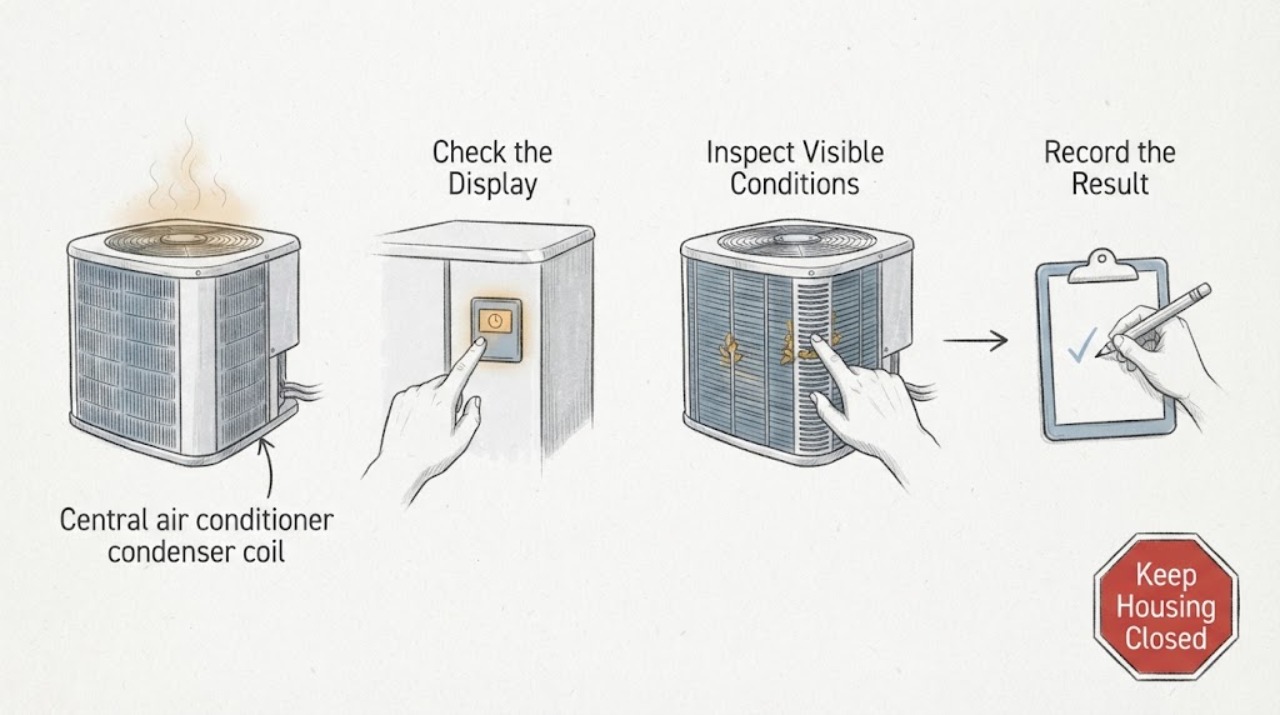
Work through in order
Diagnostic checks
Use only checks that match the exact appliance or system and its official guide.
-
Check 1
With the system in its ordinary operating state and from a safe position, read the thermostat display and note the selected mode, setpoint, room temperature, and whether the system is calling for cooling without opening the thermostat or changing wiring.
Expected result: Record whether the display is blank, the setpoint is below room temperature, cooling starts, or the display shows a warning; do not repeatedly lower the setpoint to force a test.
Next step: Write down the thermostat state and provide it to the HVAC technician; keep settings at a normal comfortable level while waiting.
Stop if: Stop if the thermostat is hot, smells burnt, sparks, has exposed wiring, or requires opening the cover or changing electrical connections.
Why this matters
Why: No cooling demand or a blank display can explain a quiet outdoor unit without proving a condenser-coil failure. A clear cooling demand with warm rooms moves the check toward airflow, outdoor operation, refrigerant, or compressor diagnosis.
-
Check 2
From a safe ground-level position, observe the outdoor condenser cabinet, fan, visible coil surface, surrounding clearance, and refrigerant lines without removing panels, touching fins or tubing, or reaching through the grille.
Expected result: Note whether the fan runs during a cooling call, the coil face appears covered by leaves or lint, ice is visible, the cabinet is leaning or damaged, or the unit is unusually loud; do not use a hose or cleaner.
Next step: Photograph the exterior condition from a safe distance and arrange HVAC service for any abnormal observation; keep the unit off if a safety symptom is present.
Stop if: Stop immediately for exposed wires, smoke, burning odor, arcing, a rapidly spinning or loose fan, refrigerant-line damage, ice that requires contact, or any need to open the cabinet.
Why this matters
Why: A visibly obstructed coil can limit outdoor heat transfer, while a fan that does not run, ice, noise, or physical damage points to a broader service issue. A clean-looking coil does not rule out internal coil, airflow, refrigerant, or compressor problems.
-
Check 3
From an accessible indoor location, inspect the return-air filter and observe airflow from supply registers without removing equipment panels, touching electrical parts, or blocking registers to create a test.
Expected result: Record whether the filter is visibly loaded, missing, wet, collapsed, or the wrong-looking size, and whether supply airflow is normal, weak, or absent in several rooms.
Next step: Photograph the filter label and note the affected rooms; give the filter condition and airflow observations to the technician and ask them to replace and assess it as appropriate.
Stop if: Stop if the filter area is wet, mold-like growth is extensive, airflow is accompanied by burning odor or unusual noise, or inspection requires a panel, tool, ladder, or contact with wiring.
Why this matters
Why: A loaded filter or weak airflow can reduce system performance and make a condenser-coil diagnosis misleading. Normal airflow does not rule out outdoor coil, refrigerant, control, or compressor trouble.
-
Check 4
Observe one normal cooling cycle from a safe location, listening for the indoor blower and outdoor fan and noting whether the unit runs steadily, stops quickly, or restarts repeatedly without changing wiring or cycling power.
Expected result: Record warm supply air, no outdoor response, a hum without fan movement, short cycling, unusual vibration, a repeated breaker trip, or a cycle that runs but does not reduce room temperature.
Next step: Stop repeated testing, document the sound and timing, and give the technician the exact behavior and any breaker or odor symptoms.
Stop if: Stop using the system for smoke, burning odor, arcing, a hot cabinet, repeated breaker operation, severe vibration, grinding, or an outdoor fan that appears loose or unsafe.
Why this matters
Why: A fan or compressor response changes the service path, but sound and runtime cannot identify a failed capacitor, motor, control, refrigerant charge, or compressor. Repeated cycling can stress the system and should not be used as a diagnostic experiment.
-
Check 5
Look from normal floor level around the indoor air handler, nearby ceiling or wall, and condensate-drain area for water or moisture signs without opening the cabinet, handling the drain, or entering a crawlspace or attic.
Expected result: Record a wet floor, drain-pan overflow, staining, ice melt, musty odor, or water near electrical equipment, and note whether it appeared while cooling was running.
Next step: Keep people away from wet electrical areas, photograph the location, and request HVAC service to assess cooling, coil condition, airflow, and condensate management together.
Stop if: Stop for active leaking, water near electrical equipment, ceiling damage, a slippery floor, or any need to remove a panel, drain line, insulation, or condensate component.
Why this matters
Why: A plugged condensate drain or ice-related water can create damage and may accompany an airflow or refrigeration problem; it does not prove the condenser coil is the source.
Use your observations
Decision map
Find the observation that best matches what you see, then follow the next safe action.
-
PATH 01Safety boundary
What you see
The outdoor fan runs and the coil looks visibly covered with debris, but there is no ice, electrical symptom, active water, or unusual noise.
Do this next
Arrange professional condenser-coil cleaning and system checks; the technician should protect the delicate fins and verify airflow and refrigerant-related symptoms rather than relying on appearance alone.
Why this path and its safety boundary
Safety stop: Do not spray the coil, use a pressure washer, apply cleaner, brush the fins, or remove the cabinet as a homeowner test.
-
PATH 02Safety boundary
What you see
The thermostat calls for cooling but the outdoor unit is silent, hums without normal fan movement, trips a breaker, or produces heat, odor, smoke, or arcing.
Do this next
Stop cooling operation and arrange urgent HVAC service; keep clear of the cabinet and do not reset a breaker repeatedly or test voltage.
Why this path and its safety boundary
Safety stop: Do not open the electrical compartment, touch the fan or capacitor, bypass a control, or continue cycling the unit.
-
PATH 03Safety boundary
What you see
Ice is visible on the outdoor or indoor coil, airflow is weak, or water appears as ice melts.
Do this next
Stop repeated cooling tests and request HVAC service to evaluate airflow, filters, coil condition, condensate management, and refrigerant-related causes before operation resumes.
Why this path and its safety boundary
Safety stop: Do not chip ice, handle refrigerant tubing, pour water on the coil, add refrigerant, or open the air handler.
-
PATH 04Safety boundary
What you see
The outdoor unit runs normally and no obvious debris is visible, but rooms remain warm or humidity remains high.
Do this next
Arrange a complete HVAC diagnosis of airflow, evaporator and condenser heat transfer, controls, refrigerant circuit, compressor operation, and duct distribution; a clean-looking condenser coil does not clear the system.
Why this path and its safety boundary
Safety stop: Do not connect gauges, release refrigerant, replace electrical components, or assume a thermostat or coil-cleaner purchase will solve the problem.
Helpful context
Understand the symptom
In a split central air conditioner, the indoor evaporator coil removes heat from indoor air and the outdoor condenser coil releases that captured heat outside. A condenser coil that looks dirty may be part of a cooling problem, but the same symptom can come from restricted indoor airflow, a control or fan fault, a refrigerant leak, compressor trouble, or another condition that cannot be diagnosed safely from the outside.
ENERGY STAR lists dirty evaporator or condenser coils, incorrect refrigerant charge, airflow problems, a blocked filter, and condensate-drain issues among maintenance concerns. These are different professional paths, so do not use a coil-cleaning product or refrigerant can as a substitute for diagnosis. A filter or thermostat observation can provide useful context, but electrical, refrigerant, coil, and compressor work belongs to an HVAC technician.
Keep the outdoor inspection visual and keep clear of the fan, fins, wiring, and refrigerant tubing. If the unit is iced, wet in an unusual way, making a new noise, or showing heat, smoke, or a burning odor, stop cooling operation and arrange service rather than repeatedly cycling it.
Only after diagnosis
Potential parts
- HVAC air filter
Consider this category only when the accessible filter is visibly loaded, missing, damaged, or due for replacement and the equipment documentation confirms the correct size and type; a filter will not repair a condenser, refrigerant, or electrical fault.
Confirm the filter dimensions, airflow direction, system requirements, and manufacturer guidance before ordering or installing. - condenser coil cleaner
Consider this category only as a technician-selected maintenance material after the coil and surrounding system are assessed; visible dirt may not be the cause and an unsuitable cleaner can damage fins or metals.
Confirm the product, coil metals, application method, and rinse requirements with the HVAC professional and equipment guidance; never use it as a refrigerant or electrical fix. - thermostat
Consider this category only after a technician confirms the thermostat or control is the failed component; a normal display or cooling call does not identify thermostat failure.
Confirm system type, wiring, power requirements, heat-pump or conventional configuration, and manufacturer compatibility before selecting a replacement.
When checks do not resolve it
Need a professional?
Arrange HVAC service when a central AC condenser coil appears dirty but cooling remains weak, or whenever the outdoor fan, coil, airflow, condensate, or thermostat observations do not explain the symptom. Escalate urgently for ice, active water, repeated breaker trips, burning odor, smoke, arcing, a non-running or buzzing outdoor unit, damaged tubing or wiring, or severe vibration.
Safety scope: This guide is limited to user observation. Do not remove panels, touch coils, fins, fans, wiring, capacitors, or refrigerant tubing; do not test voltage, connect gauges, vent or add refrigerant, spray cleaner or high-pressure water, chip ice, replace electrical components, or repeatedly reset or cycle the system.
Common questions
FAQ
Does a dirty condenser coil prove it is the reason the AC is not cooling?
No. Dirt can reduce heat transfer, but weak cooling can also involve airflow, controls, refrigerant, compressor operation, the indoor coil, or duct distribution. Photograph the visible condition and have an HVAC technician diagnose the system.
Can I spray condenser-coil cleaner or pressure-wash the outdoor unit?
Do not use cleaner or high-pressure water as a homeowner test. The fins are delicate, and the correct cleaning method depends on the equipment and contamination. A technician should clean and assess the coil without damaging it.
What does ice on the condenser or indoor coil mean?
Ice can accompany restricted airflow, a coil or condensate problem, or a refrigerant-related fault; it does not identify one cause. Stop repeated cooling tests, do not chip or melt the ice by handling the unit, and arrange HVAC service.
Can I add refrigerant if the central AC is low on cooling?
No. Do not connect gauges, open the refrigerant circuit, or add refrigerant. EPA advises having a certified technician locate and repair leaks and handle refrigerant under the applicable requirements.
Read the exact guide
Official sources
- Maintenance ChecklistENERGY STAR · ENERGY STAR identifies dirty evaporator or condenser coils, airflow problems, filters, condensate drains, thermostat settings, and refrigerant checks as maintenance concerns, while reserving electrical and refrigerant service for contractors.
- Homeowners and Consumers: Frequently Asked QuestionsU.S. Environmental Protection Agency · EPA advises homeowners to have technicians locate and repair refrigerant leaks rather than simply topping off a leaking system, prohibits intentional refrigerant release, and identifies certified technicians for refrigerant service.
- How To Clean AC Coils: AC Coil Cleaner TipsCarrier · Carrier explains that the outdoor condenser coil releases captured heat, that airflow over thin fins is important to heat transfer, and that professional cleaning reduces the risk of fin or system damage.
- Everything You Need to Know About Home CoolingU.S. Department of Energy · DOE illustrates the split-system relationship between indoor evaporator, outdoor condenser, compressor, fan, filter, and thermostat and notes that a condenser and compressor are outside the home.
Community feedback
Share a repair observation
Share a plain-text repair observation. Accepted observations are published automatically; this page may take a moment to update.