
On this page
Start here
Quick answer
A Carrier central air conditioner that is not cooling may have an incorrect thermostat mode, restricted airflow, a blocked outdoor coil, a tripped electrical circuit, a frozen evaporator coil, a condensate safety shutdown, low refrigerant, or an outdoor-unit component fault. Check the thermostat, filter, supply airflow, visible ice or water, and outdoor-unit status from a safe distance. Clear only loose debris and replace a filter when the manual allows it; do not open electrical panels, handle refrigerant, or work on the compressor. Turn the system off if ice, repeated breaker trips, water near electricity, unusual electrical noise, or a refrigerant concern is present, and arrange qualified Carrier HVAC service.
Before you begin
Safety first
- A professional should handle refrigerant and leak testing, frozen or inaccessible coils, compressors, capacitors, contactors, motors, electrical panels, duct diagnosis, condensate safety devices, sealed-system repairs, and sizing concerns. Keep homeowner work to thermostat settings, accessible filter care, visible drain or ice observations, loose debris clearance, and a clearly safe breaker observation.
Work through in order
Diagnostic checks
Use only checks that match the exact appliance or system and its official guide.
-
Check 1
Turn the cooling call off and keep clear of the equipment if there is a gas odor from another appliance, smoke, burnt wiring smell, exposed wiring, active water near electrical equipment, severe icing, or a breaker that trips again; isolate power only through the normal user-accessible control when safe.
Expected result: There is an immediate electrical, water, ice, combustion, or repeated-trip hazard, or the system can be observed safely from outside its panels.
Next step: Leave the area as appropriate and use emergency or qualified HVAC help for smoke, exposed live parts, severe water, or other immediate danger. Otherwise continue with thermostat and external checks only.
Why this matters
Why: The priority is preventing shock, fire, water damage, compressor stress, or other injury; comfort troubleshooting must wait when a hazard is present.
-
Check 2
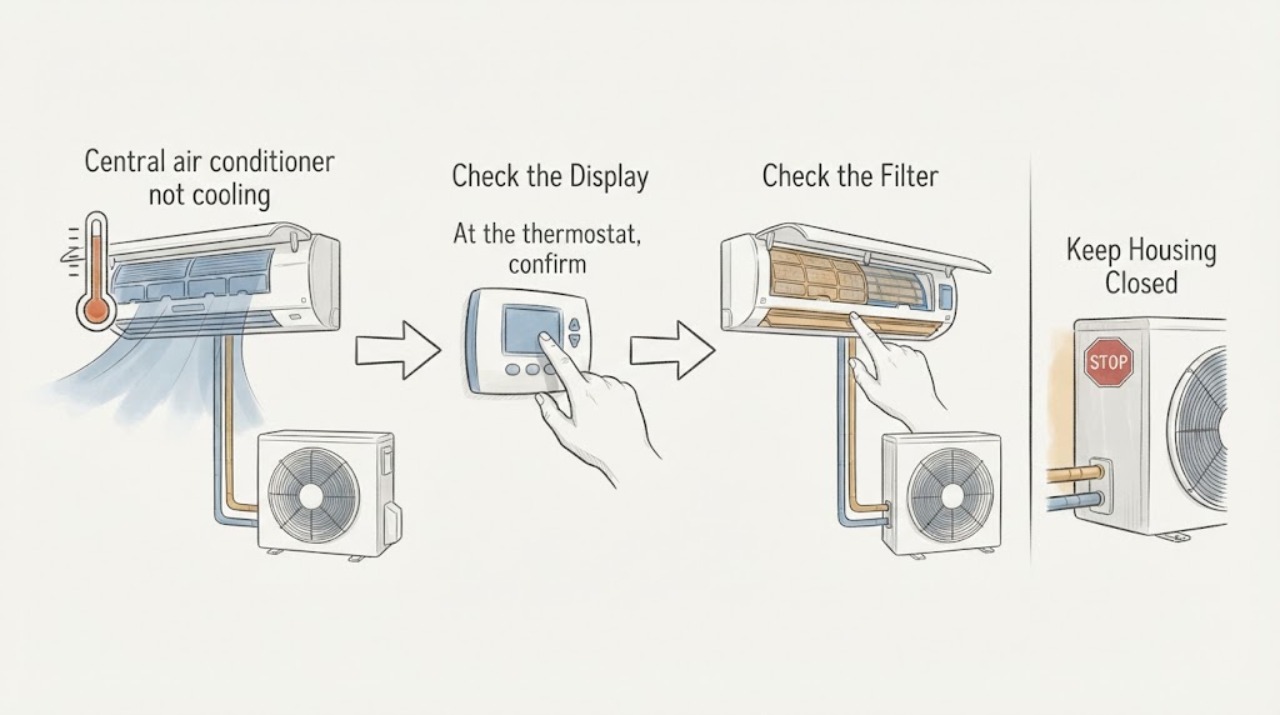
At the thermostat, confirm the mode is Cool, the target is below the room temperature, the fan setting is not forcing room-temperature air between cycles, and any schedule or hold is intentional; then wait for the system's normal start delay without repeatedly changing settings.
Expected result: The mode or target was wrong, the fan was set to run continuously, a schedule prevented cooling, the thermostat screen is blank, or the thermostat is correctly calling for cooling.
Next step: Correct only the clearly understood user setting and check a nearby supply vent. If the thermostat remains blank or the system does not respond to a correct cooling call, continue to the filter and electrical-status check without opening the thermostat or equipment wiring.
Why this matters
Why: A control setting can fully explain warm air without a mechanical failure. A blank screen suggests power or thermostat trouble, while a correct call shifts attention to airflow, power, drain protection, or the refrigeration system.
-
Check 3
Turn the system off at the thermostat and inspect the accessible air filter, return grille, supply registers, and visible duct openings; replace or clean the filter only if the Carrier or equipment manual documents that user task.
Expected result: The filter is heavily loaded, a return or supply opening is blocked, airflow is weak at several registers, or the filter and visible airflow path are clear.
Next step: Restore only a safe filter and grille condition, then make an attended cooling call. If airflow remains weak or ice appears, turn cooling off and arrange service rather than increasing the fan or removing panels.
Why this matters
Why: Restricted indoor airflow can reduce cooling and contribute to an evaporator coil freezing. A clear filter and open registers make an outdoor, refrigerant, condensate, duct, or deeper blower problem more likely.
-
Check 4
From outside the operating area, look for ice on the refrigerant tubing or outdoor cabinet, heavy frost, unusual water around the indoor air handler, or a condensate drain and pan that appears backed up; do not touch the tubing or open the coil enclosure.
Expected result: Ice is present, water is standing near the indoor unit, a drain outlet is overflowing or dry when the system has been running, or there is no ice or water clue.
Next step: Turn cooling off and arrange qualified HVAC service for ice, standing water, or a drain shutdown. Do not chip ice, add refrigerant, pour unapproved chemicals, or restart repeatedly to force cooling.
Why this matters
Why: Ice can result from restricted airflow or low refrigerant and can stop effective cooling. Indoor water or a drain backup can trigger a float switch and shut down the system. No visible clue does not rule out a sealed-system or electrical fault.
-
Check 5
With the thermostat calling for cooling and no immediate hazard, observe the outdoor unit from a safe distance for any fan movement, compressor sound, airflow, loose debris, or a unit that remains completely silent; clear only loose vegetation around the cabinet without opening it.
Expected result: The outdoor fan runs and air is warm, the fan does not run, the unit is silent despite a cooling call, unusual loud noise occurs, or the cabinet is obstructed by debris.
Next step: Remove only loose debris that can be reached safely, then stop if cooling does not return. Do not touch the fan, capacitor, disconnect, wiring, or refrigerant lines; arrange service for silence, abnormal noise, or warm air despite outdoor operation.
Why this matters
Why: A running fan with warm indoor air can still indicate refrigerant, coil, compressor, airflow, or duct trouble. A silent or non-spinning unit keeps power, controls, capacitor, motor, or compressor faults in consideration. Debris can reduce condenser heat rejection but does not prove a component failure.
-
Check 6
From the home electrical panel, identify the clearly labeled air-conditioning breaker or fuse and the outdoor disconnect, and check the Carrier thermostat or equipment display for a fault; reset a breaker only once if it is visibly tripped and the manual permits it.
Expected result: The breaker is tripped, the fuse is open, the thermostat is blank, the outdoor disconnect appears abnormal, the breaker trips again, or all visible power indications are normal.
Next step: If the breaker trips again, leave it off and arrange qualified HVAC service. Do not open the disconnect, replace fuses with a different type, or test voltage; continue only with safe external observations when power status is normal.
Why this matters
Why: A single power interruption can prevent the outdoor unit from starting. A repeated trip indicates an electrical or component fault, not a reason to keep resetting. Normal visible power shifts attention to the control signal, airflow, drain, refrigerant, or mechanical system.
-
Check 7
After only the documented filter, setting, or loose-debris correction, run one attended cooling cycle and compare supply-air temperature, airflow, room temperature trend, outdoor-unit behavior, and any water or ice return.
Expected result: Cooling returns and remains stable, airflow improves but cooling remains weak, the system runs continuously without reaching the target, short cycling occurs, or the original symptom returns.
Next step: Stop operating a system that ices, leaks, short cycles, makes abnormal noise, or cannot cool after basic checks, and provide the observations to a qualified Carrier HVAC technician.
Why this matters
Why: A stable return supports a correctable setting or airflow restriction. Weak or absent cooling after those checks makes refrigerant, coil, compressor, blower, duct, drain protection, or electrical diagnosis more likely. Long or rapidly repeating cycles can signal an airflow, refrigerant, sizing, or control problem.
Use your observations
Decision map
Find the observation that best matches what you see, then follow the next safe action.
-
PATH 01Next step
What you see
The thermostat was in the wrong mode or fan setting, and the outdoor unit and supply air behave normally after the setting is corrected.
Do this next
Keep the intended mode and schedule, then monitor comfort. If the same setting changes on its own or cooling stops again, arrange thermostat or control diagnosis.
Why this path and its safety boundary
Why it matters: A control-setting issue is more likely than a failed cooling component.
-
PATH 02Next step
What you see
The filter or return path was restricted, airflow improved after a documented correction, and cooling returns without ice or water.
Do this next
Keep the correct filter and airflow path maintained. Have service inspect the evaporator coil or blower if airflow weakens again or ice returns.
Why this path and its safety boundary
Why it matters: An indoor airflow restriction is more likely to have caused the poor cooling than a refrigerant or compressor fault.
-
PATH 03Next step
What you see
Ice appears on tubing or the coil area, the indoor unit has standing water, or cooling stops with a condensate or float-switch clue.
Do this next
Turn cooling off, protect the area from water, and arrange qualified HVAC service. Do not chip ice, open the coil, add refrigerant, or repeatedly restart the system.
Why this path and its safety boundary
Why it matters: Restricted airflow, low refrigerant, a frozen evaporator, or a blocked condensate path is more likely than a thermostat-only issue.
-
PATH 04Next step
What you see
The thermostat calls for cooling but the outdoor unit is silent, the fan does not spin, or an electrical breaker trips again.
Do this next
Leave the circuit off after a repeated trip and arrange qualified HVAC service. Do not open the disconnect or outdoor cabinet or attempt a capacitor or motor test.
Why this path and its safety boundary
Why it matters: Power, contactor, capacitor, motor, control, wiring, or compressor trouble is more likely, and outdoor components are high voltage.
-
PATH 05Next step
What you see
The outdoor unit runs but the house remains warm, supply air stays warm, the system runs continuously, or cooling is weak after the filter and debris checks.
Do this next
Stop prolonged operation if ice, unusual noise, or worsening performance appears and arrange qualified HVAC diagnosis; refrigerant and sealed-system work must not be attempted by the homeowner.
Why this path and its safety boundary
Why it matters: Low refrigerant, a refrigerant leak, dirty coil, compressor or fan problem, duct loss, inadequate airflow, or an undersized system is more likely than a simple setting issue.
Helpful context
Understand the symptom
First separate a control problem from a cooling problem
A thermostat set to heat, fan-only, or an unintended schedule can make a working Carrier system appear warm. A fan set to run continuously can also blow room-temperature air between cooling cycles. Confirm that the thermostat is calling for cooling, then check whether the indoor blower and outdoor unit respond.
Airflow is the safe place to start
A clogged filter, closed or blocked supply path, or debris restricting the outdoor coil can reduce heat transfer and cause a coil to freeze. Replace or clean the accessible filter only as the equipment manual directs, keep return and supply openings clear, and remove loose vegetation around the outdoor cabinet without bending the fins or opening the unit.
Ice and indoor water change the decision
Ice on refrigerant tubing or the outdoor unit is not a normal cooling result. It can follow restricted airflow or low refrigerant, and continued operation can stress the compressor. A clogged condensate line can cause standing water and a float switch to stop cooling. Shut the system down and arrange service rather than trying to thaw, puncture, or chemically clean the refrigeration circuit.
An outdoor unit that is silent is not automatically a bad compressor
A silent condenser may have lost power, may not be receiving a call from the thermostat, or may have a contactor, capacitor, motor, control, or compressor fault. A fan that runs without cool air can indicate airflow, refrigerant, coil, or compressor trouble. Sound and fan movement are clues only; they do not identify a part for replacement.
Keep refrigerant and electrical work professional
Carrier treats refrigerant diagnosis, frozen evaporator coils, outdoor electrical components, compressors, and complex mechanical faults as professional work. Do not remove service panels, test live voltage, add refrigerant, bypass a float switch, or repeatedly reset a breaker to keep a failing system running.
Safety boundary
Stop conditions
- Turn cooling off and arrange qualified HVAC service for ice, suspected refrigerant loss, a clogged condensate drain with standing water, continuous operation without cooling, short cycling, or abnormal outdoor-unit noise.
- Do not remove electrical covers, open the outdoor disconnect, test live voltage, handle capacitors or compressor wiring, add refrigerant, open the evaporator enclosure, or bypass a float switch or other safety control.
- If a breaker trips again, leave it off. If there is smoke, a burnt electrical smell, exposed wiring, water near electrical equipment, or another immediate hazard, leave the area as appropriate and use emergency or qualified help.
- Do not chip ice, restart repeatedly to force cooling, bend coil fins, or pour unapproved chemicals into a condensate line.
Only after diagnosis
Potential parts
- air conditioner air filter
Consider this only when the filter is damaged, missing, or the documented replacement interval or inspection identifies a restriction; a new filter will not repair a refrigerant or outdoor-unit fault.
Match the exact Carrier system, filter dimensions, airflow direction, and manual requirements. - outdoor condenser fan motor or capacitor
Consider this only after qualified electrical testing confirms a motor or capacitor fault; fan silence or failure alone does not identify which component failed.
Match the exact Carrier outdoor-unit model, electrical ratings, motor type, capacitor specification, and approved service procedure. - air conditioner contactor or control board
Consider this only when a qualified technician confirms that the outdoor unit receives the call for cooling but the switching or control component is faulty.
Verify the exact Carrier model, board or contactor revision, terminals, voltage, safety controls, and wiring documentation. - air conditioner compressor
Consider this only after a professional rules out airflow, refrigerant charge or leak, capacitor, contactor, fan, duct, and control causes and confirms compressor failure.
Compressor selection and sealed-system work require the exact Carrier outdoor-unit model and qualified installation procedure. - thermostatic control or thermostat
Consider this only when the thermostat does not issue a valid cooling call, loses display or schedule, or fails a qualified control test after settings and power are confirmed.
Match the exact Carrier thermostat, indoor unit, wiring, communicating or non-communicating architecture, and configuration instructions.
When checks do not resolve it
Need a professional?
Safety scope: A professional should handle refrigerant and leak testing, frozen or inaccessible coils, compressors, capacitors, contactors, motors, electrical panels, duct diagnosis, condensate safety devices, sealed-system repairs, and sizing concerns. Keep homeowner work to thermostat settings, accessible filter care, visible drain or ice observations, loose debris clearance, and a clearly safe breaker observation.
Common questions
FAQ
Why is my Carrier central air conditioner not cooling?
Start with the thermostat mode and fan setting, then check the accessible filter, airflow, ice, condensate water, outdoor-unit operation, and visible power status. If basic checks do not restore cooling, low refrigerant, a frozen coil, electrical or compressor fault, duct issue, or drain safety shutdown needs qualified diagnosis.
What should I check if my Carrier AC is running but blowing warm air?
Confirm a valid cooling call, inspect the filter and supply airflow, look for ice or indoor water, and observe whether the outdoor condenser operates. Warm air after those checks can indicate low refrigerant, a blocked or dirty coil, compressor or fan trouble, or a duct problem; do not handle refrigerant or high-voltage parts.
Should I run my Carrier AC if there is ice on the tubing?
No. Turn cooling off and arrange qualified service. Ice commonly points to restricted airflow or low refrigerant, and continued operation can stress the compressor. Do not chip the ice, open the coil, or add refrigerant yourself.
Why is there water near my Carrier indoor air conditioner?
A blocked condensate drain, full pan, float-switch shutdown, frozen coil thaw, or a plumbing or equipment leak may be involved. Turn cooling off if water is accumulating near electrical equipment, protect the area, and arrange service rather than bypassing the safety switch or pouring unapproved chemicals into the drain.
What if the Carrier outdoor unit does not turn on?
Check the thermostat call and visible breaker status once, if safe and permitted. If the breaker trips again, the fan or compressor is silent, or the unit makes abnormal noise, leave the circuit off and arrange qualified HVAC service; do not open the disconnect or outdoor cabinet.
Read the exact guide
Official sources
- How to Clean AC Drain Line: AC Maintenance GuideCarrier · Carrier residential central air-conditioner condensate guidance; drain layouts and homeowner access vary
- AC Maintenance Guide: Essential Tips and ServiceCarrier · Carrier residential air-conditioning maintenance guidance; maintenance scope and equipment access vary by model
- Why Is My AC Not Blowing Cold Air? Seven Common CausesCarrier · Carrier residential central-air troubleshooting; installation, thermostat, and equipment-specific limits still govern
- Cool On Flashing on Thermostat: What It Means and How to Fix ItCarrier · Carrier thermostat guidance; display labels and delay behavior vary by thermostat and system
- Troubleshoot an Air Conditioner: Six Steps to Fix an AC Not WorkingCarrier · Carrier residential split-system central air-conditioner guidance; exact controls and model procedures vary
Community feedback
Share a repair observation
Share a plain-text repair observation. Accepted observations are published automatically; this page may take a moment to update.