
On this page
Start here
Quick answer
Warm air from a central air conditioner usually points first to a thermostat or fan setting, restricted airflow, a frozen coil, a non-running outdoor unit, a refrigerant problem, or a duct-delivery problem. Set the thermostat to Cool with the fan on Auto, check the filter and visible registers, and observe the outdoor unit from a safe distance during a cooling call. Look for ice or water without opening panels or scraping anything. Turn cooling off and arrange qualified HVAC service if ice returns, the outdoor unit is dead or making unusual noise, a breaker trips, water is near electrical equipment, or refrigerant or electrical work may be needed.
Before you begin
Safety first
- The homeowner checks are visual and control-level only. Do not open electrical panels, test live circuits, handle refrigerant, or scrape ice.
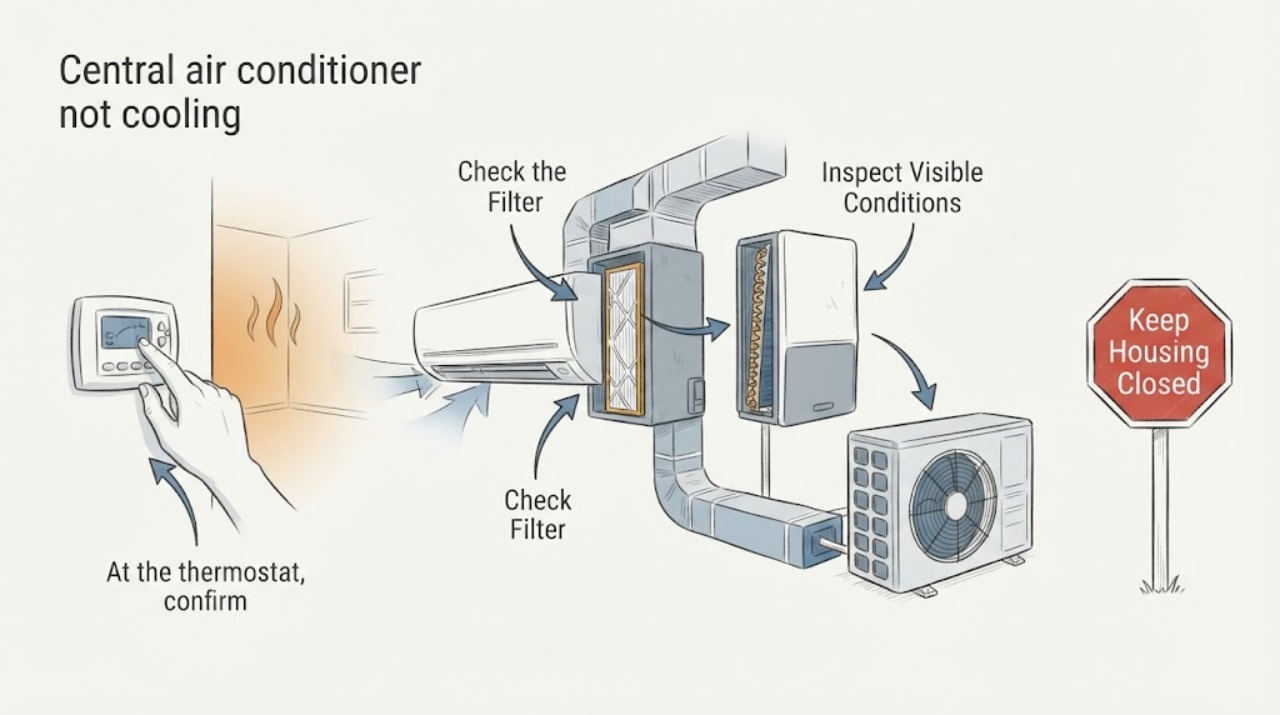
Work through in order
Diagnostic checks
Use only checks that match the exact appliance or system and its official guide.
-
Check 1
At the thermostat, confirm the mode is Cool, set the fan to Auto, and set the target below the current room temperature. If the thermostat uses a schedule or batteries, make sure the active setting is actually requesting cooling.
Expected result: Listen for the indoor blower and note whether the outdoor unit starts after the call; record whether the delivered air remains warm.
Next step: Leave the fan on Auto for normal cooling. If the settings are correct and the outdoor unit still does not respond, use the stop and service boundary below.
Why this matters
Why: If changing the mode or fan restores cooling, the symptom was a control setting rather than a failed cooling component. If the blower runs but the outdoor unit stays silent, continue with the outdoor-unit check and do not open its cabinet.
-
Check 2
With power left on and no panel removed, inspect the return-air filter and the visible supply registers. Replace a visibly loaded filter only with the size and type specified for the system, and make sure registers are open and not blocked by furniture.
Expected result: Compare airflow before and after the filter check: weak airflow at most registers differs from normal airflow that is simply warm; one weak room differs from weak airflow throughout the home.
Next step: After a filter change, allow the system to run briefly while watching for improvement. If airflow stays weak, ice appears, or the filter loads unusually fast, stop cooling and arrange HVAC service rather than adding a stronger or incompatible filter.
Why this matters
Why: A loaded filter or weak airflow can keep the indoor coil from receiving enough air and can contribute to icing. Normal airflow with warm air makes a filter restriction less likely and shifts attention to outdoor operation, refrigerant, or delivery temperature.
-
Check 3
From a safe standing position, look at the outdoor condenser while the thermostat is calling for cooling. Check only that the unit is unobstructed and whether its fan appears to run; do not remove the grille or touch the cabinet.
Expected result: The fan may run normally, remain completely still, or run with unusual noise. Note whether the indoor blower continues while the outdoor unit does not.
Next step: Clear only loose vegetation or other objects that can be removed without tools and without touching the unit. If it remains still, noisy, or repeatedly stops, stop troubleshooting at the cabinet and call a qualified HVAC technician.
Why this matters
Why: A still outdoor unit during a confirmed cooling call can explain warm air and may involve power, controls, or the condensing equipment. Unusual noise is a service clue. A running outdoor unit does not by itself prove that refrigerant charge or compressor performance is normal.
-
Check 4
Visually inspect accessible areas around the indoor equipment, the larger insulated refrigerant line, and the condensate pan or drain outlet for ice or unusual water. Do not open a panel, scrape ice, or disturb wiring.
Expected result: Look for ice on the line or cabinet, water outside the expected drain path, or a pan that is filling. Absence of visible ice does not rule out a hidden coil problem.
Next step: If ice is present, turn cooling off and leave the equipment closed while arranging service; use only a separately controlled fan if needed and safe. If water is near electrical equipment, stop and keep clear. Do not restart repeatedly to test it.
Why this matters
Why: Ice can follow restricted airflow or a refrigerant problem, while excess water can indicate a condensate or thawing issue. Either can reduce cooling and can cause damage if the system continues to run unchecked.
-
Check 5
Compare several supply registers with the return grille and note the pattern around the home. Check for a loose, visibly disconnected, sharply bent, or sagging accessible duct section without entering confined spaces or removing building finishes.
Expected result: Warm air from every register differs from one room or one branch having weak delivery. Listen for duct noise and note whether the rest of the home cools normally.
Next step: Keep any visible register open and report the pattern to the technician. Do not seal an inaccessible duct or alter dampers as a substitute for finding the fault.
Why this matters
Why: Whole-home warm air points back toward the call, indoor coil, outdoor unit, or refrigerant circuit. A single-room pattern with normal equipment operation makes a local duct, register, or damper problem more likely.
-
Check 6
After the safe checks, note whether the system reaches the target temperature, runs continuously, or cools only briefly before the air becomes warm again. Record the symptom pattern and any ice, water, noise, or breaker event for service.
Expected result: A persistent warm-air symptom despite correct settings, adequate airflow, and a running outdoor unit is different from a setting error or a blocked register; recurring ice after thawing is especially significant.
Next step: Arrange qualified HVAC diagnosis when the symptom persists or returns. Share the observations and the equipment model information from its label only if it is visible without opening anything.
Why this matters
Why: The remaining possibilities include a coil or refrigerant fault, compressor or control fault, drainage issue, or a system that is not delivering cooling through the ducts. These cannot be safely distinguished by guessing at parts or refrigerant.
Use your observations
Decision map
Find the observation that best matches what you see, then follow the next safe action.
-
PATH 01Next step
What you see
The thermostat was not calling for cooling, or the fan was set to run continuously, and cooling returns after the setting is corrected.
Do this next
Keep Cool selected with the fan on Auto and monitor whether the system reaches the target. If warm air returns with correct settings, continue to the equipment branches.
-
PATH 02Next step
What you see
Airflow is weak throughout the home, the filter is loaded, or ice appears on the indoor coil or refrigerant line.
Do this next
Turn cooling off if ice is present, leave panels closed, and arrange HVAC service if airflow does not recover after the correct filter is installed or if icing returns.
-
PATH 03Next step
What you see
The thermostat is calling, the indoor blower runs, but the outdoor unit remains still or makes an unusual noise.
Do this next
Do not remove the outdoor cover or repeatedly reset a tripping breaker. Stop at the visible check and call a qualified HVAC technician.
-
PATH 04Next step
What you see
The outdoor unit runs and airflow is normal, but every register stays warm or the target temperature is never reached; ice or water may recur.
Do this next
Arrange professional diagnosis and report the exact pattern. Do not attempt a refrigerant recharge or electrical measurement.
-
PATH 05Next step
What you see
The equipment appears to cool normally, but one room or one duct branch has weak or warm delivery.
Do this next
Keep the register open, document which rooms are affected, and have the duct distribution checked if the accessible opening and furniture checks do not explain it.
-
PATH 06Next step
What you see
A breaker trips again, burning odor or smoke is present, or water is near electrical equipment.
Do this next
Stop using the system, keep clear of the equipment, and contact a qualified professional or appropriate emergency service for the immediate hazard. Do not open panels or reset the breaker repeatedly.
Helpful context
Understand the symptom
How to read the warm-air symptom
A central air conditioner has several linked stages: the indoor coil absorbs heat, the compressor and outdoor condenser reject that heat, and the blower sends the cooled air through the duct system. A thermostat can call for cooling while one of those stages is not operating. That is why the first useful distinction is whether air is moving at all, whether the outdoor unit responds to the call, and whether cooling is lost everywhere or only at particular registers.
Keep the boundary simple
Use only visible, homeowner-level checks. Do not remove an equipment panel, touch a capacitor or wiring, test live voltage, cut into a refrigerant circuit, or scrape ice from a coil. If the system is frozen, switching off cooling prevents continued operation while a technician determines whether airflow, drainage, or refrigerant is involved.
Only after diagnosis
Potential parts
- air filter
Only consider a replacement if the installed filter is visibly loaded and the system documentation identifies its size and type.
Confirm the exact dimensions and filter specification from the existing filter or equipment documentation; do not assume a higher-restriction filter is suitable. - thermostat
Consider this only after a qualified diagnosis shows that the thermostat is not making the required cooling call or cannot hold its settings.
Compatibility depends on the system wiring, equipment type, and controls. Have the model and wiring verified before ordering or installing.
When checks do not resolve it
Need a professional?
Call a qualified HVAC technician when the thermostat and filter checks do not restore cooling, the outdoor unit stays off or sounds abnormal, ice returns, water is near equipment, a breaker trips, or the system runs without lowering the indoor temperature. Stop immediately for smoke, a burning smell, exposed wiring, or an electrical hazard. Refrigerant diagnosis or charging, capacitor and control testing, panel removal, and live electrical work are professional tasks.
Safety scope: The homeowner checks are visual and control-level only. Do not open electrical panels, test live circuits, handle refrigerant, or scrape ice.
Common questions
FAQ
Why is my central AC blowing warm air when the fan is running?
The fan can run without active cooling, or cooling may be lost because of a setting, restricted airflow, icing, an outdoor-unit fault, refrigerant trouble, or a delivery problem. Confirm Cool and Auto, then use the visible checks above without opening equipment.
Should I keep running a central AC that has ice on it?
No. Turn cooling off and leave the equipment closed while arranging service. Do not scrape the ice or repeatedly restart cooling; restricted airflow and refrigerant problems can require different professional repairs.
What if the outdoor unit is not running but the indoor blower is?
That pattern can involve power, controls, the outdoor fan, compressor, or another condensing-unit fault. Do not remove the cover or test live electrical parts; call a qualified HVAC technician if the unit stays still during a confirmed cooling call.
Why is only one room warm while the rest of the house cools?
A blocked register, damper, or local duct connection is more likely when the equipment cools normally and the problem is limited to one branch. Check only visible registers and accessible conditions, then have the air distribution checked if the pattern persists.
Read the exact guide
Official sources
- Why Is My AC Blowing Hot Air? | Troubleshooting & FixesCarrier · Carrier residential air-conditioner warm-air troubleshooting
- AC Not Blowing Cold AirTrane · residential central air-conditioner warm-air troubleshooting
- HomeCooling101U.S. Department of Energy · central air-conditioner cooling mechanics, condenser operation, and duct distribution
- Troubleshoot an Air Conditioner: 6 Steps to Fix an AC Not WorkingCarrier · Carrier residential central air-conditioner troubleshooting
Community feedback
Share a repair observation
Share a plain-text repair observation. Accepted observations are published automatically; this page may take a moment to update.