
On this page
Start here
Quick answer
An outdoor fan running does not prove that a central air conditioner is producing cooling. First confirm the thermostat is calling for cooling with the indoor fan set appropriately, then check whether air is moving through a clean filter and registers. From a safe distance, observe the outdoor unit for a normal fan, unusual noise, heavy debris, or ice; do not open the cabinet or touch electrical parts. Ice on the refrigerant tubing or indoor coil area, weak airflow, a unit that runs continuously without lowering the room temperature, or water around the indoor unit points to an airflow, frozen-coil, refrigerant, drain, or mechanical problem that needs service. Do not add refrigerant, bypass controls, reset a breaker repeatedly, or work inside the outdoor unit. If the simple thermostat, airflow, and visual checks do not restore cooling, stop operating the system if ice, burning odor, repeated electrical trips, or water damage is present and arrange qualified HVAC service.
Before you begin
Safety first
- Do not open the outdoor or indoor cabinet, touch capacitors or wiring, connect gauges, add or release refrigerant, bypass controls, scrape ice, spray a running electrical unit, or repeatedly reset a breaker. Keep the system off for burning odor, smoke, exposed conductors, visible ice, water near electrical equipment, or repeated trips.
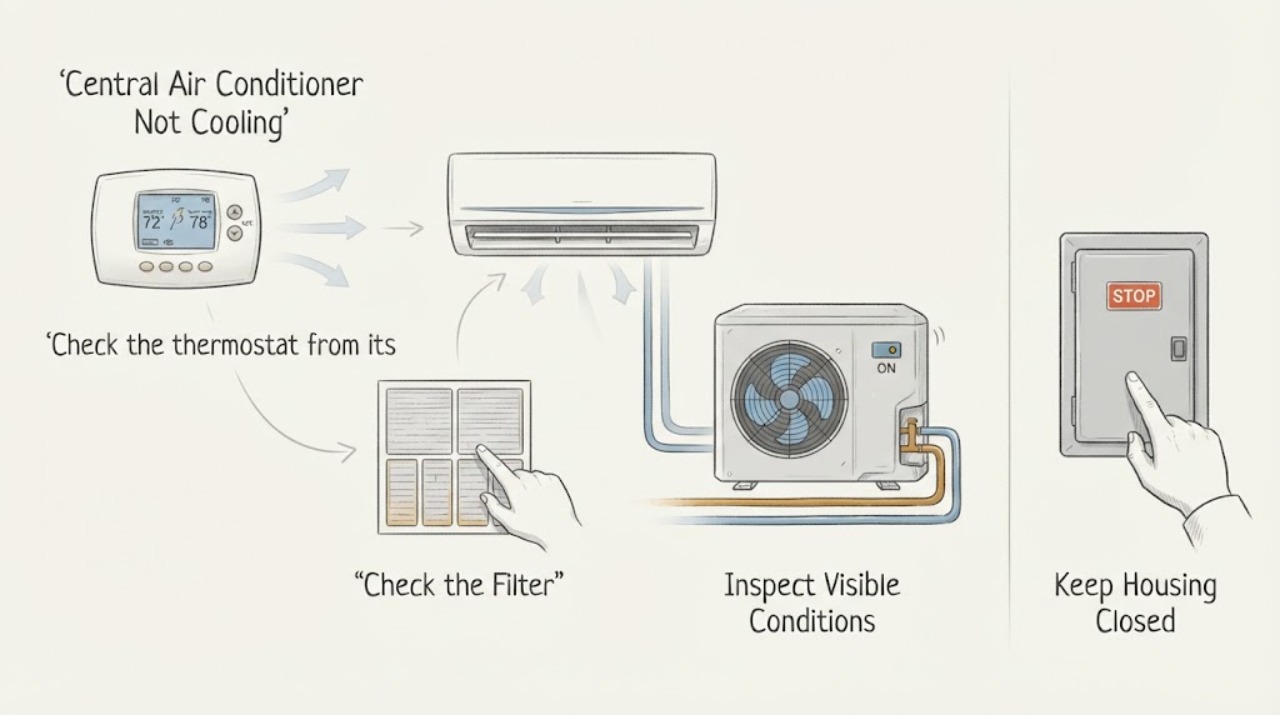
Work through in order
Diagnostic checks
Use only checks that match the exact appliance or system and its official guide.
-
Check 1
Check the thermostat from its normal user interface: confirm the mode is Cool, the set point is below the room reading, and the fan setting is understood. If the fan is set to On, note whether it continues blowing when the system is not actively cooling; do not remove the thermostat cover or change wiring.
Expected result: The thermostat is in Heat or Off, the set point is not calling for cooling, the fan runs continuously with warm air, the display is blank, or the control is correctly calling for cooling.
Next step: Correct only the normal user settings and observe one complete cooling call. If the thermostat is blank, repeatedly loses power, or a correct call produces warm air, continue with the airflow and symptom checks and arrange HVAC service if it persists.
Why this matters
Why: A mode, schedule, set-point, or fan-setting mismatch can make a working system appear to blow warm air. A correct cooling call with continued low cooling moves attention to airflow, ice, the outdoor heat-rejection side, or the refrigerant and mechanical circuit.
-
Check 2
Inspect the return-air filter using the ordinary filter access, without opening the air handler cabinet. Note whether it is visibly loaded with dust, collapsed, wet, or the wrong size, and check whether supply registers are open and delivering a normal amount of air compared with other rooms.
Expected result: The filter is dirty, blocked, wet, or damaged; airflow is weak at several registers; airflow is normal but the air is warm; or only one register has poor flow.
Next step: If the filter is clearly due for replacement, use the exact size and type specified for the system and record whether airflow changes; do not install a filter that cannot seat correctly. If the filter is wet, airflow remains weak, or cooling is still poor with normal airflow, stop treating the filter as the diagnosis and arrange service.
Why this matters
Why: A blocked filter or broad weak airflow can starve the indoor coil and reduce cooling, while one poor register may be a local grille or duct issue. Normal airflow with warm supply air makes a thermostat, heat-rejection, frozen-coil, refrigerant, or compressor/control issue more likely than a filter-only issue.
-
Check 3
Observe the outdoor unit from a safe standing position while the thermostat calls for cooling. Note whether the fan spins, warm air is being discharged, the unit is silent or short-cycling, the coil surface is visibly packed with leaves or debris, and whether there are new rattles, buzzing, or burning odors. Do not remove panels, reach through the grille, spray the unit, or touch the refrigerant lines.
Expected result: The fan runs with warm discharge air; the fan does not run; the cabinet is heavily obstructed; the unit cycles off quickly; or there is unusual noise, odor, or visible damage.
Next step: Keep the observation and timing for the technician. Do not attempt an electrical repair or cabinet cleaning; if there is burning odor, repeated tripping, exposed wiring, a loose panel, or a loud abnormal sound, turn the system off at the thermostat and arrange prompt service.
Stop if: Stop immediately for burning odor, smoke, exposed wiring, a loose or damaged cabinet, arcing, or any need to reach inside the outdoor unit.
Why this matters
Why: A running fan with no indoor cooling does not establish that the compressor and refrigerant circuit are working. Heavy debris can restrict heat rejection; a silent, noisy, short-cycling, or odorous unit can involve controls, a motor, a capacitor, a compressor, or another high-voltage fault.
-
Check 4
Look for ice or frost without touching it: inspect visible refrigerant tubing near the indoor unit or outdoor unit and the accessible area around the indoor air handler for ice, frost, or unusual water after the system has been operating. Do not scrape ice, use a heat gun, remove a panel, or continue a long cooling call to test it.
Expected result: Ice or frost is visible on tubing or coil-area surfaces; the ice has melted but there is unusual condensate or water; or there is no ice and no abnormal water.
Next step: If ice, unusual water, or a soaked filter is present, switch the thermostat out of cooling and arrange qualified HVAC service; protect nearby belongings from water without opening the equipment. If no ice is present, continue only with the non-invasive airflow and monitoring observations.
Stop if: Stop cooling and call for service for visible ice, water damage, a wet air handler area, or any sign that water is near electrical equipment.
Why this matters
Why: Ice can accompany restricted airflow or low refrigerant and can prevent normal cooling; continued operation can damage the compressor. Water around the indoor unit can also indicate a condensate-drain or frozen-coil problem. No ice makes that specific path less likely but does not rule out other faults.
-
Check 5
Compare the cooling result with the run pattern over one normal call: note whether the indoor temperature decreases at all, whether supply air is consistently cooler than the room, whether the system runs continuously, and whether the outdoor unit starts and stops rapidly. Record outdoor weather and the time of the observation rather than relying on a single hand-feel test.
Expected result: The system runs continuously without reaching the set point; cooling is weak but airflow is strong; cooling is normal for a while then fades; or the system rapidly cycles.
Next step: Save the thermostat and monitoring observations and arrange HVAC diagnosis when cooling remains inadequate after the normal setting and filter checks. Do not change refrigerant charge, bypass controls, or repeatedly restart a system that is short-cycling or icing.
Why this matters
Why: Continuous operation with strong airflow but inadequate cooling is consistent with a heat-rejection, refrigerant, compressor, or other mechanical issue. Cooling that fades with ice points toward a frozen-coil path; rapid cycling can reflect a control or system problem. Outdoor temperature and house load can affect run time, so the pattern needs the other observations.
-
Check 6
Check only the visible, normal-user indicators of power and drainage: note whether the thermostat display is stable, whether the indoor blower runs, whether an electrical breaker is already tripped, and whether the accessible condensate drain area shows overflow or water damage. Do not test voltage. Do not open disconnects, remove electrical covers, or keep resetting a breaker.
Expected result: The indoor blower is off while the thermostat calls; a breaker is tripped; the display repeatedly goes blank; water is accumulating near the indoor unit; or the visible power and drain indicators look normal.
Next step: Leave a tripped breaker or recurring power interruption for a qualified technician, especially if it trips again or there is odor or heat. Arrange service for overflow or water damage; if these indicators are normal, use the accumulated thermostat, airflow, outdoor, ice, and run-pattern evidence for the HVAC diagnosis.
Stop if: Stop and keep the equipment off for repeated trips, burning odor, water near electrical equipment, smoke, or exposed conductors.
Why this matters
Why: A missing indoor blower, unstable control power, or condensate overflow can stop or impair cooling and may involve electrical, safety, or drain controls. A normal visible power and drain view does not clear the refrigerant, coil, compressor, or control circuit.
Use your observations
Decision map
Find the observation that best matches what you see, then follow the next safe action.
-
PATH 01Next step
What you see
The thermostat was not calling for cooling, its schedule or mode was wrong, or the fan was set to run independently and the system cools after the normal setting is corrected.
Do this next
Keep the normal setting and observe future cycles. If warm air returns with a correct cooling call, continue with airflow and equipment checks instead of repeatedly changing the set point.
Why this path and its safety boundary
Why it matters: A control setting was mimicking a cooling failure. The outdoor fan detail was incidental rather than proof of a mechanical fault.
-
PATH 02Next step
What you see
Airflow is weak at several registers, the filter is blocked or wet, or ice appears on visible tubing or around the indoor coil area.
Do this next
Use only the documented filter access and correct replacement if the filter is due; stop cooling for ice or water and arrange qualified HVAC service. Do not scrape ice or open the air handler.
Why this path and its safety boundary
Why it matters: Restricted airflow and a frozen evaporator are more likely. Low refrigerant can produce a similar ice pattern, so a clean filter would not make refrigerant work a user repair.
-
PATH 03Next step
What you see
The indoor blower and registers move a normal amount of air, the thermostat calls for cooling, the outdoor fan runs, but the home remains warm and there is no simple setting or filter explanation.
Do this next
Stop adding DIY fixes and arrange a qualified HVAC diagnosis. Ask the technician to evaluate the cooling circuit and leak evidence rather than treating an unknown refrigerant condition as a routine top-off.
Why this path and its safety boundary
Why it matters: A refrigerant, dirty condenser, compressor, control, or other heat-rejection problem is more likely than a filter-only fault. A running outdoor fan does not confirm compressor operation or correct refrigerant charge.
-
PATH 04Next step
What you see
The outdoor unit is silent, short-cycles, makes a new loud or buzzing sound, has a burning odor, repeatedly trips power, or shows exposed or damaged electrical components.
Do this next
Turn the system off at the thermostat, keep people away from the unit, and arrange qualified HVAC service. Do not remove panels, reach through the grille, reset the breaker repeatedly, or attempt a capacitor or wiring test.
Why this path and its safety boundary
Why it matters: A motor, capacitor, compressor, contactor, control, or power fault is more likely, and these components present an electrical hazard. The apparent fan operation may be intermittent or may not represent the full condensing unit.
-
PATH 05Next step
What you see
Water is accumulating around the indoor unit, the condensate drain appears to overflow, or wet materials and water damage accompany the loss of cooling.
Do this next
Stop cooling, protect nearby contents without opening the equipment, and arrange HVAC service for the drain and cooling system. Address wet building materials promptly under appropriate moisture-remediation guidance.
Why this path and its safety boundary
Why it matters: A plugged drain, frozen coil, or another condensate problem may be affecting operation and the building. Water near electrical equipment raises the safety priority.
Helpful context
Understand the symptom
The outdoor fan is only one part of the cooling cycle
A split central air conditioner moves heat from the indoor evaporator to the outdoor condensing unit. The outdoor fan may spin while the thermostat is mis-set, airflow is restricted, the indoor coil is frozen, the compressor or controls are failing, or the refrigerant circuit has a problem. That is why the useful first question is not simply whether the outdoor fan runs; it is whether the system is calling for cooling, moving enough indoor air, and showing a symptom that changes the service path.
Stay on the user-safe side of the equipment
Use the thermostat, registers, filter access, and a safe visual view of the outdoor unit. Do not remove access panels, touch a capacitor or wiring, connect gauges, add refrigerant, bridge a control, spray a running electrical unit, or repeatedly reset a tripped breaker. Ice, a burning smell, standing water, or repeated trips can worsen damage if the system keeps running, so move directly to the stop and service boundary.
What makes the outdoor-unit detail useful
If the indoor blower moves strong air but that air is not cool and the outdoor unit is operating, low refrigerant, a dirty condenser, compressor or control trouble, or a frozen indoor coil become more plausible than a simple thermostat display issue. If airflow is weak, start with the filter and registers instead. If cooling fails only after rain or the outdoor unit makes a new sound, preserve that timing and report it rather than trying to reproduce the fault with water or an opened cabinet.
Only after diagnosis
Potential parts
- replacement air filter
Consider this category only when the accessible filter is visibly loaded, wet, damaged, or due for replacement according to the equipment guidance; a filter change does not diagnose warm supply air with normal airflow.
Confirm the exact dimensions, filter type, airflow direction, and equipment guidance before ordering. The filter must seat correctly without bypass gaps or excessive restriction. - outdoor condenser fan motor or run capacitor
Consider this category only after a qualified technician identifies a failed motor or capacitor from the outdoor-unit symptom; a fan that appears to run does not justify replacing either part.
Match the equipment model, electrical ratings, motor characteristics, mounting, and manufacturer service information. These are not ordinary-user diagnostic or replacement parts. - indoor evaporator coil or matched refrigerant-system component
Consider this category only when qualified testing confirms a coil, leak, or matched-system defect; ice or weak cooling alone cannot identify the failed component.
Confirm the full equipment match, refrigerant design, dimensions, metering arrangement, and code or manufacturer requirements with the servicing professional. Do not order a generic coil or handle refrigerant lines as a user repair.
When checks do not resolve it
Need a professional?
Stop and arrange qualified HVAC service for visible ice or frost, water near the indoor unit or electrical equipment, burning odor, smoke, exposed wiring, repeated breaker trips, loud or abnormal outdoor-unit noise, a blank or unstable thermostat, suspected refrigerant loss, or cooling that remains inadequate after the normal thermostat, filter, register, and visual checks. Do not add refrigerant, open equipment, bypass controls, scrape ice, or keep restarting a short-cycling system.
Safety scope: Do not open the outdoor or indoor cabinet, touch capacitors or wiring, connect gauges, add or release refrigerant, bypass controls, scrape ice, spray a running electrical unit, or repeatedly reset a breaker. Keep the system off for burning odor, smoke, exposed conductors, visible ice, water near electrical equipment, or repeated trips.
Common questions
FAQ
Why is my outdoor AC unit running but the house is not cooling?
The outdoor fan can run while the thermostat setting, indoor airflow, evaporator coil, refrigerant circuit, compressor, controls, or condenser heat rejection has a problem. Check the normal thermostat setting and accessible filter first, then record airflow, ice, outdoor-unit noise, and the run pattern. Persistent warm supply air needs HVAC diagnosis rather than assuming the fan proves the system is healthy.
Should I keep running the AC if the outdoor fan is spinning?
Not when there is ice, water damage, a burning smell, smoke, repeated electrical tripping, or an abnormal noise. Ice can accompany restricted airflow or low refrigerant, and continued operation can damage the compressor. Turn the system off at the thermostat and arrange service for those signs.
Can a dirty filter cause the outdoor unit to run but not cool?
Yes. A loaded filter can restrict indoor airflow and reduce cooling; it can also contribute to a frozen indoor coil. Inspect the filter through its ordinary access and use the exact replacement specified for the system if it is due. If airflow remains weak, the filter is wet, or cooling stays poor, arrange service.
Can I add refrigerant if the AC is running but not cold?
No. Do not connect gauges or add refrigerant as an ordinary-user fix. EPA advises having a technician locate and repair a leak instead of simply topping off a leaking system, and Carrier identifies refrigerant troubleshooting as professional work. Give the technician the run pattern and any ice or airflow observations.
What should I tell an HVAC technician about this symptom?
Report whether the thermostat was calling for cooling, whether the indoor blower and registers had normal airflow, the filter condition, whether the outdoor fan ran, any warm discharge air, ice or water, unusual noise or odor, breaker trips, and whether the system ran continuously or short-cycled. Photos and timing help distinguish airflow, frozen-coil, electrical, refrigerant, and heat-rejection paths.
Read the exact guide
Official sources
- Homeowners and Consumers: Frequently Asked QuestionsU.S. Environmental Protection Agency · Official EPA homeowner information on refrigerant service and why a leaking stationary AC system should not be treated as a casual top-off
- Troubleshoot an Air Conditioner: 6 Steps to Fix an AC Not WorkingCarrier · Manufacturer troubleshooting guidance for homeowners observing inadequate cooling while the outdoor condensing unit may be operating
- Maintenance ChecklistENERGY STAR, U.S. Environmental Protection Agency · Official maintenance checklist identifying accessible filter maintenance and professional checks associated with poor cooling and equipment protection
Community feedback
Share a repair observation
Share a plain-text repair observation. Accepted observations are published automatically; this page may take a moment to update.