
On this page
Start here
Quick answer
A thermostat call proves that the control is requesting cooling, not that the indoor coil, outdoor condenser, compressor, or refrigerant circuit is operating. Set the thermostat to Cool with the fan on Auto, confirm the setpoint is below room temperature, and observe whether air moves from the registers. Then check the accessible filter and vents, look from a safe distance to see whether the outdoor unit starts, and look for ice or unusual water. Weak airflow can contribute to a frozen coil; a silent outdoor unit can indicate power or control trouble; a running unit that blows warm air can involve airflow, a dirty coil, refrigerant, or compressor problems. Do not open electrical panels, handle refrigerant, scrape ice, or keep running the system with visible ice, repeated breaker trips, burning odor, or unusual electrical noise.
Before you begin
Safety first
- This article supports checking thermostat settings, a user-serviceable filter, unobstructed registers, visible ice or water, and the outdoor unit's general operating state from a safe distance. It does not authorize panel or cabinet opening, refrigerant handling, live electrical testing, capacitor or compressor work, drain bypass, or wiring changes.
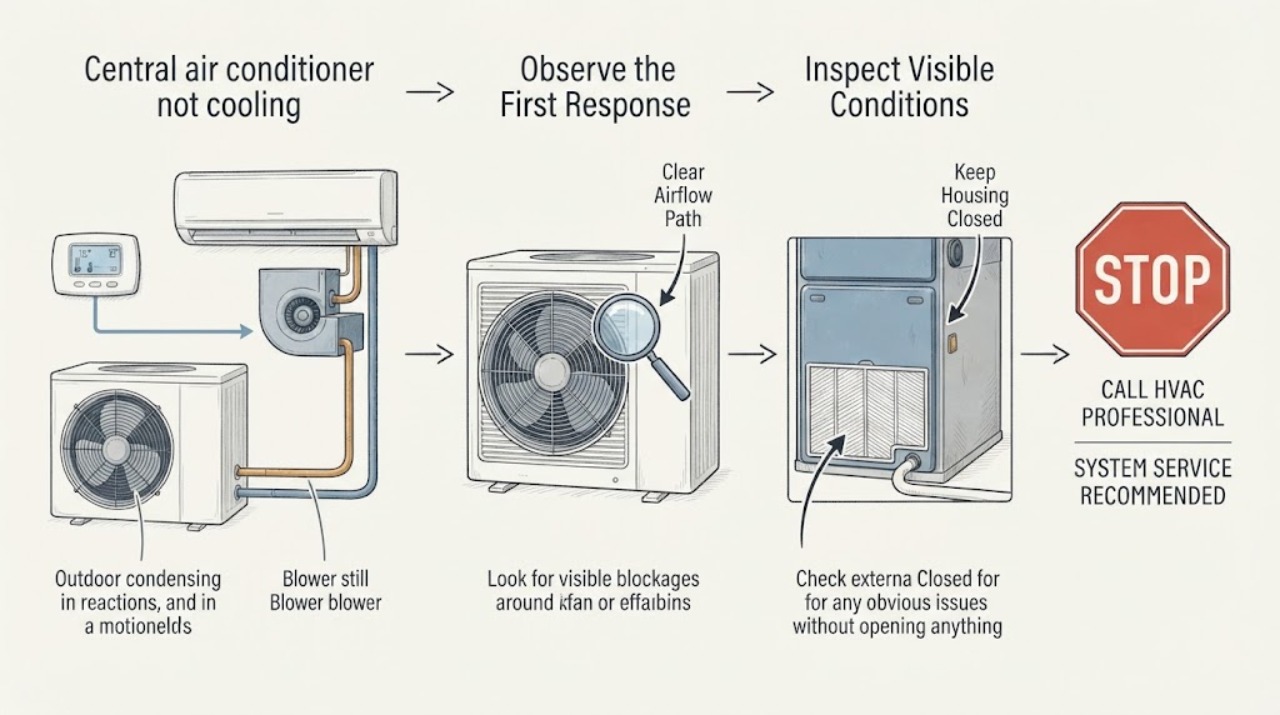
Work through in order
Diagnostic checks
Use only checks that match the exact appliance or system and its official guide.
-
Check 1
At the thermostat, confirm Mode is Cool, the set temperature is below the current room temperature, and Fan is Auto rather than On. Wait for the normal response and feel the airflow at several registers without blocking them.
Expected result: Record whether the thermostat continues to call, the indoor blower runs, airflow is normal or weak, and air feels cool, neutral, or warm.
Next step: Restore only an accidentally changed thermostat mode, setpoint, schedule, or fan setting; if the call remains active but airflow is absent, weak, or warm, continue with the matching branch and arrange service when user-level checks do not restore cooling.
Stop if: Do not bridge thermostat wires, remove the thermostat base to test voltage, or run the fan continuously to mask a cooling fault.
Why this matters
Why: A thermostat in Cool with a lower setpoint and a blower running confirms the call is reaching at least part of the system, but warm air can still result from a fan-only setting, airflow restriction, frozen coil, refrigerant issue, or outdoor-unit fault. No blower response points first toward indoor power, control, blower, or condensate-safety issues rather than proving the outdoor unit is bad.
-
Check 2
Turn the thermostat to Off before inspecting a user-accessible air filter, then compare the filter with its installed manual's replacement guidance. Check that return grilles and supply registers are open and not blocked by furniture or coverings; replace the filter only if it is the correct user-serviceable type and the manual permits it.
Expected result: Record whether the filter is visibly loaded with dust, airflow is weak at multiple registers, one zone is affected, or airflow is normal after the filter and grilles are addressed.
Next step: Restore the filter and grilles, return the thermostat to Cool, and observe the system without opening the air handler. If airflow remains weak or ice appears, turn cooling off and arrange HVAC service.
Stop if: Do not remove an inaccessible coil, open the air-handler cabinet, clean wiring, use a sharp tool on the coil, or keep cooling on while the coil or refrigerant lines are frozen.
Why this matters
Why: A clogged filter or blocked return can reduce airflow, make the system work harder, and contribute to an evaporator coil freezing. Normal airflow after a clean, correctly installed filter makes a severe filter restriction less likely but does not rule out refrigerant, coil, condenser, or compressor problems.
-
Check 3
With a valid cooling call and from outside the unit's operating zone, observe the outdoor condensing unit without touching it or removing any cover. Note whether the fan runs, whether the unit is silent, whether it makes a loud or unusual noise, and whether leaves or tall vegetation visibly obstruct the enclosure.
Expected result: Record whether the outdoor unit starts, the fan runs but cooling remains absent, the unit cycles off quickly, or the unit is silent despite the thermostat call. Record visible ice, water, smoke, or damage if present.
Next step: Keep clear of the fan and electrical components, remove only loose debris that is safely outside the enclosure if the unit is off, and arrange professional service when the unit is silent, noisy, short-cycles, or runs without cooling.
Stop if: Do not reach through the grille, hose or spray the unit while it is energized, open the disconnect or service panel, touch refrigerant lines, or attempt a capacitor, motor, contactor, or compressor test.
Why this matters
Why: A silent outdoor unit can point toward a power, disconnect, control, contactor, capacitor, or compressor issue. A running fan with warm indoor air can still involve the refrigeration circuit, dirty condenser, frozen indoor coil, or compressor. Debris around the condenser can reduce heat rejection, but visible cleanliness does not prove the refrigeration circuit is charged or healthy.
-
Check 4
Look without touching for frost or ice on accessible copper tubing or the outdoor unit, unusual water around the indoor unit, a rising condensate pan if it is visible without opening equipment, or a wet area near the air handler. Do not scrape ice or remove a panel.
Expected result: Record no ice or water, ice on tubing or a coil, excessive condensate, a full or overflowing pan, or water near electrical equipment.
Next step: Turn the cooling system off when ice is visible and arrange qualified HVAC service; if water is near electrical equipment, keep clear and address the electrical safety risk. Do not restart repeatedly to see whether ice returns.
Stop if: Do not chip ice, pour chemicals into an unknown drain, open the evaporator cabinet, handle refrigerant lines, or continue operating with a frozen coil or active leak.
Why this matters
Why: Ice can follow restricted airflow, a dirty coil, low refrigerant, or another refrigeration problem; continuing to run the system can damage the compressor. A condensate blockage or safety switch can stop an indoor unit, while water near electrical equipment creates an additional hazard. These observations do not identify the refrigerant charge or failed component.
-
Check 5
If the indoor unit and outdoor unit are both not operating and there are no smoke, burning odor, water, or other hazards, look at the clearly labeled air-conditioner breaker and outdoor disconnect from a safe position. Only if you are comfortable and the equipment is dry, follow the installed instructions for one reset; do not reset a breaker that trips immediately or repeatedly.
Expected result: Record whether a breaker or disconnect is visibly off, whether the system starts after one permitted reset, whether it trips again, or whether power appears present but the outdoor unit remains silent.
Next step: Leave the circuit off after a repeat trip and arrange a qualified HVAC or electrical inspection. Provide the thermostat call, indoor and outdoor operating states, breaker behavior, filter condition, and any ice or water observations.
Stop if: Do not remove a disconnect cover, replace a fuse, reset repeatedly, open the electrical panel, or work on capacitors, contactors, motors, compressors, or wiring.
Why this matters
Why: A tripped device can explain a no-operation symptom, but a repeat trip indicates an electrical or equipment fault. Power present with no outdoor response, or a cooling call with the indoor blower but no condenser, requires professional control and high-voltage diagnosis rather than more resets.
Use your observations
Decision map
Find the observation that best matches what you see, then follow the next safe action.
-
PATH 01Safety boundary
What you see
The thermostat remains in Cool with a lower setpoint, but the indoor blower does not run or airflow is absent from most registers.
Do this next
Check the user-accessible filter, return and supply grilles, and any clearly labeled power status without opening equipment; arrange HVAC service if airflow does not return or the air handler requires cabinet access.
Why this path and its safety boundary
Why it matters: The problem is more likely in indoor power, the blower, a control signal, a blocked filter or return, or a condensate safety switch than in outdoor refrigerant performance alone.
Safety stop: Do not remove the blower cabinet, bypass a condensate switch, bridge thermostat wiring, or test live voltage.
-
PATH 02Safety boundary
What you see
Airflow is weak, the filter is loaded or returns are blocked, and ice or frost appears on accessible tubing or the indoor coil area.
Do this next
Turn cooling off, address only a clearly user-serviceable filter or obstruction, and arrange HVAC service to inspect the coil, airflow, drain, and refrigerant circuit before restarting normal cooling.
Why this path and its safety boundary
Why it matters: Restricted airflow, a dirty coil, low refrigerant, or another refrigeration issue can freeze the evaporator; the combination does not prove which cause is primary.
Safety stop: Do not scrape ice, use heat to thaw the coil, open the air handler, add refrigerant, or keep operating to test it.
-
PATH 03Safety boundary
What you see
The thermostat calls for cooling and the indoor blower may run, but the outdoor condensing unit is silent or will not start.
Do this next
Check for a clearly visible breaker or disconnect state only from a safe position and only as allowed by the equipment instructions. If it is already on, it trips again, or the unit remains silent, arrange qualified HVAC service.
Why this path and its safety boundary
Why it matters: A power, disconnect, control, contactor, capacitor, motor, compressor, or related fault is possible; a thermostat call does not supply a homeowner-accessible diagnosis of those components.
Safety stop: Do not open the disconnect or service panel, reset repeatedly, reach into the fan grille, or attempt electrical component replacement.
-
PATH 04Safety boundary
What you see
The indoor blower and outdoor unit run, but the registers remain warm or the home does not cool; there is no obvious thermostat-setting error.
Do this next
Check the filter, grilles, outdoor obstruction, and visible ice without opening equipment. If those observations do not explain the symptom, turn the system off if ice or abnormal operation appears and arrange professional diagnosis.
Why this path and its safety boundary
Why it matters: Dirty condenser airflow, a frozen indoor coil, low or leaking refrigerant, a compressor or fan problem, duct or airflow loss, or another refrigeration fault remains possible. The fan running does not prove that the compressor is producing cooling.
Safety stop: Do not connect gauges, add refrigerant, open the cabinet, test the compressor or capacitor, or keep running a system with ice or unusual noise.
-
PATH 05Safety boundary
What you see
The cooling call coincides with a rising condensate pan, water near electrical equipment, repeated breaker trips, burning odor, smoke, sparks, or loud electrical or mechanical noise.
Do this next
Turn the system off from the normal thermostat control if safe, keep away from water and energized equipment, and arrange urgent HVAC or electrical service. Leave and call emergency services for smoke or fire.
Why this path and its safety boundary
Why it matters: This is a safety or equipment-protection condition, not a normal cooling adjustment. A condensate switch, electrical fault, frozen coil, compressor problem, or water intrusion may be involved.
Safety stop: Do not reset repeatedly, touch wet electrical equipment, open panels, use water on an electrical fire, or continue operating the system to observe it.
Helpful context
Understand the symptom
A cooling call is not proof that the whole system is running
In a split central air conditioner, the thermostat sends a cooling request, the indoor air handler moves air across the evaporator coil, and the outdoor condensing unit rejects heat through its coil and compressor. A call can be present while a fan setting, clogged filter, tripped power device, condensate safety switch, frozen coil, refrigerant problem, or outdoor-unit fault prevents useful cooling. Start by separating the symptom into no airflow, no outdoor operation, ice or water, or normal-looking operation with warm air.
Use only user-accessible checks
Thermostat settings, a replaceable filter, open supply and return grilles, visible ice, and the outdoor unit's general operating state can provide useful evidence without exposing live electrical parts. Keep hands, tools, hoses, and panels away from the outdoor fan, wiring, disconnect, and refrigerant tubing. If a breaker trips again, a coil freezes, or an electrical or refrigerant fault is suspected, stop the system and arrange qualified service.
Protect the compressor and give the technician the pattern
Continuing to run an air conditioner with a frozen coil, low airflow, or refrigerant fault can turn a cooling complaint into a larger repair. Record whether the indoor blower runs, whether the outdoor fan runs, whether air is weak or warm, and whether ice or condensate is visible. That pattern helps a technician distinguish airflow and drain issues from outdoor electrical, refrigeration, or compressor problems without guessing at a replacement part.
Safety boundary
Stop conditions
- Do not open the outdoor disconnect, electrical panel, air-handler cabinet, or service cover; do not test live voltage or handle capacitors, contactors, motors, compressors, or wiring.
- Do not connect gauges, add or release refrigerant, repair a leak, or alter the refrigeration circuit. Refrigerant diagnosis and handling require qualified HVAC service.
- Turn cooling off when ice is visible, airflow is severely restricted, water is rising or leaking near electrical equipment, the system makes unusual noise, or a breaker trips again.
- Do not scrape frozen coils, repeatedly reset a breaker, bypass a condensate safety switch, or use a thermostat setting to conceal a mechanical fault.
- Arrange qualified HVAC service when a thermostat call remains active but there is no airflow, the outdoor unit is silent, the unit runs without cooling, ice or recurring water appears, or any electrical, refrigerant, compressor, or drain work is indicated.
Only after diagnosis
Potential parts
- central air-conditioner air filter
Consider this category only if the existing user-serviceable filter is visibly loaded and the installed manual identifies its size and replacement type.
Confirm the exact dimensions, airflow rating, installation direction, and equipment instructions; do not use a filter change to bypass a frozen coil or weak-airflow fault. - condenser fan or compressor electrical component
Consider this category only after a qualified technician identifies a failed capacitor, contactor, motor, or related component in the outdoor condensing unit.
The exact unit model, electrical rating, component specification, and safe installation must be confirmed by a qualified professional; do not order from the symptom or open the unit.
When checks do not resolve it
Need a professional?
Arrange qualified HVAC service when the thermostat calls for cooling but airflow is absent or weak, the outdoor unit is silent or repeatedly stops, the system runs while blowing warm air, ice or recurring condensate appears, the breaker trips again, or diagnosis would require refrigerant, electrical, compressor, fan, coil, drain, or cabinet work. Turn the system off for visible ice, water near electrical equipment, unusual noise, or repeated trips; treat smoke, sparks, or fire as an emergency.
Safety scope: This article supports checking thermostat settings, a user-serviceable filter, unobstructed registers, visible ice or water, and the outdoor unit's general operating state from a safe distance. It does not authorize panel or cabinet opening, refrigerant handling, live electrical testing, capacitor or compressor work, drain bypass, or wiring changes.
Common questions
FAQ
Why is my central air conditioner not cooling if the thermostat calls for cooling?
The call only confirms a request for cooling. The indoor blower, filter and airflow, condensate safety switch, outdoor fan and compressor, electrical supply, condenser, evaporator coil, and refrigerant circuit must still operate. Check the thermostat and filter, observe the outdoor unit from a safe distance, and stop for ice, repeated trips, water, or unusual noise.
What should I check first when the thermostat is calling for cooling?
Confirm Cool mode, a setpoint below room temperature, and Fan Auto. Then check a user-serviceable filter and blocked registers or returns, and note whether the indoor blower and outdoor condensing unit run. These observations separate basic airflow and settings from outdoor-unit, refrigeration, and electrical branches.
What if the outdoor unit runs but the air is still warm?
A running outdoor fan does not prove that the compressor and refrigeration circuit are cooling. Check airflow and visible ice without opening equipment. A dirty condenser, frozen coil, low or leaking refrigerant, compressor or fan problem, or duct issue may remain; refrigerant and electrical diagnosis belongs to a qualified HVAC professional.
Should I keep running the AC if I see ice?
No. Turn cooling off and arrange professional service. Ice can be associated with restricted airflow, a dirty coil, or low refrigerant, and continuing to operate a frozen system can damage the compressor. Do not scrape the ice, add refrigerant, or open the air handler.
Can I reset the AC breaker if the thermostat calls for cooling?
Only follow the installed equipment instructions and consider one reset if the equipment is dry and you are comfortable doing so. If the breaker trips again, do not retry; leave the system off and arrange qualified HVAC or electrical service. Never open the disconnect or electrical panel to troubleshoot.
Read the exact guide
Official sources
- HomeCooling101U.S. Department of Energy · DOE consumer cooling overview; the short guide is general and does not replace the installed central-air manual or qualified service diagnosis.
- Why Is My AC Not Blowing Cold Air? 7 Common CausesCarrier · Carrier residential air-conditioner guidance; breaker, thermostat, filter, and service actions are subject to the installed system manual and local safety requirements.
- Troubleshoot an Air Conditioner: 6 Steps to Fix an AC Not WorkingCarrier · Carrier residential central-air guidance; exact controls, user actions, and service requirements vary by installed equipment and local requirements.
- AC Not Blowing Cold Air? Learn What to DoTrane · Trane homeowner guidance for residential air conditioners; user-serviceable locations and equipment-specific instructions must be confirmed against the installed system manual.
Community feedback
Share a repair observation
Share a plain-text repair observation. Accepted observations are published automatically; this page may take a moment to update.