
On this page
Start here
Quick answer
A central AC blower motor problem usually shows up as weak or no indoor airflow, but warm air can also come from thermostat settings, a restricted filter, a frozen coil, an outdoor-unit fault, or another control problem. Start with safe observations: read the thermostat, compare airflow at several registers, inspect only an accessible filter, and look and listen at the air handler and outdoor unit without opening panels. If the blower does not run, hums, stops, shows ice or water, or the system has a burning odor, repeated trip, or exposed wiring, turn cooling off with the normal thermostat control if safe and call an HVAC technician. Do not touch a capacitor, motor, wiring, refrigerant, service panel, or electrical disconnect.
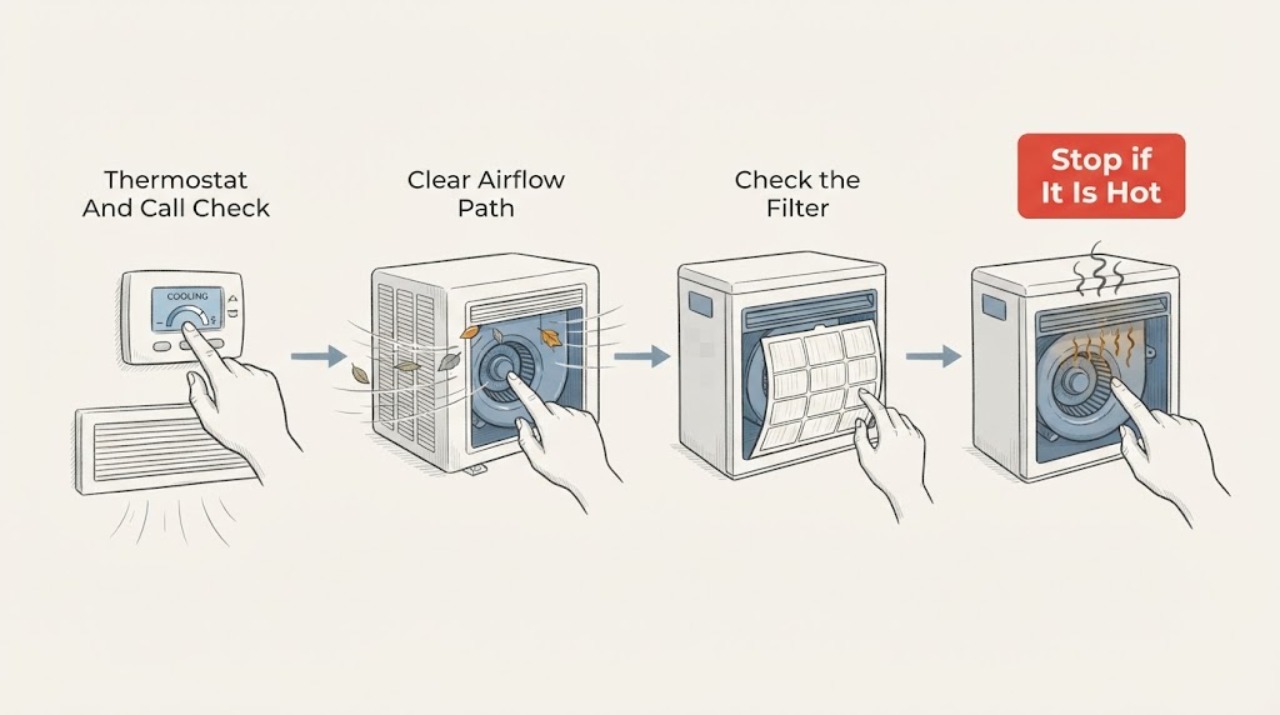
Work through in order
Diagnostic checks
Use only checks that match the exact appliance or system and its official guide.
-
Check 1
Read the thermostat display and record the mode, fan setting, setpoint, room temperature, schedule or hold state, and whether it shows a cooling call; make only ordinary user-level adjustments described by the thermostat instructions and do not open the thermostat or air handler.
Expected result: The thermostat may be off, in heat, in fan-only mode, set above the room temperature, displaying a schedule change, or correctly calling for cooling.
Next step: Record the display and any safe setting correction, then compare airflow at several registers. Do not repeatedly cycle the system to force a response.
Stop if: Stop if the thermostat is wet, hot, damaged, sparking, or connected to exposed wiring; keep clear and request qualified HVAC or electrical help.
Why this matters
Why: An incorrect mode, setpoint, schedule, or fan setting can make warm or intermittent air appear to be a blower fault. A correct cooling call with weak or absent airflow moves the investigation toward filter, blower, coil, control, or power symptoms.
-
Check 2
From safe indoor positions, compare airflow and supply-air temperature at several open registers and at the return grille without inserting objects, removing grilles, or opening ductwork.
Expected result: Airflow may be normal at all registers, weak at all registers, absent at all registers, or weak in only one room or branch; supply air may feel cool, neutral, or warm.
Next step: Write down the pattern, affected rooms, and whether the return has airflow, then continue only with the accessible filter and external-unit observations.
Stop if: Stop if there is a burning smell, smoke, buzzing, exposed wiring, water near electrical equipment, sudden loss of airflow with ice, or any unsafe need to access a duct or grille.
Why this matters
Why: Weak or absent airflow throughout the home is consistent with an air-handler, blower, filter, coil, control, or power issue. Normal airflow with warm air points more toward cooling production or refrigerant-related causes; a single weak register may be distribution or duct-related rather than a blower-motor failure.
-
Check 3
If the filter is user-accessible in the location and manner described by the owner manual, inspect it from a dry, safe position and replace it only as that manual permits; do not remove an air-handler panel or reach near the blower, coil, wiring, or moving parts.
Expected result: The filter may be clean, visibly loaded with dust, collapsed, wet, missing, or inaccessible without opening equipment.
Next step: Record the filter condition and exact identity if visible. Use the normal thermostat control to stop cooling when ice or water is present, and arrange HVAC service rather than increasing fan operation to compensate.
Stop if: Stop if filter access requires a panel, ladder, contact with wet or icy equipment, contact with wires or moving parts, or force to remove the filter.
Why this matters
Why: A restricted filter can reduce airflow and contribute to blower overheating or coil icing, but a clean filter does not clear the blower motor, capacitor, control, coil, duct, or refrigerant system. A wet or collapsed filter points to a separate condition that needs professional review.
-
Check 4
From outside the closed air-handler enclosure and without touching it, observe and listen during one normal cooling call for a blower start, steady airflow, humming, repeated starts, clicking, vibration, or a sudden stop; do not remove the panel, reach inside, spin the wheel, or probe a capacitor.
Expected result: The air handler may start and run steadily, stay silent, hum without useful airflow, start and stop, vibrate, show ice, or show water around the equipment.
Next step: If the blower is not operating, sounds abnormal, or ice or water is present, stop cooling with the normal thermostat control if safe and give the symptom and timing to an HVAC technician.
Stop if: Stop immediately for smoke, burning odor, arcing, exposed wiring, a hot enclosure, water near electrical parts, a fan starting unexpectedly, or any need to open the air handler.
Why this matters
Why: A silent or humming indoor blower with weak or absent register airflow is consistent with a blower, capacitor, relay, control, or power issue. Ice can result from low airflow or another fault. These observations cannot distinguish the motor from its controls and require technician testing.
-
Check 5
From a clear ground-level position, observe the outdoor condenser during a normal cooling call without touching, hosing, opening, or reaching through the grille; note the fan, airflow, debris, ice, sound, and visible enclosure condition.
Expected result: The outdoor fan may run normally, remain off, run intermittently, make an unusual noise, show heavy debris, or show ice or damage while the indoor blower is weak or absent.
Next step: Photograph the unit from a safe distance and report the indoor-versus-outdoor pattern. Leave the system off with normal controls when ice, damage, burning odor, or abnormal noise is present.
Stop if: Stop for a hot enclosure, smoke, burning odor, exposed wiring, active arcing, damaged fan blades, ice, water near electrical components, or any urge to reach through the grille.
Why this matters
Why: A normal outdoor fan does not prove the indoor blower is faulty, and an abnormal condenser can explain no cooling even when indoor airflow exists. Comparing indoor and outdoor observations helps the technician separate airflow delivery from heat-rejection or power symptoms.
-
Check 6
Record when cooling or airflow changed, whether the symptom follows a filter change, outage, storm, maintenance visit, or unusual noise, and whether the system has been short-cycling; do not recreate the event with repeated starts or breaker resets.
Expected result: The problem may be constant, intermittent, tied to a cooling call, preceded by humming or vibration, accompanied by ice or water, or associated with a breaker or safety-device trip.
Next step: Give the complete timeline, safe observations, photos, filter identity, and thermostat state to the HVAC technician. Keep suspect operation stopped when the system shows a safety warning.
Stop if: Stop troubleshooting for repeated trips, smoke, fire, burning odor, shock, exposed wiring, water threatening electrical equipment, or any request to perform live tests or remove a service cover.
Why this matters
Why: Timing and associated symptoms help a technician distinguish airflow restriction, overheating, frozen coil, control, power, or motor symptoms, but no history alone proves that the blower motor needs replacement.
Use your observations
Decision map
Find the observation that best matches what you see, then follow the next safe action.
-
PATH 01Next step
What you see
The thermostat is off, not calling for cooling, in heat or fan-only mode, or using an unexpected schedule or setpoint.
Do this next
Correct only the ordinary setting identified by the thermostat instructions and observe once. If cooling or airflow remains abnormal, continue with the register pattern and call for service rather than repeatedly cycling the system.
-
PATH 02Next step
What you see
Airflow is weak or absent at most registers, the filter is restricted or wet, or the indoor blower is not running normally.
Do this next
Stop cooling with the normal thermostat control when ice, water, overheating, or abnormal noise is present and contact an HVAC technician. Do not open the air handler or replace a motor or capacitor yourself.
-
PATH 03Next step
What you see
Airflow is normal but supply air is warm or the home remains warm.
Do this next
Treat this as a broader cooling diagnosis rather than proof of a blower fault. Provide thermostat, filter, outdoor-unit, ice, runtime, and recent-event observations to an HVAC professional; do not handle refrigerant or open panels.
-
PATH 04Next step
What you see
The outdoor condenser fan is off, noisy, damaged, iced, obstructed, or operating differently from the indoor airflow pattern.
Do this next
Leave the system off when a hazard or ice is present and request HVAC service. Do not touch the condenser, capacitor, fan blade, electrical disconnect, or refrigerant circuit.
-
PATH 05Next step
What you see
Ice is visible on tubing or the indoor unit, or water is pooling around the air handler or drain area.
Do this next
Turn cooling off using normal thermostat controls if safe and call an HVAC technician. Do not scrape ice, force a thaw, open the coil cabinet, add refrigerant, or keep running the system to test it.
-
PATH 06Next step
What you see
There is smoke, fire, active arcing, strong burning odor, exposed wiring, shock, repeated breaker trips, or an enclosure that is hot or damaged.
Do this next
Stop using the system, keep people away, and leave the area for smoke or fire. Contact emergency services or the utility when appropriate, and otherwise arrange prompt qualified HVAC or electrical service. Do not reset or test the equipment again.
Helpful context
Understand the symptom
Separate the indoor blower from the outdoor condenser fan
A split central AC has an indoor air-handler blower that moves conditioned air through the ducts and an outdoor condenser fan that releases heat. The indoor blower motor is one possible cause of low or absent airflow, but the same no-cooling complaint can begin with a thermostat, filter, frozen coil, power, relay, capacitor, or outdoor-unit issue. A register pattern and a safe view of each unit help route the problem without assuming the motor is failed.
Keep blower diagnosis at the homeowner boundary
Trane identifies filters, thermostat settings, and an external air-handler power observation as possible user checks, then places relays, wiring, capacitors, and blower-motor faults with a trained HVAC professional. The motor and capacitor can remain energized or retain energy even when the fan is stopped. Do not remove an air-handler panel or use a tool to start, spin, probe, or test the blower.
Warm air does not prove a blower-motor failure
Normal airflow with warm supply air points in a different direction from weak or absent airflow. Carrier lists thermostat settings, restricted filters, blocked condenser airflow, frozen coils, refrigerant issues, and sizing among possible causes of an AC that is not cooling. Preserve the symptom pattern and tell the technician what changed after each safe observation.
Safety boundary
Stop conditions
- Do not remove an air-handler or condenser panel, touch a blower motor, capacitor, wiring, refrigerant line, electrical disconnect, or moving fan part.
- Stop for ice, water near electrical equipment, smoke, burning odor, buzzing, arcing, exposed wiring, repeated breaker trips, a hot enclosure, or an unexpected fan start.
- Do not scrape ice, jump-start a fan, perform a live test, add refrigerant, change wiring, or repeatedly reset the system.
- If safe thermostat, register, filter, and external-unit observations do not restore cooling or airflow, leave the system unmodified and call an HVAC technician.
Only after diagnosis
Potential parts
- HVAC air filter
Consider this category only if the filter is visibly restricted and the owner manual identifies it as user-accessible; a filter change cannot correct a blower, capacitor, control, coil, duct, or refrigerant fault.
Confirm the exact size, type, airflow requirements, and manufacturer guidance before selection; do not substitute a filter that restricts required airflow. - condenser coil cleaner
Consider this category only after a qualified technician confirms that exterior coil cleaning is appropriate; do not open the condenser or apply chemicals as a blower diagnosis.
Confirm coil material, surrounding surfaces, runoff controls, and manufacturer instructions; a dirty outdoor coil does not identify an indoor blower-motor fault. - thermostat
Consider this category only if a qualified diagnosis identifies the thermostat or control as faulty; weak airflow alone does not justify replacing it.
Confirm system type, wiring, power, staging, heat-pump or conventional configuration, and model compatibility before selection or installation.
When checks do not resolve it
Need a professional?
Call an HVAC technician when airflow remains weak or absent after the thermostat and accessible-filter observations, when the indoor blower is silent, humming, vibrating, or stopping, when ice or water appears, when outdoor and indoor operation do not match, or when cooling remains poor despite normal airflow. Provide the thermostat mode and fan setting, register pattern, filter condition and identity, air-handler and outdoor-unit observations, ice or water evidence, sound and timing history, and any safe photos. Stop immediately and seek urgent help for smoke, fire, arcing, strong burning odor, exposed wiring, shock, repeated breaker trips, or water threatening electrical equipment.
Common questions
FAQ
How can I tell if the central AC blower motor is the problem?
Weak or absent airflow at most registers with a normal cooling call and an indoor blower that is silent, humming, vibrating, or stopping is consistent with a blower-side fault, but it does not distinguish the motor from a capacitor, relay, control, filter, coil, or power issue. Leave panels closed and call an HVAC technician.
What is the difference between the blower motor and the outdoor AC fan?
The indoor blower pushes air through the home's ducts. The outdoor condenser fan moves air through the outdoor coil to release heat. Observe both from safe external positions so the technician knows whether the problem is airflow delivery, heat rejection, or both.
Can a dirty filter make the blower stop or the AC stop cooling?
A visibly restricted filter can reduce airflow and contribute to overheating or coil icing, but a clean filter does not clear the blower motor or another fault. Check only an accessible filter according to the owner manual and avoid opening the air handler.
Should I keep running the AC if the blower is humming or not moving air?
No. Use the normal thermostat control to stop cooling if safe, especially for humming, no airflow, ice, water, odor, or overheating. Do not jump-start the fan, scrape ice, reset repeatedly, or touch the capacitor; arrange HVAC service.
Why is my AC blowing warm air even though the blower works?
Normal airflow with warm air can come from thermostat settings, a dirty outdoor condenser, frozen coil, refrigerant or compressor issue, sizing, or another cooling fault. Record the thermostat, filter, outdoor-unit, ice, and runtime observations and have an HVAC professional diagnose it.
Read the exact guide
Official sources
- Air Handler Fan Not Working: Causes and SolutionsTrane · General manufacturer guidance for residential air handlers; exact system instructions and qualified technician diagnosis govern the user's equipment.
- Why Is My AC Not Blowing Cold Air? 7 Common CausesCarrier · General residential central-AC routing guidance; it does not identify a specific blower motor or authorize live electrical, refrigerant, or panel work.
- AC Fan Not Spinning? Here’s Why and How to Fix ItCarrier · General central-AC fan guidance; a homeowner should use only external observations and leave motor, capacitor, wiring, and refrigerant diagnosis to a trained technician.
Community feedback
Share a repair observation
Share a plain-text repair observation. Accepted observations are published automatically; this page may take a moment to update.