
On this page
Start here
Quick answer
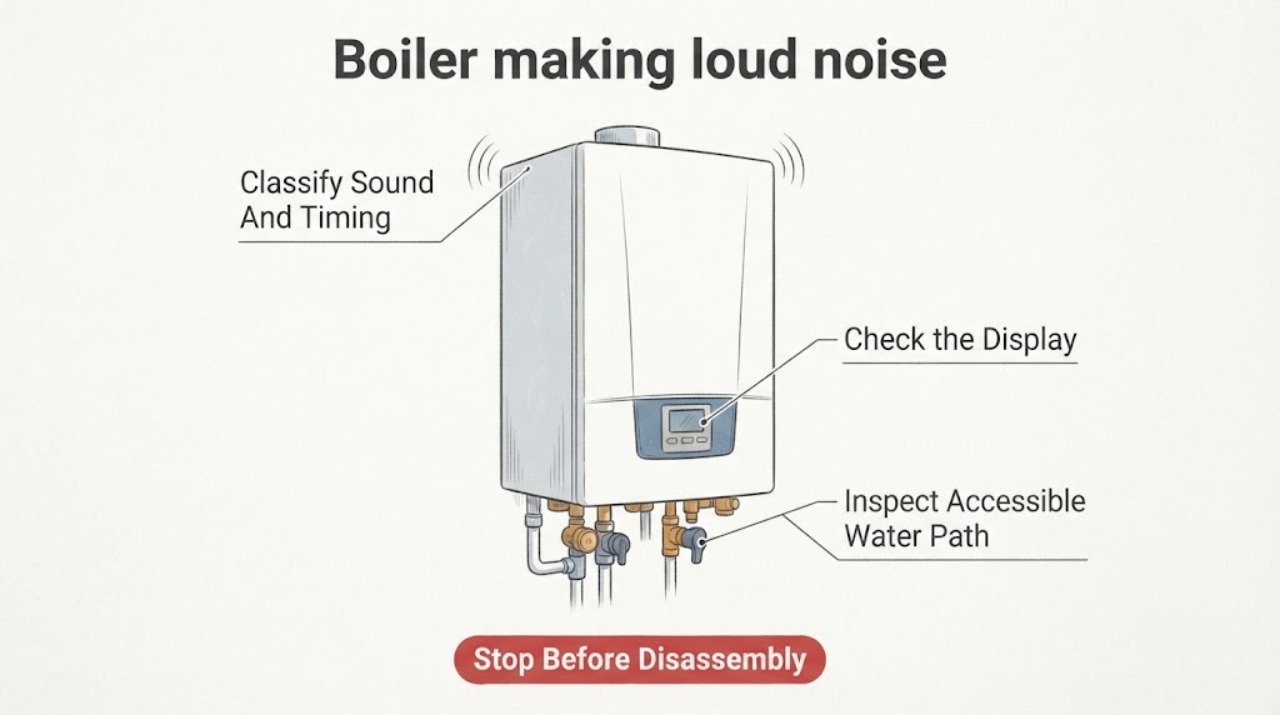
A loud boiler is not diagnosed by volume alone: gurgling, splashing, or whistling can point to air or flow in the hydronic system, while knocking or cracking may come from expanding pipes, brackets, pressure or flow controls, or a boiler component. Note exactly when and where the sound occurs, check the display, pressure gauge, accessible piping, venting, and nearby radiators without opening the boiler, and stop for gas or exhaust concerns, water leaks, abnormal pressure movement, a carbon-monoxide alarm, repeated lockouts, or any work involving combustion, electricity, hot water, or internal controls; those conditions need a qualified heating professional.
Work through in order
Diagnostic checks
Use only checks that match the exact appliance or system and its official guide.
-
Check 1
From a safe position, listen during one normal heating call and note the sound type, its location, and its timing: ignition, burner operation, circulation, shutdown, or only at a radiator or pipe. Do not repeatedly cycle the boiler just to reproduce the noise.
Expected result: The noise is gurgling or splashing, rushing or humming, knocking or cracking, a sharp ignition sound, or a new sound from the boiler cabinet; it occurs continuously or only during a specific phase.
Next step: Write down the sound and timing, then use the matching branch. Keep the boiler at its normal user setting and stop if the sound is accompanied by odor, smoke, a fault display, water, or unstable operation.
Stop if: Stop immediately for a gas smell, combustion or exhaust odor, smoke, a carbon-monoxide alarm, flame rollout, violent banging, or a boiler that shuts down repeatedly.
Why this matters
Why: Water or air sounds direct attention toward circulation and air management; pipe or radiator knocking directs attention toward expansion, supports, or flow/pressure controls; a cabinet or ignition sound is more likely to need boiler service than a simple radiator observation.
-
Check 2
Read the boiler display and pressure gauge from outside the cabinet, without removing a cover or adjusting a valve. Record any alert, lockout, or error message and whether pressure is steady, falling, rising, or fluctuating more than usual compared with the equipment's normal indication.
Expected result: The display reports a fault, the boiler has locked out, pressure is repeatedly changing, or the display and pressure indication remain normal while the noise continues.
Next step: Use the exact model manual or give the recorded message to a qualified heating professional. Do not use a universal pressure target, repeatedly reset the boiler, or adjust fill, relief, gas, or control valves based on noise alone.
Stop if: Stop for a rapidly rising pressure indication, water discharge, a pressure-relief event, repeated lockout, a damaged gauge, or any need to open the cabinet or change a control setting.
Why this matters
Why: A fault or abnormal pressure pattern makes the noise part of a broader operating problem; a normal-looking indication does not rule out an air, pump, pipe-support, venting, or internal component issue.
-
Check 3
With the boiler operating only in its normal enclosed state, visually inspect accessible piping, valves, pumps, radiators, and baseboards for water, staining, corrosion, or a new wet spot. Compare the noisy area with a quiet zone without touching hot surfaces or loosening fittings.
Expected result: Water, corrosion, or staining is present near the boiler or distribution piping; one radiator or zone is cooler; or the accessible water path looks dry and intact.
Next step: Keep clear of hot or leaking components and arrange heating service for water, corrosion, or a persistent noise. If the path is dry, continue with sound classification and external venting observations rather than opening a fitting.
Stop if: Stop for active leaking, steam or scalding water, a bulging or damaged component, water near electrical equipment, or any need to tighten or dismantle a hot connection.
Why this matters
Why: A leak or deteriorating connection can change pressure and circulation and should be corrected before continued operation; uneven heat can accompany air, circulation, or control problems but does not identify the noisy part.
-
Check 4
If the noise is gurgling, splashing, or whistling at radiators or pipes, check whether the exact boiler and radiator instructions permit homeowner radiator bleeding. Only if the radiator is cool enough to handle, the heating circuit is off as instructed, and the valve is accessible, observe the radiator vent externally; do not open boiler drains or refill the system.
Expected result: Air escapes and then water appears at the radiator vent, the noise remains after the permitted bleed, pressure changes, or no radiator vent is safely accessible.
Next step: Close the radiator vent when the equipment instructions say to do so, keep the system under observation, and contact a heating professional if noise persists, pressure is abnormal, or the procedure is not explicitly allowed for the system.
Stop if: Stop for hot water, a seized or damaged vent, a leak that will not stop, a pressure change, a gas or combustion concern, or any need to bleed the boiler itself or add system water.
Why this matters
Why: Air can create noise and circulation problems, but water at the vent, a pressure change, or persistent noise may indicate that the system needs correct purging, pressure management, or another service rather than repeated bleeding.
-
Check 5
From ground level or another safe position, look at accessible boiler venting and combustion-air intake piping and its exterior termination. Note leaves, snow, debris, a loose or disconnected section, staining, or damage without removing a cap, inserting anything, or entering the boiler cabinet.
Expected result: An intake or vent is visibly blocked, disconnected, damaged, leaking at a joint, or clear while the boiler remains noisy.
Next step: Leave the boiler off if the equipment instructions or a professional advises it and arrange qualified heating service for any blockage, damage, or leakage. Do not seal joints, alter vent routing, or test combustion.
Stop if: Stop for flue-gas odor, soot, exhaust entering the home, a carbon-monoxide alarm, a hot or damaged vent, or any need to climb, disassemble, or open the boiler.
Why this matters
Why: A visible venting or air-intake problem can affect safe operation and is not a noise-damping adjustment; a clear exterior does not rule out an internal flue, combustion, fan, or control fault.
-
Check 6
Make a service record with the sound recording if safe, exact location, start and stop timing, display message, pressure behavior, water or corrosion observations, affected heating zone, recent draining or refill, and the boiler model from its exterior label. Do not diagnose or replace a pump, valve, vent, burner, or control from the sound alone.
Expected result: The record distinguishes a stable operating sound from a new or worsening sound and identifies whether the boiler, distribution piping, venting, or a safety symptom is involved.
Next step: Arrange qualified heating service for new banging, gurgling, or unusual noise, persistent humming or squeaking, abnormal pressure, leakage, poor heat, or any safety symptom. Keep the boiler off when a stop condition is present.
Stop if: Do not continue troubleshooting when the next step requires gas work, combustion testing, electrical measurements, internal access, hot-water draining, pressure adjustment, or a safety-control bypass.
Why this matters
Why: Specific timing and location help a technician separate air, flow, expansion, pressure, venting, and component causes; lack of a visible fault is not proof that continued operation is safe.
Use your observations
Decision map
Find the observation that best matches what you see, then follow the next safe action.
-
PATH 01Next step
What you see
The sound is gurgling, splashing, or whistling at radiators or pipes.
Do this next
Follow the exact equipment instructions for any permitted radiator bleeding only when the radiator and procedure are safe. If noise, pressure change, or water persists, arrange professional air-purging and circulation diagnosis.
-
PATH 02Next step
What you see
The sound is rushing, gushing, or humming near a pump or thermostatic valve.
Do this next
Do not change pump speed or valve settings from sound alone. Record the location and have a heating professional assess circulation, balancing, pump condition, and controls.
-
PATH 03Next step
What you see
Knocking or cracking comes from a radiator, baseboard, wall, or pipe route during heating or cooldown.
Do this next
Note the exact route and timing and arrange professional inspection of pipe supports, brackets, expansion clearance, flow, and pressure controls. Do not cut walls or loosen supports to chase the sound.
-
PATH 04Next step
What you see
The sound starts at ignition, comes from the boiler cabinet, or is a sharp bang, rumble, or repeated start-stop event.
Do this next
Stop repeated cycling and arrange qualified boiler service for burner, combustion, fan, heat-exchanger, control, and venting assessment. Keep the cabinet closed.
-
PATH 05Next step
What you see
Noise occurs with abnormal pressure movement, water, corrosion, uneven heating, a fault display, lockout, or loss of heat.
Do this next
Turn the system off if the equipment instructions or safety condition calls for it and contact a qualified heating professional. Do not refill, drain, reset, or adjust controls repeatedly.
-
PATH 06Next step
What you see
There is a gas smell, flue-gas odor, soot, smoke, a carbon-monoxide alarm, exposed wiring, or water near electrical equipment.
Do this next
Leave the area and follow local gas or carbon-monoxide emergency guidance; do not operate, reset, or open the boiler. Obtain emergency assistance and qualified heating or electrical assessment as appropriate.
Helpful context
Understand the symptom
A sound is a clue, not a component diagnosis
Record whether the noise is gurgling, splashing, whistling, rushing, humming, squeaking, knocking, cracking, or a sharp ignition or shutdown sound. Also record whether it comes from the boiler cabinet, a pump or valve, a radiator or baseboard, or the wall and pipe route, and whether it happens at startup, during heating, or after shutdown. Viessmann notes that some water-flow sounds are normal within limits, but the associated cause is not guaranteed from sound alone; a heating contractor may need to hear it in person.
What common patterns can mean
Gurgling, splashing, or whistling in radiators and pipes can be consistent with air in a hydronic system. A strong rushing or gushing sound can reflect excessive circulation flow, while humming near a thermostatic valve can be related to pump setting or an aging pump. Knocking or cracking at a radiator or wall can be pipe expansion against tight brackets or pipe supports; knocking in the system can also involve a flow or pressure-control issue. These are direction-setting patterns, not proof that a particular valve, pump, or boiler part has failed.
Keep the boiler cabinet and combustion path closed
A homeowner check can be visual and external: read the boiler display and gauge, look for water or corrosion around accessible piping, valves, pumps, radiators, and baseboards, and look at accessible venting or combustion-air piping for an obvious blockage or disconnected section. Do not remove the jacket, adjust gas or combustion settings, change a pump or pressure-control setting, open an electrical compartment, or bypass a safety control. A gas smell, flue or exhaust concern, carbon-monoxide alarm, or water near electrical equipment is an immediate stop condition.
Only after diagnosis
Potential parts
- automatic air vent or radiator air vent
Consider this category only after a qualified professional confirms that trapped air or a failed vent is the cause of the specific gurgling or whistling symptom.
Confirm the exact boiler or heating-system design, connection size, temperature and pressure suitability, and installation instructions; not every noisy system needs a new vent. - circulator pump or pump component
Consider this category only after flow, balancing, electrical supply, and pump condition have been professionally tested and the pump is identified as the cause of humming or gushing.
Confirm system flow and head requirements, voltage, flange or connection dimensions, control compatibility, and the exact boiler and piping design before selection. - pressure or flow-control valve
Consider this category only when a qualified heating professional confirms a missing, misadjusted, or failed pressure or flow-control component behind knocking or abnormal circulation.
Confirm the system schematic, valve function, connection, operating limits, and required commissioning; do not select a valve from noise alone.
When checks do not resolve it
Need a professional?
The boiler makes new banging, gurgling, humming, squeaking, or other unusual noise., Noise is paired with pressure movement, water, corrosion, uneven heating, a lockout, error display, or loss of heat., The sound comes from ignition, the burner, the boiler cabinet, venting, or a component that cannot be safely inspected externally., A permitted radiator-bleed observation does not resolve air noise, or bleeding changes pressure or releases persistent water., Diagnosis would require gas, combustion, electrical, hot-water, pressure, pump, valve, venting, or internal boiler work.
Common questions
FAQ
Is a loud boiler always dangerous?
No. Some water-flow sounds can occur during normal operation, but a new or worsening sound can indicate air, circulation, pipe expansion, pressure or flow control, venting, or a boiler-component problem. Classify the sound externally and arrange professional evaluation for unusual noise or any safety symptom.
What does gurgling or whistling in the heating system mean?
It can be consistent with air in the hydronic system. Follow the exact equipment instructions before attempting any permitted radiator bleed, and stop for hot water, a leak, pressure change, or a procedure that requires boiler access. Persistent noise needs professional air and circulation diagnosis.
Why does my boiler make a banging or knocking sound?
The location and timing matter. Pipe expansion against brackets can create knocking or cracking near radiators and walls, while a system knocking sound can involve flow or pressure controls. A sharp cabinet or ignition bang should be treated as a boiler-service issue; do not adjust burner or pressure controls yourself.
Should I adjust the boiler pressure to stop the noise?
Not based on noise alone. Read the gauge and note whether pressure is stable or changing, then use the exact model instructions or contact a qualified heating professional. There is no universal pressure setting for every boiler and hydronic system.
When should I turn the boiler off and call for help?
Stop and seek qualified help for a gas or exhaust odor, carbon-monoxide alarm, smoke, water leak, abnormal pressure, repeated lockout, ignition or cabinet banging, exposed wiring, or any need to open the boiler or work on gas, combustion, electrical, hot-water, pump, valve, or venting components.
Read the exact guide
Official sources
- Balancing Hydronic Systems in Multifamily BuildingsU.S. Department of Energy, Building America · Hydronic circulation, air elimination, and noise context
- Boiler Winter Maintenance ChecklistWeil-McLain · Boiler homeowner visual checks and professional-service triggers
- The heating system makes noises – what now?Viessmann US · Viessmann heating-system noise patterns and homeowner boundaries
Community feedback
Share a repair observation
Share a plain-text repair observation. Accepted observations are published automatically; this page may take a moment to update.