
On this page
Start here
Quick answer
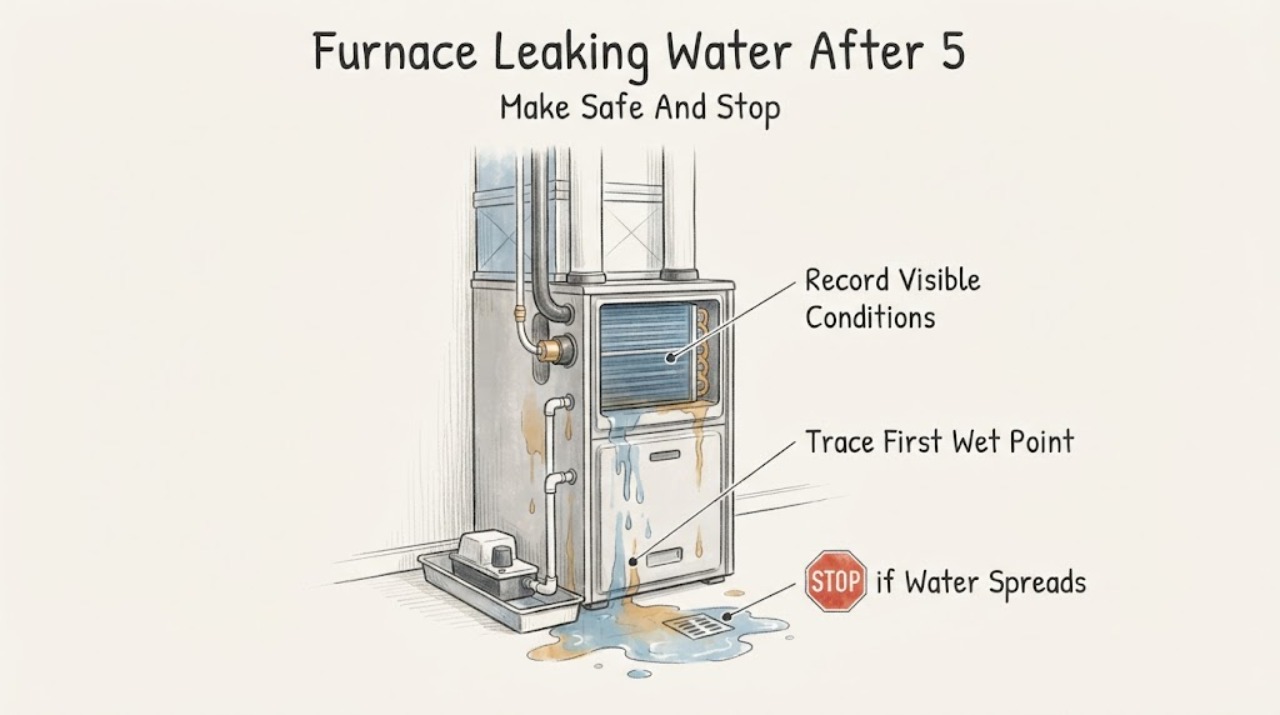
A Carrier furnace leaking water after five years needs source tracing, not an age-based part diagnosis. If it is a high-efficiency condensing furnace, a blocked or disconnected condensate drain, trap, pan, or pump can back water up; a whole-home humidifier, air-conditioner evaporator coil and pan, or nearby supply/drain line can also wet the furnace area. A cracked heat exchanger or damaged flue path is a less common but serious possibility because combustion products and carbon monoxide may be involved. Turn the system off, contain the water, keep it away from electrical components, and identify whether the leak appears during heating, cooling, humidifier operation, or all the time. Do not open the burner cabinet, disturb gas or vent components, bypass safety controls, or continue operating with a CO alarm, gas odor, smoke, water inside controls, active flooding, or a concealed leak; arrange qualified HVAC service.
Before you begin
Safety first
- This article supports system shutdown, water containment, dry external observation, mode timing, and clearly owner-accessible visual checks only. Do not energize wet equipment, open burner or coil panels, handle refrigerant, disconnect pressurized humidifier lines, clear internal drains with chemicals or compressed air, test combustion or live electrical parts, bypass safety controls, or operate with gas, CO, smoke, flooding, or vent warnings.
Work through in order
Diagnostic checks
Use only checks that match the exact appliance or system and its official guide.
-
Check 1
Turn the heating and cooling system off with the normal thermostat control, contain visible water, and inspect from a dry position for water at controls, wiring, the outlet or disconnect, smoke, gas odor, unusual flame, or a CO alarm.
Expected result: Record whether the leak is a drip, stream, or pool; whether water has reached electrical or combustion components; and whether anyone has headache, dizziness, nausea, weakness, confusion, or shortness of breath.
Next step: Keep the system off and obtain qualified HVAC, electrical, plumbing, or emergency help as appropriate. For a CO alarm or suspected exposure, leave immediately and call emergency services from outside; do not re-enter until permitted.
Stop if: Do not touch wet electrical parts, operate switches where gas may be present, run a wet furnace, or repeatedly restart the system to see whether the leak stops.
Why this matters
Why: Water inside controls, active flooding, combustion symptoms, gas odor, smoke, or a CO alarm is not a routine drain check. A dry, contained drip still needs source tracing, but it does not make internal furnace work safe.
-
Check 2
Record that the Carrier furnace is approximately five years into service without treating that age as a failed-part conclusion. Note the exact model if safely visible, whether the system is high-efficiency or unknown, the season, and which equipment was operating when water appeared.
Expected result: Record whether water appears during heating, cooling, humidifier operation, after shutdown, during rain or freezing weather, or while the equipment is idle; include maintenance, filter, and prior repair history.
Next step: Use the operating pattern to choose the source branch and keep the system off if water is near the cabinet or the condition cannot be isolated safely.
Stop if: Do not remove a cabinet panel to identify the furnace type, disturb gas or vent parts, or assume every Carrier furnace uses the same condensate arrangement.
Why this matters
Why: Water during heating supports a furnace condensate or attached humidifier path; water during cooling supports an evaporator-coil or AC drain path; water while idle or after weather changes may involve a drain, humidifier, plumbing, or frozen line. Five-year age only sets context.
-
Check 3
With the system off and surfaces dry, place separate dry tissue or cloth at owner-accessible points: the condensate drain termination and visible tubing, pan edge, condensate pump exterior, humidifier housing and water connections, AC coil-pan drain area, and nearby plumbing.
Expected result: Identify the first point that becomes wet when a safe, brief observation is possible: drain or pan, pump, humidifier, coil-side pan, supply line, pipe joint, cabinet seam, or an inaccessible internal area.
Next step: Photograph and label the first wet point, then use only the matching external check below. Leave the system off if the origin cannot be reached without opening panels or moving equipment.
Stop if: Do not insert tools into drains, reach into the burner or blower compartment, remove a pan, open a wall, or use compressed air or chemicals to clear a line without model-specific service instructions.
Why this matters
Why: The first wet point is more informative than the puddle beneath the furnace. A drain or pan path suggests condensate management; a humidifier or supply connection suggests water-service equipment; a cabinet seam, heat exchanger area, or hidden source requires professional inspection.
-
Check 4
If the furnace is a high-efficiency condensing type or the leak appears during heat, inspect only visible condensate tubing, trap or drain-pan connections, and the exterior of any pump for a kink, disconnection, overflow, crack, or standing water. Follow the exact Carrier model instructions for any owner-accessible cleaning; otherwise do not disassemble it.
Expected result: Record a full or backed-up drain, a loose or kinked tube, pump that does not run when its normal control calls for it, a cracked pan, frozen line, or a dry and unobstructed visible path.
Next step: Keep the furnace off for standing water or a wet cabinet and arrange HVAC service. Do not operate a pump or furnace with exposed wiring, a cracked pan, or an inaccessible blockage.
Stop if: Do not remove internal drain traps, open the furnace cabinet, cut tubing, bypass a condensate safety switch, or force a frozen line or pump.
Why this matters
Why: A blocked, disconnected, frozen, or failed condensate path can back water into or around a high-efficiency furnace. A clear exterior does not rule out an internal trap, drain, pump, heat exchanger, or flue issue.
-
Check 5
If a whole-home humidifier is installed near the Carrier furnace, inspect only its exterior reservoir or housing, cap or gasket, water-supply tubing, visible drain tube, and floor beneath it with the water supply isolated if the valve is clearly identified and operates normally.
Expected result: Record a cracked tank or housing, a reservoir that is not seated, a brittle gasket, a kinked or blocked drain tube, a wet supply connection, or a furnace leak that occurs when the humidifier calls.
Next step: Leave the humidifier and furnace off for a crack, active supply leak, wet electrical area, or blocked inaccessible drain; arrange HVAC or plumbing service. Do not seal a pressurized tank with household adhesive.
Stop if: Do not disconnect a pressurized water line, open a humidifier housing near energized equipment, use sealant on a cracked tank, or run the humidifier after water reaches controls.
Why this matters
Why: Carrier identifies cracked tanks, poorly seated reservoirs, damaged gaskets, and blocked drainage as humidifier leak paths. A wet humidifier does not prove the furnace itself is leaking, while water from the furnace cabinet requires separate HVAC diagnosis.
-
Check 6
If water appeared during cooling or after cooling stopped, inspect only visible AC condensate tubing and the exterior of the drain-pan area for overflow, ice melt, a kink, or a damaged pan; verify that the air filter is present and maintained according to the exact system instructions.
Expected result: Record ice or meltwater, a clogged or overflowing drain, a cracked pan, weak cooling, or a leak that occurs only during AC operation; also record whether the furnace cabinet remains dry when heat runs.
Next step: Turn cooling off, keep the area dry, and arrange HVAC service for ice, overflow, a cracked pan, refrigerant concern, or persistent leakage. Do not chip ice or open the coil cabinet.
Stop if: Do not scrape a coil, handle refrigerant, remove the coil panel, run cooling with an active leak or ice, or pour chemicals into a drain line without approved instructions.
Why this matters
Why: Carrier identifies a clogged AC drain, frozen evaporator coil, and damaged drain pan as cooling-side leak paths. A cooling leak can appear at a shared indoor cabinet and be mistaken for a furnace leak; refrigerant, coil, and pan work is not an ordinary owner repair.
-
Check 7
From a safe exterior position, look for visible vent corrosion, disconnection, blockage, unusual combustion odor, soot, or water entering around the flue; do not open the burner compartment or inspect the heat exchanger yourself.
Expected result: Record a wet or corroded vent, blocked termination, soot, flame or exhaust abnormality, CO alarm, or no visible combustion warning.
Next step: Stop using the furnace and arrange urgent qualified HVAC service for any vent, flame, soot, odor, CO, or heat-exchanger concern. Follow emergency procedures for a CO alarm or suspected gas exposure.
Stop if: Do not test combustion, gas pressure, flame rollout, vent pressure, heat-exchanger integrity, or safety switches; do not reset a rollout control or operate with a damaged vent.
Why this matters
Why: A water leak near the heat exchanger or flue can be serious, and a damaged vent or heat exchanger may allow combustion products or CO into the home. A clear termination does not certify internal combustion safety.
-
Check 8
Only if the area is dry, the water source was safely isolated, no electrical or combustion warning exists, and a qualified technician or exact Carrier procedure permits it, make one brief operating observation from outside the cabinet. Record the exact model, first wet point, operating mode, leak rate, drain or humidifier state, and any error, sound, or odor.
Expected result: Record whether water returns during heat, cooling, humidifier operation, shutdown, or no operation, and whether it reaches controls, flooring, walls, or a concealed space.
Next step: Stop after one comparison, leave the affected equipment off, and provide the model, timeline, photographs, and observations to qualified HVAC service; add plumbing or electrical help when the evidence points outside the furnace or toward a wet power hazard.
Stop if: Do not run repeated cycles, operate with water entering the cabinet, or continue testing after a leak, code, noise, odor, heat, smoke, gas, or CO warning.
Why this matters
Why: A repeat leak tied to one operating mode narrows the system path but does not prove a part. A leak that returns without operation, worsens, or remains unlocated requires service rather than repeated cycling.
Use your observations
Decision map
Find the observation that best matches what you see, then follow the next safe action.
-
PATH 01Next step
What you see
Water appears during heating, the Carrier system is high-efficiency or has visible condensate tubing, and the first wet point is a drain, trap, pan, pump, or nearby condensate connection.
Do this next
Keep the furnace off if water is pooling or reaching the cabinet, document the visible obstruction, kink, pump, or pan clue, and arrange qualified HVAC service for the condensate path. Do not bypass a condensate safety switch or open the cabinet.
-
PATH 02Next step
What you see
Leakage occurs when the whole-home humidifier operates or the first wet point is its tank, gasket, supply tubing, valve, or drain tube, while the furnace cabinet is otherwise dry.
Do this next
Isolate the humidifier water only if the valve is clearly identified and safe, leave the humidifier off, and arrange HVAC or plumbing service for a cracked housing, failed seal, pressurized connection, or blocked drain.
-
PATH 03Next step
What you see
Water appears during cooling or after cooling shutdown, there is ice or meltwater, or the first wet point is the shared evaporator-coil drain, pan, or tubing rather than a heating condensate path.
Do this next
Turn cooling off and arrange qualified HVAC service for a clogged drain, frozen coil, damaged pan, airflow or refrigerant concern. Do not chip ice, open the coil cabinet, or handle refrigerant.
-
PATH 04Next step
What you see
Water appears while heating, cooling, and humidification are off, or the first wet point is a nearby pipe, condensate discharge, supply line, floor drain, or wall rather than the furnace.
Do this next
Keep water isolated if possible and arrange plumbing or HVAC assessment to separate a building-water leak from equipment condensate. Protect the floor and walls and do not move the furnace to chase the source.
-
PATH 05Next step
What you see
Water is from a cabinet or combustion area, the vent is blocked, corroded, disconnected, or wet, or the leak is accompanied by gas odor, soot, abnormal flame, smoke, unusual combustion noise, or a CO alarm.
Do this next
Stop using the furnace and obtain urgent qualified HVAC service. For a CO alarm or suspected exposure, leave immediately for fresh air and call emergency services from outside; do not re-enter until permitted.
-
PATH 06Next step
What you see
The water returns after five years despite a dry, apparently clear external path, the first wet point cannot be found, or the leak persists after one safe mode comparison.
Do this next
Leave the system off and request model-specific HVAC diagnosis. Provide the five-year service history, mode timing, photographs, drain and humidifier details, and any water or electrical impact; do not order a pan, pump, coil, or furnace part from age alone.
Helpful context
Understand the symptom
Five years is context, not the diagnosis
A leak that first appears after five years may reflect a maintenance, seal, drain, corrosion, installation, or component change, but age alone cannot identify the source. Record where the water first appears and which system was operating. A high-efficiency Carrier furnace normally creates condensate that should leave through a drain; a conventional furnace may have water from an attached humidifier, an air-conditioner coil and pan, or a nearby plumbing line instead.
Protect the furnace and the room first
Turn the system off using a normal control, contain the water with a towel or shallow container, and keep water away from the furnace controls, outlet, disconnect, and wiring. If the furnace or electrical components are wet, if water is spreading into a wall or ceiling, or if the leak is active, leave the system off and call qualified service. A gas odor, smoke, unusual flame, or CO alarm is a separate emergency; leave for fresh air and follow emergency instructions.
Trace the operating condition and first wet point
After the area is safe and dry, note whether water appears during heat, cooling, humidifier operation, defrost or weather changes, or while the equipment is idle. Use dry tissue at the accessible drain termination, pan edge, humidifier housing, tubing connections, and nearby plumbing, without removing panels. Water can travel down a cabinet, so the lowest puddle is not necessarily the source.
Keep internal combustion work off the homeowner checklist
A blocked condensate drain or loose accessible tube may be a service clue, but opening a burner compartment, inspecting a heat exchanger, changing a flue, testing a pressure switch, or working on gas controls requires qualified HVAC service. Carrier and CPSC both emphasize proper venting and professional inspection for fuel-burning equipment. Do not make a leak disappear by resetting a safety switch or running the furnace while water is entering electrical or combustion areas.
Safety boundary
Stop conditions
- A CO alarm sounds, anyone has possible CO symptoms, gas odor or smoke is present, an unusual flame or soot appears, or combustion products may be entering the home.
- Water reaches furnace controls, wiring, an outlet, disconnect, thermostat wiring, or another electrical component, or active flooding threatens walls, ceilings, flooring, or appliances.
- The furnace, vent, heat exchanger, humidifier, evaporator coil, or drain source is behind a panel, in a wall, inaccessible, corroded, cracked, or damaged.
- The leak is a stream, returns immediately, appears from the furnace cabinet or combustion area, or cannot be isolated with a clearly identified safe shutoff.
- A condensate, humidifier, or AC drain is frozen, pressurized, blocked internally, or would require cutting tubing, opening a cabinet, or using chemicals or compressed air.
- Any step would require opening gas or combustion compartments, handling refrigerant, testing live voltage, measuring combustion or gas pressure, bypassing a safety control, or resetting a rollout or limit without diagnosis.
- The equipment has been under water or has wet controls; do not energize it until qualified service inspects it.
- The leak remains unlocated or returns after one safe external observation; stop repeated heat, cooling, or humidifier cycles and request service.
- Do not treat 'after 5 years' as proof of a failed pump, pan, heat exchanger, coil, humidifier, or furnace; compatibility and cause require the exact model and diagnosis.
Only after diagnosis
Potential parts
- condensate drain tubing, trap, or pan
Consider only when heating-mode evidence and service inspection confirm a blocked, cracked, disconnected, or failed condensate component.
Verify furnace model, drain configuration, slope, trap design, condensate safety controls, and approved materials; do not substitute tubing or bypass a drain safeguard. - condensate pump
Consider only when water backs up and qualified diagnosis confirms the pump is not moving condensate after the drain path and power are evaluated.
Confirm pump capacity, safety-switch wiring, discharge routing, voltage, and exact system requirements; a pump replacement is not justified by a puddle alone. - whole-home humidifier tank, pad, valve, or drain component
Consider only when the leak follows humidifier operation and inspection confirms a cracked housing, failed gasket, supply valve, water panel, or blocked drain.
Match humidifier model, water connection, pad or reservoir design, drain routing, and control requirements; do not seal a cracked pressurized housing. - AC evaporator drain pan or condensate component
Consider only when cooling-mode evidence, ice melt, or a shared indoor cabinet inspection confirms a pan, coil, or drain fault.
Verify indoor-unit and coil model, pan orientation, drain connection, airflow, and refrigerant diagnosis; coil and refrigerant work requires qualified HVAC service. - heat exchanger or vent component
Consider only after qualified service confirms corrosion, cracking, or vent failure; water location and age do not establish this fault.
Confirm the exact furnace model, fuel, vent design, safety evaluation, and approved replacement procedure; do not operate with suspected combustion-product leakage.
When checks do not resolve it
Need a professional?
Arrange qualified HVAC service promptly for a Carrier furnace leaking water after five years when the leak pools, returns, enters the cabinet, follows heating or cooling operation, involves a condensate pump, humidifier, evaporator coil, drain pan, heat exchanger, vent, or inaccessible tubing, or remains unexplained after safe external checks. Request plumbing help for a nearby supply or building-drain leak and electrical help for water near energized equipment. Treat a CO alarm, gas odor, smoke, active flooding, or suspected combustion leak as urgent.
Safety scope: This article supports system shutdown, water containment, dry external observation, mode timing, and clearly owner-accessible visual checks only. Do not energize wet equipment, open burner or coil panels, handle refrigerant, disconnect pressurized humidifier lines, clear internal drains with chemicals or compressed air, test combustion or live electrical parts, bypass safety controls, or operate with gas, CO, smoke, flooding, or vent warnings.
Common questions
FAQ
Is it normal for a Carrier furnace to produce water?
A high-efficiency condensing furnace can naturally produce condensate, but the water should leave through its drain rather than pool around the furnace. A conventional furnace may have water from an attached humidifier, shared AC coil, or nearby plumbing, so identify the model and operating mode.
Does a Carrier furnace leaking after five years mean it needs replacement?
No. Five years is useful history but does not identify the cause. Carrier lists drain, pump, humidifier, heat-exchanger, pan, and other paths. Trace the first wet point and operating condition, then have a technician diagnose before choosing repair or replacement.
Why does water leak from the bottom of a Carrier furnace?
Carrier identifies a clogged condensate drain, loose or failed condensate pump, corroded heat exchanger, or built-in humidifier as common possibilities. Water can also come from a shared AC coil and pan or nearby plumbing, so the bottom puddle is not enough to identify the source.
Could the air conditioner be the source of water near my furnace?
Yes. A shared indoor cabinet can receive cooling condensate from a clogged drain, frozen evaporator coil, or damaged drain pan. Turn cooling off for an active leak or ice and arrange HVAC service; do not open the coil cabinet or handle refrigerant.
What if the water is coming from the humidifier?
Carrier lists a cracked tank, improperly seated reservoir, damaged gasket, or blocked drain tube as humidifier leak paths. Isolate the humidifier only through a clearly identified safe shutoff, keep water away from the furnace controls, and use HVAC or plumbing service for a pressurized or concealed leak.
Can a furnace water leak cause carbon monoxide?
Water itself does not identify a CO leak, but Carrier notes that a cracked heat exchanger may allow CO, and vent or combustion problems are serious. Leave immediately for a CO alarm or suspected exposure, call emergency services from outside, and do not use the furnace until trained personnel inspect it.
Read the exact guide
Official sources
- Carbon Monoxide Fact SheetU.S. Consumer Product Safety Commission · Supports the gas-furnace CO and emergency stop boundary, not a diagnosis of the Carrier water leak.
- Humidifier Repair Guide: How to Fix Common IssuesCarrier · Supports the attached whole-home humidifier branch and its tank, gasket, supply, and drain distinctions; actual access and parts depend on the humidifier model.
- Furnace Leaking Water: Causes, Signs, and SolutionsCarrier · Directly addresses Carrier furnace leaks and supports condensate, pump, heat-exchanger, humidifier, water-damage, and service boundaries; it does not diagnose an unspecified model by age alone.
- Why Is My AC Leaking Water?Carrier · Supports separating a cooling-side evaporator coil, drain pan, frozen coil, or condensate-drain leak from a furnace leak when equipment shares an indoor cabinet.
Community feedback
Share a repair observation
Share a plain-text repair observation. Accepted observations are published automatically; this page may take a moment to update.