
On this page
Start here
Quick answer
Start with safe observations: confirm the thermostat is calling for cooling, compare airflow at the registers, inspect an accessible air filter without opening equipment, and observe the outdoor unit from a clear ground-level position. Ice, burning odor, repeated breaker trips, exposed wiring, unusual electrical noise, or water near electrical equipment are stop conditions—turn the system off using normal controls if safe and call an HVAC professional. Do not handle refrigerant, capacitors, electrical panels, live wiring, coils inside cabinets, or repeated resets. If the thermostat and airflow clues do not explain the warm air, the system needs qualified diagnosis.
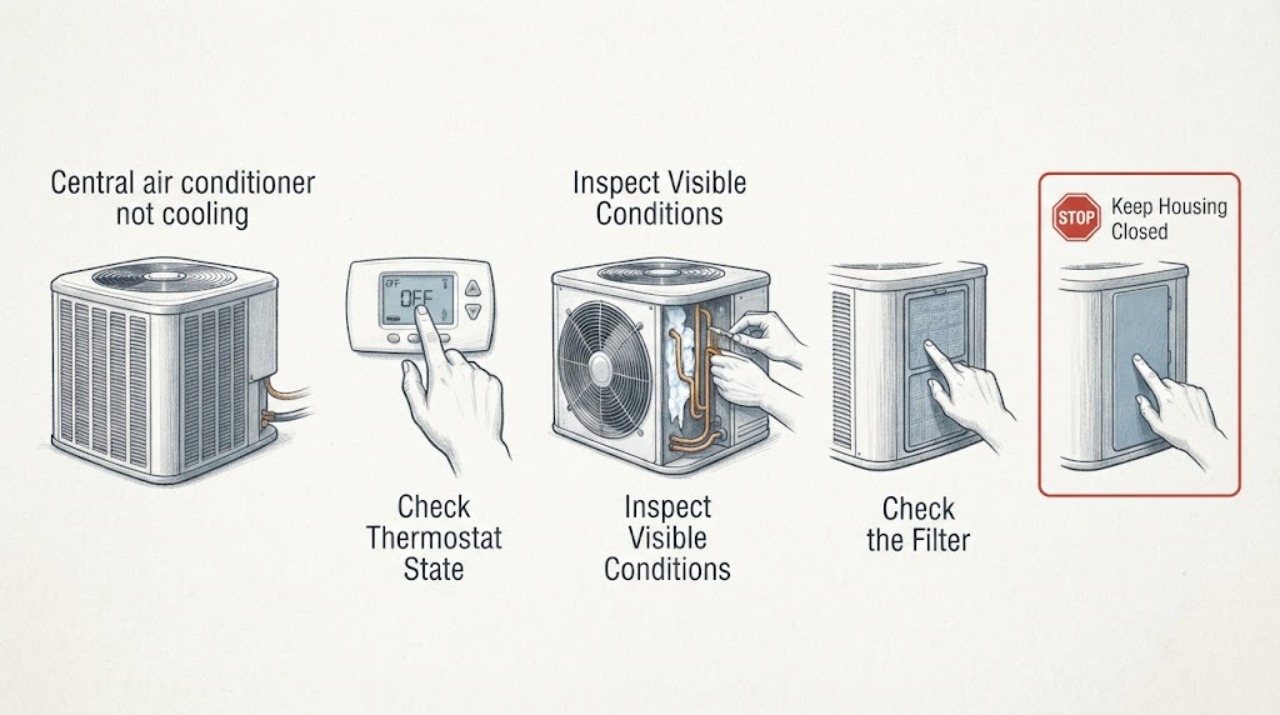
Work through in order
Diagnostic checks
Use only checks that match the exact appliance or system and its official guide.
-
Check 1
Read the thermostat display and record the mode, fan setting, setpoint, room temperature, schedule or hold state, and any blank-screen or warning indication; make only the ordinary user setting check described in the manual and do not repeatedly reset the system.
Expected result: Note whether it is calling for cooling, whether the setpoint is below the room temperature, whether the fan is set to run continuously, and whether the display is responsive.
Next step: Record the thermostat state for the service request and continue to the airflow observation if the settings are already correct.
Stop if: Stop if the thermostat is wet, damaged, hot, sparking, or connected to exposed wiring; keep clear and call a qualified professional.
Why this matters
Why: A heat mode, an unexpectedly high setpoint, a fan-only setting, a schedule change, or a blank display can explain warm air without proving an equipment failure. A correct cooling call with warm air moves the investigation to airflow or equipment symptoms.
-
Check 2
From a safe indoor position, compare airflow and air temperature at several open supply registers and the return grille without inserting tools or opening the air handler.
Expected result: Record whether airflow is normal, weak at all registers, weak only in one zone, or absent, and whether the air is cool, neutral, or warm compared with the room.
Next step: Give the pattern and affected rooms to the HVAC technician; do not remove registers or access ductwork to investigate.
Stop if: Stop if there is a burning smell, smoke, unusual electrical noise, visible water near electrical equipment, or a sudden loss of airflow with ice.
Why this matters
Why: Weak airflow can point toward a filter, duct, blower, or frozen-coil issue; normal airflow with warm air can point toward thermostat, outdoor-unit, refrigerant, or other equipment causes. One uncomfortable room alone can also reflect distribution rather than the cooling plant.
-
Check 3
If the filter is user-accessible according to the owner’s manual and the area is dry, observe its visible condition without opening an equipment cabinet or reaching near moving or energized parts.
Expected result: Record whether the filter is clean, visibly loaded with dust, collapsed, wet, or missing, and note the filter identity shown on its frame or the manual.
Next step: Follow only the model’s ordinary filter-care instructions if the filter is safely accessible, then tell the technician what you observed; do not use filter replacement as a reason to keep running a system with ice or another stop condition.
Stop if: Stop if accessing the filter requires removing a panel, touching wiring, reaching into a blower compartment, or contacting wet or icy equipment.
Why this matters
Why: A visibly restricted filter can reduce airflow and contribute to poor cooling or icing, but a clean filter does not rule out a frozen coil, refrigerant issue, duct problem, or mechanical fault.
-
Check 4
From a clear ground-level position, observe the outdoor condenser for visible debris blocking the exterior, ice, damaged panels, unusual noise, or whether its fan appears to run during a normal cooling call; do not touch, hose, open, or reach into the unit.
Expected result: Record normal-looking operation, no visible operation, intermittent operation, heavy debris, visible ice, impact damage, or an unusual sound or odor.
Next step: Photograph the condition from a safe distance and give it to the HVAC professional; leave service work and any coil or electrical access to them.
Stop if: Stop immediately for ice, smoke, burning odor, exposed wiring, arcing, a damaged enclosure, or a fan that appears unsafe to approach.
Why this matters
Why: A blocked-looking exterior or a non-running outdoor unit may explain poor cooling, but the cause could be electrical, mechanical, refrigerant, or control-related. Ice or burning odor makes continued operation unsafe to troubleshoot casually.
-
Check 5
Look from safe accessible positions for frost or ice on visible refrigerant tubing, excess condensate near the indoor unit, water at the drain area, unusually long runtime, or repeated short cycling; do not thaw ice with tools or inspect inside the coil cabinet.
Expected result: Record no ice, localized frost, widespread ice, water overflow, long continuous operation, or repeated starts and stops, along with when the symptom began.
Next step: Stop cooling operation using normal controls if safe when ice, burning odor, water near electrical equipment, or repeated trips are present, and arrange HVAC service with the symptom history.
Stop if: Do not continue operating or touch the system when ice is present, the breaker trips, smoke or burning odor occurs, or water threatens electrical equipment.
Why this matters
Why: Ice and abnormal condensate can accompany restricted airflow or refrigerant-related faults; long runtime or short cycling can have several causes. These observations require technician diagnosis rather than a refrigerant or electrical DIY response.
Use your observations
Decision map
Find the observation that best matches what you see, then follow the next safe action.
-
PATH 01Next step
What you see
The thermostat is not calling for cooling because of mode, setpoint, schedule, fan state, or a blank display.
Do this next
Correct only the ordinary user setting or battery issue described in the manual if safe, then observe whether cooling returns; arrange service if the display or control remains abnormal.
-
PATH 02Next step
What you see
Airflow is weak or absent, the filter is visibly restricted, or the system shows ice or abnormal condensate.
Do this next
Stop operation when ice or water/electrical risk is present and contact an HVAC professional; do not open the air handler or keep running the unit to force thawing.
-
PATH 03Next step
What you see
The outdoor unit does not appear to operate during a cooling call, is heavily obstructed, is noisy, damaged, or shows ice.
Do this next
Keep clear and request qualified HVAC diagnosis; do not touch the condenser, electrical disconnect, capacitor, fan, or refrigerant circuit.
-
PATH 04Next step
What you see
There is burning odor, smoke, arcing, exposed wiring, water near electrical equipment, a repeated breaker trip, or an unsafe enclosure.
Do this next
Stop using the system, keep people away, and seek prompt qualified HVAC/electrical help appropriate to the hazard; do not reset or test it repeatedly.
Helpful context
Understand the symptom
Separate settings, airflow, and equipment symptoms
A central system that runs without cooling can have a thermostat or airflow problem, a blocked outdoor condenser, a frozen coil, a condensate issue, low refrigerant, or an electrical or mechanical fault. Carrier and Trane homeowner guidance both use thermostat settings, filter/airflow, outdoor-unit condition, and visible ice as useful routing observations, while reserving refrigerant, electrical, and inaccessible coil work for qualified technicians.
Keep the inspection non-invasive
Use the thermostat display, registers, an accessible filter door that the owner’s manual identifies, and a ground-level view of the outdoor unit. Do not remove service panels, touch wiring, open an electrical panel, handle a capacitor, connect gauges, add refrigerant, force a fan, or repeatedly restart a failing system.
Only after diagnosis
Potential parts
- HVAC air filter
Consider this category only if the installed filter is visibly restricted and the owner’s manual identifies it as user-accessible; filter replacement cannot correct ice, refrigerant, electrical, or mechanical faults.
Confirm the exact size, type, airflow rating, and model guidance before ordering; do not substitute a filter that restricts required airflow. - condenser coil cleaner
Consider this category only after a qualified professional confirms that coil cleaning is appropriate; do not apply chemicals or open the outdoor unit as a homeowner diagnostic.
Verify compatibility with the coil material, surrounding surfaces, runoff controls, and manufacturer instructions before any professional-approved use. - thermostat
Consider this category only if a qualified diagnosis confirms the thermostat or control is faulty; warm air alone does not identify the thermostat as the cause.
Confirm system type, wiring, power requirements, staging, heat-pump or conventional configuration, and model compatibility before selection or installation.
When checks do not resolve it
Need a professional?
Arrange high-priority HVAC service when correct thermostat settings and safe airflow observations do not restore cooling, or whenever the outdoor unit is abnormal, cooling is absent, ice appears, condensate overflows, runtime is abnormal, or the issue recurs. Treat burning odor, smoke, arcing, exposed wiring, water near electrical equipment, and repeated breaker trips as urgent stop conditions.
Have this ready
- Provide thermostat mode/setpoint/fan state, register airflow pattern, filter condition and identity, outdoor-unit observations, ice or condensate evidence, runtime/short-cycle history, photos from safe positions, and any recent outage, storm, maintenance, or control change.
Common questions
FAQ
Why is my central AC running but not cooling?
Common possibilities include thermostat settings, restricted airflow, a blocked outdoor unit, ice, condensate trouble, refrigerant issues, or an electrical or mechanical fault. Use safe observations to route service rather than guessing one cause.
Should I keep running the AC if it is blowing warm air?
Do not keep running it when ice, burning odor, water near electrical equipment, repeated breaker trips, or other safety symptoms are present. Stop using it with normal controls if safe and call an HVAC professional.
Can a dirty filter cause an AC to stop cooling?
A visibly restricted filter can reduce airflow and contribute to poor cooling or icing, but a clean filter does not rule out other faults. Check only an accessible filter according to the manual and share the result with the technician.
What does ice on an air conditioner mean?
Ice can accompany restricted airflow or refrigerant-related problems, among other causes. Do not scrape or thaw it with tools, handle refrigerant, or open the coil cabinet; stop operation if safe and arrange professional diagnosis.
When should I call an HVAC technician immediately?
Call promptly for persistent warm air, an abnormal outdoor unit, ice, condensate overflow, repeated short cycling, or no cooling after safe settings and airflow checks. Seek urgent help for smoke, burning odor, arcing, exposed wiring, water near electrical equipment, or repeated breaker trips.
Read the exact guide
Official sources
- Troubleshoot an Air ConditionerCarrier · This manufacturer page distinguishes thermostat/filter observations from electrical, refrigerant, frozen-coil, and condenser faults that should be handled by professionals; it is not a license to perform live testing.
- Why Is My AC Not Blowing Cold Air? 7 Common CausesCarrier · The manufacturer page supports safe observation of thermostat, filter, outdoor-unit, and ice symptoms while identifying refrigerant and frozen-coil work as professional tasks; exact equipment behavior varies by system.
- AC Not Blowing Cold AirTrane · The manufacturer page supports routing observations for thermostat, filter, airflow, condensate, outdoor coil, and visible ice; it recommends trained HVAC help for inaccessible coils and refrigerant-related issues.
Community feedback
Share a repair observation
Share a plain-text repair observation. Accepted observations are published automatically; this page may take a moment to update.