
On this page
Start here
Quick answer
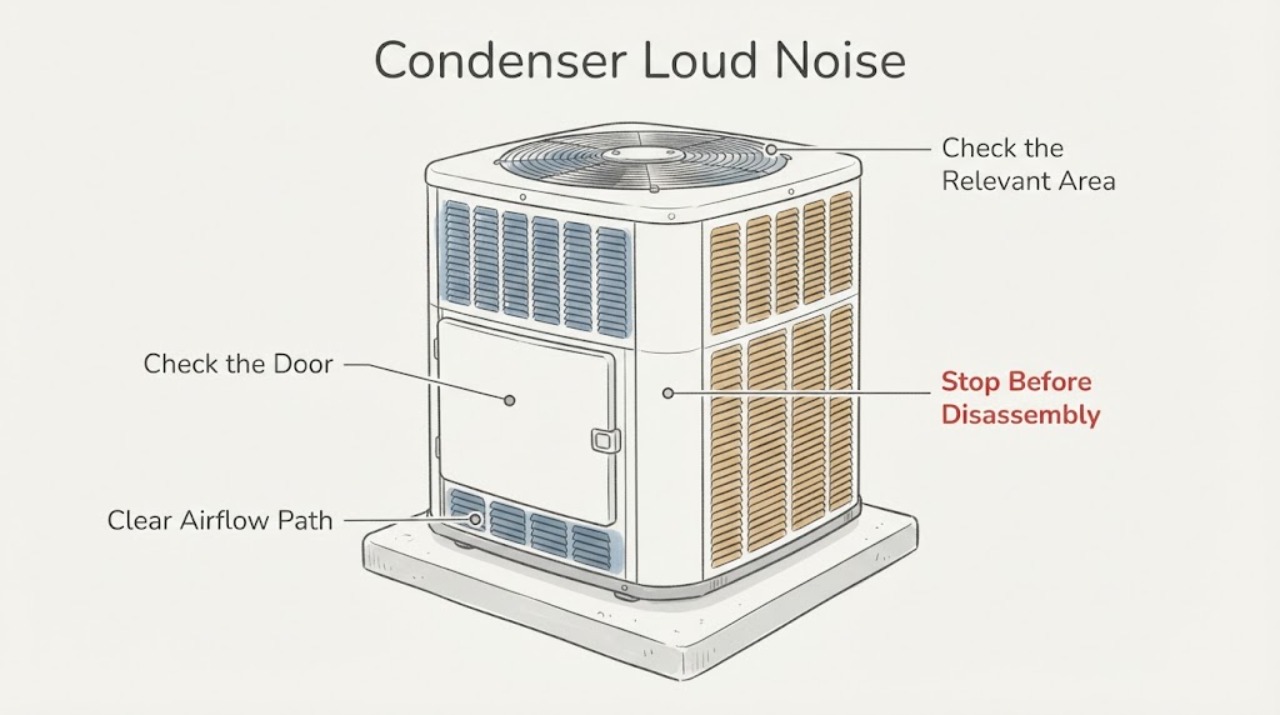
A loud sound blamed on the condenser may be coming from the outdoor condenser fan or compressor, or from the indoor blower motor that shares the same cooling call. First identify whether the sound is indoors or outdoors and whether it starts, continues, or stops with the cooling cycle. Turn cooling off if the sound is new, harsh, rattling, grinding, or accompanied by poor cooling, vibration, heat, odor, or a trip. With power off and panels closed, make only visual checks for a damaged outdoor fan blade, blocked clearance, loose-looking exterior debris, an overdue filter, or a condensate issue. Do not open electrical compartments, handle a capacitor, touch wiring, open a refrigerant circuit, or run the system to test a suspected fault; those checks belong to an HVAC professional.
Work through in order
Diagnostic checks
Use only checks that match the exact appliance or system and its official guide.
-
Check 1
Stand at a safe distance and identify whether the loudest sound is at the outdoor condenser cabinet, the indoor air handler or blower opening, a supply/return grille, or the connecting line area. Do not remove a guard or panel.
Expected result: Record the location, sound type (hum, buzz, rattle, grinding, squeal, clicking, or hiss), and whether it begins at startup, remains during operation, or continues after shutdown.
Next step: Use the matching outdoor or indoor branch below and keep the system off if the sound is new, severe, metallic, or paired with another symptom.
Why this matters
Why: An outdoor sound points first to the condenser fan, fan motor, compressor, mounting, or outdoor electrical controls. An indoor sound points toward the blower motor, blower wheel, filter, duct, or indoor controls. A hiss near the coil or refrigerant line is a professional-only concern.
-
Check 2
With the thermostat set to off, look through the outdoor grille from outside the cabinet and check that the visible fan blade is intact, not contacting the guard, and not obstructed by leaves or a loose object. Do not reach through the grille or spin the blade.
Expected result: A cracked, bent, loose, missing, or visibly obstructed blade, or a guard that appears to be touching it, is visible; or the exterior looks clear.
Next step: If damage or contact is visible, leave cooling off and request HVAC service. If the exterior is clear but noise remains, do not restart repeatedly; continue with the indoor filter and symptom record.
Why this matters
Why: A blade that is out of balance or striking another part can create rattling or vibration and can damage the fan motor. A clear exterior does not rule out a motor, bearing, capacitor, contactor, compressor, or internal mounting fault.
-
Check 3
Inspect the outdoor unit's surrounding clearance from the ground without opening the cabinet. Note leaves, loose fencing, a cover, branches, or anything that could vibrate against the cabinet or restrict airflow.
Expected result: Debris or a loose nearby object is present, or the area is clear and the cabinet still vibrates or makes the same noise.
Next step: Only remove loose debris that is fully outside the cabinet and safe to reach with the system off. Do not straighten fins, remove panels, or continue operation to see whether a vibration worsens; arrange service if the sound persists.
Why this matters
Why: An external object can make a rattle or resonance, while a clear area with persistent vibration makes an internal fan, compressor, mounting, or electrical diagnosis more likely.
-
Check 4
At the indoor return-air location, identify the filter size and condition without opening the blower compartment. If the filter is visibly loaded and the owner's instructions allow homeowner replacement, replace it with the exact specified type while the system is off.
Expected result: The filter is heavily loaded, airflow was weak, or the filter is clean and the indoor blower still hums, squeals, rattles, or fails to move air.
Next step: After the allowed filter change, leave cooling off if the noise is harsh, the blower does not run normally, ice is visible, or airflow remains weak. Have the technician inspect the blower assembly and coil.
Why this matters
Why: A restricted filter can reduce airflow and strain the blower, but replacing a filter cannot correct a failing motor, wheel, control, or frozen coil. A clean filter with a continuing noise points away from this simple check.
-
Check 5
Look for water around the indoor air handler or a condensate drain outlet without touching wiring or opening the cabinet. Also note any ice on accessible tubing or at the indoor coil area, and any warm-air symptom.
Expected result: Water, a backed-up drain indication, ice, weak airflow, or warm air is present; or there is no visible moisture or ice.
Next step: If water is near electrical equipment, ice is present, or airflow is poor, keep cooling off and arrange HVAC service. Do not chip ice, pour hot water, pour chemicals into an unknown drain, or open the coil compartment.
Why this matters
Why: A plugged condensate path can cause water damage, while ice and weak airflow can accompany blower or evaporator problems. These signs do not identify a condenser fan or compressor fault by themselves.
-
Check 6
Write down the operating symptoms for the service call: indoor airflow, supply-air temperature trend, outdoor fan behavior observed only from a safe distance, thermostat setting, breaker or disconnect events, odor, vibration, and whether the sound changes with startup or shutdown.
Expected result: The noise is isolated to one cycle stage, is paired with no outdoor fan, repeated electrical trips, poor cooling, a burning odor, refrigerant-like hiss, or severe vibration; or it is a stable familiar sound with normal operation.
Next step: Give the record and exact model information to an HVAC professional. Keep the system off for a hazardous or unexplained noise; do not test a capacitor, contactor, motor, compressor, wiring, or refrigerant circuit yourself.
Why this matters
Why: A changed sound with a second symptom raises the likelihood of a mechanical, electrical, airflow, compressor, or refrigerant issue and should not be confirmed by repeated test runs. A familiar stable sound with normal operation may be a design or installation characteristic, but a technician should still assess a new change.
Use your observations
Decision map
Find the observation that best matches what you see, then follow the next safe action.
-
PATH 01Next step
What you see
The sound is outdoors and the fan blade is cracked, bent, loose, or touching the guard.
Do this next
Arrange qualified service and follow the exact model guidance.
Why this path and its safety boundary
Why it matters: Leave the condenser off and call HVAC service. Do not reach through the grille or replace a blade without model-specific service procedures and safe power isolation.
-
PATH 02Next step
What you see
The sound is outdoors, the area is clear, and there is grinding, hard buzzing, severe vibration, or a new high-pitched sound.
Do this next
Arrange qualified service and follow the exact model guidance.
Why this path and its safety boundary
Why it matters: Stop cooling and request professional diagnosis of the condenser fan motor, compressor, capacitor, contactor, mounting, and controls. A visible-clear check cannot clear internal faults.
-
PATH 03Next step
What you see
The sound is indoors near the air handler and airflow is weak, the filter is loaded, or the blower is humming or squealing.
Do this next
Arrange qualified service and follow the exact model guidance.
Why this path and its safety boundary
Why it matters: Use only the exact filter replacement allowed by the equipment instructions. If the noise or weak airflow remains, leave the system off for blower, wheel, coil, or control service.
-
PATH 04Next step
What you see
Ice or water is visible near the indoor coil or air handler, especially with weak airflow or warm supply air.
Do this next
Arrange qualified service and follow the exact model guidance.
Why this path and its safety boundary
Why it matters: Turn cooling off and protect the area from water. Allow only a safe, natural thaw with the equipment off; do not chip ice, add heat, or open the coil. Schedule HVAC service to find the airflow, blower, drain, or refrigerant cause.
-
PATH 05Next step
What you see
The sound is a brief, familiar startup, shutdown, or airflow noise and there is no new vibration, odor, water, ice, poor cooling, or electrical symptom.
Do this next
Arrange qualified service and follow the exact model guidance.
Why this path and its safety boundary
Why it matters: Document the normal pattern and monitor it. If it becomes louder or changes character, stop cooling and arrange an inspection rather than relying on the previous sound being normal.
-
PATH 06Next step
What you see
The noise is accompanied by smoke, a burning odor, visible arcing, a hot plug or disconnect, repeated breaker trips, a gas odor, or refrigerant-like hissing.
Do this next
Arrange qualified service and follow the exact model guidance.
Why this path and its safety boundary
Why it matters: Stop using the system immediately. If safe without approaching the hazard, isolate power from a dry, safe location; do not operate switches near a gas odor, re-energize a tripped circuit, or attempt a repair. Use emergency or qualified HVAC/electrical help as appropriate.
Helpful context
Understand the symptom
A split-system condenser is the outdoor section, normally containing the condenser coil, outdoor fan, and compressor. The indoor air handler has the blower motor and evaporator coil. A sound that travels through ductwork or framing can make one section seem responsible for the other, so location and timing matter more than the word condenser alone.
A brief, familiar startup or shutdown sound can be normal on some systems, but a new change in loudness, a grinding or metallic sound, repeated hard starting, or strong vibration is not a safe homeowner repair target. The useful goal is to document the sound and separate an external obstruction from a fan, blower, compressor, capacitor, contactor, control, or refrigerant problem.
Use only the external checks below. Keep the system off when a blade is damaged, a panel is loose, the equipment is hot, or any electrical or refrigerant fault is suspected. An HVAC technician can test motors and electrical connections safely and can evaluate the compressor and refrigerant circuit without turning a noise into a larger failure.
Safety boundary
Stop conditions
- Smoke, flame, visible arcing, a burning or melting odor, a hot plug or disconnect, or repeated breaker trips: stop using the system and obtain qualified emergency electrical or HVAC help.
- A gas odor or suspected refrigerant leak: leave the area as appropriate, avoid ignition sources and electrical switching near the odor, and contact the relevant emergency or qualified service provider.
- Severe vibration, a blade striking the guard, exposed wiring, water at electrical equipment, ice, or a compressor/fan that will not start: keep the system off and do not open panels or run another test cycle.
Only after diagnosis
Potential parts
- condenser fan motor or fan blade
Consider only if a qualified diagnosis finds outdoor fan imbalance, a damaged blade, or a failed fan motor; loud noise alone does not identify the part.
Confirm the exact equipment model and manufacturer fit information before ordering; installation requires safe power isolation and model-specific procedures. - blower motor or blower wheel
Consider only if the sound is localized indoors and a qualified technician confirms a blower motor, wheel, bearing, or related assembly fault after airflow checks.
Do not infer fit from appearance or voltage; confirm the exact air-handler or furnace model and have a qualified technician install it. - run capacitor
Consider only after professional testing links hard starting or humming to the capacitor; the outdoor noise pattern alone is not proof.
Capacitors can retain a dangerous charge. Do not touch, discharge, measure, or replace one yourself; confirm the exact model-rated part through the technician.
Common questions
FAQ
Is a loud condenser always a failed compressor?
No. The sound may come from an outdoor fan or blade, mounting, electrical start components, or the indoor blower. Localize the sound and stop for a new or harsh noise; a technician must test the compressor rather than guessing from sound alone.
Can a dirty filter make the condenser sound loud?
A loaded filter restricts indoor airflow and can strain the blower or contribute to coil icing, which can change system behavior. It does not prove an outdoor condenser fault. Replace it only as the exact equipment instructions allow, with cooling off, then seek service if the noise or airflow problem remains.
Can I test the capacitor or spin the outdoor fan by hand?
No. Keep hands out of the grille and leave capacitor testing, discharge, wiring, motor, compressor, and refrigerant work to a qualified HVAC professional. A visual check for a damaged blade from outside the guard is the safe limit.
What details should I give the HVAC technician?
Report where the sound is loudest, its character, when it starts, whether the fan or blower moves air, any change in cooling, ice or water, vibration, odor, smoke, or breaker event, and the exact model. This separates outdoor condenser, indoor blower, airflow, electrical, and refrigerant paths.
Read the exact guide
Official sources
- Is This Normal? HVAC Smells and Sounds, ExplainedTrane · HVAC noise patterns, indoor blower versus outdoor fan/compressor clues, startup changes, hissing, vibration, and professional stop guidance
- Why is My Air Conditioner Fan Not Working?Carrier · Indoor blower and outdoor condenser fan locations, damaged blade observation, filter and airflow clues, frozen coil, fan motor, compressor, and capacitor safety boundaries
- What is a condenser?Carrier · Outdoor condenser composition, indoor evaporator location, unusual outdoor noise, airflow, frozen coil, compressor, and refrigerant service boundaries
- Maintenance ChecklistENERGY STAR · Filter inspection, blower and coil maintenance, condensate drain, controls, electrical safety, and professional refrigerant checks
Community feedback
Share a repair observation
Share a plain-text repair observation. Accepted observations are published automatically; this page may take a moment to update.