
On this page
Start here
Quick answer
A loud outdoor condenser can make a contactor buzz or chatter, but the same sound may come from the fan, compressor, loose cabinet parts, a capacitor, or another electrical fault. Record when the sound occurs and whether the fan starts, the system cools, or a breaker trips, using only safe observations outside the cabinet. Do not remove the panel, touch the contactor or capacitor, enter the unit, or perform energized testing. Shut the system off and arrange HVAC service for a sudden or persistent loud noise; stop immediately for smoke, burning odor, arcing, refrigerant hiss, abnormal heat, or repeated trips.
Before you begin
Safety first
- Keep the condenser off with the cabinet closed. Do not touch or open the contactor, capacitor, motor, compressor, disconnect, panel, wiring, or refrigerant lines; do not add refrigerant, spin the fan, reset repeatedly, or perform energized testing.
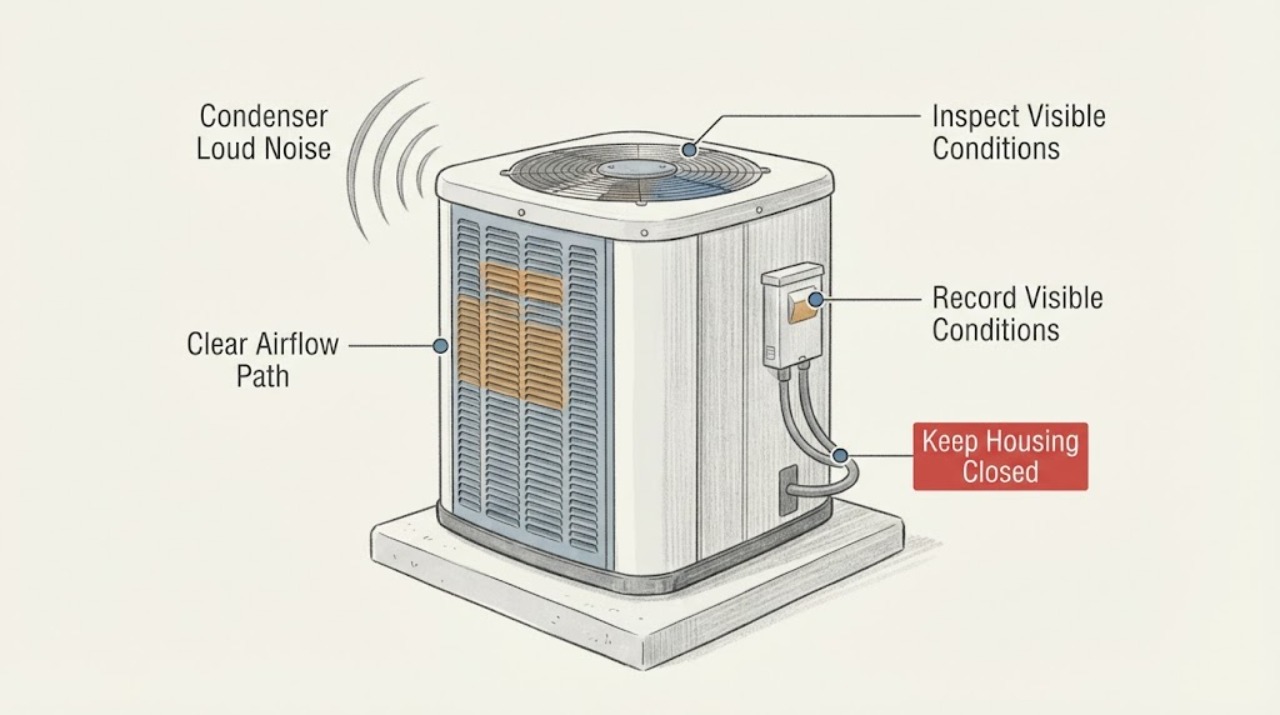
Work through in order
Diagnostic checks
Use only checks that match the exact appliance or system and its official guide.
-
Check 1
From a safe position outside the condenser cabinet, record whether the loud sound is a steady hum, rapid chatter, click, rattle, grind, bang, squeal, or hiss. Do not put hands, tools, or a listening device through the grille.
Expected result: Note whether the sound starts at the cooling call, continues while the unit runs, changes at shutdown, or occurs when the unit is not called to run.
Next step: Keep the system off if the noise is sudden, loud, or persistent and provide the description to HVAC service. Do not open the cabinet to listen closer.
Why this matters
Why: Start or stop timing can help a technician distinguish switching, fan, compressor, or cabinet vibration, but no sound pattern confirms a contactor fault.
-
Check 2
Observe one normal thermostat call from a safe location only if there is no smoke, odor, heat, arcing, hissing, or other immediate hazard. Note whether the outdoor fan starts and whether indoor airflow or comfort changes.
Expected result: The fan may start normally, fail to start, start briefly, or the unit may remain silent while the thermostat calls. Stop the observation if the sound becomes harsh or any hazard appears.
Next step: Do not repeat the call or cycle power. Keep the unit off and report the fan response and cooling result to an HVAC technician.
Why this matters
Why: A no-start or fan-only response can involve controls, contactor, capacitor, motor, compressor, or protection; a running fan does not prove the compressor or contactor is sound.
-
Check 3
Note the thermostat mode and call, indoor airflow, and whether the loud condenser event is paired with warm air, weak airflow, short cycling, or no cooling. Change no wiring or control settings beyond the normal user interface.
Expected result: A call with warm indoor air, repeated starts, or no outdoor response is a meaningful service history; a normal temperature result does not make a new loud sound safe.
Next step: Stop using the system for a new or worsening noise and arrange HVAC diagnosis. Do not add refrigerant or attempt an electrical repair.
Why this matters
Why: Cooling symptoms can accompany a condenser, capacitor, contactor, fan, compressor, airflow, or refrigerant problem, and several causes can sound alike.
-
Check 4
From outside the cabinet, inspect the surrounding clearance and visible exterior for leaves, branches, loose-looking panels, bent fins, heavy rust, oil-like residue, or physical impact. Do not remove the grille or reach into the fan area.
Expected result: Debris, a vibrating panel, bent metal, residue, or damage may explain a mechanical noise or require service; a clear exterior does not clear internal electrical parts.
Next step: Keep hands and tools out of the cabinet and tell the technician what is visible. Stop the system for damage, residue, ice, or a noise that worsens under load.
Why this matters
Why: A condenser disperses heat outdoors, and restricted airflow or physical damage can increase strain and noise. Visible oily residue can indicate a refrigerant issue.
-
Check 5
Observe the home's HVAC breaker or disconnect status only from a safe, dry position and record whether protection has tripped, whether the noise preceded the trip, and whether it trips again. Do not open the disconnect or panel and do not repeatedly reset it.
Expected result: A trip, failed start, or repeated trip changes the event into an electrical fault investigation rather than a noise-only question.
Next step: Leave the condenser off and arrange urgent HVAC service. If the panel, disconnect, or unit is hot, smoking, sparking, or smells burned, move away and obtain emergency help.
Why this matters
Why: The contactor, capacitor, motor, compressor, wiring, or another load may be involved, but protective-device status cannot identify the failed part.
-
Check 6
Record the unit's history: whether the noise is new, whether it follows rain or heat, when maintenance or installation occurred, and whether it happens in cooling, heating, startup, shutdown, or defrost. Do not deliberately reproduce a severe sound.
Expected result: A new noise, a mode-specific event, or a change after work narrows the technician's questions without proving a contactor or compressor failure.
Next step: Keep the system off if the sound is abnormal or worsening and give the timeline to the HVAC provider. Leave the cabinet closed.
Why this matters
Why: Some systems have expected startup, shutdown, or defrost sounds, but a noticeable change or persistent loud noise needs assessment.
-
Check 7
Prepare a service note with the sound type, exact start and stop timing, thermostat call, fan response, indoor comfort, breaker or disconnect status, visible exterior condition, weather, recent work, and all safety signs.
Expected result: A detailed external history lets the technician plan safe isolation and distinguish a switching symptom from fan, compressor, cabinet, or refrigerant clues.
Next step: Keep the condenser unused until the HVAC technician confirms the unit and its electrical and refrigerant systems are safe to operate.
Why this matters
Why: A contactor and other condenser components require professional testing; sound and visual observations cannot establish safe operation or part fit.
Use your observations
Decision map
Find the observation that best matches what you see, then follow the next safe action.
-
PATH 01Next step
What you see
The condenser makes a new steady buzz, rapid chatter, or repeated clicking at startup.
Do this next
Stop using the system and arrange HVAC service. The contactor or its control circuit is one possibility, but a capacitor, motor, compressor, wiring, or control issue can sound similar; do not open the cabinet.
-
PATH 02Next step
What you see
The fan runs but the system is loud and indoor air remains warm or cooling is weak.
Do this next
Turn the system off and call HVAC service. The compressor, contactor, capacitor, airflow, or refrigerant circuit may need diagnosis; do not add refrigerant or test internal parts.
-
PATH 03Next step
What you see
The unit is silent, the fan fails to start, or it starts briefly and stops.
Do this next
Leave it off and request professional diagnosis of the call, contactor, capacitor, motor, compressor, and protective controls. Do not repeat the start attempt.
-
PATH 04Next step
What you see
The noise is grinding, banging, rattling, or accompanied by vibration, visible damage, or oil-like residue.
Do this next
Shut the system off and schedule HVAC service. A fan, compressor, loose component, physical damage, or refrigerant issue may be involved; keep hands out of the cabinet.
-
PATH 05Next step
What you see
The sound occurs only during an expected startup, shutdown, or heat-pump defrost event and then returns to the usual sound without other symptoms.
Do this next
Record the mode and duration and compare it with the exact owner guidance for the model. If the sound is new, louder than before, persistent, or paired with poor comfort, arrange HVAC inspection rather than assuming it is normal.
-
PATH 06Next step
What you see
There is smoke, a burning or electrical odor, visible arcing, a refrigerant-like hiss, severe heat, shock, or repeated breaker operation.
Do this next
Stop immediately, move away, keep others away, and obtain urgent or emergency help. Do not touch the unit, disconnect, panel, refrigerant lines, capacitor, contactor, or wiring.
Helpful context
Understand the symptom
Separate the contactor sound from other condenser noises
The contactor is an electrical switching component inside the outdoor cabinet. A low buzz or repeated chatter that begins exactly when a cooling call starts can be associated with the contactor or its control circuit, but an outdoor fan can rattle, a compressor can hum or bang, and a loose panel can vibrate. Do not use the sound to justify opening the cabinet. Record the timing and visible system response for the technician.
Use the operating response as the safe decision point
From outside the unit, note whether the outdoor fan starts, whether indoor air changes temperature, whether the noise ends when the call ends, and whether the unit stops or trips protection. A condenser that is loud and not cooling, or that repeatedly starts and stops, needs service. A normal-looking fan does not clear the contactor, compressor, capacitor, wiring, or refrigerant circuit.
Keep high-voltage and refrigerant work professional
The outdoor cabinet can contain line-voltage conductors, a charged capacitor, a contactor, a motor, and a compressor. Refrigerant lines may also be pressurized. Keep the disconnect and enclosure closed, avoid wet cleaning or reaching through the grille, and let a qualified HVAC technician isolate power and test the system with the correct equipment.
Safety boundary
Stop conditions
- Stop immediately for smoke, fire, a burning or electrical odor, visible arcing, shock, rapid heat, severe vibration, a refrigerant-like hiss, or repeated breaker operation. Move away and obtain emergency help when appropriate.
- Turn the HVAC system off and keep it off for a new, loud, or worsening condenser noise, no-start condition, weak cooling, visible damage, oil-like residue, or a fan that fails to start.
- Do not remove the outdoor cabinet, disconnect cover, electrical panel, grille, contactor, capacitor, motor, or compressor access; do not touch wiring, add refrigerant, spin the fan, use a meter, or perform energized electrical testing.
- Do not repeatedly cycle the thermostat, disconnect, or breaker to reproduce the sound. A normal-looking fan or temporary quiet period does not clear the contactor, wiring, capacitor, compressor, or refrigerant circuit.
Only after diagnosis
Potential parts
- contactor
Consider only if a qualified HVAC diagnosis confirms contactor wear, chatter, welded contacts, or a related control fault.
Voltage, coil type, pole configuration, rating, system model, and installation must be verified by a qualified HVAC technician. - run capacitor
Consider only if professional testing identifies a failed or out-of-spec capacitor associated with the noise or no-start symptom.
Capacitors can retain hazardous energy; capacitance, voltage rating, configuration, and fit must be verified and installed by a qualified technician. - condenser fan motor
Consider only when diagnosis confirms fan motor, bearing, or related mechanical failure rather than a contactor or control issue.
Motor specifications, rotation, mounting, electrical ratings, and system compatibility require professional verification. - compressor electrical service
Consider only when professional diagnosis links the noise or no-start symptom to the compressor circuit; the sound alone is not enough.
Compressor and refrigerant work is system-specific and must be performed by a qualified HVAC technician.
When checks do not resolve it
Need a professional?
Call after recording the sound timing and safe external response, or immediately for smoke, odor, arcing, shock, severe heat, refrigerant-like hissing, visible damage, or repeated protective-device operation.
Safety scope: Keep the condenser off with the cabinet closed. Do not touch or open the contactor, capacitor, motor, compressor, disconnect, panel, wiring, or refrigerant lines; do not add refrigerant, spin the fan, reset repeatedly, or perform energized testing.
Common questions
FAQ
What does a buzzing condenser contactor sound like?
A steady buzz or rapid chatter that begins at startup can be associated with a contactor or its control circuit, but a capacitor, motor, compressor, or wiring issue can sound similar. Record the timing from outside and keep the cabinet closed.
Can I open the condenser to inspect the contactor?
No. The outdoor cabinet can contain line-voltage conductors and a charged capacitor. Keep it closed and have a qualified HVAC technician isolate and inspect the contactor and related components.
Why is the condenser loud but still cooling?
A fan, cabinet vibration, contactor, capacitor, compressor, or another component can produce noise before cooling is lost. A new or worsening sound still merits HVAC service; continued cooling does not prove safe operation.
Should I reset the breaker if the condenser is noisy?
Do not repeatedly reset it. Record the visible status from a safe position and leave the system off; repeated trips point to an electrical or equipment fault that needs professional diagnosis.
When is condenser noise an emergency?
Smoke, burning or electrical odor, visible arcing, shock, severe heat, refrigerant-like hissing, fire, or repeated protective-device operation requires immediate stop and urgent help. Move away and do not touch the unit, panel, disconnect, or refrigerant lines.
Read the exact guide
Official sources
- AC Capacitor | Air Conditioner Capacitor | CarrierCarrier · General Carrier AC capacitor information; exact component and ratings are model-specific.
- Troubleshoot an Air Conditioner: 6 Steps to Fix an AC Not WorkingCarrier · General Carrier residential AC guidance; user checks must remain outside energized equipment.
- What is an AC Condenser Unit? | Function, Cost & RepairCarrier · General residential condenser information; it does not diagnose a particular installation.
- Is This Normal? HVAC Smells and Sounds, ExplainedTrane · General Trane residential HVAC guidance; exact normal sounds vary by equipment model and mode.
Community feedback
Share a repair observation
Share a plain-text repair observation. Accepted observations are published automatically; this page may take a moment to update.