
On this page
Start here
Quick answer
A loud outdoor condenser sound can come from the fan guard or debris, a fan motor or blade, the compressor, a loose panel, refrigerant or pressure conditions, or a capacitor that is struggling to start a motor. From a dry, safe position, note whether the sound is a hum, rattle, grind, squeal, click, or bang and whether the outdoor fan starts and airflow or cooling changes. Do not open the condenser cabinet, touch the fan, capacitor, compressor, wiring, or refrigerant lines, discharge a capacitor, or perform live tests. A capacitor can retain a dangerous charge after power is disconnected. Stop for burning odor, smoke, sparks, arcing, heat, exposed damage, ice, water, violent vibration, or a breaker trip, and arrange qualified HVAC service.
Before you begin
Safety first
- This article permits only safe listening and visible observation, thermostat and airflow checks, and exact-manual filter or grille checks with the equipment off. It does not authorize cabinet opening, capacitor inspection or discharge, live testing, fan access, wiring work, refrigerant or high-pressure work, safety bypass, or repeated restarts.
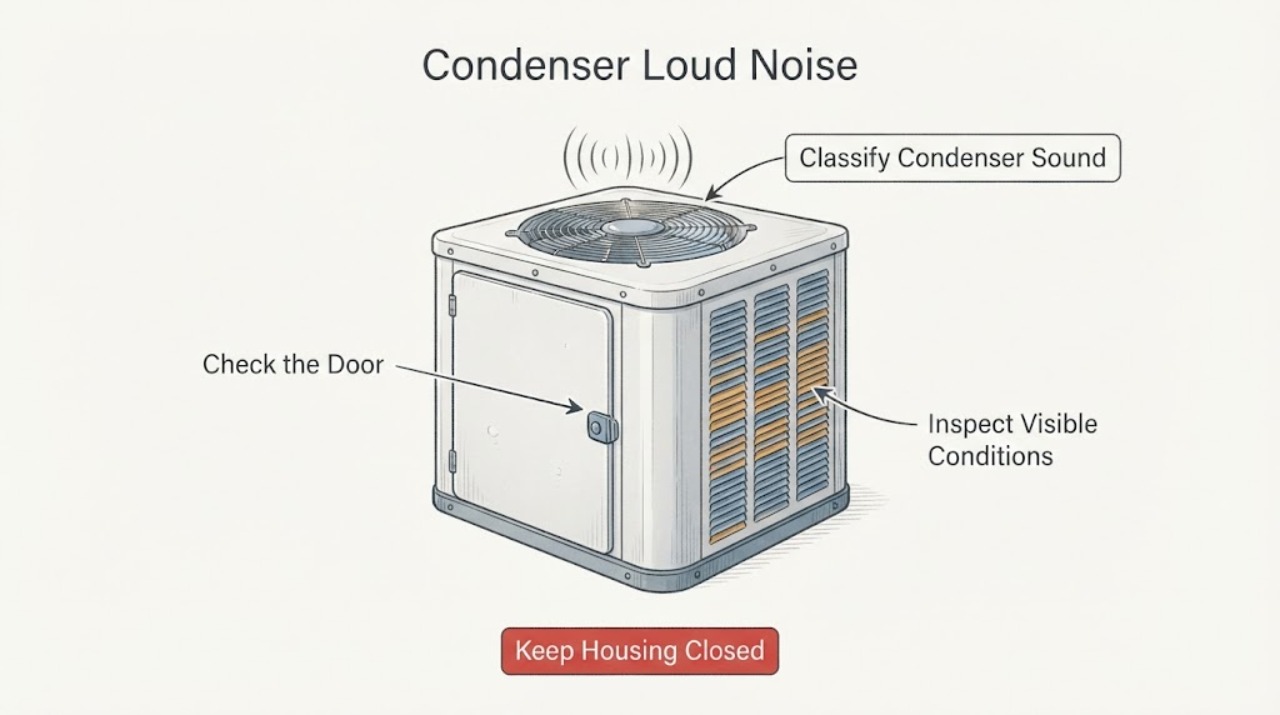
Work through in order
Diagnostic checks
Use only checks that match the exact appliance or system and its official guide.
-
Check 1
Stop normal cooling and observe the condenser from a dry, stable position without touching the cabinet, grille, fan, disconnect, wiring, or refrigerant lines. Look for smoke, sparks, arcing, a burning odor, a hot enclosure, water near electrical equipment, ice, exposed damage, or violent vibration.
Expected result: There is only an unusual sound, or there is also smoke, fire, arcing, burning odor, heat, water, ice, damage, severe vibration, or a tripped breaker.
Next step: For smoke, fire, arcing, shock, or immediate danger, move away and call emergency responders. Otherwise keep the system off and arrange urgent HVAC service for water, ice, heat, odor, damage, or violent vibration.
Stop if: Do not touch wet, hot, smoking, sparking, or damaged equipment, and never use water on energized HVAC equipment.
Why this matters
Why: A sound without a visible warning can be documented; a warning can indicate electrical, fire, water, mechanical, or refrigerant risk and is not a reason to approach the unit.
-
Check 2
From outside the closed cabinet, record whether the condenser makes a hum, rattle, grind, squeal, click, hiss, bang, or high-pitched sound and whether it occurs at startup, during steady running, intermittently, or while shutting down. Do not deliberately cycle the system repeatedly to reproduce it.
Expected result: A hum occurs with no fan start, a click is followed by silence, grinding or squealing persists, a rattle follows vibration, or the sound is only a brief transition.
Next step: Keep a written or audio description for the technician. Leave the system off when the sound is persistent, worsening, or damaging rather than using a restart to test it.
Stop if: Do not put hands or tools near a moving fan, remove a guard, or run through a bang, grind, or violent vibration.
Why this matters
Why: Hum or click with a failed start can be a capacitor, motor, control, or compressor clue; grinding and squealing suggest a moving-part concern; rattling can involve a panel, guard, or mounting; a brief transition does not clear a new or worsening loud sound.
-
Check 3
During no more than one normal thermostat call, observe the outdoor fan from a safe distance and note whether it starts, runs steadily, stops, or remains still while the unit hums. Do not approach the fan or try to start it by hand.
Expected result: The fan starts normally, hums without turning, runs unevenly, stops unexpectedly, or the compressor sound is present without normal cooling response.
Next step: Record the fan and cooling response and stop operation for a stalled, noisy, uneven, or repeatedly stopping fan. Call a qualified HVAC technician for motor, capacitor, control, compressor, and wiring diagnosis.
Stop if: Do not touch fan blades, compressor, wiring, disconnects, or the capacitor, and do not hand-start a stalled motor.
Why this matters
Why: A fan that hums without turning can be consistent with a capacitor or motor problem, but the control, wiring, blade, and compressor circuits can produce similar symptoms. A compressor or outdoor-unit symptom should not be diagnosed from the fan alone.
-
Check 4
Check the thermostat display and mode without opening the equipment, and note whether indoor supply airflow is normal, weak, or absent. With the system off, inspect only the user-accessible filter and return/supply grilles if the exact manual permits that access.
Expected result: The thermostat is calling normally and airflow is normal, or the filter is dirty, wet, damaged, incorrectly sized or directed, or grilles are blocked and airflow is weak.
Next step: Correct only a clearly user-accessible filter using the exact manual-specified size, type, and airflow direction, and clear ordinary visible grille blockage. If the condenser noise or weak airflow remains, leave the system off and call HVAC service.
Stop if: Do not run without a filter, remove ductwork, open an indoor or outdoor panel, or continue operation with ice, water, or no airflow.
Why this matters
Why: A control-setting or airflow issue can make the outdoor section run abnormally or contribute to coil icing and motor strain, but a filter condition does not prove a condenser capacitor fault.
-
Check 5
With the unit off and panels closed, look around the condenser for leaves, loose objects, a visibly displaced cover, blocked clearance, bent external grille, water, or ice. Do not reach through the grille, straighten fins, remove the guard, or spray into the unit.
Expected result: The surroundings are clear and dry, or an object, obstruction, ice, water, damaged grille, or visible movement is present.
Next step: Only move a loose object that is clearly outside the unit and can be removed without reaching toward the fan; otherwise leave the equipment off and call HVAC service. Do not assume clearing the area fixes an internal fault.
Stop if: Do not enter standing water, scrape ice, bend fins, remove a grille, open the cabinet, or restore power to wet or damaged equipment.
Why this matters
Why: A loose external object or panel can rattle, while ice, water, damage, or blocked airflow can indicate an airflow, drain, refrigerant, pressure, or mechanical condition requiring a professional assessment.
-
Check 6
From a safe position, note whether the indoor or outdoor system has visible ice, reduced airflow, hissing, unusual cooling loss, or a compressor that runs with an abnormal sound. Do not touch refrigerant tubing, loosen fittings, remove ice, or continue running solely to observe a pressure symptom.
Expected result: There is no ice or cooling change, or there is ice, hissing, weak airflow, cooling loss, or an unusual compressor response.
Next step: Turn the system off and arrange HVAC service for ice, hissing, cooling loss, or abnormal compressor behavior. A trained technician must handle refrigerant and high-pressure diagnosis.
Stop if: Do not open a refrigerant circuit, vent refrigerant, apply heat to ice, use a gauge, or bypass a pressure or freeze safety.
Why this matters
Why: Ice, hissing, poor airflow, and a loud compressor can involve airflow, refrigerant, pressure, compressor, or control conditions; sound alone cannot identify a leak or pressure fault.
-
Check 7
Give the HVAC technician the model, sound recording or description, exact timing, fan response, cooling and airflow response, filter and visible-obstruction observations, ice or water, odor or heat, vibration, breaker behavior, and recent service history. Keep the condenser cabinet closed while waiting.
Expected result: The pattern points to hum/no-start, fan noise, compressor noise, mechanical rattling, airflow restriction, or an electrical or refrigerant warning.
Next step: Schedule qualified HVAC service and ask for the root cause before any capacitor or motor replacement. Resume use only when the technician confirms the system is safe and operating normally.
Stop if: Do not open the cabinet, discharge or replace a capacitor, measure live voltage, bypass a safety, or buy a capacitor by appearance or generic rating.
Why this matters
Why: The record helps the technician choose safe checks for the fan, motor, capacitor, contactor, compressor, cabinet, airflow, refrigerant, pressure, or controls without a homeowner live test.
Use your observations
Decision map
Find the observation that best matches what you see, then follow the next safe action.
-
PATH 01Safety boundary
What you see
The loud noise is accompanied by smoke, fire, sparks, arcing, shock, burning odor, hot equipment, exposed damage, water near electrical parts, violent vibration, or a breaker trip.
Do this next
Move away and call emergency responders for fire, smoke, arcing, shock, or immediate danger; otherwise keep the system off and arrange urgent HVAC service.
Why this path and its safety boundary
Why it matters: The sound may accompany an electrical, fire, water, mechanical, or other immediate hazard.
Safety stop: Do not touch, open, reset, spray, or operate the equipment.
-
PATH 02Safety boundary
What you see
The sound is a brief, familiar startup or shutdown transition with no odor, heat, damage, vibration, cooling loss, or change from the system's normal behavior.
Do this next
Document the sound and monitor without opening the unit; arrange HVAC service if it recurs, grows louder, or affects operation.
Why this path and its safety boundary
Why it matters: Some systems make normal short operating transitions, but a new, louder, repeated, or worsening sound is not cleared by this possibility.
Safety stop: Stop use for any hazard sign or persistent mechanical noise.
-
PATH 03Safety boundary
What you see
The noise is a rattle or vibration that changes with outdoor-fan operation, and a loose external object, cover, or visible obstruction is present.
Do this next
Only remove an object that is clearly outside the unit and safely reachable without approaching the fan; otherwise keep the unit off and call HVAC service.
Why this path and its safety boundary
Why it matters: An external object or panel may be contacting or vibrating near the condenser, but the fan, motor, guard, and mounting still need professional assessment if the sound persists.
Safety stop: Do not reach through the grille, remove the guard, bend fins, or open the cabinet.
-
PATH 04Safety boundary
What you see
The condenser hums or clicks but its fan does not start, starts and stops, or the compressor fails to start normally.
Do this next
Leave the system off and call a qualified HVAC technician to de-energize, discharge, test, and diagnose the circuit safely.
Why this path and its safety boundary
Why it matters: A capacitor, fan or compressor motor, contactor, control, wiring, or mechanical problem is possible; the capacitor clue is not a user diagnosis.
Safety stop: Do not hand-start the fan, discharge or replace the capacitor, measure live parts, or repeatedly restart the unit.
-
PATH 05Safety boundary
What you see
The sound is grinding, squealing, banging, persistent rattling, or accompanied by visible movement or poor cooling.
Do this next
Stop the system if the noise is new, worsening, or damaging and arrange HVAC inspection; provide the timing and safe observations.
Why this path and its safety boundary
Why it matters: A fan blade, bearing, motor, mounting, cabinet, compressor, or another moving component may be damaged or loose.
Safety stop: Do not open the cabinet, tighten internal parts, spin the fan, or continue through violent vibration.
-
PATH 06Safety boundary
What you see
Ice, hissing, weak airflow, cooling loss, or an abnormal compressor response accompanies the noise.
Do this next
Turn the system off and call HVAC service for airflow, refrigerant, pressure, compressor, and safety-control diagnosis.
Why this path and its safety boundary
Why it matters: An airflow, refrigerant, pressure, compressor, or freeze-protection condition may be present and cannot be safely identified by sound alone.
Safety stop: Do not scrape ice, apply heat, use gauges, open refrigerant lines, or bypass a safety.
-
PATH 07Safety boundary
What you see
Visible checks are normal but the loud condenser noise continues, cooling is abnormal, or the source cannot be isolated.
Do this next
Keep the system off as appropriate and schedule qualified HVAC inspection instead of replacing a part based on sound alone.
Why this path and its safety boundary
Why it matters: An internal fan, capacitor, compressor, contactor, control, wiring, mounting, refrigerant, pressure, or model-specific fault remains possible.
Safety stop: Do not open the unit, perform live tests, discharge a capacitor, bypass safeties, or repeatedly run a failing system.
Helpful context
Understand the symptom
The sound and timing narrow the path, but do not prove a capacitor failure
A hum from the outdoor unit with a fan that does not start can be a capacitor or motor-start clue, but a control, wiring, compressor, or mechanical problem can sound similar. Rattling may be a loose panel or debris; grinding or squealing may indicate a damaged fan, bearing, or other moving part; a click followed by no start may involve a control or start circuit. A short normal startup or shutdown sound is different from a new, loud, worsening, or repeated sound. Record the pattern instead of repeatedly restarting the system.
Keep the condenser cabinet closed
The outdoor condenser contains moving fan parts, high-voltage electrical components, a compressor, and refrigerant or high-pressure systems. A homeowner can observe the equipment from a safe distance and check ordinary thermostat settings, airflow, and visible surroundings. Do not remove the service panel, spin the fan, tighten internal parts, touch a capacitor, measure voltage, open a refrigerant circuit, or use a tool or hose inside the unit. Carrier specifically warns that a capacitor may hold lethal energy after power is disconnected and that testing or replacement requires trained handling.
What to give the HVAC technician
Provide the model and fuel/electrical system information, the exact sound, when it occurs, whether the outdoor fan starts, whether cooling or airflow changes, any ice or water, visible obstruction, odor, heat, vibration, breaker behavior, and recent service or filter work. This lets the technician separate fan, capacitor, compressor, contactor, airflow, refrigerant, pressure, and cabinet or mounting checks without asking you to conduct a hazardous test.
Safety boundary
Stop conditions
- Stop immediately and move away for smoke, fire, arcing, sparks, shock, burning odor, hot equipment, exposed damage, violent vibration, or a breaker trip; use emergency responders for immediate danger.
- For water, ice, or a wet area near electrical equipment, leave the system off, do not enter unsafe water, and do not restore power to wet or damaged equipment.
- Do not open the condenser cabinet, touch or discharge a capacitor, measure live voltage, handle wiring, reach into or hand-start a fan, open refrigerant lines, use gauges, or perform high-pressure work. A capacitor can remain charged after power is disconnected.
- Do not repeatedly restart a noisy or stalled motor, run through grinding or violent vibration, bypass a pressure or freeze safety, or select a capacitor by appearance or generic rating. Persistent noise, no-start, cooling loss, ice, or compressor symptoms require qualified HVAC service.
When checks do not resolve it
Need a professional?
Call a qualified HVAC technician for persistent or worsening condenser noise, hum/no-start, fan trouble, grinding, squealing, rattling, weak cooling, ice, hissing, water, repeated trips, or any unresolved cause. Use emergency responders for smoke, fire, arcing, shock, or immediate danger.
Safety scope: This article permits only safe listening and visible observation, thermostat and airflow checks, and exact-manual filter or grille checks with the equipment off. It does not authorize cabinet opening, capacitor inspection or discharge, live testing, fan access, wiring work, refrigerant or high-pressure work, safety bypass, or repeated restarts.
Common questions
FAQ
Does a loud condenser always mean the capacitor is bad?
No. A capacitor is one possible cause, especially when the outdoor unit hums or a motor fails to start, but the fan, motor, compressor, contactor, control, wiring, mounting, airflow, refrigerant, or pressure system can sound similar. A technician must test the system safely.
Is it safe to check or replace a condenser capacitor after turning the power off?
No. A capacitor can retain dangerous electrical energy after power is disconnected. Do not open the cabinet, discharge it, measure it, or replace it; a qualified HVAC technician should de-energize and test it.
Can I run the air conditioner if the condenser is rattling or grinding?
Do not keep running it to see whether the noise clears. A new, worsening, grinding, squealing, banging, or violently vibrating condenser should remain off and be inspected, especially if cooling is weak or an odor, heat, smoke, ice, water, or breaker trip is present.
What should I record before calling HVAC service?
Record the sound type and timing, whether the outdoor fan starts, indoor airflow and cooling response, filter and visible-surroundings condition, ice or water, odor or heat, vibration, breaker behavior, system model, and recent service. Observe from a safe distance and keep the cabinet closed.
Read the exact guide
Official sources
- AC Fan Not Working? Reasons Why It Stopped SpinningTrane · Manufacturer fan troubleshooting used to separate symptoms; exact equipment and manual control the applicable checks.
- Troubleshoot an Air Conditioner: 6 Steps to Fix an AC Not WorkingCarrier · Manufacturer AC troubleshooting used for visible and settings checks; exact model manual and professional service control.
- Maintenance ChecklistENERGY STAR · Government energy-efficiency maintenance checklist used for low-risk visible maintenance and escalation; exact equipment instructions control.
- Is This Normal? HVAC Smells and Sounds, ExplainedTrane · Manufacturer explanation of sound and safety patterns; a qualified technician must determine the actual model-specific cause.
- Furnace Blower Motor Repair & Replacement GuideCarrier · Manufacturer motor and electrical safety guidance used for general HVAC risk boundaries; condenser model and service manual control.
- What is an AC Capacitor? | Cost, Signs of Failure & ReplacementCarrier · Manufacturer capacitor guidance used for safety and conditional symptom interpretation; exact system specifications and qualified service control.
Community feedback
Share a repair observation
Share a plain-text repair observation. Accepted observations are published automatically; this page may take a moment to update.