
On this page
Start here
Quick answer
A loud outdoor condenser is not automatically a failed compressor. From a safe distance, first note whether the sound is a brief click at start or stop, a steady motor hum, fan rattle or scraping, cabinet vibration, or a harsh grinding, banging, or repeated starting sound. Also note whether the condenser fan is visibly turning, whether cooling has changed, and whether ice, oily residue, smoke, burning odor, or a tripped breaker is present. Do not open the cabinet, reach through the grille, touch a capacitor, contactor, compressor, fan, wiring, or refrigerant tubing, or keep restarting a noisy system. A persistent or worsening noise, poor cooling, short cycling, or any safety sign needs qualified HVAC service; refrigerant and high-voltage diagnosis belong to the technician.
Before you begin
Safety first
- Keep the system off for smoke, odor, heat, arcing, water, residue, severe movement, poor cooling with ice, or repeat protective-device operation. Cabinet, electrical, compressor, moving-fan, and refrigerant work belongs to qualified HVAC personnel.
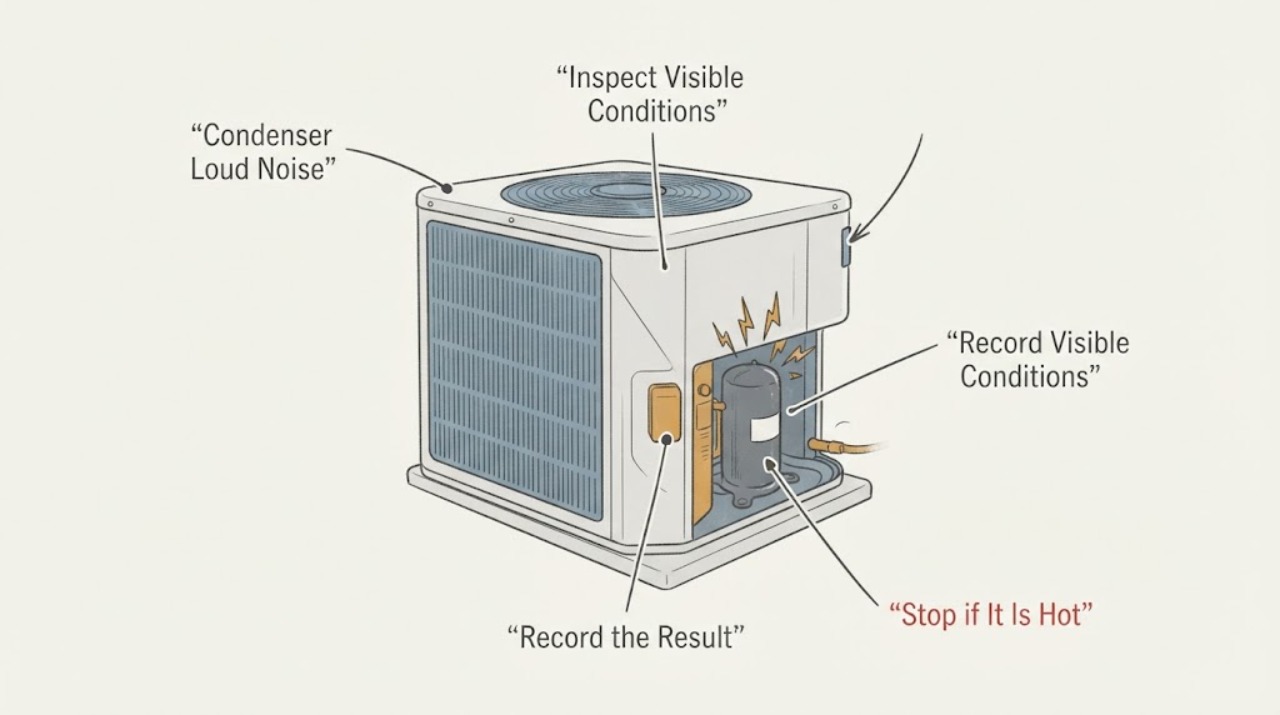
Work through in order
Diagnostic checks
Use only checks that match the exact appliance or system and its official guide.
-
Check 1
From a dry position outside the condenser's clearance zone, observe for smoke, burning or hot-insulation odor, visible arc or flash, a hot or discolored disconnect or enclosure, exposed wiring, oil-like residue, water near electrical equipment, severe vibration, or a breaker that opens when the system runs; do not touch the unit.
Expected result: A safety sign, fluid residue, severe movement, or repeat protective-device operation is present.
Next step: Stop the system with a safe normal control if possible, keep clear, and arrange urgent HVAC or electrical service. If there is smoke or fire, leave and use the local emergency route from a safe location.
Stop if: Stop immediately for smoke, fire, arc or flash, burning odor, heat, exposed wiring, water at electrical parts, oil-like residue, severe movement, or a repeat breaker opening.
Why this matters
Why: The noise may accompany an electrical, fire, refrigerant, moisture, or mechanical hazard rather than normal operating sound.
-
Check 2
During one ordinary cooling call only when there is no warning sign, listen from several safe positions and record whether the sound is a brief click, steady hum, rattling or scraping, rhythmic banging, grinding, squealing, or repeated start-stop; note whether it begins at startup, during the run, or at shutdown.
Expected result: The sound is a short click, a steady low hum, a fan-like rattle or scrape, a cabinet vibration, a harsh mechanical sound, or a repeated start attempt.
Next step: Record the sound and stop the system if it is harsh, worsening, continuous, or paired with poor cooling. Do not run extra cycles to reproduce it and do not open the cabinet.
Stop if: Stop for a harsh, metallic, continuous, or rapidly worsening sound, smoke, odor, heat, ice, fluid residue, or a new breaker trip.
Why this matters
Why: Timing and character can narrow the next branch: a click may occur at control switching, fan noise follows airflow or blade rotation, while harsh or repeated compressor-like sounds need prompt professional assessment. They do not prove which part has failed.
-
Check 3
From outside the enclosure and well away from the top grille, observe during the same single call whether the condenser fan turns smoothly, turns slowly, stops, wobbles, or remains still while a deeper sound continues; do not reach through the grille or approach moving blades.
Expected result: The fan turns smoothly with a separate low hum, the fan rattles or wobbles, the fan is still while the unit hums, or the whole unit is silent.
Next step: Keep the system off for a still, wobbling, scraping, or noisy fan and arrange HVAC service. Leave the fan, capacitor, contactor, compressor, and wiring untouched.
Stop if: Stop for contact between a blade and grille, a still fan with a harsh hum, smoke, heat, odor, arcing, or any need to enter the enclosure.
Why this matters
Why: A fan-specific pattern can involve a blade, motor, airflow obstruction, or control. A deep hum with a non-starting fan or a silent unit can involve electrical starting components or compressor control, but this observation cannot distinguish a capacitor, contactor, motor, or compressor fault.
-
Check 4
With the condenser off through its normal thermostat control, observe from the outside whether leaves, fencing, stored items, or other debris restrict the air path and whether the enclosure has visible dents, corrosion, loose-looking external panels, or a shifted position; do not remove a panel, insert tools, or wash the unit.
Expected result: The air path is visibly restricted, the cabinet or pad appears displaced, an external panel vibrates, or the outdoor clearance and exterior look normal.
Next step: Keep objects away without touching the condenser. If the unit is displaced, damaged, or the noise persists, arrange HVAC inspection; do not straighten fins or remove the cabinet.
Stop if: Stop for a damaged cabinet, exposed conductors, fluid residue, water at electrical parts, unstable equipment, or any need to access the fan or coil.
Why this matters
Why: Blocked airflow, an unstable base, or a loose external panel can increase vibration and sound, but a clean-looking exterior does not rule out an internal fan, electrical, compressor, or refrigerant fault.
-
Check 5
Observe the indoor result and outdoor unit from a safe distance: note whether the home cools, the system runs continuously or cycles rapidly, air is warm, ice is visible on tubing or the unit, water is collecting, or oily residue is present; do not touch tubing or scrape ice.
Expected result: Noise is paired with poor cooling, long or short cycles, ice, water, oily residue, or no performance change.
Next step: Stop cooling for ice, water, oily residue, or worsening performance and arrange HVAC service. Give the technician the sound timing and performance pattern.
Stop if: Stop for ice, water near electrical equipment, oily residue, smoke, odor, heat, or worsening cooling with a loud sound.
Why this matters
Why: Noise plus performance loss can point to airflow, condenser, compressor, or refrigerant conditions that need professional diagnosis. Ice or residue is not a cue to add heat or handle the refrigerant circuit.
-
Check 6
From a safe listening position, note whether a single click occurs only as the system starts or stops and whether the fan and cooling then operate normally; do not repeatedly switch the thermostat or use the electrical disconnect to chase the sound.
Expected result: The click is brief with normal operation, clicking repeats without a stable start, or clicking is accompanied by a hum, trip, vibration, or poor cooling.
Next step: Monitor only the existing pattern if it is brief and performance is normal. For repeated clicking or any performance or safety symptom, keep the system off and call HVAC.
Stop if: Stop for repeated clicking, a deep hum without start, smoke, odor, heat, arcing, a breaker trip, or poor cooling.
Why this matters
Why: A single control transition can sound different from repeated failed starts. Repeated clicking with no stable operation suggests a control or electrical starting issue that should not be tested by cycling.
-
Check 7
Prepare a service note with the condenser and thermostat models, sound type and location, start/run/stop timing, fan motion, cooling result, cycle length, clearance and base observations, ice or residue, recent storm or power event, and breaker behavior; keep the cabinet and disconnect closed.
Expected result: The noise persists, returns, worsens, or diagnosis would require entering the cabinet, touching the compressor, fan, contactor, capacitor, wiring, or refrigerant circuit.
Next step: Arrange qualified HVAC service and leave the system off for abnormal sound, poor cooling, ice, residue, heat, odor, smoke, or repeated cycling. Do not choose a replacement component from sound alone.
Stop if: Stop user diagnosis whenever a cabinet, panel, electrical disconnect, moving blade, motor, capacitor, contactor, compressor, wiring, or refrigerant circuit would need access.
Why this matters
Why: The remaining possibilities include a fan blade or motor, mounting or cabinet vibration, contactor or capacitor, compressor, airflow, refrigerant, or another model-specific fault.
Use your observations
Decision map
Find the observation that best matches what you see, then follow the next safe action.
-
PATH 01Next step
What you see
Smoke, burning odor, heat, arcing, exposed wiring, water near electrical parts, oily residue, severe movement, or a repeat breaker trip is present.
Do this next
Stop the system, keep clear, and arrange urgent HVAC or electrical service; leave and use the local emergency route for smoke or fire.
Why this path and its safety boundary
Why it matters: The condenser has a potential electrical, fire, refrigerant, moisture, or mechanical hazard.
-
PATH 02Next step
What you see
The fan wobbles, scrapes, rattles, turns slowly, or remains still while the unit hums.
Do this next
Keep the system off and request HVAC diagnosis without reaching through the grille or opening the cabinet.
Why this path and its safety boundary
Why it matters: A blade, motor, airflow obstruction, or electrical starting problem is possible, but the fan assembly and electrical parts are not user-service points.
-
PATH 03Next step
What you see
A deep or harsh sound continues from the cabinet while the fan appears normal, cooling is poor, or the system starts and stops repeatedly.
Do this next
Stop extra cycles and arrange qualified HVAC service. Do not touch the compressor or attempt electrical or refrigerant work.
Why this path and its safety boundary
Why it matters: Compressor, contactor, capacitor, refrigerant, airflow, or mounting conditions are possible; sound alone cannot identify the component.
-
PATH 04Next step
What you see
The unit has blocked clearance, a shifted base, loose-looking external panels, or vibration transmitted to nearby structure.
Do this next
Keep the airflow path clear of stored objects without entering the unit and arrange HVAC inspection for displacement, mounting, or persistent vibration.
Why this path and its safety boundary
Why it matters: Airflow restriction or external vibration may be amplifying the sound, but an internal fault remains possible.
-
PATH 05Next step
What you see
A single click occurs at start or stop and the fan, cooling, and cycle remain normal.
Do this next
Record it and monitor without repeated cycling; arrange HVAC service if it becomes frequent, louder, or linked to poor operation.
Why this path and its safety boundary
Why it matters: The sound may be a normal control transition, but recurrence, failed starts, or performance change makes it a service symptom.
Helpful context
Understand the symptom
The condenser is a system, not one part
The outdoor condenser cabinet contains several sound-producing or sound-transmitting elements: the compressor, condenser fan, coil airflow, electrical controls, tubing, mounting feet, and the cabinet or pad. A brief click at startup can be a control event, while a rhythmic rattle can come from a fan or loose external contact. A deep hum with poor cooling can involve the compressor or its electrical starting components, but sound alone cannot confirm a part.
Use location, timing, and system response
Listen from outside the cabinet without leaning over the fan or touching the enclosure. Record whether the noise begins at the thermostat call, continues throughout the cycle, appears only at shutdown, or changes with outdoor temperature. Compare the noise with the indoor airflow and cooling result. If the system is noisy and performance is worsening, stop rather than extending the run for a better recording.
What stays with HVAC service
The fan grille, cabinet panels, capacitor, contactor, compressor, wiring, refrigerant circuit, and electrical disconnect are not user-service points in this article. Do not insert an object into the grille, spray or wash inside the cabinet, remove a panel, or handle refrigerant. A technician can safely verify the sound source, electrical startup, airflow, vibration, pressures, and system condition.
Safety boundary
Stop conditions
- Stop immediately for smoke, fire, burning or hot-insulation odor, arcing, exposed wiring, hot or discolored electrical parts, water near electrical equipment, oily residue, severe movement, or a repeat breaker opening.
- Do not open the condenser cabinet, disconnect box, or electrical panel; do not reach through the grille, touch moving blades, or handle the motor, capacitor, contactor, compressor, wiring, or refrigerant circuit.
- Do not insert tools or sticks, straighten fins, wash inside the cabinet, add heat to ice, or attempt a refrigerant check or repair.
- Stop repeated thermostat cycles when the unit hums without starting, clicks repeatedly, grinds, bangs, scrapes, overheats, short-cycles, or loses cooling.
- If smoke or fire is present, leave the area and use the local emergency route from a safe location; do not return to investigate.
Only after diagnosis
Potential parts
- condenser fan blade or motor
Consider this only if professional inspection confirms that the fan is damaged, unbalanced, seized, or electrically failed.
Confirm the exact outdoor-unit model and motor or blade specifications with the HVAC technician before selecting a part. - run capacitor or contactor
Consider this only after a qualified technician confirms that a starting or switching component is responsible for the hum, repeated clicking, or failed start.
These are model- and electrical-rating-specific components; do not open the cabinet or choose a rating from the sound. - compressor or compressor mounting
Consider this only if professional diagnosis links the persistent deep or harsh noise and performance loss to the compressor or its mounting.
Compressor and refrigerant work requires qualified HVAC handling and exact system identification.
When checks do not resolve it
Need a professional?
The condenser makes persistent grinding, banging, scraping, rattling, squealing, or repeated-start noise., The fan wobbles, scrapes, turns slowly, remains still while the unit hums, or is visibly damaged., Noise is paired with poor cooling, long or short cycles, ice, water, oily residue, or no stable startup., The cabinet, pad, external panel, or nearby structure vibrates, shifts, or appears damaged., Diagnosis would require opening a cabinet or disconnect, touching electrical or moving parts, or handling refrigerant.
Safety scope: Keep the system off for smoke, odor, heat, arcing, water, residue, severe movement, poor cooling with ice, or repeat protective-device operation. Cabinet, electrical, compressor, moving-fan, and refrigerant work belongs to qualified HVAC personnel.
Common questions
FAQ
Does a loud condenser always mean the compressor is bad?
No. The outdoor cabinet also contains a condenser fan, coil airflow path, controls, mounting, and other sound sources. Fan movement, timing, cooling result, and safety signs help set the service priority, but a part cannot be selected from sound alone.
Can I open the condenser to find the noise?
No. Keep the cabinet and disconnect closed. The fan, capacitor, contactor, compressor, wiring, and refrigerant circuit require qualified HVAC diagnosis.
What should I record before calling HVAC?
Record the sound type, where it seems to come from, when it starts, whether the fan turns, whether cooling changed, cycle behavior, visible ice or residue, clearance, recent power events, and any breaker or odor symptom.
Read the exact guide
Official sources
- Troubleshoot an Air Conditioner: 6 Steps to Fix an AC Not WorkingCarrier · Air-conditioner condenser troubleshooting, electrical and refrigerant safety, ice, abnormal outdoor noise, and professional service.
- AC Fan Not Working? Reasons Why It Stopped SpinningTrane · Outdoor condenser-fan identification, fan noise symptoms, capacitor and motor safety, and HVAC service guidance.
- Understanding Your AC Condenser UnitCarrier · AC condenser components, outdoor-unit noise signs, airflow, electrical, compressor, and refrigerant service boundaries.
Community feedback
Share a repair observation
Share a plain-text repair observation. Accepted observations are published automatically; this page may take a moment to update.