
On this page
Start here
Quick answer
An air-conditioner-only condenser is not a heat source, so it will not heat a home; a heat-pump outdoor condenser can heat by reversing the refrigerant flow. First confirm which system you have, then check that the thermostat is in Heat with the fan on Auto, the indoor filter and accessible airflow are not restricted, and the outdoor unit has clear air paths. A brief interruption, stopped outdoor fan, or lukewarm air can occur during a heat-pump defrost cycle, but constant cool air, heavy ice, repeated breaker trips, hissing, burning odor, or unusual noise is a reason to stop and arrange qualified HVAC service. Do not open the cabinet, touch wiring or refrigerant, move the fan, or scrape ice.
Before you begin
Safety first
- Observation and normal user controls only; no panel removal, live testing, refrigerant handling, fan contact, ice removal, wiring changes, or component replacement.
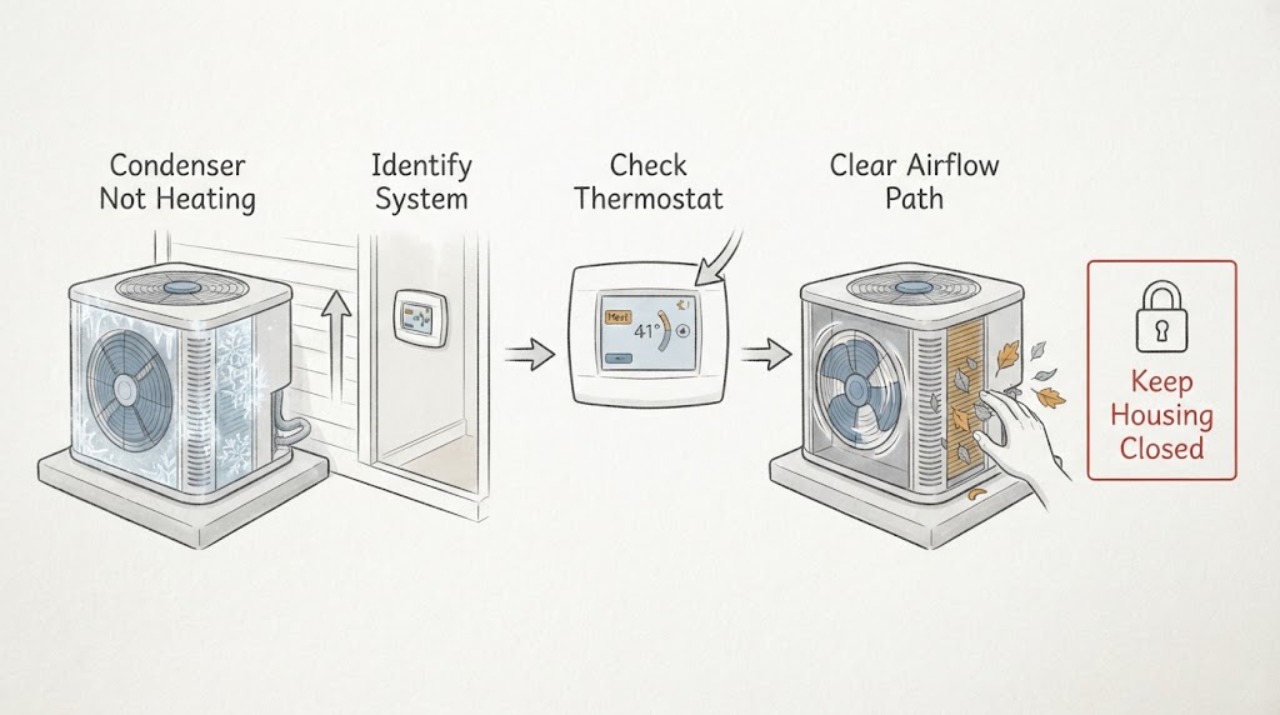
Work through in order
Diagnostic checks
Use only checks that match the exact appliance or system and its official guide.
-
Check 1
From a safe standing position, identify whether the outdoor condenser is a dedicated air conditioner or part of a heat pump by checking the thermostat for Heat, Auxiliary Heat, or Emergency Heat labels and reading the exterior data plate. Do not remove a panel or look inside the cabinet.
Expected result: The controls and documentation identify a heat pump, identify an air conditioner only, or do not clearly identify the system.
Next step: If it is an air conditioner only, use the separate furnace or heater troubleshooting path. If it is a heat pump, continue with the thermostat and airflow checks. If uncertain, record the data-plate information and ask a qualified HVAC professional to identify it.
Stop if: Stop if identification would require opening the cabinet, touching wiring, or entering an unsafe area.
Why this matters
Why: An air-conditioner-only condenser is not expected to heat the home; a heat-pump condenser should be able to operate in heating mode. Unclear identity means a heating diagnosis would be unsafe to guess.
-
Check 2
At the thermostat, verify that the mode is Heat, the setpoint is above the room temperature, and the fan is Auto rather than On. Make only normal user-control changes; do not remove the thermostat or alter wiring.
Expected result: The mode was Cool or another non-heating setting, the fan was On, the setpoint was not calling for heat, or the settings were already correct.
Next step: Correct one clearly wrong setting and observe one normal heating call. If the settings were correct or the symptom persists, continue with airflow and outdoor observations rather than repeatedly resetting controls.
Stop if: Stop if the thermostat shows an electrical warning, damaged wiring, smoke, or a fault that calls for service in the manual.
Why this matters
Why: A wrong mode or fan setting can make a heat pump appear to blow cold air. Correct settings do not prove the outdoor unit or refrigeration circuit is healthy.
-
Check 3
With the system off only as needed for a safe accessible check, inspect the indoor air filter and supply or return grilles without tools, and note whether air reaches the rooms during a heating call. Replace a visibly dirty user-serviceable filter only as directed by the equipment instructions.
Expected result: The filter is visibly clogged or airflow is weak, the filter is reasonably clear with normal airflow, or the filter and airflow cannot be assessed safely.
Next step: Correct one accessible filter or grille restriction and retest once. If airflow remains weak, the filter is clear, or the symptom returns, stop troubleshooting and give the observation to a qualified HVAC professional.
Stop if: Do not reach into a blower, remove ductwork, climb, or handle a wet or energized component.
Why this matters
Why: A clogged filter or restricted airflow can reduce heating performance and may cause a heat pump to struggle or shut down. Normal airflow makes a simple restriction less likely but does not rule out outdoor, control, or refrigerant problems.
-
Check 4
From outside the cabinet, inspect the outdoor condenser's visible air path for leaves, snow, vegetation, or other obstruction, and observe whether the unit has normal sound or a visible fan response during a heating call. Do not touch the grille, fan, coil, or refrigerant tubing.
Expected result: The air path is blocked, the path is clear but the unit is silent, the fan does not move, or the unit operates without an obvious obstruction.
Next step: Remove only loose debris that is safely outside the cabinet and retest once. If the unit remains silent, the fan does not move, a breaker trips again, or the cause is not clearly external, switch the system off and arrange service.
Stop if: Stop immediately for exposed wiring, arcing, burning odor, repeated breaker trips, a moving fan near an unsafe reach, or any need to open the cabinet.
Why this matters
Why: Obstructions can reduce heat transfer. A silent unit, nonmoving fan, or repeated electrical protection response points to a power, control, motor, or other fault that cannot be confirmed by sight alone.
-
Check 5
During one heating call, observe the thermostat or indoor display and the outdoor unit from a safe distance for a defrost or preheating indication, temporary fan stop, water vapor, or melting frost. Do not turn off power just to interrupt a displayed defrost cycle and do not scrape ice.
Expected result: A defrost or preheating indication appears and the system later resumes heating, or ice continues to grow, the indication never clears, or heating never returns.
Next step: Allow one normal defrost or preheating event to complete according to the model instructions. If the unit does not recover, the ice grows, or the cycle repeats abnormally, stop and arrange qualified HVAC service.
Stop if: Stop for heavy ice, water entering an electrical area, smoke-like odor with no clear vapor explanation, or any unsafe access.
Why this matters
Why: Temporary changes during defrost can be normal on a heat pump. Persistent heavy ice or failure to resume can indicate airflow, refrigerant, defrost-control, or sensor trouble.
-
Check 6
Record whether the system heats in one mode but not the other, whether the complaint began after a mode change, and whether there is hissing, liquid, unusual noise, or a displayed fault. Observe only; do not measure refrigerant pressure or open controls.
Expected result: Cooling works but heating does not, the unit has hissing or visible liquid, unusual noise, a persistent fault display, or none of these findings.
Next step: Turn the system off for persistent hazardous or damaging symptoms and provide the pattern, display message, weather, and photos to a qualified HVAC professional. Do not attempt refrigerant, electrical, or valve repair.
Stop if: Stop immediately for burning odor, smoke, arcing, gas odor, severe noise, exposed refrigerant tubing damage, or repeated protective shutdown.
Why this matters
Why: Heating-only failure can be consistent with a reversing-valve issue; hissing, liquid, a frozen coil, unusual noise, or a persistent fault can indicate a professional electrical or refrigerant investigation. Absence of these signs does not prove the system is sound.
Use your observations
Decision map
Find the observation that best matches what you see, then follow the next safe action.
-
PATH 01Next step
What you see
The outdoor condenser is identified as a dedicated air conditioner rather than a heat pump.
Do this next
Do not diagnose a failed heating condenser; use the indoor furnace or other heating-system path and have that system assessed if it is not heating.
Why this path and its safety boundary
Why it matters: A standard air conditioner cools and does not provide indoor heating.
-
PATH 02Next step
What you see
The thermostat was in Cool, the fan was On, or the setpoint was not calling for heat.
Do this next
Correct the normal user setting once, leave the fan on Auto, and retest one heating call. Escalate if the symptom persists.
Why this path and its safety boundary
Why it matters: The control setting can explain cool airflow without proving an equipment failure.
-
PATH 03Next step
What you see
The accessible filter or grilles are restricted and airflow is weak.
Do this next
Correct only the accessible user-serviceable restriction according to the manual, then retest once. Use service if airflow stays weak or the issue recurs.
Why this path and its safety boundary
Why it matters: Restricted airflow can reduce heat-pump performance and may cause shutdown.
-
PATH 04Next step
What you see
A defrost or preheating indication appears and the system resumes heating after the cycle.
Do this next
Monitor according to the model instructions. Arrange service if the cycle does not clear, heating does not return, or ice keeps growing.
Why this path and its safety boundary
Why it matters: The temporary change is consistent with normal heat-pump frost protection.
-
PATH 05Next step
What you see
Heavy ice grows, cool air remains constant, or the outdoor unit does not recover from defrost.
Do this next
Stop the heating call if the equipment is at risk and arrange qualified HVAC service; do not scrape ice or handle refrigerant.
Why this path and its safety boundary
Why it matters: Persistent symptoms can involve airflow, refrigerant, defrost controls, sensors, or another fault beyond safe observation.
-
PATH 06Next step
What you see
A breaker trips again, the unit is silent, the fan does not move, there is burning odor or arcing, or unusual noise persists.
Do this next
Turn the system off, keep clear of the cabinet, and request prompt qualified HVAC assessment.
Why this path and its safety boundary
Why it matters: The pattern can indicate an electrical, motor, control, or mechanical fault and is not a safe homeowner repair.
-
PATH 07Next step
What you see
The equipment type, airflow, or outdoor behavior cannot be determined safely.
Do this next
Stop at the safe boundary and provide the model information, control settings, timing, photos, weather, and observed symptoms to a qualified HVAC professional.
Why this path and its safety boundary
Why it matters: An incomplete observation cannot distinguish normal operation from a hidden fault.
Helpful context
Understand the symptom
Start with the word condenser
People often call the outdoor HVAC cabinet a condenser even when it is a heat pump. A dedicated air conditioner has no heating mode; it normally works with a separate indoor furnace or other heater. A heat pump uses the outdoor unit as part of a reversible cycle, so a heating complaint should be investigated as a heat-pump problem only after that distinction is clear. A thermostat with Heat, Auxiliary Heat, or Emergency Heat labels is a useful clue, but use the equipment manual or data plate for confirmation.
Cool air does not always mean failure
Heat-pump supply air can feel cooler than furnace air. When frost forms outdoors, the system may enter defrost or preheating, briefly changing airflow and heat delivery while it protects the equipment or melts frost. A short, documented defrost indication is different from ice that keeps growing or cool air that continues without recovery. Follow the controls and instructions for the exact model if they differ.
Keep the checks external
The useful homeowner checks are mode, airflow, power status, and visible clearance. Keep hands out of the cabinet and do not remove panels, test live voltage, handle refrigerant lines, move a fan, or chip ice. A breaker that trips again, an electrical smell, exposed wiring, or an unusual mechanical sound changes the situation from observation to service.
What to record for the technician
Record whether the system is an air conditioner or heat pump, the thermostat mode and fan setting, indoor airflow, outdoor fan and compressor sounds, frost or ice pattern, weather, and any display message. Include the model and serial information from the exterior data plate without opening the equipment. These observations can help a qualified technician distinguish a control, airflow, defrost, refrigerant, or reversing-valve investigation.
Safety boundary
Stop conditions
- The outdoor unit has smoke, burning odor, arcing, exposed wiring, or a repeated breaker trip.
- Heavy ice continues to grow, water reaches electrical parts, or a defrost cycle does not recover heating.
- The outdoor fan is not moving, the unit makes severe or persistent unusual noise, or the cabinet needs to be opened.
- The suspected cause involves refrigerant, a reversing valve, a capacitor, a motor, controls, wiring, or live electrical testing.
- The system type or symptom cannot be identified safely from external observation.
When checks do not resolve it
Need a professional?
Call a qualified HVAC professional when safe control, filter, clearance, and one normal defrost observation do not restore heating, or immediately for electrical hazards, repeated protective shutdown, persistent ice, unusual noise, hissing, or suspected refrigerant or control faults.
Safety scope: Observation and normal user controls only; no panel removal, live testing, refrigerant handling, fan contact, ice removal, wiring changes, or component replacement.
Common questions
FAQ
Can a normal air-conditioner condenser heat my home?
No. A dedicated air conditioner is a cooling unit and normally works with a separate indoor heater. If the outdoor unit is part of a heat pump, it can operate in heating mode through a reversible refrigerant cycle.
Why does a heat pump sometimes stop heating or blow cool air?
Defrost or preheating can temporarily change airflow and heating while frost is cleared. Wrong thermostat settings, a dirty filter, restricted outdoor airflow, low refrigerant, or a reversing-valve problem are other possibilities. Constant cool air or failure to recover needs professional assessment.
Should I scrape ice from the outdoor condenser?
No. Observe whether the heat pump completes its normal defrost operation, but do not scrape ice, touch the fan, or open the cabinet. Ice that keeps growing or does not clear is a reason to arrange qualified HVAC service.
What can I check before calling an HVAC professional?
Confirm the system type, thermostat Heat mode, setpoint, and fan Auto setting; inspect the accessible filter and grilles; look for outdoor obstructions from a safe distance; and record defrost indications, ice, sounds, and timing. Do not perform electrical, refrigerant, panel, fan, or valve work.
Read the exact guide
Official sources
- [LG Air Conditioner] Heating stops and defrost/preheating icon appearsLG Electronics USA · LG support explains one product family’s status behavior; apply the normal-operation concept only when the user’s controls or manual show the same indication.
- How to Troubleshoot Your Heat Pump: Tips and Tricks to Keep Your HVAC Systems Running SmoothlyTrane · General safety and escalation context for heat-pump observations; not a substitute for model-specific service instructions.
- Heat Pump Not Heating? Here’s How to TroubleshootCarrier · General homeowner observations for a heat pump; exact controls and service limits vary by model.
- Troubleshooting Tips for a Heat Pump Not HeatingTrane · General heat-pump decision guidance; use the exact equipment manual for model-specific behavior.
- How Do I Know If I Have A Heat Pump?Carrier · System-identification guidance; do not inspect inside an energized cabinet or use a visual clue as a repair diagnosis.
Community feedback
Share a repair observation
Share a plain-text repair observation. Accepted observations are published automatically; this page may take a moment to update.