
On this page
Start here
Quick answer
A furnace can make a brief click before ignition, a soft hum, or a small duct ping as metal warms, but a new, loud, worsening, or unusual noise needs attention. The timing and character help separate airflow or duct vibration from a blower or inducer problem, loose panel, ignition fault, or electrical issue. Start with a sound-and-timing record, confirm the thermostat and airflow path, and inspect only accessible external areas. Do not open the furnace cabinet, handle gas or electrical parts, relight or adjust burners by guesswork, or continue operation when there is a gas odor, carbon-monoxide alarm, smoke, burning smell, sudden bang, or severe mechanical noise.
Before you begin
Safety first
- This article covers sound logging, thermostat confirmation, filter and register checks, and external visual observation only. Do not open the cabinet, handle gas or electrical components, adjust burners, relight a pilot, bypass a safety control, or test combustion yourself.
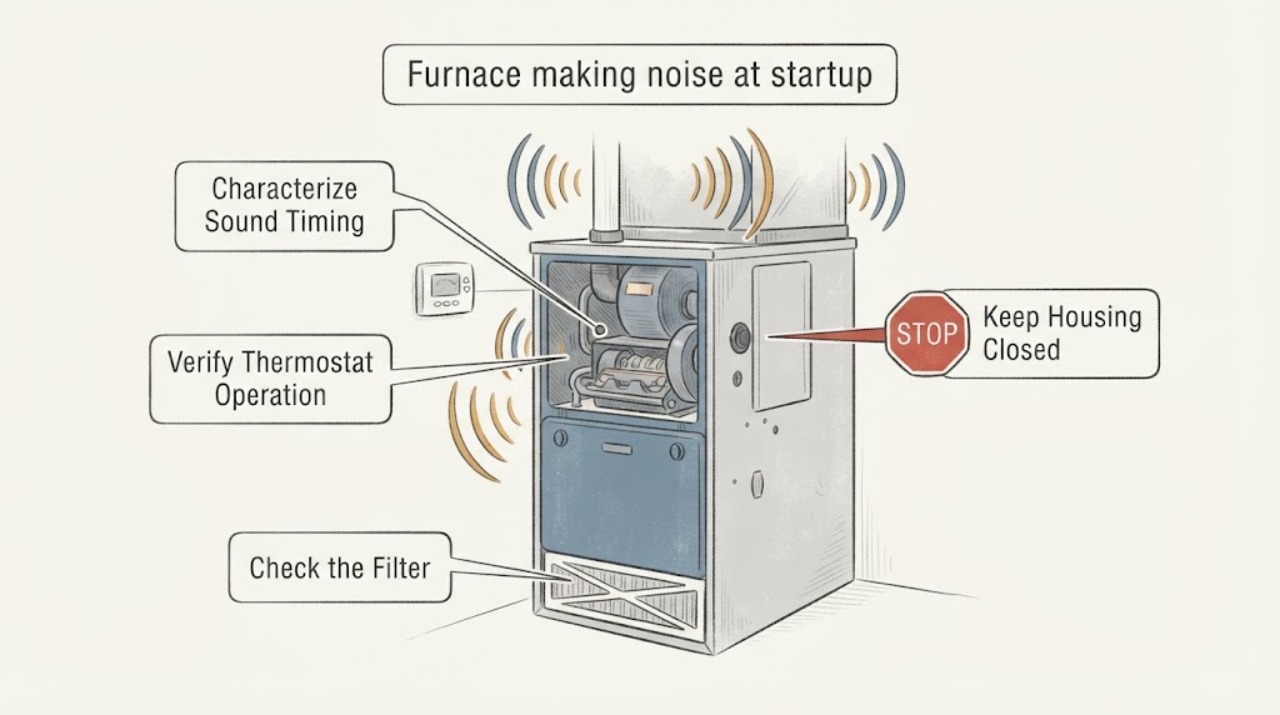
Work through in order
Diagnostic checks
Use only checks that match the exact appliance or system and its official guide.
-
Check 1
From a safe location, listen to one or two normal heating calls and record the sound type, exact timing, duration, location, and whether it is new, louder, or changing; do not remove a panel or place hands near the furnace.
Expected result: Classify it as a brief click or soft hum, a light duct ping, a bang or boom at ignition, a whistling sound, a high-pitched squeal, a buzz, a rattle or vibration, or a sound that continues when the furnace is idle.
Next step: Keep the recording or written description for service and continue only with the thermostat and external airflow checks if there is no odor, smoke, alarm, severe noise, or visible hazard.
Stop if: Stop the heat call for a sudden bang, loud hissing, smoke, burning odor, gas odor, carbon-monoxide alarm, or severe vibration.
Why this matters
Why: Brief clicks, soft hums, and mild duct expansion can be normal for some systems. Startup bangs, persistent buzzes, high-pitched motor sounds, rattles, and idle noise shift concern toward ignition, airflow, duct or panel vibration, blower or inducer, or electrical components.
-
Check 2
At the thermostat, confirm that the system is set to Heat, the fan setting and schedule are intentional, the displayed room temperature is plausible, and the noise starts with a normal heat call rather than with the fan alone.
Expected result: The sound occurs only when the blower runs, only when the burners or heat source start, at both stages, or even when there is no call for heat.
Next step: Leave the thermostat at the confirmed settings, document the sequence, and request HVAC diagnosis if the sound does not match normal operation or continues without a heat call.
Stop if: Do not remove the thermostat, change wiring, repeatedly cycle the heat, or attempt to bypass a control to reproduce the noise.
Why this matters
Why: A blower-only sound points toward air movement, blower, duct, or filter conditions; a sound synchronized with ignition points toward combustion or ignition service; noise while idle suggests an electrical or control component and is not explained by normal warm-air flow.
-
Check 3
With the furnace not actively heating and without opening the cabinet, inspect the accessible filter and room registers; replace a visibly loaded user-serviceable filter with the exact type and size specified by the equipment instructions, and make sure return and supply vents are open and not covered.
Expected result: The filter is clean or loaded, airflow is weak at several registers or only one, the whistle changes after the correct filter is installed, or airflow remains weak despite an unobstructed path.
Next step: Run a normal heat call only if no warning symptom is present and observe whether the sound changes; arrange service when the noise persists, airflow stays weak, or the filter becomes loaded again unusually quickly.
Stop if: Never operate the furnace without its required filter. Do not reach into the blower, remove the cabinet, or continue heating when there is a safety alarm, burning odor, smoke, or abnormal ignition.
Why this matters
Why: A loaded filter or blocked vent can create airflow noise and heat-exchanger overheating or safety shutdown. Persistent weak airflow suggests duct, blower, coil, or another HVAC issue rather than permission to remove the filter or use a more restrictive substitute.
-
Check 4
From outside the furnace cabinet, look for a visibly loose access cover, duct joint, register grille, or nearby object that vibrates when the blower starts; do not remove fasteners or reach inside the equipment.
Expected result: The sound follows a visible duct or grille vibration, comes from an access cover, has no visible source, or is accompanied by movement, scraping, or grinding.
Next step: If an external grille or nearby object is clearly loose and safe to leave alone, document it for repair; otherwise stop at observation and give the location and sound change to the technician.
Stop if: Do not remove access panels, tighten internal hardware, lubricate a motor, touch a belt or capacitor, or operate with a panel that cannot latch securely.
Why this matters
Why: A visible duct, grille, or cover vibration can transmit blower noise without proving an internal failure. Scraping, grinding, or unexplained movement makes a blower wheel, motor, bearing, inducer, or loose internal component more likely and requires service.
-
Check 5
Without opening the furnace, check the room for a strong or lingering gas odor, smoke, burning-wire smell, unusual exhaust, a carbon-monoxide alarm, water near the unit, or a rapidly worsening noise; leave the area rather than trying to identify the internal source.
Expected result: No safety sign is present, there is a mild transient odor at first seasonal startup, or there is a persistent gas or burning odor, alarm, smoke, unusual exhaust, water, or loud ignition event.
Next step: For a strong or lingering gas odor or carbon-monoxide alarm, leave immediately without operating switches and contact emergency or gas-safety services from outside. For other urgent signs, stop the furnace and obtain prompt qualified HVAC service.
Stop if: Do not light flames, operate switches in a suspected gas leak, silence or ignore a carbon-monoxide alarm, or restart the furnace to test the sound.
Why this matters
Why: No warning sign permits ordinary observation only. Persistent gas or burning odor, an alarm, smoke, unusual exhaust, or a loud ignition event can indicate combustion, electrical, or heat-exchanger danger and is not a DIY noise diagnosis.
-
Check 6
Gather the sound recording or description, exact timing in the heat sequence, thermostat setting, filter condition, airflow observations, furnace fuel type if known, age, last service, recent installation or repair, and any odor or safety event.
Expected result: The noise is unchanged since installation, began after a repair or filter change, is worsening with age, or occurs with weak heat, short cycling, uneven rooms, a tripped safety, or increased energy use.
Next step: Request qualified HVAC inspection and ask the technician to assess airflow, duct and panel vibration, blower or inducer operation, ignition and burner condition, electrical controls, venting, and heat-exchanger safety as applicable.
Stop if: Do not authorize burner, ignition, motor, heat-exchanger, gas, or electrical work based only on the sound; ask for the measured cause and compatible repair path.
Why this matters
Why: A post-installation or post-repair sound raises an assembly or installation question; a worsening sound with airflow or heating symptoms supports a mechanical or maintenance issue. The record narrows the visit but cannot identify a safe replacement part on its own.
Use your observations
Decision map
Find the observation that best matches what you see, then follow the next safe action.
-
PATH 01Next step
What you see
The sound is a brief click before ignition, soft steady hum, or mild duct ping at warm-up, has always behaved this way, and there are no comfort, odor, alarm, or vibration changes.
Do this next
Monitor it during routine filter and professional maintenance; document any change in volume, timing, duration, or heating performance.
Why this path and its safety boundary
Why it matters: Normal ignition, motor, and duct expansion sounds are more plausible than a developing fault, although a change in a familiar sound should reopen the diagnosis.
-
PATH 02Next step
What you see
Whistling, rushing, or a blower-related squeal occurs as air begins moving, the filter is loaded, or several registers have weak airflow.
Do this next
Correct only the safe filter, return, and register condition, then arrange HVAC service if the sound or weak airflow remains; do not open the blower compartment.
Why this path and its safety boundary
Why it matters: Restricted airflow, duct leakage or vibration, or a blower motor or wheel issue is more likely than an ignition-only fault.
-
PATH 03Safety boundary
What you see
A bang or boom occurs at ignition, the sound is new or worsening, or the furnace produces a persistent gas, smoke, or unusual exhaust warning.
Do this next
Stop the furnace and request prompt qualified service. For a strong or lingering gas odor or carbon-monoxide alarm, leave immediately and contact emergency or gas-safety services from a safe location.
Why this path and its safety boundary
Why it matters: Delayed ignition, burner, venting, combustion, or another serious furnace condition is possible; this pattern should not be tested repeatedly.
Safety stop: Do not relight, adjust, clean, or inspect burners; do not operate switches where gas may be present.
-
PATH 04Next step
What you see
The furnace rattles, buzzes, vibrates, or scrapes during startup or heat, and a visible duct, grille, or cover does not explain the sound.
Do this next
Stop at external observation and arrange HVAC service, especially when the sound is new, loud, worsening, or accompanied by weak airflow, overheating, smoke, or a tripped breaker.
Why this path and its safety boundary
Why it matters: A loose internal or external component, blower or inducer, motor, transformer, capacitor, or duct connection may be involved; sound alone cannot safely choose the failed part.
-
PATH 05Safety boundary
What you see
Buzzing or humming continues when there is no heat call, or it coincides with flickering, a burning-wire smell, a tripped breaker, smoke, or a hot cabinet.
Do this next
Stop using the furnace and obtain prompt qualified HVAC or electrical help; leave for smoke or fire and contact emergency services as appropriate.
Why this path and its safety boundary
Why it matters: An electrical control, transformer, motor, or wiring issue is more likely and may be a fire or shock hazard.
Safety stop: Do not open the electrical compartment, touch wiring or capacitors, repeatedly reset protection, or restart the unit for another test.
-
PATH 06Next step
What you see
The noise began after installation or repair, remains after a correct filter and vent check, or is accompanied by uneven heat, repeated shutdowns, or increased energy use.
Do this next
Give the service history and symptom record to the installer or qualified HVAC technician and request measured diagnosis and a compatible repair recommendation.
Why this path and its safety boundary
Why it matters: Installation, assembly, airflow, motor, ignition, venting, or heat-exchanger safety should be verified rather than assuming the furnace simply needs a generic replacement part.
Helpful context
Understand the symptom
When the sound happens is the first useful clue
Listen from a safe position and note whether the sound occurs before heat starts, at ignition, as the blower begins, continuously while warm air moves, or as the system shuts down. Trane notes that a light click before ignition, a soft hum, and mild duct pinging can be ordinary, while a sudden bang at startup can indicate delayed ignition. A high-pitched squeal, persistent buzz, or new rattle is not identified by sound alone and should not be diagnosed by opening the cabinet.
Safe checks stop at the filter, vents, thermostat, and visible exterior
A dirty filter or blocked return or supply vent can restrict airflow and make the furnace overheat, whistle, or shut down on a safety limit. Carrier and Trane both recommend checking the thermostat, filter, and unobstructed vents as basic steps. These checks do not test a blower motor, inducer, burner, ignition, heat exchanger, capacitor, wiring, or gas pressure; those components require a qualified HVAC technician.
Treat odor and combustion warnings as safety events
A loud ignition bang, gas odor, carbon-monoxide alarm, smoke, burning-wire smell, or severe hissing is not a routine noise investigation. Stop the furnace, leave the home immediately for a strong or lingering gas odor or an active carbon-monoxide alarm, avoid switches or flames, and contact emergency or gas-safety services from a safe location. For other new loud or unusual furnace noises, request HVAC service rather than repeating the heat call to collect more evidence.
Safety boundary
Stop conditions
- Do not open the furnace cabinet, touch wiring, capacitors, motors, burners, ignition parts, gas controls, or heat-exchanger areas.
- Stop immediately for a strong or lingering gas odor, carbon-monoxide alarm, smoke, fire, burning-wire smell, unusual exhaust, or water near electrical equipment; leave or obtain appropriate emergency help as required.
- Do not relight or adjust a pilot or burner, bypass a safety limit, repeatedly reset a breaker, or restart the furnace to reproduce a bang or severe noise.
- Do not operate the furnace without its required filter or with an access panel that cannot latch securely.
- Arrange qualified HVAC service for a new, loud, worsening, scraping, grinding, high-pitched, or unexplained sound, especially when heat or airflow is affected.
Only after diagnosis
Potential parts
- furnace air filter
Consider this category only when the existing user-serviceable filter is visibly loaded and the equipment instructions specify its size and type; persistent noise or weak airflow still requires diagnosis.
Confirm exact dimensions, airflow rating, installation direction, and equipment requirements before ordering; never operate the furnace without the required filter. - furnace blower motor or wheel assembly
Consider this category only after professional testing links a squeal, grinding, weak airflow, or vibration to the blower motor or wheel; a sound description alone cannot identify it.
Confirm exact furnace model, motor characteristics, wheel dimensions, controls, and installation requirements with a qualified technician before ordering. - furnace ignition or burner service component
Consider this category only when a qualified technician identifies delayed ignition, a failed igniter, dirty burner, or another combustion-related fault; do not select or clean a burner from a noise symptom alone.
Confirm fuel type, furnace model, safety controls, manufacturer procedure, and combustion setup with qualified service; installation and adjustment are not ordinary user work. - furnace inducer or electrical control component
Consider this category only after testing identifies an inducer, transformer, capacitor, relay, or other control fault associated with the noise; these parts involve hazardous equipment access.
Confirm exact model, electrical specifications, venting arrangement, and safety tests with a qualified technician; do not open the electrical compartment.
When checks do not resolve it
Need a professional?
Arrange qualified HVAC service for any new, loud, worsening, scraping, grinding, high-pitched, buzzing, rattling, or unexplained furnace sound; for a startup bang, weak airflow, uneven heat, repeated safety shutdown, or noise that continues while idle; and after a correct filter and vent check does not help. Stop the furnace for smoke, burning odor, severe vibration, or unusual exhaust. For a strong or lingering gas odor or carbon-monoxide alarm, leave immediately without operating switches and contact emergency or gas-safety services from a safe location.
Safety scope: This article covers sound logging, thermostat confirmation, filter and register checks, and external visual observation only. Do not open the cabinet, handle gas or electrical components, adjust burners, relight a pilot, bypass a safety control, or test combustion yourself.
Common questions
FAQ
What furnace sounds can be normal at startup?
A brief click before ignition, a soft hum, and a mild ping from ductwork warming can be normal for some systems. A new, loud, worsening, banging, squealing, grinding, buzzing, or unexplained sound is not safely diagnosed by sound alone and should be assessed by an HVAC professional.
Why does my furnace bang when it starts?
A bang or boom at ignition can indicate delayed ignition or a burner or combustion problem, although ducts can also make different expansion sounds. Stop repeating the heat call and arrange prompt qualified service; do not clean or adjust burners yourself.
Can a dirty furnace filter cause noise?
Yes. A loaded filter can restrict airflow and contribute to whistling, blower strain, overheating, or a safety shutdown. Replace it only with the correct filter specified for the furnace and arrange service if airflow or noise remains abnormal.
What does a high-pitched squeal or grinding sound mean?
It can point toward a blower motor, inducer, bearing, wheel, or loose-component issue, but the sound cannot identify the part safely. Stop at external observation and request HVAC service, especially when airflow is weak or the sound is worsening.
Is a furnace buzz dangerous?
A mild familiar hum may be normal, but a new or persistent buzz can involve a motor, transformer, control, wiring, or loose component. Stop for burning odor, smoke, flickering, a hot cabinet, or a tripped breaker and obtain qualified service without opening the electrical compartment.
When should I stop using a noisy furnace?
Stop for a startup bang, gas odor, carbon-monoxide alarm, smoke, burning-wire smell, unusual exhaust, severe vibration, water near electrical equipment, or a rapidly worsening sound. Leave immediately for a strong or lingering gas odor or an active carbon-monoxide alarm and seek help from a safe location.
Read the exact guide
Official sources
- Furnace Blower Motor Repair & Replacement GuideCarrier · Carrier residential furnace blower-motor guidance; motor, capacitor, wiring, and cabinet work requires qualified HVAC service.
- Furnace Troubleshooting Guide | Fix a Furnace Not WorkingCarrier · Carrier residential furnace troubleshooting guidance for gas and oil examples; component diagnosis and repair require qualified service.
- Furnace Making a Buzzing Noise? Learn Why and What to DoTrane · Trane residential gas-furnace troubleshooting guidance; exact equipment instructions and qualified service govern a specific furnace.
- Furnace Service Guide: Importance, Frequency & BenefitsCarrier · Carrier residential furnace service guidance; an individual furnace needs professional inspection to identify the actual fault.
- Furnace Troubleshooting: Gas Furnace SolutionsTrane · Trane residential gas-furnace troubleshooting guidance; gas, combustion, electrical, and mechanical repairs require licensed or qualified professionals.
Community feedback
Share a repair observation
Share a plain-text repair observation. Accepted observations are published automatically; this page may take a moment to update.