
On this page
Start here
Quick answer
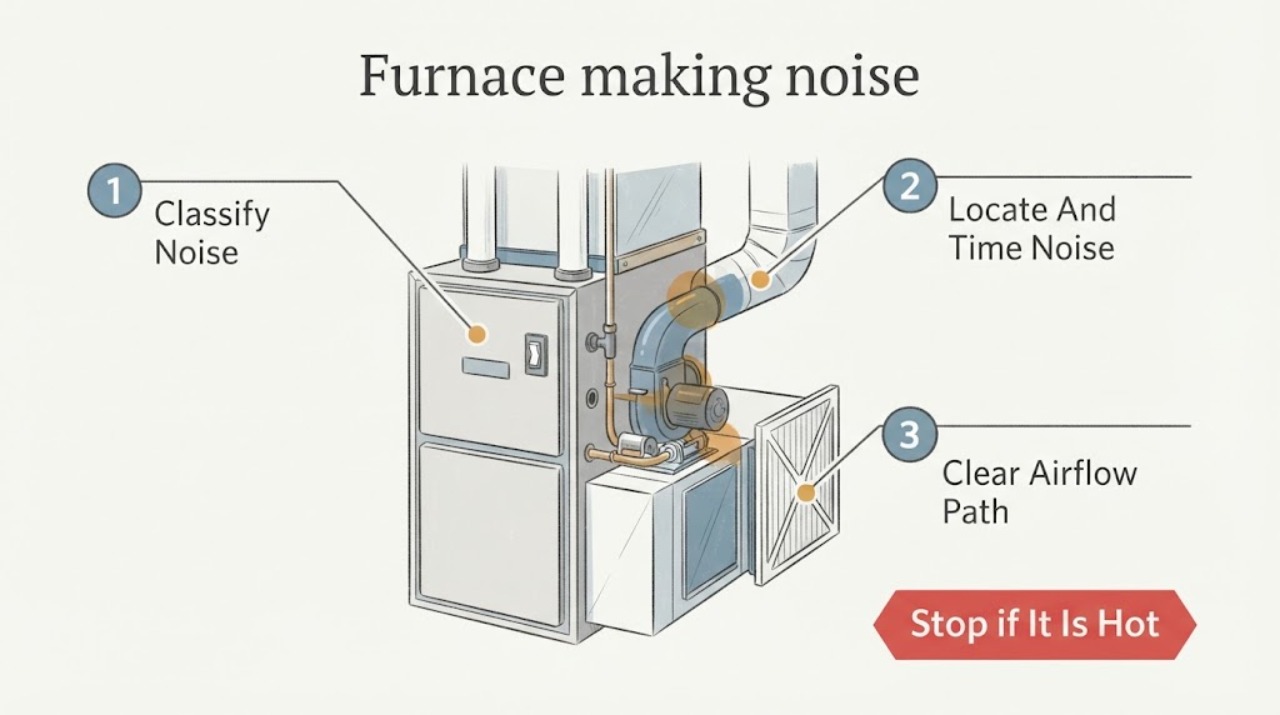
Do not open the furnace cabinet, touch combustion or electrical parts, bypass a safety control, or keep running the system to reproduce a dangerous sound. From a safe standing position, record whether the noise is a hum, buzz, rattle, squeal, whistle, bang, grinding, or hiss; where it is loudest; whether it occurs at startup, shutdown, or throughout a cycle; and whether there is burning odor, gas odor, smoke, vibration, poor airflow, or a carbon-monoxide alarm. A sudden bang at ignition, gas odor, hissing, grinding or metal contact, burning smell, smoke, or an alarm is a stop-use condition. Leave the area or home as appropriate and contact emergency or HVAC service. A new but less urgent noise still warrants a professional diagnosis because blower, inducer, burner, controls, ductwork, and airflow restrictions can sound similar.
Work through in order
Diagnostic checks
Use only checks that match the exact appliance or system and its official guide.
-
Check 1
From a safe distance, describe the sound in ordinary words: hum, buzz, rattle, squeal, whistle, bang, grinding, scraping, clicking, or hiss. Note whether it is steady, intermittent, pulsing, or accompanied by vibration; do not move close to the furnace or touch its cabinet to feel the vibration.
Expected result: The noise is a low hum, electrical-sounding buzz, rattle, high-pitched squeal or whistle, bang or boom, grinding or scraping, repeated click, or hiss.
Next step: Write down the exact sound and arrange HVAC service; use the stop branches immediately for gas, carbon monoxide, burning, smoke, metal contact, or ignition-bang symptoms.
Stop if: Stop listening and leave the area as appropriate for gas odor, hissing with gas odor, smoke, burning smell, an alarm, or a violent or metallic sound.
Why this matters
Why: Different sound families can point a technician toward airflow or ductwork, blower or inducer components, loose material, ignition, gas, or electrical concerns, but sound alone is not a diagnosis. Grinding, scraping, a bang at ignition, or hissing deserves a higher-priority response than a mild familiar hum.
-
Check 2
Using existing use history or a single ordinary event only when no hazard sign is present, record whether the sound is loudest at the furnace, a nearby duct, a register, a return grille, or another room. Note whether it begins before ignition, during ignition, when the blower starts, while heating, or at shutdown; do not cycle the furnace repeatedly.
Expected result: The sound starts before ignition, at ignition, when airflow begins, throughout heating, at shutdown, or only at a distant register or duct.
Next step: Give the sequence and location to the HVAC technician. Keep the system off if the sound is sudden, worsening, metallic, or associated with gas, smoke, burning, or an alarm.
Stop if: Stop any operation used to listen if the sound escalates or a safety warning appears.
Why this matters
Why: Timing and location help separate burner or inducer behavior from blower, duct, register, or control behavior. A sound that travels through ducts may not originate at the nearest register, and a startup bang can require immediate attention.
-
Check 3
From normal room positions, note whether airflow at registers is weak, uneven, or accompanied by whistling, and whether a filter condition indicator or an already visible filter looks heavily loaded. Do not remove a furnace panel, reach into the blower, run without a filter, or force the system through repeated cycles.
Expected result: Airflow is normal, weak, uneven, whistling, or unknown; the filter is visibly loaded or its condition cannot be seen safely.
Next step: Record the airflow and filter context for service and follow only the furnace manual's safe filter guidance if the filter is designed to be reached without opening a hazardous panel. Otherwise leave it for the technician.
Stop if: Stop if filter access requires a service panel, the furnace is hot or smoking, or operating the unit is unsafe.
Why this matters
Why: Restricted airflow can contribute to whistling or noisy operation, while normal airflow does not rule out blower, inducer, burner, duct, or control problems. A filter observation is only a maintenance clue and does not authorize cabinet access.
-
Check 4
From a safe location, note any gas or sulfur-like odor, burning or electrical odor, smoke, unusual heat, visible flame abnormality through an intended viewing window if one is already visible, or a carbon-monoxide alarm. Do not open a panel, relight a pilot, adjust a gas valve, or touch a detector or furnace component.
Expected result: There is no unusual odor or alarm, a burning smell or smoke, a strong or persistent gas odor, a carbon-monoxide alarm, or an abnormal visible flame.
Next step: For gas odor or a carbon-monoxide alarm, leave the home and contact emergency services or the gas utility from a safe location. For smoke or burning, turn away from the furnace and seek emergency or HVAC help; otherwise schedule HVAC service for the sound.
Stop if: Stop all furnace operation and leave as appropriate for gas odor, a carbon-monoxide alarm, smoke, burning smell, or an abnormal flame.
Why this matters
Why: Gas odor, a carbon-monoxide alarm, smoke, burning odor, or an abnormal flame is an emergency or stop-use signal rather than a troubleshooting branch. No odor or alarm does not make a loud or new mechanical noise safe to ignore.
-
Check 5
Record whether the noise began after a filter change, duct or thermostat work, power interruption, seasonal startup, maintenance visit, or a long period of inactivity. Note whether the furnace still heats, short-cycles, produces weak airflow, or displays an existing status light without opening the cabinet.
Expected result: The noise follows recent work or startup, occurs with short cycling or weak heat, appears with a status indication, or has no clear trigger.
Next step: Send the history, sound description, timing, location, airflow, odor, alarm, and model information if visible without access to service areas to the HVAC provider.
Stop if: Stop once the next step would involve opening the cabinet, testing live electrical parts, inspecting combustion, or operating under a warning condition.
Why this matters
Why: The history helps the professional prioritize airflow, installation, mechanical, combustion, or control checks, but it cannot identify a failed part or justify a reset loop. A noisy furnace that still heats can still have a developing mechanical or safety issue.
Use your observations
Decision map
Find the observation that best matches what you see, then follow the next safe action.
-
PATH 01Next step
What you see
There is gas odor, hissing with gas odor, a carbon-monoxide alarm, smoke, burning smell, or an abnormal flame
Do this next
Do not operate switches or the furnace. Leave the home if gas or carbon monoxide is suspected and contact emergency services or the gas utility from a safe location; arrange HVAC service after the immediate hazard is handled.
-
PATH 02Next step
What you see
The furnace makes a sudden bang or boom at ignition, grinding, scraping, or metal-contact noise
Do this next
Stop using the furnace and request prompt HVAC service. Do not open the cabinet, inspect burners or the blower, or run it again to confirm the noise.
-
PATH 03Next step
What you see
The sound is a whistle and airflow is weak or a safely visible filter appears loaded
Do this next
Record the airflow and filter condition and follow only the model manual's safe filter-access guidance. Do not run without a filter or open a service panel; call HVAC service if the noise remains.
-
PATH 04Next step
What you see
The sound is a rattle, buzz, or high-pitched squeal without a hazard odor
Do this next
Note whether it is at startup, while the blower runs, or through the ductwork and schedule HVAC service. Do not tighten panels, access the blower, replace a motor, or touch electrical components.
-
PATH 05Next step
What you see
The noise is familiar, mild, and unchanged, with normal heat, airflow, and no warning signs
Do this next
Document it and mention it at routine HVAC maintenance rather than trying to correct hidden parts. Escalate if it becomes louder, changes type, or is joined by odor, poor heat, vibration, or cycling.
Helpful context
Understand the symptom
The sound pattern is more useful than a guess
A furnace can make ordinary low-level operating sounds, but a change in the usual sound, a loud noise, or a sound linked to ignition needs context. Manufacturer guidance distinguishes high-pitched, rattling, whistling, buzzing, banging, and hissing patterns, while noting that a noise may come from ductwork or airflow rather than the cabinet itself. A sound description helps the technician without asking a homeowner to inspect hidden components.
Safety boundary
Keep the furnace off when there is gas odor, a carbon-monoxide alarm, smoke, burning smell, metal-on-metal contact, or a sudden ignition bang. Do not open panels, reach into the blower area, inspect burners, adjust gas controls, touch wiring or capacitors, reset repeatedly, or operate the furnace under a hazard condition.
Only after diagnosis
Potential parts
- furnace blower motor
Consider this category only if an HVAC professional confirms that the blower motor is the source of the noise and identifies a serviceable failure after safe isolation and diagnosis.
Confirm furnace model, motor type, mounting, electrical characteristics, and manufacturer fit information; a sound does not establish compatibility. - furnace blower wheel
This is relevant only when a technician identifies a damaged, obstructed, or misaligned blower wheel as the cause and confirms that replacement is appropriate.
Match the furnace model, wheel dimensions, rotation, hub, and mounting details through the manufacturer or technician; do not access or spin the wheel yourself. - furnace inducer motor
Consider this category only after an HVAC professional links a startup or draft-related noise to the inducer assembly and confirms the exact replacement path.
Confirm furnace model, venting and assembly configuration, electrical specifications, and manufacturer-approved fit; combustion-side components are professional service work.
When checks do not resolve it
Need a professional?
Call an HVAC professional for any new, loud, persistent, or worsening furnace noise, especially banging at ignition, grinding, scraping, strong buzzing, high-pitched squealing, hissing, poor airflow, short cycling, or weak heat. Treat gas odor, carbon-monoxide alarm, smoke, burning smell, and abnormal flame as immediate stop-use or emergency conditions.
Have this ready
- Provide the sound description, loudest location, startup or shutdown timing, whether the blower or heat cycle is involved, airflow and filter history, thermostat or status information visible without opening the unit, odors, alarms, recent work, model if visible, and whether the furnace still heats.
Common questions
FAQ
Is a furnace hum normal?
A mild familiar hum can be part of normal operation, but a new, louder, changing, or vibrating hum should be documented and evaluated. Do not open the cabinet or assume the sound is harmless if heat, odor, airflow, or alarms are abnormal.
What does a bang when the furnace starts mean?
A sudden bang or boom at ignition can signal a combustion or ignition problem and should be treated as a stop-use condition. Leave the furnace off and arrange prompt HVAC service; do not inspect burners or repeatedly restart it.
Can I keep using a furnace that is making a rattling or squealing noise?
Do not keep operating it to reproduce a new or worsening noise, especially if it sounds metallic, is accompanied by vibration, burning odor, poor heat, or short cycling. Record the sound and timing from a safe distance and call an HVAC professional.
Read the exact guide
Official sources
- Furnace Troubleshooting: Gas Furnace SolutionsTrane · General gas-furnace safety context; it is not a substitute for licensed HVAC service.
- Furnace Troubleshooting GuideCarrier · General furnace guidance; product manuals and qualified technicians govern model-specific work.
- Furnace Making a Buzzing Noise? Learn Why and What to DoTrane · General gas-furnace symptom guidance; exact model documentation and qualified service govern repair.
Community feedback
Share a repair observation
Share a plain-text repair observation. Accepted observations are published automatically; this page may take a moment to update.