
On this page
Start here
Quick answer
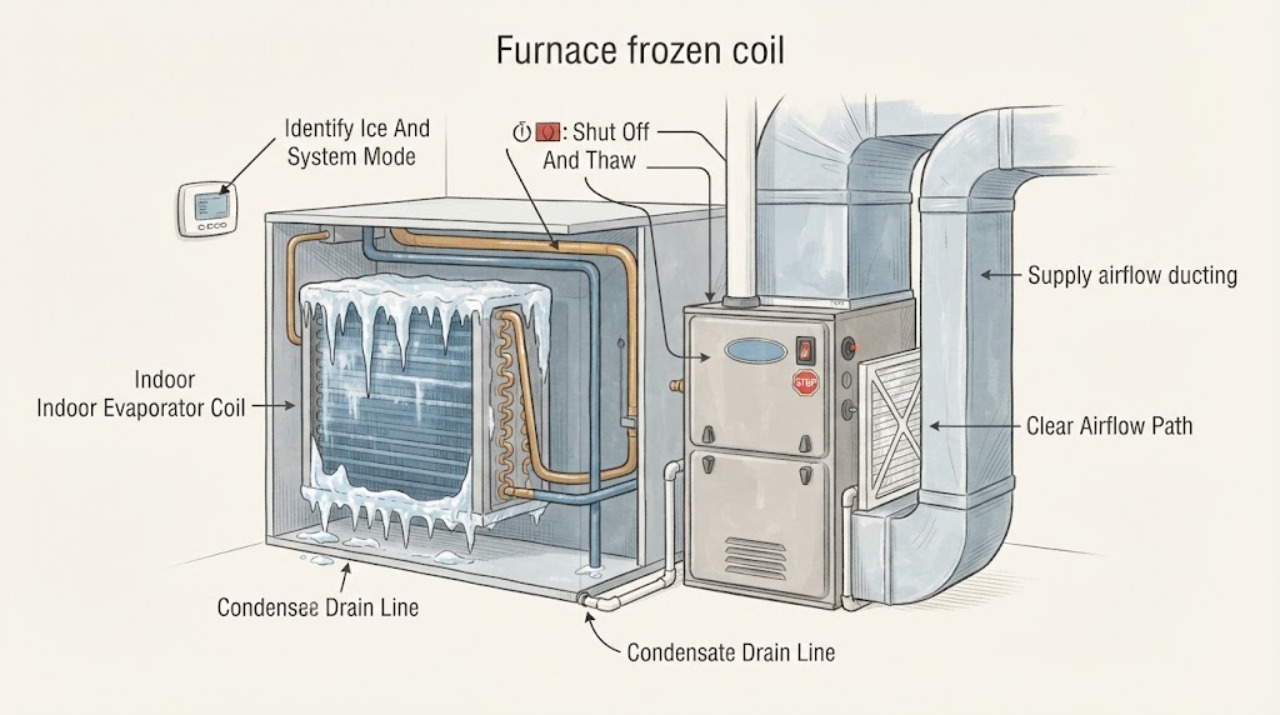
In a furnace-and-central-AC system, the frozen coil is usually the indoor evaporator coil mounted in or beside the furnace airflow path, not the furnace heat exchanger. If you see ice on the indoor coil or refrigerant line, or the system blows warm air while cooling runs, turn cooling off at the thermostat and do not keep operating the system frozen. If your equipment and thermostat manual permit it, the indoor fan may be set to ON while the coil thaws, but protect the area from meltwater and stop if water reaches electrical equipment. Once safe and accessible, check or replace a dirty air filter with the exact approved type and make sure return grilles and supply registers are not blocked. Do not chip ice, open the coil cabinet, test refrigerant or live electrical circuits, or clean a hidden coil yourself. Persistent ice, low airflow after thawing, water damage, repeated freezing, a breaker trip, or gas/combustion or carbon-monoxide warning requires qualified HVAC service.
Before you begin
Safety first
- User checks are limited to thermostat controls, safe thawing, an approved accessible filter change, room-side register/return inspection, and dry external observation; refrigerant, internal coil, combustion, electrical, condensate, attic, and cabinet work requires qualified HVAC service.
Work through in order
Diagnostic checks
Use only checks that match the exact appliance or system and its official guide.
-
Check 1
From a dry, safe position, note whether ice or frost is visible on the accessible refrigerant line, coil cabinet exterior, or outdoor tubing, and record whether the thermostat is calling for cooling, the indoor blower moves air, and the air from registers is warm or weak. Do not remove any furnace or coil panel.
Expected result: Ice is visible on indoor or refrigerant tubing; the AC runs but blows warm air; airflow is weaker than usual; there is a thawing puddle; or only the outdoor unit appears frosted in cold weather on a heat pump.
Next step: If indoor or line ice is present, turn cooling off and proceed to safe thawing. If there is only normal-looking outdoor heat-pump frost, follow the heat-pump manual and monitor its defrost behavior; escalate if thick ice persists or heating is affected.
Stop if: Stop for smoke, burning odor, gas odor, a carbon-monoxide alarm, exposed wiring, active water near electrical equipment, or unsafe access to the coil.
Why this matters
Why: Indoor or line ice plus poor cooling is consistent with a frozen evaporator coil, while a puddle can be meltwater or a separate condensate issue. Some outdoor heat-pump frost in cold weather can be part of a normal defrost cycle, so it should not be treated as the same indoor-coil diagnosis.
-
Check 2
At the thermostat, turn the cooling mode off. If the equipment manual permits the indoor fan to run independently and there is no water near electrical parts, set the fan to ON only while the ice thaws; otherwise leave the system off. Put a pan or absorbent material below accessible meltwater without reaching into the unit, and keep people away from wet flooring.
Expected result: Ice gradually clears without overflow; water begins approaching wiring or a furnace control; the blower does not run; or ice remains solid after the system has been off for a reasonable manual-directed thaw period.
Next step: Keep cooling off and arrange service if water threatens the equipment, the fan will not operate normally, or ice remains. Do not chip, scrape, melt with an appliance, or restart cooling while ice is present.
Stop if: Never chip ice or use a hairdryer, heat gun, torch, space heater, or other heat source; stop if meltwater reaches electrical parts or the furnace cabinet.
Why this matters
Why: Thawing is necessary before a technician can evaluate the coil and refrigerant lines. Water near electrical equipment, a failed blower, or ice that does not clear indicates a safety or equipment problem rather than a reason to add heat or restart cooling.
-
Check 3
With the system off and the filter access designed for normal user access, inspect the air filter. Replace or clean it only with the exact type and method specified by the equipment manual. From the room side, make sure return grilles and supply registers are not covered by furniture, drapes, or stored items; do not open the furnace or coil cabinet to inspect the blower or evaporator coil.
Expected result: The filter is visibly clogged; registers or a return grille are blocked; airflow improves after the approved filter change and obstruction removal; or the filter and room-side airflow appear normal but the coil freezes again.
Next step: Leave cooling off until all ice has cleared. If the filter was the only clear restriction, follow the manual for a cautious restart and monitor once; if ice returns or airflow stays weak, arrange HVAC service.
Stop if: Do not run the system with a blocked filter, remove internal panels, brush a hidden coil, or use a filter that is not approved for the equipment.
Why this matters
Why: A dirty filter or blocked return can restrict airflow enough to contribute to evaporator-coil freezing. Improved airflow is useful evidence but does not prove that the coil, blower, thermostat, refrigerant charge, or outdoor unit is sound. Recurrence with normal accessible airflow needs professional diagnosis.
-
Check 4
During thawing, observe only the accessible area below or beside the indoor unit for a stable drain pan, a controlled condensate path, water spreading toward flooring, or staining on the furnace cabinet. Do not reach into the pan, clear a concealed line, lift the unit, or use electrical equipment in water.
Expected result: Meltwater is contained and drains normally; water pools, overflows, or stains the cabinet/ceiling; the condensate line appears blocked; or there is no water but the coil remains frozen or cooling is poor.
Next step: Protect the area and leave the system off for overflow, staining, or suspected drain blockage; arrange HVAC service. Do not pour chemicals into a condensate line or open the cabinet to reach the pan.
Stop if: Stop for active overflow, water near controls or outlets, ceiling damage, unstable equipment, or any need to enter an attic/crawlspace or open the air handler.
Why this matters
Why: Contained meltwater is expected as ice clears, while overflow or staining can add a condensate-drain or property-damage problem. No water does not disprove a frozen coil; the ice may be elsewhere or the symptom may have another cause.
-
Check 5
After the coil is fully thawed and the area is dry, check only the normal thermostat mode, setpoint, schedule, and visible system status. Look at the electrical panel for an obviously tripped HVAC breaker without removing its cover; do not reset a breaker if it trips again, if water is present, or if there is an electrical odor.
Expected result: The thermostat was not calling for cooling; the breaker is tripped; the breaker trips again; the blower or outdoor unit does not start; or settings and visible power appear normal but cooling remains weak.
Next step: Correct a clear thermostat setting once according to the manual and monitor only after the coil is thawed. For a repeated trip, no operation, or persistent weak cooling, leave the system off and call a qualified HVAC professional.
Stop if: Do not open the electrical panel, measure voltage, bypass a switch, repeatedly reset a breaker, or operate equipment with water near electrical parts.
Why this matters
Why: A wrong thermostat schedule or a single safe control issue can mimic a cooling fault. A repeated trip, absent blower/outdoor operation, or normal settings with weak cooling points to electrical, motor, control, refrigerant, or airflow diagnosis beyond a user check.
-
Check 6
If the system is dry and the coil has completely thawed, document the exact thermostat mode, filter condition, register/return airflow, location and extent of ice, condensate behavior, outdoor-unit status, and how quickly ice returns. Do not perform another cooling trial if ice is still visible or if the system shows abnormal noise, odor, water, or electrical behavior.
Expected result: Cooling works and ice does not return; cooling works briefly then ice returns; airflow remains weak; the outdoor unit runs abnormally; or the system never restores cooling after thawing.
Next step: Arrange qualified HVAC service for recurrence, persistent weak airflow, no cooling, abnormal outdoor operation, or any uncertainty about the thaw. Provide the photographs, filter information, thermostat setting, timeline, and water observations.
Stop if: Stop using cooling for recurrent ice, low airflow, water damage, unusual noise, burning/gas odor, carbon-monoxide warning, or any need for refrigerant or internal electrical testing.
Why this matters
Why: A one-time event after an accessible airflow restriction may be less serious, but recurring ice or persistent poor cooling can involve a dirty coil, blower, thermostat, low refrigerant, drain, or outdoor-unit problem. The pattern guides the technician but does not establish a part failure.
Use your observations
Decision map
Find the observation that best matches what you see, then follow the next safe action.
-
PATH 01Next step
What you see
Ice is visible on the indoor evaporator coil, its cabinet, or the refrigerant line, and the AC is running or blowing warm air.
Do this next
Turn cooling off at the thermostat, allow safe thawing, protect against meltwater, and arrange qualified HVAC assessment. Do not chip the ice or restart cooling while it remains.
Why this path and its safety boundary
Why it matters: The cooling system may be operating with a frozen coil, which can damage the coil or other components and cannot be diagnosed accurately while encased in ice.
-
PATH 02Next step
What you see
The filter is dirty or a return grille or supply register is visibly blocked, and airflow is weaker than normal.
Do this next
With cooling off and ice thawed, correct only the accessible filter or room-side obstruction approved by the manual. Monitor once; arrange service if airflow stays low or ice returns.
Why this path and its safety boundary
Why it matters: Restricted airflow is a plausible contributor to coil freezing, but it does not rule out a dirty hidden coil, blower issue, thermostat problem, or refrigerant fault.
-
PATH 03Next step
What you see
Thawing produces overflow, water near the furnace controls, ceiling staining, or an apparently blocked condensate path.
Do this next
Keep cooling off, protect people and property, avoid electrical equipment in water, and arrange HVAC service. Do not open the air handler or pour chemicals into a concealed drain.
Why this path and its safety boundary
Why it matters: The meltwater may be exposing a condensate-drain or property-damage problem in addition to the frozen coil.
-
PATH 04Next step
What you see
The filter and accessible airflow are normal but ice returns after thawing, or cooling remains weak.
Do this next
Leave cooling off and arrange qualified HVAC diagnosis. Give the technician the ice location, recurrence timing, filter status, airflow observations, and thermostat behavior; do not add refrigerant or open the cabinet.
Why this path and its safety boundary
Why it matters: A recurring freeze can involve the evaporator coil, blower, thermostat, outdoor condenser, refrigerant charge, or another system condition that requires professional instruments.
-
PATH 05Next step
What you see
A breaker trips again, there is smoke, burning or gas odor, exposed wiring, water at electrical parts, a carbon-monoxide alarm, or unsafe furnace access.
Do this next
Stop using the equipment and keep people away. Leave the area and contact appropriate emergency or qualified electrical/HVAC help from a safe location for gas odor, smoke, or a carbon-monoxide alarm; do not reset protection or open the furnace.
Why this path and its safety boundary
Why it matters: The condition is an electrical, fire, combustion, or water hazard rather than a routine frozen-coil check.
-
PATH 06Next step
What you see
Only the outdoor unit has light frost during cold-weather heat-pump operation and the indoor evaporator coil is not iced.
Do this next
Follow the heat-pump manual and observe whether the unit completes its normal defrost. Arrange service if ice grows thick, the defrost cycle lengthens, or heating performance deteriorates.
Why this path and its safety boundary
Why it matters: Some outdoor frost can be part of a heat-pump defrost cycle, so it is not automatically the indoor frozen-coil problem described here.
-
PATH 07Next step
What you see
The coil fully thaws, a clearly dirty accessible filter or blocked register is corrected, cooling returns, and ice does not recur.
Do this next
Keep the filter maintained according to the manual, keep return and supply paths clear, and monitor for recurrence. Arrange service if the freeze returns or cooling becomes weak again.
Why this path and its safety boundary
Why it matters: An airflow or operating-condition contribution is plausible, but the result does not certify the hidden coil, blower, refrigerant circuit, or controls.
Helpful context
Understand the symptom
What “furnace frozen coil” usually means
A furnace can be the indoor air-moving unit for a split air conditioner. In that arrangement, the evaporator coil is typically mounted where air leaves the furnace, and it can freeze when airflow is restricted or the cooling circuit has a problem. Ice on a visible refrigerant line, inadequate cooling, weak airflow, or thawing water near the indoor unit are useful clues, but warm air or a puddle can also have another cause. The symptom does not identify a failed part.
Stop cooling before inspecting
Running an air conditioner with a frozen evaporator coil can damage the system. Turn cooling off at the thermostat and do not chip the ice or apply a hairdryer, heat gun, torch, or other improvised heat. The coil may release substantial water as it thaws, so protect flooring and stop if water approaches wiring, a furnace control, an outlet, or other electrical equipment. Never open the coil cabinet or handle refrigerant.
Use the thaw result to choose the next step
If ice clears and cooling returns after an accessible dirty filter or blocked register is corrected, airflow may have contributed, but recurrence still deserves an HVAC assessment. If ice returns, cooling remains weak, the filter is clean, or the outdoor unit and indoor blower behave abnormally, the cause may involve the coil, blower, thermostat, condensate system, refrigerant circuit, or electrical controls. Those checks require trained equipment and should not be inferred from frost alone.
Safety boundary
Stop conditions
- Turn cooling off for visible indoor coil or refrigerant-line ice; do not run the AC while frozen, chip ice, or use a hairdryer, heat gun, torch, space heater, or other improvised heat source.
- Do not open the furnace or coil cabinet, handle refrigerant, perform live electrical measurements, bypass protection, clean a hidden coil, or add refrigerant from symptoms alone.
- Stop for water near controls or outlets, overflow, ceiling damage, smoke, burning or gas odor, exposed wiring, a repeated breaker trip, a carbon-monoxide alarm, or unsafe attic/crawlspace access.
- Arrange qualified HVAC service when ice returns after thawing, airflow remains weak, cooling does not recover, the condensate path overflows, or the cause is not clear after the accessible filter and register checks.
When checks do not resolve it
Need a professional?
Call promptly for recurrent ice, persistent weak or warm airflow, water overflow or ceiling damage, abnormal outdoor-unit operation, a dirty coil that is not safely accessible, low-refrigerant suspicion, a repeated breaker trip, smoke, gas odor, or a carbon-monoxide warning.
Safety scope: User checks are limited to thermostat controls, safe thawing, an approved accessible filter change, room-side register/return inspection, and dry external observation; refrigerant, internal coil, combustion, electrical, condensate, attic, and cabinet work requires qualified HVAC service.
Have this ready
- Provide the furnace and AC model information, thermostat mode and schedule, ice location and extent, filter type and condition, return/supply airflow observations, condensate water behavior, outdoor-unit status, recurrence timing, and photographs from a safe dry position.
Common questions
FAQ
Is the frozen coil part of my furnace or my air conditioner?
In a typical split system, the indoor evaporator coil belongs to the cooling system and is commonly mounted in or beside the furnace airflow path. Do not open the furnace to verify it; use the accessible ice, airflow, and thermostat observations and let an HVAC professional identify the exact equipment.
Should I keep running the AC if the furnace coil is frozen?
No. Turn cooling off at the thermostat and let the coil thaw. If the manual permits and the area is dry, the indoor fan may run independently while it thaws. Do not restart cooling while ice remains, and do not chip or heat the ice.
Can a dirty filter cause a frozen evaporator coil?
A dirty or clogged filter can restrict airflow and contribute to freezing. Replace or clean it only with the model-approved type and method, and keep return grilles and supply registers clear. If ice returns after the filter and airflow check, arrange HVAC service.
What should I do with water under the furnace while the coil thaws?
Protect the floor and observe from a dry position without reaching into the unit. If water overflows, stains a ceiling, reaches controls or outlets, or the condensate path appears blocked, keep cooling off and arrange HVAC service. Do not open the cabinet or use electrical equipment in water.
Why does my coil freeze again after it thaws?
Recurrence can involve airflow, the hidden coil or blower, thermostat operation, the outdoor unit, or refrigerant and other system conditions. A clean accessible filter does not rule those out. Leave cooling off and give a qualified HVAC technician the ice location, timing, airflow, filter, and thermostat observations.
Read the exact guide
Official sources
- Measure Guideline: Air Conditioner Diagnostics, Maintenance, and ReplacementU.S. Department of Energy · Technical context for airflow restriction, evaporator fouling, coil freezing, compressor risk, and why hidden coil diagnostics require professional methods.
- Got a Frozen Evaporator Coil? Don’t Panic, Do This.American Standard · Indoor evaporator coil in an air conditioner or heat-pump system; thawing, filter and register checks, condensate precautions, recurrence, and professional service boundary.
- Troubleshoot an Air Conditioner | AC TroubleshootingCarrier · Split-system AC paired with a furnace; evaporator-coil location, frozen-coil signs, airflow/filter contributors, refrigerant/electrical professional boundary, and shutoff guidance.
Community feedback
Share a repair observation
Share a plain-text repair observation. Accepted observations are published automatically; this page may take a moment to update.