
On this page
Start here
Quick answer
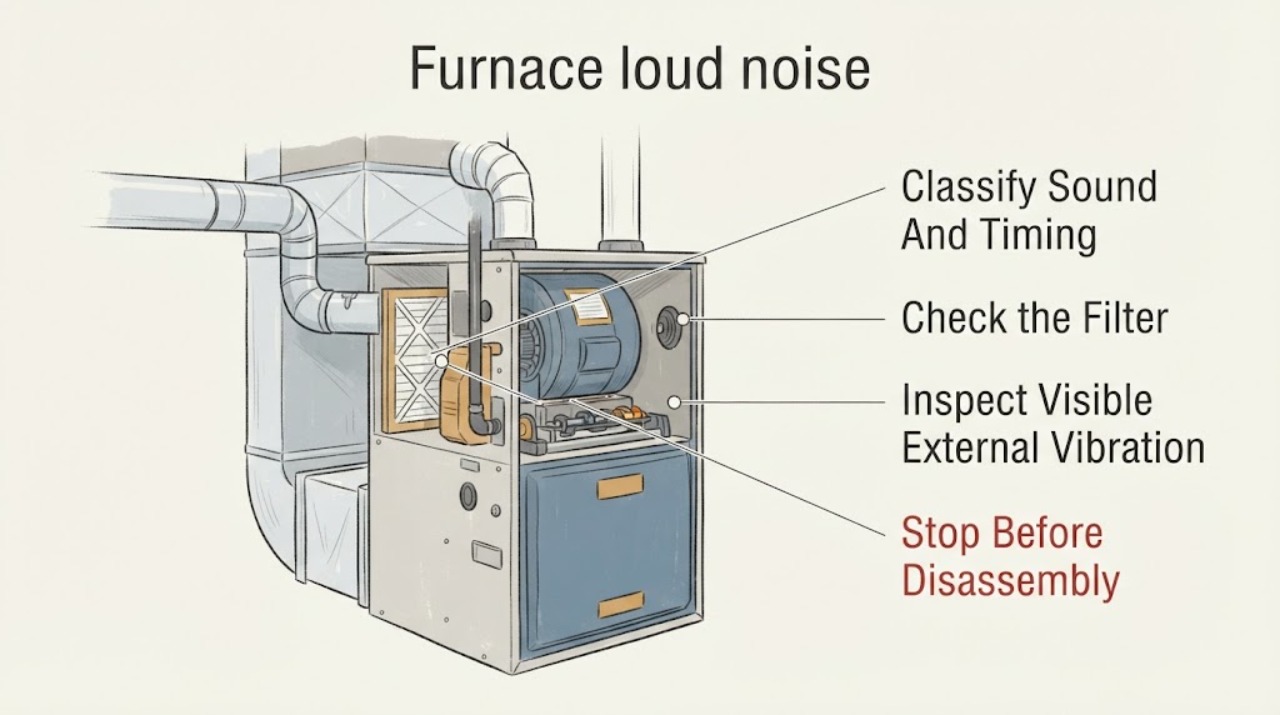
A furnace that suddenly becomes loud should be identified by sound and timing, not by replacing a guessed part. With the system off and cool, note whether the noise is a bang at ignition, whistle during airflow, rattle or vibration, high-pitched squeal, buzzing, or rumbling. A dirty filter or blocked register can contribute to airflow noise, while a bang at startup can indicate delayed gas ignition and a squeal or abnormal buzz can indicate blower or electrical trouble. Stop for gas odor, smoke, a carbon-monoxide alarm, flame or venting concerns, or a repeated harsh startup; leave the furnace off and use qualified HVAC service.
Work through in order
Diagnostic checks
Use only checks that match the exact appliance or system and its official guide.
-
Check 1
From a safe position, listen during one normal call for heat only if there is no gas odor, smoke, alarm, flame abnormality, or harsh ignition. Record whether the noise is a bang or boom, whistle, rattle, vibration, squeal, buzz, rumble, or a light duct ping, and whether it occurs at startup, blower engagement, steady airflow, or shutdown.
Expected result: A bang at the burner start, whistle while air moves, rattle that changes when a panel or duct vibrates, high-pitched squeal, electrical buzz, or low rumble each has a different next diagnostic path. A sound heard only at a register may be ductwork rather than the furnace cabinet.
Next step: Use the matching branch below and stop the cycle if the sound is harsh, worsening, accompanied by odor or smoke, or otherwise abnormal for the equipment.
Stop if: Do not repeatedly cycle a furnace that bangs at ignition, emits gas odor or smoke, triggers a carbon-monoxide alarm, or shows an abnormal flame.
Why this matters
Why: Sound and timing are evidence about ignition, airflow, loose sheet metal or ductwork, blower mechanics, or combustion. They do not identify a replacement part by themselves.
-
Check 2
With the furnace off and the filter accessible without removing a service panel, inspect the filter for visible dust loading and confirm that supply registers and return grilles are open and not covered by furniture or stored items.
Expected result: A visibly loaded filter or blocked return can restrict airflow; an open, clear airflow path with the same whistle or cycling noise makes a duct, blower, or furnace diagnosis more likely.
Next step: Replace the filter only with the size and type specified for the system, restore clear registers, and observe one normal cycle. If the loud noise continues, arrange HVAC service rather than increasing the filter rating or altering ductwork without a design check.
Stop if: Do not reach into the blower compartment, remove a furnace access panel, run the system without its required filter, or use the filter check to investigate a bang, gas odor, smoke, or combustion concern.
Why this matters
Why: Carrier and Trane associate whistling and poor airflow with a dirty filter or obstructed air path, but a clean filter does not rule out a mechanical fault or improperly sealed duct.
-
Check 3
With the system off, visually inspect only accessible external duct joints, grilles, and furnace panels for a loose-looking connection, separated seam, or panel that visibly vibrates. Do not press on a panel, remove fasteners, or place hands near moving equipment.
Expected result: A rattle or buzz localized to a duct or panel and absent when the furnace is off supports a sheet-metal or duct connection issue; a noise that comes from inside the cabinet or persists independently of airflow needs professional diagnosis.
Next step: Report the location and timing to an HVAC technician. Leave the system off if the panel is displaced, the cabinet is damaged, or the noise is severe or worsening.
Stop if: Do not tighten internal fasteners, lubricate a motor, bypass a blower-door switch, or remove the cabinet to reach a suspected source.
Why this matters
Why: Loose ductwork or panels can transmit vibration, but similar sounds can also come from a blower, motor, transformer, capacitor, or other internal component.
-
Check 4
Check the thermostat display and note whether the noise occurs only during a call for heat, after the blower starts, during continuous fan operation, or when the system stops. Do not raise the setpoint repeatedly to force more cycles.
Expected result: A sound that follows the blower or continuous fan points toward airflow, duct, or blower behavior; a sound exactly at gas ignition points toward the burner/ignition branch; a noise that continues after the call ends may indicate a blower control or mechanical issue.
Next step: Record the thermostat mode, fan setting, cycle stage, and duration of the noise, then give that sequence to the service technician.
Stop if: Do not force repeated ignition cycles, leave the fan running to mask the sound, or continue operation when the noise is accompanied by overheating, odor, smoke, or a protection trip.
Why this matters
Why: The cycle event narrows the system section involved, but it cannot safely prove a motor, bearing, burner, or control-board failure from listening alone.
-
Check 5
Without opening the furnace, check from a safe position for gas odor, soot, smoke, an unusual flame visible through an intended viewing window, a blocked or damaged-looking vent termination, or a carbon-monoxide alarm. Do not use smell or appearance to justify opening the combustion compartment.
Expected result: Gas odor, smoke, soot, an abnormal flame, a CO alarm, or suspected venting damage changes the situation from noise troubleshooting to a combustion-safety response. No visible warning does not certify safe combustion or venting.
Next step: Turn the furnace off from a safe location. If gas odor or a CO alarm is present, leave the area and contact emergency or gas authorities as appropriate; otherwise arrange qualified HVAC service before reuse.
Stop if: Do not operate electrical switches near a gas odor, relight a pilot, adjust gas pressure, clean burners, inspect a heat exchanger, or restart the furnace after a CO alarm until the hazard is professionally addressed.
Why this matters
Why: DOE explains that fuel-burning appliances need correct combustion air and venting and can produce carbon monoxide if malfunctioning or improperly vented. This cannot be verified by a homeowner listening test.
-
Check 6
Prepare a service record with the furnace fuel type if known, model number, sound description, exact cycle stage, location, filter condition, thermostat/fan setting, recent maintenance or installation, and any odor, alarm, breaker, or flame observation.
Expected result: A repeatable recording of when and where the sound occurs helps the technician distinguish duct or airflow vibration from blower, ignition, burner, or control problems without requiring the homeowner to open the furnace.
Next step: Give the record to a qualified HVAC professional and leave the furnace off when the noise is harsh, recurrent, or associated with a safety warning.
Stop if: Do not order a blower motor, capacitor, burner, igniter, belt, or control part from the noise alone; model fit and diagnosis must be confirmed professionally.
Why this matters
Why: Noise is a symptom shared by several subsystems; the sequence and operating context are more reliable than a guessed part name.
Use your observations
Decision map
Find the observation that best matches what you see, then follow the next safe action.
-
PATH 01Safety boundary
What you see
A bang or boom occurs when a fuel-burning furnace starts or the main burner ignites.
Do this next
Turn the furnace off and arrange qualified HVAC service. Tell the technician the sound occurs at ignition and whether there is odor, soot, flame irregularity, or a code.
Why this path and its safety boundary
Why it matters: Delayed ignition or a burner/combustion problem is possible and should not be treated as ordinary duct expansion.
Safety stop: No repeated ignition attempts, burner cleaning, gas adjustment, cabinet opening, or continued heating through the bang.
-
PATH 02Safety boundary
What you see
A whistle or strong air-rush noise occurs while the blower is moving air and there is no combustion warning.
Do this next
Check the accessible filter and clear registers once, then arrange service if the sound remains or airflow is poor.
Why this path and its safety boundary
Why it matters: A dirty filter, blocked return or register, or duct gap/restriction is plausible; an unobstructed airflow path with persistent noise points toward duct or blower diagnosis.
Safety stop: Do not run without the required filter, add a higher-resistance filter without guidance, or alter ductwork as a guess.
-
PATH 03Safety boundary
What you see
A rattle or vibration follows airflow and appears localized to a grille, duct, or external panel.
Do this next
Record the location and have an HVAC professional inspect it; leave the furnace off if the panel is displaced or the noise is severe.
Why this path and its safety boundary
Why it matters: Loose ductwork, a panel, or sheet-metal resonance is possible, but an internal blower or motor fault can sound similar.
Safety stop: Do not remove panels, reach into the blower compartment, or tighten internal parts.
-
PATH 04Safety boundary
What you see
A high-pitched squeal, screech, or abnormal buzz occurs during blower operation or from the furnace cabinet.
Do this next
Stop normal operation if the sound is new or worsening and arrange qualified HVAC diagnosis of electrical and mechanical components.
Why this path and its safety boundary
Why it matters: Trane associates squealing with blower-motor trouble and abnormal buzzing with possible transformer, capacitor, blower, or duct issues; the location and model determine the repair.
Safety stop: Do not lubricate, discharge, bypass, or replace electrical or motor components yourself.
-
PATH 05Safety boundary
What you see
A loud rumble occurs at startup or during burner operation, especially with soot, odor, flame irregularity, or a CO alarm.
Do this next
Turn the furnace off and obtain qualified HVAC service; leave the area and use emergency guidance for gas odor or a CO alarm.
Why this path and its safety boundary
Why it matters: Dirty burners, delayed or poor combustion, venting, or heat-exchanger concerns require professional combustion and safety checks.
Safety stop: No burner disassembly, pilot relighting after an alarm, gas-pressure adjustment, or continued operation to compare sounds.
-
PATH 06Safety boundary
What you see
The sound is only a brief light click, whoosh, or mild duct ping at the expected cycle transition, with no change in heating, odor, alarm, or abnormal vibration.
Do this next
Monitor without forcing extra cycles, keep the filter and registers maintained, and mention any change at routine HVAC service.
Why this path and its safety boundary
Why it matters: Some operating and duct-expansion sounds can be normal, but a newly louder or changing sound should still be documented.
Safety stop: Escalate if the sound becomes loud, harsh, repetitive, or is joined by odor, smoke, flame change, or a safety alarm.
Helpful context
Understand the symptom
The sound is a diagnostic clue
A brief click, ignition whoosh, or light duct ping can be part of a normal heating cycle, but a new loud or harsh sound deserves attention. The most useful details are the sound's character, its location, and whether it starts at ignition, when the blower starts, while air is moving, or as the furnace shuts down. That timing separates airflow and duct noise from burner, ignition, blower, or control concerns.
Keep the homeowner checks external
The safe checks are a thermostat call for heat, an accessible filter, open and unobstructed supply and return registers, and visible external signs such as a loose-looking panel or duct connection. Do not open the furnace cabinet, adjust gas pressure, clean burners, lubricate a motor, or test combustion. Those actions can expose electrical, fuel, moving-part, or carbon-monoxide hazards.
When a loud furnace becomes a safety issue
A bang at burner ignition, gas odor, smoke, a carbon-monoxide alarm, soot, an abnormal flame, or evidence that exhaust is not venting normally is not a filter-maintenance problem. Turn the system off from a safe location, leave the area if fuel or combustion danger is possible, and use emergency or qualified HVAC help as appropriate.
Safety boundary
Stop conditions
- Stop the furnace for a bang or boom at fuel ignition, gas odor, smoke, soot, abnormal flame, suspected venting failure, or a carbon-monoxide alarm.
- Do not open the furnace cabinet, reach into moving equipment, test live electrical parts, adjust fuel pressure, clean burners, or inspect a heat exchanger as a homeowner noise check.
- Do not repeatedly restart the furnace to reproduce a harsh sound or bypass a safety switch, limit, or other protective control.
- Do not treat a clean filter as clearance for a persistent squeal, buzz, rumble, or recurring shutdown; arrange qualified HVAC diagnosis.
- Do not purchase or install a blower, capacitor, belt, burner, igniter, or control part based on sound alone; model fit and the failed component require professional confirmation.
Only after diagnosis
Potential parts
- blower motor or motor assembly
Only relevant when a qualified diagnosis links a squeal, abnormal buzz, vibration, or airflow failure to the blower motor or its assembly after the filter and duct path are evaluated.
Confirm the furnace model, motor specifications, controls, and approved fitment before ordering; sound alone does not establish compatibility. - blower capacitor or electrical control
Only consider this category when a qualified technician identifies an electrical or motor-start fault; an abnormal buzz can also originate elsewhere.
Electrical ratings and model-specific fit must be verified by a qualified professional; do not handle or discharge capacitors yourself. - burner or ignition component
Only relevant after a bang, rumble, or failed ignition is professionally traced to burner or ignition operation rather than airflow, venting, or controls.
Fuel and ignition components are model- and fuel-specific and require qualified installation and safety testing; do not select from the sound alone. - duct connection or vibration-control component
Only relevant when inspection confirms that the noise is produced by a loose duct joint, panel, or vibration path rather than an internal furnace fault.
The repair depends on the duct design and installation; have the connection and airflow impact assessed before changing it.
When checks do not resolve it
Need a professional?
Arrange qualified HVAC service for any new loud or worsening noise, especially a squeal, abnormal buzz, rumble, recurring rattle, or sound inside the cabinet., Treat a bang at ignition, gas odor, smoke, soot, abnormal flame, suspected venting issue, or CO alarm as an urgent safety boundary rather than routine troubleshooting., If the filter and register check does not change a whistle or airflow noise, have the duct system and blower inspected rather than altering the system yourself.
Have this ready
- Furnace model number and fuel type if known
- Sound description, location, and exact cycle stage
- Whether the noise began after installation, maintenance, filter change, or another event
- Filter and register observations
- Any gas odor, smoke, soot, flame change, code, breaker trip, or carbon-monoxide alarm
Common questions
FAQ
Is a little furnace noise normal?
A light click before ignition, a normal operating hum, or a mild duct ping as the system heats can occur. A sound that is suddenly loud, harsh, repetitive, or different from the normal cycle should be recorded and evaluated rather than dismissed.
What does a bang when the furnace starts mean?
A bang or boom at burner ignition can indicate delayed gas ignition or a burner problem and needs qualified HVAC attention. Turn the furnace off and do not keep restarting it to compare the sound.
Can a dirty furnace filter cause a loud noise?
A loaded filter can restrict airflow and contribute to whistling or poor airflow. Inspect and replace an accessible filter with the specified type, keep registers clear, and arrange service if the sound persists or is not an airflow whistle.
What causes a furnace to squeal or buzz?
A squeal can point toward blower-motor trouble, while an abnormal buzz can involve a motor, capacitor, transformer, or loose duct connection. These components require professional diagnosis; do not open the cabinet or handle electrical parts.
Should I run a noisy furnace if there is no smoke?
Do not use the absence of smoke as a safety clearance. Stop for a bang at ignition, gas odor, soot, abnormal flame, suspected venting trouble, a carbon-monoxide alarm, or a worsening internal noise. For a less urgent but new noise, arrange HVAC inspection before relying on the system normally.
Read the exact guide
Official sources
- Heater Not Working? Try Our Furnace Troubleshooting GuideCarrier · Carrier's general furnace guidance; component behavior can vary by furnace type and model.
- HVAC Combustion FurnacesU.S. Department of Energy Building Science Education · Combustion furnace safety concepts; not a substitute for the appliance's installation or service manual.
- Combustion Equipment SafetyU.S. Department of Energy · General fuel-burning appliance safety; qualified testing is required for combustion and venting conditions.
- Why Is My Furnace Making a Buzzing Noise?Trane · Trane residential gas-furnace troubleshooting guidance used for general sound-to-check distinctions, not model-specific repair instructions.
Community feedback
Share a repair observation
Share a plain-text repair observation. Accepted observations are published automatically; this page may take a moment to update.