
On this page
Start here
Quick answer
A furnace does not provide cooling; it is the heating and indoor-air-moving part of many central HVAC systems. If the home is not cooling, check the thermostat's Cool mode and temperature setting, keep the fan on Auto, inspect the accessible air filter and vents, and observe whether the outdoor air-conditioning condenser operates. A furnace blower may still run while the outdoor condenser or indoor cooling coil has a fault. Turn the system off and arrange qualified HVAC service for a frozen coil, repeated breaker trips, burning or gas odor, exposed wiring, water near electrical parts, a nonworking outdoor unit, or any issue involving refrigerant, gas, live voltage, or internal panels.
Before you begin
Safety first
- Normal thermostat controls and external observation only; no furnace or condenser panel removal, live electrical testing, gas-control work, refrigerant handling, moving-fan contact, coil access, or component replacement.
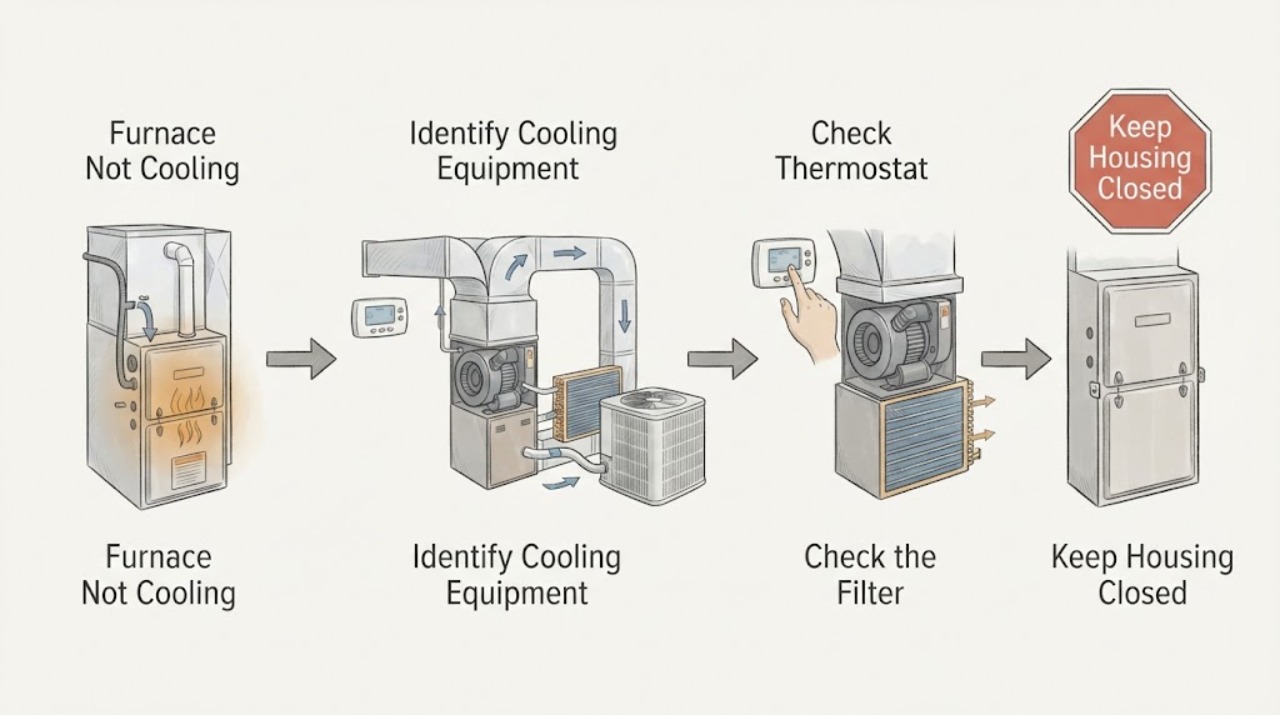
Work through in order
Diagnostic checks
Use only checks that match the exact appliance or system and its official guide.
-
Check 1
Identify whether the home has a furnace paired with a separate outdoor air conditioner, a heat pump, or a packaged unit by observing the indoor equipment, outdoor cabinet, thermostat labels, and accessible documentation. Do not open a panel to identify components.
Expected result: The thermostat and equipment indicate a furnace plus AC, a heat pump, a packaged system, or an uncertain arrangement.
Next step: Use the matching cooling-system branch and the equipment manual. If the arrangement is uncertain, record the model information and arrange qualified HVAC identification instead of testing internal parts.
Stop if: Stop if identification requires removing a door, cabinet, cover, or access panel, or if the equipment is damaged or unsafe.
Why this matters
Why: A furnace alone is a heating appliance; in a furnace-plus-AC system the outdoor condenser and indoor cooling coil provide cooling. A heat pump or packaged system follows a different control path.
-
Check 2
At the thermostat, verify that the mode is Cool, the setpoint is below the room temperature, and the fan is Auto rather than On. Make only normal user-control changes and do not remove the thermostat or alter its wiring.
Expected result: The mode was Heat or Off, the fan was On, the setpoint was not calling for cooling, or all settings were already correct.
Next step: Correct one clearly wrong setting and observe one cooling call. If the settings were correct or cool air does not return, continue with airflow and outdoor observations rather than repeatedly cycling the controls.
Stop if: Stop for a blank or damaged thermostat, exposed wiring, smoke, a burning odor, or any need to open the control.
Why this matters
Why: A wrong mode, fan setting, or setpoint can make the system move room-temperature air or run the furnace rather than call for cooling. Correct settings do not prove the condenser, coil, or blower is healthy.
-
Check 3
Inspect the user-accessible furnace or air-handler filter and the supply and return vents without opening the blower compartment. Note whether the filter is visibly clogged and whether vents are covered or closed.
Expected result: The filter is dirty, vents or returns are blocked, airflow is weak, or the filter and accessible vents appear clear with normal airflow.
Next step: Replace the filter only as directed by the equipment manual and uncover accessible vents, then retest one cooling call. If airflow remains weak, the filter is clear, or the symptom returns, turn the system off and arrange service.
Stop if: Do not reach into the blower, remove ductwork, climb, or handle a wet or energized component.
Why this matters
Why: A dirty filter or blocked airflow can reduce cooling performance and may cause protective shutdown. Normal airflow makes a simple restriction less likely but does not clear the outdoor condenser or indoor coil.
-
Check 4
During one cooling call, observe the outdoor condensing unit from a safe distance for normal sound, fan movement, and clear space around the cabinet. Remove only loose debris outside the unit; do not touch the grille, fan, coil, wiring, or tubing.
Expected result: The outdoor unit runs and the surrounding air path is clear, the unit is silent, the fan does not move, or debris blocks the exterior area.
Next step: Clear only loose external debris without reaching into the cabinet and retest once. If the unit stays silent, the fan does not move, or the cause is not clearly external, turn the system off and arrange qualified HVAC service.
Stop if: Stop for exposed wiring, arcing, burning odor, a moving fan near an unsafe reach, repeated breaker trips, or any need to open the cabinet.
Why this matters
Why: A blocked exterior can reduce heat rejection, while a silent unit or nonmoving fan can reflect power, control, motor, or compressor trouble. Sight and sound cannot identify the failed component.
-
Check 5
Look from a safe position for frost or ice on accessible refrigerant tubing or around the indoor or outdoor coil area, and note unusual water near the indoor unit. Do not touch the tubing, remove an indoor panel, or chip ice.
Expected result: No ice or unusual water is visible, frost or ice is present, or water is near electrical parts or the indoor equipment.
Next step: Turn the cooling system off and arrange service for visible ice, persistent water, or suspected coil trouble. Do not diagnose refrigerant charge, airflow, or a condensate fault from appearance alone.
Stop if: Stop immediately for water near wiring, a ceiling leak, ice that requires force to remove, exposed tubing damage, or any electrical hazard.
Why this matters
Why: Carrier lists frozen coils, frost on tubing, and unusual condensate among cooling symptoms. A frozen coil can be damaged by continued operation, and water near electricity adds a safety concern.
-
Check 6
Record whether the furnace blower runs, the outdoor condenser starts, the system short-cycles, a breaker has tripped, or the thermostat display went blank. Check the electrical panel only if it is dry, accessible, and you are comfortable with the normal user action; do not reset a breaker repeatedly.
Expected result: The blower runs without cooling, the outdoor unit has no response, the breaker trips again, the system cycles rapidly, or the power and run pattern appear normal.
Next step: If a single clearly tripped breaker is safely restored, observe one cooling call. If it trips again, the unit remains unresponsive, or rapid cycling continues, turn the system off and request qualified HVAC service.
Stop if: Stop for a hot panel, sparks, smoke, burning or gas odor, wet electrical equipment, or any need to remove a panel or measure voltage.
Why this matters
Why: A furnace blower can operate while the cooling side is unavailable. Repeated trips, short cycling, or no outdoor response may indicate electrical, control, coil, or condenser faults that require professional testing.
-
Check 7
After only a plainly corrected thermostat setting, accessible filter, open vent, or loose external debris issue, run one supervised cooling call and compare supply airflow and room temperature with the original observation.
Expected result: Cool air returns and the system runs normally, cooling is unchanged, or the original symptom returns after a short run.
Next step: Monitor without repeated resets if cooling is restored. If cooling remains absent or the symptom recurs, turn the system off as appropriate and give the complete timeline and observations to a qualified HVAC professional.
Stop if: Stop immediately for ice, water, smoke, gas odor, burning smell, unusual noise, or repeated protective shutdown.
Why this matters
Why: Improvement supports the corrected user-accessible condition but does not prove the equipment has no latent fault. No change or recurrence indicates that the simple observation did not resolve the cooling problem.
Use your observations
Decision map
Find the observation that best matches what you see, then follow the next safe action.
-
PATH 01Next step
What you see
The equipment is a furnace without a cooling condenser or heat-pump function.
Do this next
Do not troubleshoot the furnace as a cooling appliance. Identify the home's separate cooling equipment or arrange qualified HVAC assessment if no cooling system is known.
Why this path and its safety boundary
Why it matters: A furnace provides heat and blower airflow but does not create cool air.
-
PATH 02Next step
What you see
The thermostat was not calling for cooling or the fan was set to On.
Do this next
Correct the setting once, use Fan Auto, and observe one cooling call. Escalate if cool air does not return or the setting changes again.
Why this path and its safety boundary
Why it matters: A normal control setting can explain warm or room-temperature airflow without proving an equipment failure.
-
PATH 03Next step
What you see
The filter is clogged, vents are covered, or airflow is weak.
Do this next
Replace the filter as directed and uncover accessible vents, then retest once. Use service if airflow stays weak, the filter is clear, or the issue recurs.
Why this path and its safety boundary
Why it matters: Restricted airflow can reduce cooling and may trigger a safety shutdown.
-
PATH 04Next step
What you see
The outdoor unit is silent, its fan does not move, the surrounding air path is blocked, or the unit cycles rapidly.
Do this next
Clear only loose external debris and retry once if safe. Turn the system off and arrange qualified HVAC service for no response, repeated cycling, or any electrical warning.
Why this path and its safety boundary
Why it matters: The cooling side may have an external obstruction or a power, motor, compressor, control, or capacitor fault.
-
PATH 05Next step
What you see
Frost or ice is visible on tubing or a coil area, or water appears near the indoor unit.
Do this next
Turn cooling off and arrange professional assessment. Do not chip ice, handle refrigerant, open the coil cabinet, or continue running the system to force a diagnosis.
Why this path and its safety boundary
Why it matters: A frozen coil or condensate problem can damage the system and may involve airflow or refrigerant conditions.
-
PATH 06Next step
What you see
A breaker trips again, the cord or panel is hot, there is smoke, burning or gas odor, exposed wiring, or water near electrical equipment.
Do this next
Stop using the system, leave a gas-odor area without operating switches, and request the appropriate qualified emergency, utility, electrician, or HVAC help.
Why this path and its safety boundary
Why it matters: The condition is an immediate electrical, combustion, or water hazard rather than a normal cooling complaint.
-
PATH 07Next step
What you see
The thermostat, filter, vents, outdoor area, power observation, and one supervised retest do not restore cooling.
Do this next
Turn the system off if it is icing, leaking, short-cycling, or otherwise at risk, and arrange qualified HVAC service with the recorded observations.
Why this path and its safety boundary
Why it matters: The remaining possibilities are beyond safe visual diagnosis and may include an indoor coil, refrigerant circuit, blower, control, or condenser fault.
Helpful context
Understand the symptom
First identify which part should cool
In a typical split central system, the furnace is indoors and supplies heat and blower airflow, while the air conditioner has an outdoor condensing unit and an indoor evaporator coil. The same thermostat and ducts can serve both modes. Therefore, a furnace that is not cooling may actually mean the cooling mode is wrong, the blower is moving uncooled air, or the outdoor air-conditioning side is not operating. If the home has a heat pump or a packaged unit, the exact arrangement differs and the equipment manual controls the interpretation.
Keep checks at the user boundary
Use normal thermostat controls and inspect only accessible filters, vents, and the outside area around the condenser. Do not open a furnace or condenser cabinet, test live circuits, handle refrigerant, touch a moving fan, or work on gas controls. If you smell gas, leave the area and use the appropriate emergency or utility procedure rather than operating switches.
What the result tells you
A wrong thermostat mode, blocked filter, or closed vent can explain warm airflow and may be corrected once. A blower that runs with no cold air, an outdoor unit that is silent, a frozen coil, or a breaker that trips again points beyond a simple furnace setting. Visual checks narrow the handoff; they do not confirm a compressor, capacitor, coil, refrigerant, control, or motor failure.
Record the system pattern
Write down the thermostat mode and fan setting, whether the blower runs, supply-air feel, filter condition, outdoor-unit sound and fan response, visible frost or water, breaker behavior, and when the problem began. Include equipment model information from an accessible label. Tell the technician whether heating still works, because that helps separate the furnace and cooling paths.
Safety boundary
Stop conditions
- Smoke, burning odor, gas odor, sparks, exposed wiring, a hot panel or cord, or water near electrical equipment is present.
- The outdoor condenser is silent, the fan does not move, the system short-cycles, or a breaker trips again.
- Frost or ice is visible on a coil or refrigerant tube, or condensate is leaking near the indoor unit.
- The inspection would require opening a furnace, air-handler, or condenser cabinet, testing live voltage, handling refrigerant, or touching a moving fan.
- Cooling is still absent after one safe correction and one supervised retest.
When checks do not resolve it
Need a professional?
Call a qualified HVAC professional when the system's cooling side does not respond after safe user checks, or immediately for ice, water, electrical or combustion hazards, repeated protective shutdown, abnormal noise, or suspected refrigerant, coil, motor, compressor, or control faults.
Safety scope: Normal thermostat controls and external observation only; no furnace or condenser panel removal, live electrical testing, gas-control work, refrigerant handling, moving-fan contact, coil access, or component replacement.
Common questions
FAQ
Can a furnace provide cooling?
No. A furnace provides heat and often moves air through the ducts. Cooling usually comes from a separate air conditioner or heat pump, although the furnace blower and thermostat may be shared.
Why is my furnace blower running but the house is not cooling?
The fan can move air while the cooling call is wrong, the filter or vents restrict airflow, or the outdoor condenser or indoor coil is unavailable. Check normal thermostat settings and accessible airflow, then use service for persistent warm air, ice, water, or a nonworking condenser.
Should I keep running the system if I see ice?
No. Turn cooling off and arrange professional assessment for visible ice or a frozen coil. Do not chip the ice, open the coil cabinet, or handle refrigerant; continued operation can damage the system.
What should I check before calling for HVAC service?
Confirm the system arrangement, thermostat Cool mode, setpoint, and Fan Auto setting; inspect the accessible filter and vents; observe the outdoor unit from a safe distance; and record ice, water, power behavior, sounds, and timing. Do not open panels or perform electrical, gas, or refrigerant work.
Read the exact guide
Official sources
- How do an AC, Heat Pump and Furnace Work Together?Trane · General system-identification guidance; equipment combinations and controls vary by installation.
- HVAC TroubleshootingTrane · General homeowner observation guidance for central HVAC; follow the exact equipment manual and local safety requirements.
- Troubleshoot an Air Conditioner | AC Troubleshooting | CarrierCarrier · Comparable manufacturer cooling guidance for a furnace-associated central HVAC system; exact installation and controls vary.
- Heater Not Working? Try Our Furnace Troubleshooting GuideCarrier · Furnace-side context only; it does not claim that a furnace itself provides cooling.
Community feedback
Share a repair observation
Share a plain-text repair observation. Accepted observations are published automatically; this page may take a moment to update.