
On this page
Start here
Quick answer
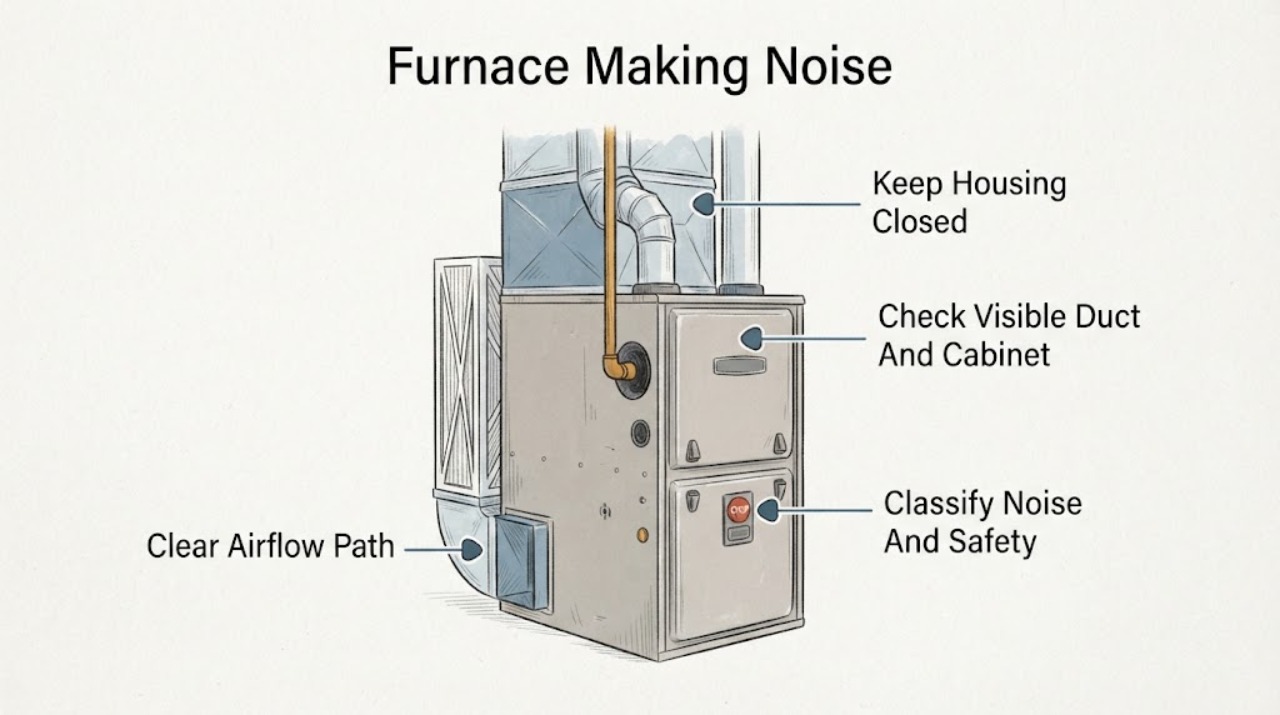
A Goodman furnace should not be assumed faulty from a familiar start-up click or airflow sound, but a new or worsening bang, grinding, screech, rattling, whistling, burning odor, or gas odor deserves attention. First note when the sound occurs—at ignition, during blower operation, at shutdown, or continuously—then check only the thermostat setting, accessible air filter, open registers, and loose-looking external duct or cabinet panels. A dirty filter can contribute to whistling and restricted airflow; loose ductwork or panels can rattle; loud ignition, grinding, motor or bearing sounds, smoke, sparking, soot, or gas odor require the furnace to remain off and qualified HVAC or gas-utility help. Do not remove the access panel to inspect burners, heat exchanger, blower, wiring, or gas controls. Record the sound, timing, airflow, odors, error lights, and Goodman model for the technician.
Work through in order
Diagnostic checks
Use only checks that match the exact appliance or system and its official guide.
-
Check 1
Turn the thermostat to a setting that will not call for heat, stay near a clear exit, and record the noise without opening the furnace. Note whether it occurs at ignition, while the blower or inducer runs, at shutdown, or all the time; describe it as a click, whistling, rattling, banging, grinding, squealing, or humming. Also note any gas or sulfur odor, smoke, soot, sparks, or carbon-monoxide alarm.
Expected result: The sound is a brief familiar start-up or airflow sound with no odor, a whistle or rattle during airflow, a loud ignition bang, grinding or screeching, or there is gas odor, smoke, soot, sparking, or a carbon-monoxide alarm.
Next step: If any gas or sulfur odor, smoke, sparking, soot, carbon-monoxide alarm, or violent ignition occurs, leave the area without operating switches and contact the gas utility or emergency service from a safe location. Otherwise continue with the filter, airflow, and visible-panel checks while keeping the cabinet closed.
Stop if: Do not relight a pilot, reset a safety lockout repeatedly, operate the furnace with an access panel removed, or continue a test when a safety warning is present.
Why this matters
Why: Sound that follows airflow makes a filter, register, duct, or loose-panel issue more likely. A loud ignition sound can indicate delayed burner ignition, while grinding or screeching can involve a motor, bearing, or other moving component. Gas, combustion, smoke, or electrical warning signs are not a routine noise check.
-
Check 2
With the furnace not actively heating, inspect the homeowner-accessible air filter and replace or clean it only according to the Goodman manual. Confirm supply registers and return grilles are open and not covered by furniture, and look for a crushed or visibly loose section of accessible ductwork.
Expected result: The filter is visibly loaded with dust, airflow is weak or the whistle changes when a register is opened, a return or supply is blocked, or the filter and accessible airflow path look normal.
Next step: Install the exact manual-approved filter in the correct airflow direction and clear only removable obstructions from grilles. If the noise persists after airflow is restored, do not compensate by changing fan wiring or opening the cabinet; arrange HVAC service.
Stop if: Do not run the furnace without its required filter, use an unapproved filter that restricts airflow, or reach into a return, blower, or burner compartment.
Why this matters
Why: A dirty filter or restricted return can create airflow noise and stress the furnace. A register or duct restriction can make whistling or rushing sounds. Normal accessible airflow shifts suspicion toward a blower, inducer, burner, bearing, panel, or control issue rather than a simple filter condition.
-
Check 3
From outside the furnace cabinet and without removing panels, listen at the nearest supply register, return grille, and accessible duct or cabinet seams while the system is off. Look for a loose-looking external panel, grille, fastener, or duct connection that visibly vibrates; do not insert tools or hands into openings.
Expected result: The sound follows airflow at a register, comes from a visibly vibrating external panel or duct, is strongest at the cabinet, or cannot be localized without opening the furnace.
Next step: Tighten or reseat only an obviously loose external grille or panel fastener when the furnace is off and the manual permits it; otherwise photograph the location and arrange service. Do not pull the furnace out or remove an access panel to continue localization.
Stop if: Do not tape, drill, pry, or fasten into a gas appliance cabinet or duct, and do not touch moving or hot parts.
Why this matters
Why: A register, duct seam, or external panel can resonate when air moves, whereas a cabinet-centered sound can come from an internal blower, inducer, motor, bearing, burner, or heat-exchanger area. An inaccessible source is not safely identified by listening alone.
-
Check 4
Record whether the noise is present on every heat call, only after the furnace has warmed, only when the blower starts or stops, or together with weak heat, short cycling, a burning smell, or a blinking fault indicator visible through the normal viewing area. Compare the timing with the thermostat call without opening the cabinet.
Expected result: The noise repeats at ignition, starts with the blower, appears only after warm-up or shutdown, accompanies weak airflow or short cycling, or appears with a fault light or odor.
Next step: Keep the furnace off for loud ignition, grinding, burning or sulfur odor, smoke, soot, sparks, or repeated lockout. For other persistent patterns, provide the timing, error indication, model, filter result, and sound recording to a qualified HVAC technician rather than performing internal tests.
Stop if: Do not bypass a limit or door switch, test gas pressure or combustion, inspect a heat exchanger, or probe electrical terminals.
Why this matters
Why: Ignition-timed noise makes combustion or burner timing more likely; blower-timed noise makes a blower wheel, motor, bearing, or airflow issue more likely; warm-up or shutdown noise can involve expansion, contraction, or a component that shifts with temperature. Repeated fault indicators, odor, weak airflow, or short cycling increase the need for professional diagnosis.
Use your observations
Decision map
Find the observation that best matches what you see, then follow the next safe action.
-
PATH 01Next step
What you see
The noise follows airflow and the filter is dirty, a return or register is blocked, or an accessible duct or external panel visibly vibrates.
Do this next
Restore the manual-approved filter and clear removable grille obstructions. Have an HVAC professional correct persistent duct vibration, cabinet vibration, or noise that remains with normal airflow.
Why this path and its safety boundary
Why it matters: An airflow restriction or loose duct or panel is more likely than a combustion or motor fault.
-
PATH 02Next step
What you see
A bang or boom occurs as the burners ignite, or the noise is accompanied by gas or sulfur odor, soot, smoke, a yellow or unstable flame visible only through a normal viewing area, or a carbon-monoxide alarm.
Do this next
Turn the furnace off from a safe control if no gas odor is present; if gas or sulfur odor, smoke, or a carbon-monoxide alarm is present, leave without operating switches and contact the gas utility or emergency service. Arrange qualified HVAC inspection before use.
Why this path and its safety boundary
Why it matters: Delayed ignition or another combustion or heat-exchanger safety issue is possible; this is beyond an ordinary homeowner noise adjustment.
-
PATH 03Next step
What you see
Grinding, screeching, humming, or rumbling begins when the blower starts, persists with a clean filter and open vents, or occurs with weak airflow.
Do this next
Stop using the furnace if the noise is severe, worsening, accompanied by burning odor, or airflow is failing. Otherwise schedule qualified HVAC service; do not open the cabinet or lubricate an unknown component.
Why this path and its safety boundary
Why it matters: A blower wheel, motor, bearing, mounting, or another internal moving part is more likely than a grille or filter problem.
-
PATH 04Next step
What you see
The filter, vents, and visible duct or panel checks are normal, but the sound is cabinet-centered, repeats across heat calls, returns after a reset, or appears with a fault indicator.
Do this next
Leave the furnace off if the sound is harsh, the unit overheats, repeatedly locks out, or any odor or electrical warning appears. Give a qualified HVAC technician the exact timing, sound description, model, fault indication, and accessible-check results.
Why this path and its safety boundary
Why it matters: An inducer, blower, motor, bearing, ignition, control, or other internal issue is more likely and cannot be confirmed safely from outside.
Helpful context
Understand the symptom
The timing of the noise is more useful than the volume alone
A brief click and airflow sound can occur during a normal heating sequence, but the same furnace making a new bang at ignition, grinding while the blower runs, or rattling only as air moves has a different decision path. Note whether the sound is inside the cabinet, at a register, in a return, or in visible ductwork. The observation narrows the likely area; it does not authorize opening the furnace.
Keep gas and combustion work outside the homeowner check
The accessible checks are airflow, thermostat operation, visible filter condition, and loose external panels or duct connections. Burners, ignition, gas valves, pressure switches, heat exchangers, blower assemblies, and internal wiring require model-specific procedures and qualified service. Gas odor, smoke, soot, sparking, or a carbon-monoxide alarm changes this from noise troubleshooting to an immediate safety response.
Only after diagnosis
Potential parts
- furnace air filter
Only consider this category when the accessible filter is dirty, damaged, or missing and the Goodman manual identifies its correct replacement specification.
Confirm the exact Goodman furnace model, filter dimensions, airflow direction, and manufacturer guidance before replacement. - furnace blower motor or wheel
Only consider this category when a technician confirms that a blower-timed grinding, humming, rumbling, weak-airflow, or vibration symptom comes from the blower assembly.
Blower components are model- and configuration-specific and require qualified HVAC diagnosis and installation. - furnace inducer motor or burner ignition assembly
Only consider this category when qualified service confirms an ignition-timed noise or inducer fault after combustion and venting checks.
Gas and combustion components require exact model fitment and professional installation; do not order from sound alone.
When checks do not resolve it
Need a professional?
Stop using the Goodman furnace and obtain qualified HVAC service for a loud ignition bang, grinding or screeching from the cabinet, repeated lockout, persistent noise after the filter and airflow checks, weak airflow, burning odor, smoke, soot, sparking, a hot or damaged electrical connection, or any diagnosis requiring panel removal, burner or heat-exchanger inspection, gas adjustment, electrical testing, or motor or bearing access. If you smell gas or sulfur, do not operate switches or attempt relighting; leave the area and contact the gas utility or emergency service from a safe location. If a carbon-monoxide alarm sounds, leave immediately and seek emergency assistance.
Common questions
FAQ
What does a rattling or whistling Goodman furnace usually indicate?
If the sound follows airflow, first check the accessible filter, open registers, return grilles, and visible duct or panel vibration. A dirty filter can contribute to whistling, while loose ductwork or panels can rattle. Persistent or cabinet-centered noise needs HVAC service.
Is a bang when a Goodman furnace starts dangerous?
A loud ignition bang is not a routine homeowner adjustment and may indicate delayed ignition or another combustion problem. Turn the furnace off and arrange qualified HVAC inspection. If there is gas or sulfur odor, smoke, soot, sparking, or a carbon-monoxide alarm, leave immediately without operating switches and contact the appropriate emergency or gas utility service.
Can I open my Goodman furnace to find the source of the noise?
Do not remove the furnace access panel to inspect burners, the heat exchanger, blower, inducer, wiring, or gas controls. You can record the timing and sound, check the filter and accessible airflow, and photograph visible external duct or panel vibration. Internal diagnosis belongs to qualified HVAC service.
Read the exact guide
Official sources
- Heater Not Working? | Furnace Troubleshooting TipsCarrier · Manufacturer furnace troubleshooting for filter and airflow checks, gas safety, and whistling, ignition, and rattling noise patterns
- Find Reliable Furnace Repair Service Near YouCarrier · Manufacturer furnace repair guidance for unusual sounds, odors, airflow, ignition, blower, heat exchanger, electrical, gas, and professional-service boundaries
- Heating and Cooling Products | HVAC Systems | GoodmanGoodman · Goodman gas furnace product features, quiet operation, blower motor noise reduction, and model-dependent features
Community feedback
Share a repair observation
Share a plain-text repair observation. Accepted observations are published automatically; this page may take a moment to update.