
On this page
Start here
Quick answer
If a heat pump is not cooling, first confirm the thermostat is in Cool with the setpoint below the room temperature and the fan on Auto, then note whether the indoor and outdoor units run, whether airflow is weak, and whether ice is visible. Check only the accessible filter, registers, and outdoor-unit clearance. Do not open electrical panels, handle refrigerant, scrape ice, or keep resetting a breaker that trips. A frozen coil, repeated electrical trip, warm air with the system running, no airflow, or cooling that does not return after the safe checks needs a qualified HVAC professional.
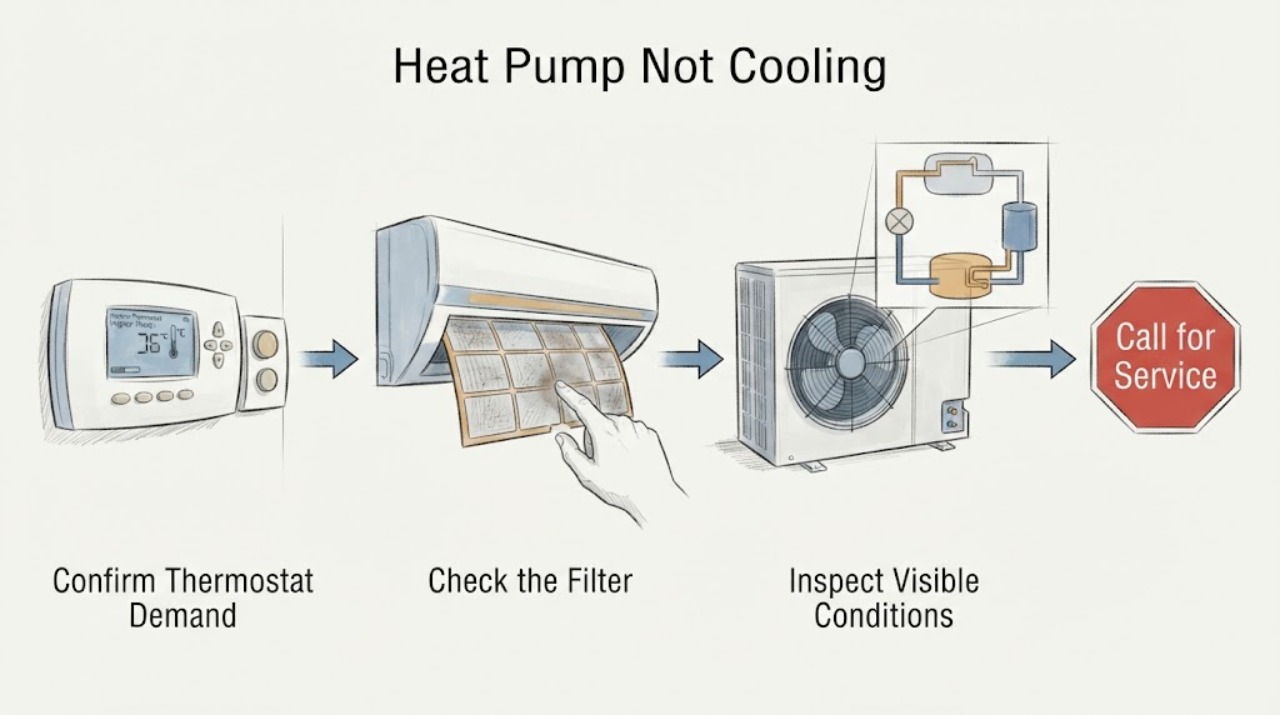
Work through in order
Diagnostic checks
Use only checks that match the exact appliance or system and its official guide.
-
Check 1
At the thermostat, confirm the mode is Cool, the setpoint is below the current room temperature, and the fan is set to Auto unless the system manual says otherwise. Check for a blank display or an active schedule, hold, or lock indication without opening the thermostat.
Expected result: The thermostat is in Heat, Off, Auto, or constant Fan; the setpoint is not below room temperature; the display is blank; or the cooling demand is correctly shown.
Next step: Correct only the visible setting using the thermostat's normal controls and allow one normal cooling cycle to begin. If the display stays blank or the system does not respond to a correct demand, use the power or service branch.
Stop if: Stop if the thermostat, wiring, or surrounding area is wet, hot, damaged, or sparking.
Why this matters
Why: An incorrect mode or setpoint can make a working heat pump deliver warm air or not call for cooling. A blank or unresponsive control raises a control or power question. A correct demand means the next distinction is whether the equipment starts and moves air.
-
Check 2
After a correct cooling demand is displayed, observe from a safe position whether air moves at the indoor registers and whether the outdoor unit is operating. Do not remove an outdoor-unit cover or reach through the grille.
Expected result: The indoor blower and outdoor unit both run; the indoor blower runs but the outdoor unit is silent; the outdoor unit runs but there is no indoor airflow; or neither unit runs.
Next step: Record the pattern. If either unit is silent, inspect only the visible thermostat and breaker state; do not open a disconnect or equipment panel. If both units run, continue to the airflow and ice checks.
Stop if: Stop for smoke, burning odor, unusual electrical noise, exposed wiring, damaged equipment, or a breaker that trips.
Why this matters
Why: Both units operating with warm air points toward airflow, ice, or a refrigeration/changeover problem. A silent outdoor unit can be a power or outdoor-equipment fault, while no indoor airflow can be an indoor power or blower issue. No operation requires a safe power check rather than repeated thermostat changes.
-
Check 3
Inspect the accessible indoor air filter and the supply registers and return grilles. Replace a visibly dirty disposable filter with the exact type specified by the system manual, or clean a reusable filter only as the manual directs; open registers and remove only loose external obstructions.
Expected result: The filter is visibly loaded, registers or returns are blocked, airflow is weak, or the filter and air openings appear clear with normal airflow.
Next step: After a safe filter change or removal of an external obstruction, allow one normal cooling cycle. If airflow remains weak, the coil freezes, or the system still cannot cool, stop and arrange HVAC service.
Stop if: Do not reach into the blower or coil cabinet, wash an inaccessible coil, or continue running if ice is visible.
Why this matters
Why: A dirty filter or blocked air path can restrict airflow and reduce cooling. A clean filter and clear openings make an internal blower, coil, duct, or refrigeration issue more plausible; they do not prove those parts are faulty.
-
Check 4
From outside the equipment, look for leaves, grass, snow, or other loose debris blocking the outdoor coil or top discharge, and note whether shrubs or structures restrict the visible airflow path. Do not bend coil fins, spray into the unit, or remove guards.
Expected result: Loose debris or overgrowth is visibly restricting the outdoor unit; the unit is clear; or the outdoor coil has heavy ice, damage, or a fan that is not running.
Next step: With power left undisturbed, remove only loose debris that is safely reachable from outside the unit. If ice, damage, or a nonrunning fan remains, turn the system off and arrange professional assessment.
Stop if: Do not open the unit, touch the fan, chip ice, or work near exposed electrical parts.
Why this matters
Why: Restricted outdoor airflow can reduce heat transfer and cooling performance. Heavy ice, a damaged coil, or a nonrunning fan is beyond a safe cleaning check and may involve controls, motors, airflow, or refrigerant.
-
Check 5
Visually inspect the accessible indoor coil area only if it can be seen without removing a cover, and look at the outdoor coil and refrigerant lines for unusual ice. Also look for standing water or an accessible condensate-drain overflow; do not touch tubing or clear an internal drain.
Expected result: Ice is present on a coil or line; water is overflowing; or there is no visible ice or overflow.
Next step: If ice or overflow is present, switch the system off and arrange HVAC service; do not scrape the ice or add refrigerant. If the area is dry and clear, continue to the limited power check.
Stop if: Stop for ice, water near electrical equipment, refrigerant-oil residue, damaged tubing, or any need to open the cabinet.
Why this matters
Why: Ice can accompany restricted airflow, a thermostat issue, or low refrigerant, and continued operation can worsen the condition. A blocked condensate drain can cause water damage. No visible ice or water does not rule out a sealed-system or control fault.
-
Check 6
If there are no hazards and the electrical panel area is dry and accessible, look for a clearly tripped heat-pump breaker or a visible indoor equipment switch in the off position. Do not remove covers, open the outdoor disconnect, or reset a device repeatedly.
Expected result: A breaker is visibly tripped; the indoor equipment switch is visibly off; no device appears tripped; or a reset causes the breaker to trip again.
Next step: If the exact device is clearly resettable and the area is safe, follow its normal labeling for one reset only. If it trips again, will not reset, or the equipment remains off, stop and arrange qualified HVAC or electrical service.
Stop if: Stop for a repeat trip, heat, moisture, a damaged panel, exposed parts, or any need to test voltage.
Why this matters
Why: A power interruption can stop one or both halves of a split heat-pump system. A repeat trip indicates an unresolved electrical or equipment fault. No visible trip does not prove that high-voltage components are safe or energized.
-
Check 7
After correcting only an obvious thermostat setting, accessible filter, loose debris, or safe single protective-device state, allow one normal cooling cycle and observe the supply air and system behavior. Do not run the system continuously to force cooling or change modes repeatedly.
Expected result: Supply air becomes cool and airflow is normal; air remains warm while both units run; airflow stays weak; the system stops unexpectedly; or ice, water, noise, odor, or a repeat trip appears.
Next step: Use the system only if it operates normally and the exact manual permits it, while monitoring for recurrence. Otherwise turn it off and provide the recorded observations to a qualified HVAC professional.
Stop if: Stop immediately for ice, water near electrical equipment, burning odor, abnormal noise, exposed wiring, or another protective-device trip.
Why this matters
Why: A normal cycle after an external correction suggests that condition contributed to the symptom but does not prove the equipment is fully healthy. Warm air with both units operating can involve refrigerant or reversing-valve faults; weak airflow can involve the blower, coil, or ducts; recurring hazards require service.
Use your observations
Decision map
Find the observation that best matches what you see, then follow the next safe action.
-
PATH 01Next step
What you see
There is smoke, a burning odor, exposed wiring, water near electrical equipment, abnormal electrical noise, or a breaker trips again.
Do this next
Turn the system off if that can be done without approaching a hazard, leave the equipment alone, and arrange qualified HVAC or electrical help; use emergency response for fire or immediate danger.
-
PATH 02Next step
What you see
The thermostat is not calling for cooling because it is in the wrong mode, has an unsuitable setpoint, or has a blank or unresponsive display.
Do this next
Correct only the visible thermostat setting once using the normal controls. If the display remains blank or a correct demand does not start the system, arrange professional service.
-
PATH 03Next step
What you see
The filter is dirty, registers or returns are blocked, or airflow remains weak.
Do this next
Replace or clean the accessible filter as the manual specifies and clear loose external obstructions. If airflow remains weak, stop and have the blower, coil, and duct path assessed.
-
PATH 04Next step
What you see
Loose debris or overgrowth restricts the outdoor unit, but no electrical or mechanical hazard is visible.
Do this next
Remove only loose debris that is safely reachable without opening or touching the unit. If cooling does not return, use the service branch.
-
PATH 05Next step
What you see
Ice is visible on a coil or line, or condensate is overflowing.
Do this next
Turn the system off and arrange HVAC service. Do not scrape ice, add refrigerant, or clear an internal drain without qualified instruction.
-
PATH 06Next step
What you see
The thermostat is correctly calling for cooling, both units run, airflow is reasonable, and the air remains warm.
Do this next
Stop user-level diagnosis and arrange HVAC service for possible refrigerant, coil, compressor, or reversing-valve assessment; do not open the system or handle refrigerant.
-
PATH 07Next step
What you see
The indoor or outdoor unit does not start after a correct cooling demand, or a visible power check does not explain the outage.
Do this next
Arrange qualified HVAC or electrical service rather than opening the disconnect, panel, or equipment cabinet.
Helpful context
Understand the symptom
What the symptom can tell you
A heat pump can run without delivering cool air when the thermostat is in the wrong mode, airflow is restricted, the outdoor unit cannot reject heat, the coil is iced, or a sealed refrigeration or changeover fault is present. First distinguish no operation from operation with warm air and from weak airflow. These checks are for an air-source heat pump's visible controls and accessible maintenance items, not for opening the unit or measuring its electrical or refrigerant circuit.
Keep the work at the homeowner level
Do not remove covers, measure live voltage, touch capacitors or terminals, add refrigerant, cut into tubing, scrape ice from a coil, or force a reversing valve. If the system is iced, shut it off and let a professional determine why it froze. A breaker that trips again is a stop signal, not an invitation to keep restarting the equipment.
What to record for service
Record the thermostat mode and setpoint, indoor temperature, whether the indoor blower and outdoor unit run, airflow strength, filter condition, outdoor clearance, visible ice or water, any breaker behavior, and when the symptom began. Note whether the heat mode still operates, but do not change modes repeatedly to force a diagnosis. These observations help a technician separate controls, airflow, coil, and sealed-system branches.
Safety boundary
Stop conditions
- Do not open electrical panels, outdoor disconnects, blower cabinets, or coil covers; do not measure live voltage or touch capacitors, terminals, fans, or refrigerant tubing.
- Do not add refrigerant, scrape ice, force a reversing valve, bypass a control, or keep resetting a tripped breaker.
- Stop for smoke, burning odor, exposed wiring, water near electrical equipment, fire, or another immediate hazard and use emergency help when appropriate.
When checks do not resolve it
Need a professional?
Use qualified HVAC service when safe thermostat, filter, airflow, outdoor-clearance, and visible power checks do not restore cooling, or when the system is frozen, repeatedly trips, has no airflow, or runs while delivering warm air.
Have this ready
- Provide the thermostat mode and setpoint, indoor temperature, indoor and outdoor run status, airflow strength, filter condition, outdoor clearance, ice or water observations, breaker behavior, heat-mode behavior, and when the problem began. Do not remove panels to collect more information.
Common questions
FAQ
Why is my heat pump running but not cooling the house?
If both units run but the air remains warm, first confirm Cool mode, the setpoint, a clean filter, clear registers, and an unobstructed outdoor unit. Ice, low refrigerant, a coil problem, or a reversing-valve fault needs professional diagnosis rather than an internal repair attempt.
Can a dirty filter make a heat pump stop cooling?
Yes. A loaded filter can restrict airflow and reduce cooling, and severe restriction can contribute to icing or shutdown. Check the accessible filter and replace or clean it according to the system manual; persistent weak airflow or ice needs service.
What should I do if ice is on the heat pump?
Turn the system off and arrange HVAC service. Do not chip or scrape the ice, add refrigerant, or continue running the unit to force it clear; restricted airflow, a refrigerant issue, or another fault may be involved.
Should I keep resetting the breaker when the heat pump will not cool?
No. Check only for a clearly visible trip from a dry, safe position and follow the device's normal labeling for one reset at most. If it trips again or the system remains off, stop and arrange qualified HVAC or electrical service.
Read the exact guide
Official sources
- Maintenance ChecklistENERGY STAR · General heat-pump maintenance boundaries for filters, condensate drains, coils, airflow, controls, and professional checks
- Heat Pump Not Heating | Heat Pump Not CoolingCarrier · Manufacturer guidance for cooling-mode settings, power, filters, outdoor coil, ice, refrigerant, and reversing-valve service boundaries; not a model-specific repair procedure
- Why Is My Heat Pump Not Cooling? Troubleshooting TipsTrane · Manufacturer guidance for thermostat, power, airflow, ice, reversing-valve, and refrigerant escalation; not a model-specific repair procedure
Community feedback
Share a repair observation
Share a plain-text repair observation. Accepted observations are published automatically; this page may take a moment to update.