
On this page
Start here
Quick answer
If a heat pump is not heating, first confirm the thermostat is calling for heat and that the fan is set to Auto, then check the accessible air filter, indoor and outdoor power status, and the outdoor unit for leaves, snow, or a solid ice coating. Cool air for a short period can occur during a normal defrost cycle, and heat-pump supply air may feel less hot than furnace air. If the system stays cold, the outdoor coil remains heavily iced, a breaker trips again, or the unit works in cooling but not heating, stop repeated resets and arrange qualified HVAC service; refrigerant, electrical, reversing-valve, and control faults are not safe user-level repairs.
Before you begin
Safety first
- Keep the system off as directed when a breaker trips, heavy ice persists, the fan is abnormal, or an electrical or mechanical hazard is present. Do not open the cabinet, handle live wiring, test refrigerant, bypass controls, or force the reversing valve.
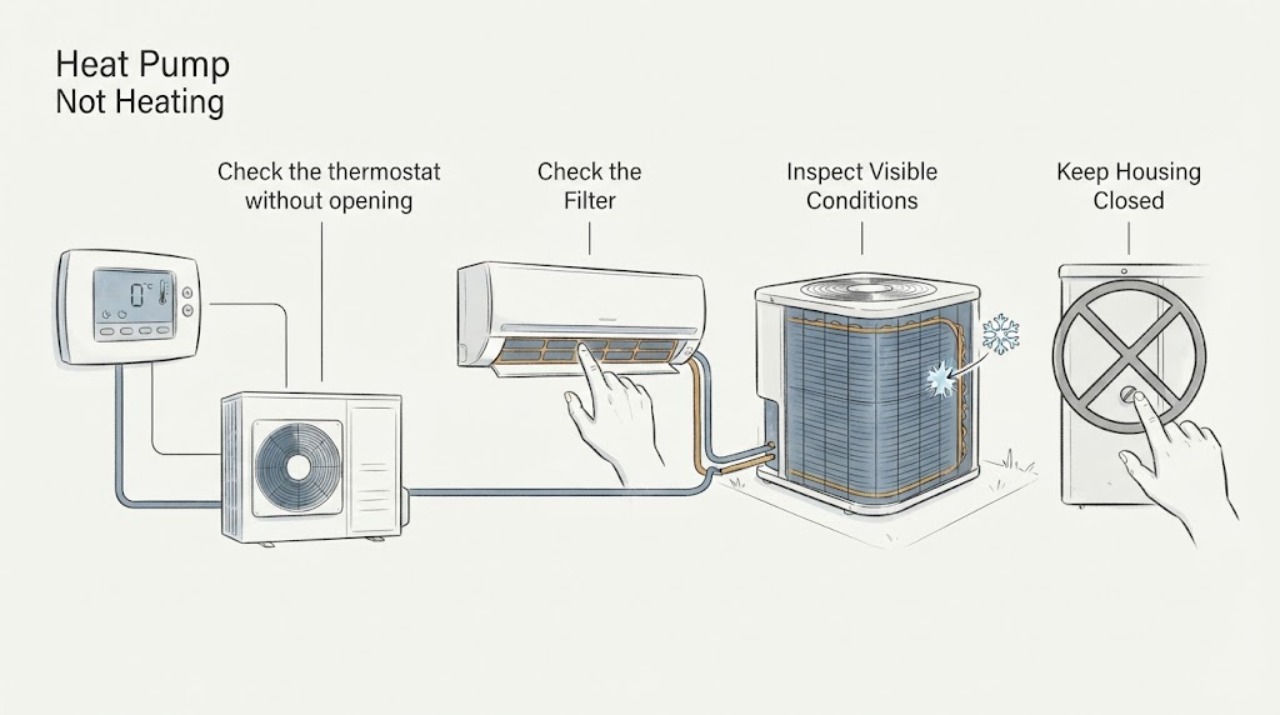
Work through in order
Diagnostic checks
Use only checks that match the exact appliance or system and its official guide.
-
Check 1
Check the thermostat without opening it. Confirm the system mode is Heat, the target temperature is above the room temperature, and the fan is set to Auto unless your equipment manual specifies another setting. Note whether the thermostat shows a defrost message, a heat call, a low-battery warning, or an error.
Expected result: The thermostat may be in Cool, have the fan set to On, show an active defrost cycle, or be correctly calling for heat. The room temperature may be slowly rising, unchanged, or falling.
Next step: Correct only the clearly wrong mode, setpoint, or fan setting, then allow one normal heating cycle. If the thermostat is correct or the symptom persists, continue to the filter and power checks.
Stop if: Do not remove thermostat wiring or bypass controls to force a heat call.
Why this matters
Why: A wrong mode can make a working heat pump appear not to heat, and Fan On can circulate unheated air between cycles. A brief cool period during defrost can be normal; an unchanged or falling room temperature after defrost keeps a fault open.
-
Check 2
Inspect the accessible indoor air filter with the system stopped by its normal controls. Replace or clean it only according to the equipment instructions if it is visibly clogged; do not operate without a required filter. Check that supply and return grilles are open and not covered by furniture.
Expected result: The filter may be clean, loaded with dust, damp, or the wrong size. Several grilles may be blocked, or airflow may be normal at the accessible registers.
Next step: Correct only the accessible filter or grille issue, then observe one heating cycle. If airflow remains weak or the home stays cold, proceed to power and outdoor-unit checks and prepare for service.
Stop if: Do not remove blower or coil panels or reach into the air handler.
Why this matters
Why: A clogged filter or blocked grille restricts airflow and can make a heat pump deliver weak or lukewarm air or shut down. A clean filter and open grilles do not rule out hidden duct, indoor blower, coil, or outdoor-unit faults.
-
Check 3
Look at the electrical panel and the normal equipment power switches from a dry, safe position. Identify whether the indoor and outdoor equipment have lost power or whether a breaker is in a tripped or middle position. Reset a clearly tripped breaker only once according to the panel and equipment instructions; do not remove covers or replace a breaker.
Expected result: Both sections may have power, one may be off, or a breaker may trip again as soon as the system calls for heat. A normal breaker position does not prove the unit is receiving power.
Next step: If power was interrupted and the breaker remains on, allow the system's normal delay and observe one cycle. If the breaker trips again, power cannot be confirmed, or there is burning odor, heat, sparking, or damaged wiring, stop and call a qualified professional.
Stop if: Do not hold a breaker on, fit a larger breaker, remove panel covers, or touch wiring.
Why this matters
Why: Heat-pump indoor and outdoor sections can have separate power protection. A single interruption can explain no operation, but a repeat trip indicates an electrical or equipment fault rather than a setting problem.
-
Check 4
Inspect the outdoor unit from outside the grille. Check whether leaves, snow, vegetation, or stored items restrict the airflow space, and whether the coil has light frost that clears or a thick ice coating that remains. Keep hands and tools away from the fan and coil; remove only loose debris that is clearly outside the cabinet.
Expected result: The outdoor unit may be clear and running, obstructed by loose debris, lightly frosted during a defrost cycle, or covered in persistent ice. The fan may be running normally, stopped, or making an unusual sound.
Next step: Clear only safe external obstructions and observe one normal cycle. If the coil remains heavily iced, the fan is abnormal, or heating does not recover, stop repeated operation and call HVAC service.
Stop if: Do not chip ice, pour water on the coil, pressure-wash it, bend fins, or reach through the grille.
Why this matters
Why: Restricted outdoor airflow can reduce heating performance. Light frost that clears can be normal, but heavy ice, a stopped fan, or repeated refreezing can indicate low airflow, refrigerant, fan, or defrost trouble.
-
Check 5
Compare the symptom across operating modes only if the system is safe, powered normally, and your controls support the change. Record whether it heats poorly but cools normally, fails in both modes, or has recently changed behavior after a service or thermostat change. Do not repeatedly switch modes to provoke a fault.
Expected result: Cooling may work while heating does not, both modes may be weak, or neither mode may run. The outdoor coil may also show ice, and the thermostat may show a recurring fault.
Next step: Give the mode comparison, filter and airflow results, power behavior, ice condition, and any codes to a qualified HVAC professional rather than opening the system.
Stop if: Do not test refrigerant pressure, disconnect tubing, bypass controls, or open electrical compartments.
Why this matters
Why: Heating-only failure keeps the reversing valve or heat-side controls in the diagnostic path. Weak operation in both modes keeps airflow, power, refrigerant, and broader system faults open; the observation does not identify a replaceable part.
Use your observations
Decision map
Find the observation that best matches what you see, then follow the next safe action.
-
PATH 01Next step
What you see
The thermostat was in the wrong mode, had an incorrect setpoint, or had Fan On selected, and normal heating returns after correction.
Do this next
Keep the correct mode and fan setting, then monitor one or two normal cycles for recurrence.
Why this path and its safety boundary
Why it matters: The symptom was likely a control setting rather than an equipment failure.
-
PATH 02Next step
What you see
The system is briefly cool during a displayed or expected defrost cycle, then resumes heating.
Do this next
Do not force a defrost; monitor whether heating resumes and whether the outdoor coil clears. Persistent ice or continuous cold air requires service.
Why this path and its safety boundary
Why it matters: Temporary cool air can be normal defrost behavior.
-
PATH 03Next step
What you see
The filter or an accessible grille is blocked and airflow improves after the restriction is corrected.
Do this next
Maintain the filter as the equipment instructions specify and call HVAC service if weak airflow or poor heating returns.
Why this path and its safety boundary
Why it matters: Restricted airflow was likely contributing to poor heating.
-
PATH 04Next step
What you see
A breaker trips again, the indoor or outdoor power arrangement is unclear, or there is burning odor, sparking, heat, or damaged wiring.
Do this next
Leave the affected circuit or system off as safe and arrange qualified HVAC or electrical service.
Why this path and its safety boundary
Why it matters: An electrical or equipment fault may be present and repeated resetting is unsafe.
-
PATH 05Next step
What you see
The outdoor coil has light frost that clears normally and the home warms, without weak airflow or abnormal noise.
Do this next
Keep the outdoor airflow space clear and monitor heating performance rather than removing the frost manually.
Why this path and its safety boundary
Why it matters: The frost may be part of normal heat-pump operation.
-
PATH 06Next step
What you see
The outdoor coil remains heavily iced, the fan is abnormal, or the unit heats poorly after the external checks.
Do this next
Stop repeated operation and arrange qualified HVAC diagnosis; do not chip the ice or open the equipment.
Why this path and its safety boundary
Why it matters: Low airflow, refrigerant, fan, or defrost problems remain possible.
-
PATH 07Next step
What you see
Cooling works normally but heating does not.
Do this next
Provide the mode comparison to an HVAC professional for diagnosis.
Why this path and its safety boundary
Why it matters: A reversing-valve or heating-control fault is possible, although the symptom alone does not prove a specific component failure.
Helpful context
Understand the symptom
Separate normal operation from a heating fault
A heat pump does not usually deliver the intense hot air associated with a gas furnace. It can also blow cooler air briefly while it defrosts the outdoor coil. The useful dividing line is whether the home eventually warms and the system exits defrost normally. Constantly cold supply air, a temperature that never approaches the thermostat setting, heavy outdoor ice, or a system that heats in one mode but not the other points to a fault rather than normal operation.
Keep checks external
Homeowner checks should stay at the thermostat, accessible filter, visible power controls, and clear space around the outdoor unit. Do not open the cabinet, handle live wiring, test refrigerant, force a reversing valve, or repeatedly reset a breaker. Persistent ice, repeated trips, hissing or liquid at the unit, and electrical or mechanical symptoms belong with a qualified HVAC professional.
Safety boundary
Stop conditions
- Stop for smoke, burning odor, sparking, exposed or damaged wiring, an overheated panel, unusual mechanical noise, or a fan that is not operating normally.
- Do not repeatedly reset a breaker, hold it on, install a larger protective device, or remove electrical-panel covers.
- Do not chip or scrape outdoor-coil ice, pour hot water on it, pressure-wash the coil, or bend its fins.
- Do not open the cabinet, test refrigerant, disconnect tubing, bypass controls, or force the reversing valve or defrost system.
Only after diagnosis
Potential parts
- reversing valve or reversing-valve control
Consider only if a professional confirms that the system cools normally but cannot transfer into heating mode.
The symptom does not prove valve failure; confirm the complete model and technician diagnosis before any part selection. - outdoor fan motor or fan control
Consider only if professional testing finds abnormal outdoor-fan operation after airflow obstructions are excluded.
Verify model-specific electrical and mechanical fit; do not work on an energized fan. - defrost control or sensor
Consider only when persistent outdoor icing is confirmed and a technician finds that the defrost sequence or sensor input is faulty.
Ice alone is not proof of a failed control or sensor; use the unit's service documentation. - refrigerant circuit or leak repair
Consider only if a qualified technician confirms low charge or a leak as the cause of poor heating or icing.
Refrigerant work requires qualified service and the refrigerant specified for the exact system.
When checks do not resolve it
Need a professional?
The heat pump remains cold after thermostat, filter, power, and safe external airflow checks., A breaker trips again, the unit has an electrical or mechanical warning sign, or the fan is stopped or abnormal., The outdoor coil remains heavily iced, refreezes quickly, or the system cannot complete defrost normally., Cooling works but heating does not, or the likely fault involves refrigerant, electrical components, a reversing valve, a blower, or controls.
Safety scope: Keep the system off as directed when a breaker trips, heavy ice persists, the fan is abnormal, or an electrical or mechanical hazard is present. Do not open the cabinet, handle live wiring, test refrigerant, bypass controls, or force the reversing valve.
Common questions
FAQ
Why is my heat pump blowing cool air when set to heat?
It may be in a normal defrost cycle, the thermostat may be in the wrong mode, or the fan may be set to On and circulating air between heating cycles. If cool air continues, the home does not warm, or the outdoor unit is frozen, check the filter and safe airflow, then arrange professional service.
What can I check if my heat pump is running but not heating?
Confirm Heat mode, the setpoint, and Fan Auto; inspect the accessible filter and open grilles; check for lost power or a one-time tripped breaker; and look for outdoor leaves, snow, or heavy ice. A repeat trip, persistent ice, weak airflow, or no improvement needs HVAC diagnosis.
Is lukewarm air from a heat pump always a fault?
No. Heat-pump supply air can feel cooler than furnace air, and defrost can temporarily make the air cool. The concern is continuous cold air, a room temperature that does not recover, or poor performance combined with ice, weak airflow, or a recurring fault.
When should I stop resetting a heat-pump breaker?
Do not keep resetting it if it trips again. Leave the affected equipment off as safe and arrange qualified service, especially if there is burning odor, heat, sparking, damaged wiring, or a frozen outdoor unit. Repeated trips can indicate an electrical or equipment fault.
Read the exact guide
Official sources
- Heat Pump Not Heating? Troubleshooting Cold Air Issues | CarrierCarrier · Carrier residential heat pumps that are not heating, blowing cool air, icing, or losing power
- Common Reasons for Your Heat Pump Not HeatingTrane · Trane residential heat pumps with incorrect settings, low airflow, outdoor icing, reversing-valve symptoms, or refrigerant concerns
Community feedback
Share a repair observation
Share a plain-text repair observation. Accepted observations are published automatically; this page may take a moment to update.