
On this page
Start here
Quick answer
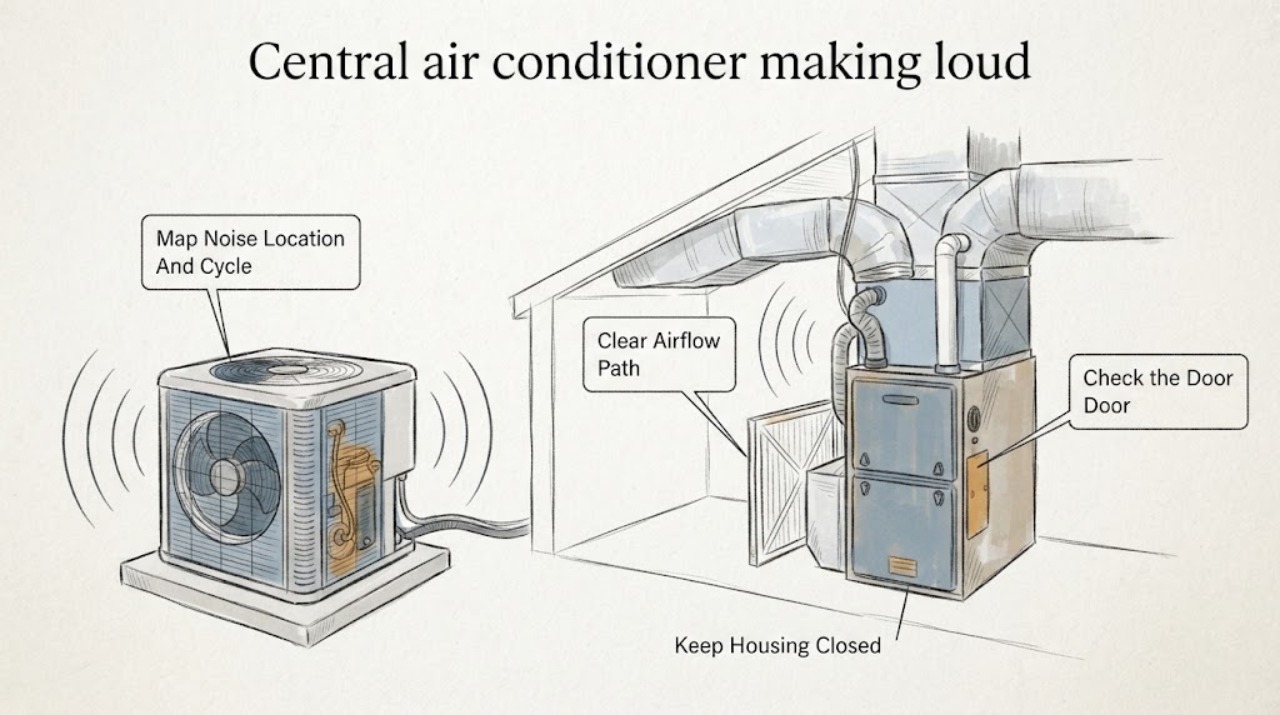
A Lennox central air conditioner may have a normal startup or operating hum, but a new or significantly louder buzzing, rattling, banging, squealing, grinding, or vibration needs attention. First locate whether the sound comes from the outdoor unit, indoor air handler or furnace, ductwork, or a register, and note whether it changes with the indoor fan, outdoor fan, compressor, or thermostat cycle. From safe, ordinary access, inspect only the filter, open supply and return paths, and visible debris or vegetation around the outdoor unit; do not open panels, touch the fan, handle refrigerant lines, or test electrical parts. Lennox associates unusual noise with loose parts, motor or fan issues, airflow problems, compressor trouble, or other system faults. Stop for smoke, burning odor, sparking, grinding, ice, water, or severe loss of cooling and arrange licensed HVAC service.
Before you begin
Safety first
- This article supports listening and ordinary-access visual checks only, plus a normal filter change or removal of loose exterior debris safely outside the cabinet. Do not open panels, touch moving or energized components, handle refrigerant, enter ductwork, or alter electrical, airflow, or control settings.
Work through in order
Diagnostic checks
Use only checks that match the exact appliance or system and its official guide.
-
Check 1
From safe standing positions, listen at indoor registers and the air handler or furnace, then near the outdoor cabinet without touching it. Note whether the sound occurs at startup, during the indoor fan, during the outdoor fan or compressor, at shutdown, or continuously.
Expected result: The sound is strongest indoors, outdoors, at a register or return, or at a transition; it is a hum, buzz, rattle, bang, squeal, click, grinding, or vibration; and it does or does not follow a fan or compressor cycle.
Next step: Write down the exact sound and timing and make a short recording from a safe distance if useful; continue only with non-contact visual checks.
Stop if: Stop immediately for grinding, metal contact, smoke, burning odor, sparking, uncontrolled vibration, or a fan that appears to strike its guard.
Why this matters
Why: Fan-linked indoor noise points toward blower, filter, duct, or register airflow. Outdoor fan or compressor timing points toward outdoor moving parts, capacitor, motor, mounting, or compressor. A new harsh sound is abnormal even if the equipment still cools.
-
Check 2
With the system stopped, inspect the accessible air filter and the return and supply openings. Replace a visibly dirty filter only with the specified type and open a vent that was intentionally closed; do not remove equipment panels.
Expected result: The filter is loaded, a return or supply is blocked, airflow is weak or whistling, or the filter and accessible openings are clear.
Next step: Allow one normal cycle after the safe filter or vent correction and compare the sound. If it persists, airflow remains weak, or cooling declines, stop repeated testing and arrange HVAC service.
Stop if: Do not operate without the required filter, close returns to quiet the system, remove a filter housing panel, or continue with collapsing airflow or visible ice.
Why this matters
Why: Restricted airflow can make the blower or registers louder and can reduce cooling. A clear filter and open vents make a duct, blower, outdoor unit, or compressor issue more likely, but do not identify the failed part.
-
Check 3
Set the thermostat to a non-cooling mode and, without opening the condenser or reaching through its grille, look around the outdoor Lennox unit for leaves, grass, loose objects, vegetation, a shifted cabinet, or anything visibly contacting it.
Expected result: Loose debris or vegetation is outside the cabinet, an object contacts the grille, the cabinet or pad appears shifted, coil fins look bent, or the area is clear.
Next step: Remove only loose objects fully outside the cabinet that cannot fall into the grille. Leave the system off and request service for bent fins, cabinet movement, contact inside the guard, or unresolved loud noise.
Stop if: Do not remove the grille, touch the fan or fins, hose the unit, straighten fins, move refrigerant piping, or work near an electrical disconnect.
Why this matters
Why: Exterior obstruction or contact can impair airflow or create rattling. A shifted cabinet, bent fins, or a clear area with persistent noise suggests a mounting, fan, motor, coil, or compressor issue for professional inspection.
-
Check 4
Record whether the sound coincides with warm air, reduced airflow, visible ice, unusual humidity, water near the indoor unit, repeated breaker trips, or a strange odor. Do not touch refrigerant lines or internal components.
Expected result: Cooling and airflow are normal, cooling is reduced, airflow is weak, ice or water is visible, a breaker trips, or an odor is present.
Next step: Stop cooling for ice, water damage, electrical symptoms, severe performance loss, or suspected refrigerant trouble and arrange licensed HVAC service with the complete symptom record.
Stop if: Do not thaw ice with tools or heat, handle refrigerant, reset a tripping breaker repeatedly, or clear concealed drains as a homeowner test.
Why this matters
Why: Noise combined with performance loss can involve airflow, filters, coils, refrigerant, fan, capacitor, compressor, drain, or controls. Ice, water, an electrical odor, or a tripped breaker raises the urgency beyond a noise-only check.
-
Check 5
If the sound is loudest in living spaces, compare nearby registers and returns during a normal fan cycle without closing vents or removing grilles. If it is loudest at equipment, keep the comparison non-contact.
Expected result: One register or duct section resonates, several registers are noisy, the return whistles, or the equipment is clearly the loudest location.
Next step: Leave all returns and supply vents open, document the loudest locations, and arrange HVAC service for persistent duct resonance, weak airflow, or equipment-local noise.
Stop if: Do not enter ductwork, tape over a return, remove a register to reach hidden parts, or alter blower speed or thermostat settings as a guess.
Why this matters
Why: A localized register or duct noise supports a loose fit, debris, pressure, or airflow path issue. Widespread register noise can reflect return, filter, duct, or system airflow. Equipment-local noise keeps the blower, outdoor fan, motor, capacitor, and compressor in focus.
-
Check 6
Collect the Lennox model and serial information from paperwork or an already accessible label, the sound recording, location and timing, filter and airflow observations, outdoor clearance, cooling result, odors, ice, water, or electrical symptoms.
Expected result: The sound returns after safe filter and clearance checks, or it is hazardous, worsening, or accompanied by cooling, airflow, water, odor, or electrical problems.
Next step: Leave the system off when the sound is harsh, hazardous, or linked to performance or water problems and arrange licensed HVAC service with the observation record.
Stop if: Do not open equipment to find the model, energize the system after smoke or electrical damage, or order a motor, capacitor, fan, compressor, or refrigerant part from sound alone.
Why this matters
Why: Lennox's professional inspection scope includes thermostat, filter, electrical connections, refrigerant, coils, ducts, blower, fan, and compressor; the recorded pattern helps the technician begin safely without homeowner disassembly.
Use your observations
Decision map
Find the observation that best matches what you see, then follow the next safe action.
-
PATH 01Safety boundary
What you see
The system makes a consistent soft hum or predictable startup, shutdown, or low-speed sound with normal cooling, airflow, and no new vibration or harsh tone.
Do this next
Document the pattern and monitor it; schedule routine professional inspection if it changes, grows louder, or begins to affect comfort or airflow.
Why this path and its safety boundary
Why it matters: The sound may fit normal operation, but a model-specific baseline is needed when the owner notices a significant change or the sound becomes louder over time.
Safety stop: Do not dismiss a new sound when it includes grinding, banging, screeching, metal contact, burning odor, smoke, or a sudden loss of cooling.
-
PATH 02Safety boundary
What you see
A buzz, rattle, bang, or vibration is strongest at the outdoor unit, changes with the condenser fan or compressor, or began with debris, contact, or cabinet movement.
Do this next
Remove only loose exterior debris outside the guard, keep the unit off for persistent or harsh noise, and arrange licensed HVAC inspection of the fan, motor, capacitor, compressor, mounting, coil, and lines.
Why this path and its safety boundary
Why it matters: Outdoor debris, a fan or motor, capacitor or start problem, loose or unbalanced parts, mounting, or compressor concern is more likely than an indoor register-only issue.
Safety stop: Do not open the cabinet, remove the guard, touch the fan, move refrigerant piping, tighten electrical or mounting parts, or lubricate the motor.
-
PATH 03Safety boundary
What you see
The noise follows the indoor fan and is strongest at the return, blower area, or registers, with a loaded filter, whistling return, weak airflow, or localized duct resonance.
Do this next
Correct only a clearly loaded filter or intentionally closed vent with the normal homeowner procedure, leave returns open, and request HVAC service if the sound or weak airflow persists.
Why this path and its safety boundary
Why it matters: Airflow restriction, duct fit, debris, blower balance, motor, or bearing trouble is more likely than an outdoor compressor-only fault.
Safety stop: Do not remove the blower door, enter ductwork, alter blower speed, reach into the fan, or keep running a system with collapsing airflow or ice.
-
PATH 04Safety boundary
What you see
The loud sound coincides with warm air, reduced cooling, weak airflow, visible ice, water, unusual humidity, repeated breaker trips, or a suspected refrigerant problem.
Do this next
Stop cooling when ice, water damage, electrical symptoms, or severe performance loss is present and arrange licensed HVAC service for a complete system assessment.
Why this path and its safety boundary
Why it matters: The sound is part of a performance or safety fault and may involve airflow, coils, refrigerant, fan, capacitor, compressor, drain, or controls rather than an isolated nuisance.
Safety stop: Do not thaw ice with tools or heat, handle refrigerant, clear concealed drains, reset a tripping breaker repeatedly, or continue operation for a longer recording.
-
PATH 05Safety boundary
What you see
The sound is grinding, screeching, rapidly worsening, accompanied by smoke, burning odor, sparks, exposed wiring, or impossible to locate without opening equipment.
Do this next
Turn the system off from normal controls and, when safe and familiar, isolate power without opening equipment. Keep people away and arrange urgent licensed HVAC service; use emergency help for an active fire or immediate danger.
Why this path and its safety boundary
Why it matters: A hazardous mechanical or electrical fault cannot be safely separated by homeowner observation and may damage equipment or create fire or shock risk.
Safety stop: Do not reset repeatedly, open panels, touch wiring, reach near moving parts, or restart the unit to see whether the sound changed.
Helpful context
Understand the symptom
Classify the sound by location and timing
Record where the sound is strongest and when it occurs: at startup, while the indoor blower runs, while the outdoor fan or compressor runs, at shutdown, or continuously. A register or return noise can be duct or airflow resonance; an indoor equipment noise can involve the blower or filter path; an outdoor noise can involve the fan, motor, mounting, capacitor, or compressor. The timing narrows the inspection but does not justify opening the unit.
Check only accessible airflow and clearance
A loaded filter, blocked return or supply, dirty coil, or vegetation and debris around the condenser can change airflow and sound. With the system stopped, replace a visibly loaded filter only with the type specified for the installation, keep returns and supply vents open, and clear loose leaves or objects from around the outside cabinet without reaching through the grille. Leave bent fins and internal dirt for a Lennox dealer or licensed technician.
A harsh mechanical noise is not a lubrication project
Lennox describes unusual banging, rattling, squealing, clicking, and humming as possible signs of loose parts, worn fans or motors, airflow trouble, or compressor problems. A sound that began suddenly, changes with vibration, or appears with reduced cooling should be documented and serviced. Do not add oil, tighten a fastener, push a fan blade, or move refrigerant piping to quiet the equipment.
Connect noise with cooling and safety symptoms
Noise alongside warm air, weak airflow, ice, tripped breakers, strange odor, or water is a system-performance or safety problem rather than a harmless sound. Low refrigerant, a blocked coil, fan or capacitor failure, compressor trouble, duct restriction, or electrical controls may require specialized tests. Note the combination and stop operating when the symptom crosses the safe boundary.
Safety boundary
Stop conditions
- Stop the air conditioner for grinding, metal contact, a fan striking its guard, smoke, burning odor, sparking, exposed wiring, or rapidly worsening vibration.
- Do not open equipment panels, remove guards, touch fans, motors, capacitors, wiring, refrigerant lines, coils, or compressor components.
- Do not straighten fins, lubricate motors, tighten electrical or mounting parts, alter blower or thermostat settings, or use a part replacement as a sound test.
- Stop cooling for visible ice, water damage, suspected refrigerant leakage, severe loss of airflow, repeated breaker trips, or a sound accompanied by major loss of cooling.
- Do not bypass required filters or close returns to quiet the system; arrange licensed HVAC diagnosis when accessible checks do not resolve the sound change.
Only after diagnosis
Potential parts
- outdoor condenser fan or motor assembly
Consider this category only when a licensed HVAC diagnosis confirms outdoor fan, motor, bearing, capacitor, or blade-related noise and identifies the exact assembly.
Confirm the Lennox model, voltage, motor characteristics, blade and mount configuration, and manufacturer fit information; do not select a motor or capacitor from sound alone. - indoor blower motor or wheel assembly
Consider this category only when the noise follows the indoor blower and a technician confirms blower wheel, motor, bearing, or mounting wear.
Confirm the exact air handler or furnace model, motor type, wheel dimensions, controls, and manufacturer fit information before ordering. - air filter
Consider this category only when the existing filter is visibly loaded or damaged and the installation specifies a user-replaceable filter of that size and type.
Confirm the filter dimensions, airflow rating, and installation requirements from the existing filter or system documentation; do not use filter removal to mask a mechanical noise. - duct or vibration-isolation hardware
Consider this category only when a qualified inspection identifies a loose duct connection, contact point, mounting pad, or vibration-transfer issue as the source.
Confirm the duct, cabinet, support, and local installation requirements with the HVAC professional; do not tape, shim, or loosen equipment supports as a test.
When checks do not resolve it
Need a professional?
Arrange licensed HVAC service promptly for any new or significantly louder Lennox AC sound that persists after safe filter and clearance checks, or for outdoor rattling, indoor blower or duct noise, reduced cooling, weak airflow, ice, water, odors, or suspected refrigerant trouble. Seek urgent service for grinding, metal contact, smoke, burning odor, sparks, exposed wiring, uncontrolled vibration, repeated breaker trips, or a rapidly worsening sound; use emergency help for an active fire or immediate danger.
Safety scope: This article supports listening and ordinary-access visual checks only, plus a normal filter change or removal of loose exterior debris safely outside the cabinet. Do not open panels, touch moving or energized components, handle refrigerant, enter ductwork, or alter electrical, airflow, or control settings.
Common questions
FAQ
Is some Lennox central air-conditioner noise normal?
A consistent soft hum or predictable startup, shutdown, or speed transition can be normal, but a significant change to banging, rattling, squealing, grinding, harsh buzzing, or strong vibration is a warning sign. Document it and arrange HVAC inspection when it persists or affects cooling.
Why is my Lennox outdoor AC unit buzzing or rattling?
Possible clues include debris, a fan or motor problem, capacitor or start trouble, loose or out-of-balance parts, mounting, or compressor issues. Look only for loose debris outside the cabinet with the system stopped; do not open the unit or touch the fan, and arrange service for persistent or harsh noise.
Can a dirty filter make a Lennox air conditioner loud?
A loaded filter can restrict airflow and change blower or register sound. Replace it only with the specified filter while the system is stopped and keep returns open. If the noise or weak airflow continues, the cause may be ductwork, blower, coil, or another component needing professional diagnosis.
Should I keep running a Lennox AC to identify the loud noise?
Use only a brief normal observation when there is no smoke, burning odor, sparking, grinding, metal contact, ice, water, or severe loss of cooling. Stop immediately for any of those conditions and do not restart repeatedly or open the equipment to investigate.
Read the exact guide
Official sources
- HVAC Inspection: What You Need to KnowLennox · Manufacturer guidance for unusual noises, odors, poor airflow, filters, electrical connections, refrigerant, ductwork, safety controls, and inspection escalation.
- Understanding Your HVAC CompressorLennox · Manufacturer glossary used for outdoor-unit clicking, rattling, or humming with warm air, hard starts, breaker trips, reduced airflow, and compressor service escalation.
- Air Conditioner Maintenance TipsLennox · Manufacturer maintenance guidance used for accessible filters, outdoor debris and vegetation, airflow, coils, and professional fin or coil service.
- Outdoor AC unit not turning onLennox · Manufacturer guidance used for outdoor-unit buzzing or humming, fan and capacitor clues, debris, refrigerant concerns, electrical symptoms, and professional escalation.
Community feedback
Share a repair observation
Share a plain-text repair observation. Accepted observations are published automatically; this page may take a moment to update.